🚀 Brazil's AI Boom in March 2026: 5 Major Shifts Happening Right Now That Are Changing Jobs, Rules, Business, and Daily Life
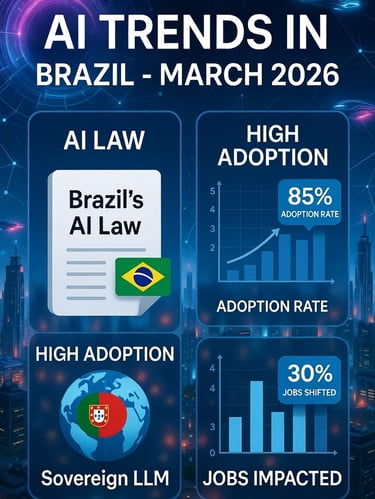
Artificial Intelligence (AI) is growing very fast in Brazil. Brazil is the largest economy in Latin America and one of the fastest-growing AI markets in the region. In December 2024, Brazil approved its first national AI law (Lei nº 15.015/2024 – Marco Legal da Inteligência Artificial). This law came into force in stages, and by March 2026 many important rules are active. In the last few weeks (late February to March 13, 2026), major news includes: the launch of Brazil's first sovereign large language model (LLM) focused on Portuguese, new public investments in AI infrastructure, big companies increasing AI spending, reports showing high adoption but serious gaps in skills and regulation enforcement, and the start of the National AI Observatory monitoring activities. These changes affect jobs (automation in some sectors, new tech jobs in nearshoring and fintech), rules (risk-based AI law now applying to high-risk systems), businesses (very fast private-sector adoption), public services (AI in health and education), and daily life (better apps, voice assistants in Portuguese, and smarter services).1. Brazil's AI Law Is Now Active – Risk-Based Regulation Started in 2026 (New Legal Framework) The Brazilian AI Law (Marco Legal da IA) is one of the most advanced in Latin America. It uses a risk-based approach similar to the EU AI Act but lighter on penalties for innovation. Key points active in March 2026: High-risk AI systems (hiring tools, credit scoring, biometric identification, medical diagnosis AI) must follow transparency, risk assessment, human oversight, and logging rules. The National Data Protection Authority (ANPD) is the main supervisor. A new National AI System (SIA) and National AI Observatory started monitoring in early 2026. Public authorities using high-risk AI must publish impact assessments. Fines can reach R$ 50 million per violation, but focus is more on guidance than punishment in the first years. In March 2026, many companies are doing compliance checks. Banks, fintechs, and healthtechs are especially careful because they use high-risk AI. Startups get sandboxes (safe test environments) to try new ideas without full rules. This law helps build trust so more companies and people use AI safely. But some experts say enforcement is still weak because ANPD needs more staff and budget. 2. Very High AI Adoption in Companies and People – Brazil Leads Latin America (Massive Private-Sector Growth) Brazil has one of the highest AI usage rates in the world. Recent surveys show: ~68–72% of Brazilians use generative AI regularly (ChatGPT, Gemini, Claude, etc.) 45–55% of companies use AI in some way (up from ~30% in 2024) In large companies (>500 employees) adoption is over 70% Popular uses: Customer service chatbots (Portuguese-speaking) Marketing content creation Data analysis and forecasting Software development assistance (GitHub Copilot style) Internal productivity (meeting summaries, email writing) In March 2026, reports say Brazilian companies plan to increase AI budgets by 35–60% this year. Fintech, agribusiness, retail, and logistics lead adoption. Nearshoring (US/European companies moving operations to Brazil) brings even more AI projects. This creates better customer experiences (faster answers in Portuguese) and helps companies compete globally. But many small businesses still use only basic AI because of cost and skills gaps. 3. First Sovereign Portuguese LLM Launched – Brazil Building Its Own AI Models (National Technological Independence) In early 2026 Brazil launched its first large sovereign language model trained mainly on Portuguese data (especially Brazilian Portuguese). Key facts: Project led by a public-private partnership (government + universities + big tech companies) Focused on cultural relevance, local slang, legal language, and medical terms in Portuguese Aims to reduce dependence on English-centric foreign models Part of the “AI Brasil Soberana” initiative inside the National AI Strategy This is very important because: Foreign models often make mistakes with Brazilian Portuguese (regional expressions, accents) Sovereign model protects sensitive data (government, health, finance) Helps public sector and education use AI in Portuguese In March 2026, this model is being tested in public services and companies. It shows Brazil wants to lead Latin America in local AI technology, not just be a user of foreign tools. 4. AI Impact on Jobs – Automation vs New Opportunities (Workforce Transformation) AI is already changing the job market in Brazil. Challenges: Routine jobs (call centers, data entry, basic accounting, simple customer support) are being automated fast Entry-level positions in some sectors are growing slower Reports show ~22–28% of jobs have high automation potential in the next 5–10 years Positive side: Nearshoring and tech hubs (São Paulo, Florianópolis, Recife) create thousands of AI-related jobs High demand for prompt engineers, AI trainers, data annotators, AI ethicists, compliance specialists Companies using AI often hire more people overall (especially skilled workers) Government and large companies run reskilling programs (especially in fintech and agribusiness) In March 2026, the discussion is intense: how to train millions of workers quickly. Vocational schools, universities, and online platforms are adding AI courses very fast. 5. Big Public Investments and National Strategy Execution – AI as National Priority (Government Push) Brazil's National AI Strategy 2024–2028 is now in full execution phase in 2026. Main pillars active right now: R$ 4 billion+ public investment announced for 2025–2028 (supercomputing, talent training, research) Coatlicue-like supercomputing projects (though smaller than Mexico's) AI centers of excellence in universities (USP, Unicamp, UFRJ, etc.) AI in public services: SUS (health system) AI for diagnostics, education platforms, tax fraud detection Ethical AI guidelines and multistakeholder governance (involving civil society) In March 2026: National AI Observatory publishes first monitoring report Public hearings on AI regulation enforcement New calls for AI projects in agribusiness, energy transition, and smart cities These investments aim to reduce inequality (AI should help poorer regions too) and position Brazil as a regional AI leader. These 5 changes are really happening in Brazil right now in March 2026. Strong new AI law with risk-based rules, very high adoption (one of the highest in the world), first sovereign Portuguese LLM, job market transformation (automation + new opportunities), and big public investments in infrastructure and talent. Whether you are a student, worker, business owner, or just interested – understanding AI is very important. The people who learn and use AI now will do well in Brazil's future. GlobalCodeMaster.com helps people learn AI in a simple and practical way. You can get ready for Brazil's AI boom here! Sources (Real Places Where This Information Comes From – Late 2025 to March 2026): Lei nº 15.015/2024 – Marco Legal da Inteligência Artificial: Planalto.gov.br – December 2024 National AI Strategy 2024–2028: Ministério da Ciência, Tecnologia e Inovação – 2024–2026 AI Adoption Surveys: Google / McKinsey / Brasscom – late 2025/March 2026 Sovereign LLM Launch: MCTI / FAPESP announcements – early 2026 Job Impact Reports: IDados / FGV / OECD – 2025–2026 National AI Observatory: gov.br – March 2026
3/13/20261 min read
My post content
Email-ibm.anshuman@gmail.com
© 2026 CodeForge AI | Privacy Policy |Terms of Service | Contact | Disclaimer | 1000 university college list|book library australia 2026|Latest AI Trends (Global & India 2026) 400 GLOBAL BOOK STORE WORLDWID|TOP 400 FREE BOOK LIBRARY USA|TOP 400 FREE BOOK LIBRARY INDIA|Audiobooks at Just ₹99 | $1.25| E-Books at Just ₹49 | $0.50| 50+ AI Expert Tutorials
All my books are exclusively available on Amazon. The free notes/materials on globalcodemaster.com do NOT match even 1% with any of my PUBLISHED BOoks. Similar topics ≠ same content. Books have full details, exercises, chapters & structure — website notes do not.No book content is shared here. We fully comply with Amazon policies.
🚀 Best content for SSC, CGL, LDC, TET, NET & SET preparation!
📚 Maths | Reasoning | GK | Previous Year Questions | Tips & Tricks
👉 Join our WhatsApp Channel now:
🔗 https://whatsapp.com/channel/0029Vb6kg2vFnSz4zknEOG1D...