🚀 Mexico's AI Momentum in March 2026: 5 Major Shifts Happening Right Now That Are Changing Jobs, Rules, Business, and Daily Life
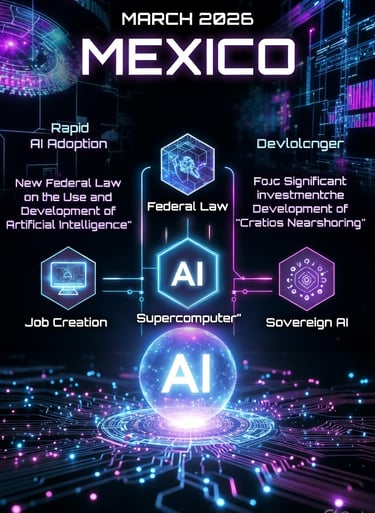
Artificial Intelligence (AI) is growing fast in Mexico. Mexico is one of the leaders in Latin America for AI use. In 2024-2025, the country worked on a new National Agenda for Artificial Intelligence (Agenda Nacional de Inteligencia Artificial para México 2024-2030). By March 2026, this plan is active, with big pushes for AI in industry, government, and everyday tools. Adoption is high – around 66% of people use AI (above global average), and many businesses use it for real work. In the last few weeks (late February to March 13, 2026), important things happened: new reports on AI readiness gaps (Mexico scores low in infrastructure and skills), proposals for a Federal Law on AI regulation, big investments in supercomputers like Coatlicue (Latin America's largest), and focus on agentic AI and cybersecurity as top priorities for 2026. These changes affect jobs (some routine work changes, but new opportunities in nearshoring and tech), rules (new bill for AI law), businesses (fast adoption for productivity), public services (healthcare and government use), and daily life (better apps, services, and tools).1. AI Adoption Is High and Growing Fast – Mexico Leads Latin America in Use (Business and People Using AI More) Mexico is ahead in Latin America for AI adoption. Recent data shows 66% of Mexicans use AI (higher than the global average of 62%). In businesses, around 40-70% use AI (including basic tools like writing or translation). This number is rising fast. Why so fast? Nearshoring (companies moving from Asia to Mexico) brings tech jobs and AI projects. Big companies use AI for customer service, data analysis, automation, and more. In industry, AI helps with decarbonization (reducing carbon), supply chains, and manufacturing. Public sector uses AI in healthcare (better planning) and government services (faster help). In March 2026, reports show Mexican organizations put agentic AI (smart AI that acts alone) and cybersecurity as top investments for the year. This means companies want AI that does complex tasks by itself, like planning or deciding. This is good for daily life – quicker online help, smarter banking apps, better online shopping. But challenges remain: many companies still use basic AI, not advanced ones. 2. New Push for AI Regulation – Bill for Federal Law on AI in Senate (Rules Coming Soon) Mexico is working on strong AI rules. In February 2026, Senator Karina Isabel Ruíz Ruíz introduced a bill for the National Law to Regulate the Use of Artificial Intelligence. If passed, this will be Mexico's first full AI law. Key points in the bill: Create a Regulatory Agency for AI development, use, and application. Set risk-based rules (high-risk AI needs more checks). Require transparency, human oversight, and protection of rights. Cover public and private sectors. Include sanctions for bad use. The bill is in Senate committees now (Joint Committees on Legislative Studies and AI Monitoring). It builds on earlier ideas like the National Alliance for AI (2023) and ethical guidelines. In March 2026, this is hot topic. Mexico has no full AI law yet (unlike EU AI Act), but the bill aims to balance innovation with safety. It wants to protect privacy, avoid bias, and keep human rights first. This helps build trust so more people and companies use AI safely. 3. Big Investments in AI Infrastructure – Supercomputer Coatlicue and More (Building Strong Tech Base) Mexico is investing heavily in AI power. The government launched Coatlicue – Latin America's biggest supercomputer. It costs MX$6 billion (about US$341 million) and has 15,000 GPUs for national data processing and AI training. Why this matters: AI needs strong computers for training models and running big tasks. Coatlicue helps Mexico do its own AI work, not depend only on foreign tech. Part of Plan México 2025-2030 – move from assembly to high-value tech like semiconductors, aerospace, and AI. Other investments: New cloud regions and "AI-ready" campuses in Queretaro. Focus on sovereign AI (Mexican-controlled AI) to keep data safe and create local value. In March 2026, this is key because Mexico scores low in AI readiness (15.3 vs global 22.1 on Salesforce index) due to infrastructure gaps. Big spending helps close this gap and supports nearshoring. This creates jobs in tech, data centers, and energy. 4. AI Impact on Jobs and Skills – Opportunities in Nearshoring, But Gaps in Training (Workforce Changes) AI changes jobs in Mexico. Some routine tasks (data entry, simple analysis) can be done by AI, so entry-level jobs may slow in some sectors. But good news: Nearshoring brings AI-related jobs (tech, manufacturing with AI). Companies using AI often hire more people (especially skilled workers). High demand for AI skills – developers, data experts, cybersecurity pros. Government and companies focus on reskilling (training workers for new roles). Challenges: Low workforce readiness score (2.9 vs global 4.5) – not enough applied AI training. Talent flight (skilled people leave Mexico). Need better education and retention plans. In March 2026, reports say AI can boost economy through fintech, cybersecurity, and industry. But without training, gaps remain. This means people need to learn AI tools to get better jobs. 5. Focus on Sovereign AI and National Development – Building Mexico's Own AI Future (Strategy and Independence) Mexico wants "sovereign AI" – AI controlled by Mexico, not foreign companies. This includes: National Agenda for AI 2024-2030 – covers governance, education, data, ethics, innovation. Plan México 2025-2030 – integrate into semiconductors, aerospace, AI chains. Ethical guidelines and multistakeholder plans. Why sovereign AI? Protect data and reduce foreign dependence. Create high-value jobs and products. Support industries like tourism, oil, agri-food with AI. In March 2026, experts say Mexico must invest in education, tax incentives, talent retention, and ethical rules to avoid falling behind. Latin America lags in AI readiness, but Mexico leads with strategy and investments. This helps long-term growth and independence. These 5 changes are really happening in Mexico right now in March 2026. High AI adoption (66% of people), new regulation bill in Senate, big supercomputer and infrastructure investments, job shifts with nearshoring opportunities, and push for sovereign AI. Whether you are a student, worker, business owner, or just interested – understanding AI is very important. The people who learn and use AI now will do well in Mexico's future. GlobalCodeMaster.com helps people learn AI in a simple and practical way. You can get ready for Mexico's AI momentum here! Sources (Real Places Where This Information Comes From – Late 2025 to March 2026): Proposal for National Agenda for AI 2024-2030: ANIA / OECD.AI – 2024-2026 AI Adoption and Readiness: Google / Salesforce Global AI Readiness Index – late 2025/March 2026 Federal Law on AI Bill: Senate of Mexico / Basham – February 2026 Coatlicue Supercomputer and Plan México: Mexico Business News / Government – 2025-2026 Agentic AI and Investment Priorities: Mexico Business News – February 2026 Sovereign AI and Gaps: Consultancy.lat / Forbes – 2025-2026
3/13/20261 min read

My post content
Email-ibm.anshuman@gmail.com
© 2026 CodeForge AI | Privacy Policy |Terms of Service | Contact | Disclaimer | 1000 university college list|book library australia 2026|Latest AI Trends (Global & India 2026) 400 GLOBAL BOOK STORE WORLDWID|TOP 400 FREE BOOK LIBRARY USA|TOP 400 FREE BOOK LIBRARY INDIA|Audiobooks at Just ₹99 | $1.25| E-Books at Just ₹49 | $0.50| 50+ AI Expert Tutorials
All my books are exclusively available on Amazon. The free notes/materials on globalcodemaster.com do NOT match even 1% with any of my PUBLISHED BOoks. Similar topics ≠ same content. Books have full details, exercises, chapters & structure — website notes do not.No book content is shared here. We fully comply with Amazon policies.
🚀 Best content for SSC, CGL, LDC, TET, NET & SET preparation!
📚 Maths | Reasoning | GK | Previous Year Questions | Tips & Tricks
👉 Join our WhatsApp Channel now:
🔗 https://whatsapp.com/channel/0029Vb6kg2vFnSz4zknEOG1D...