Description
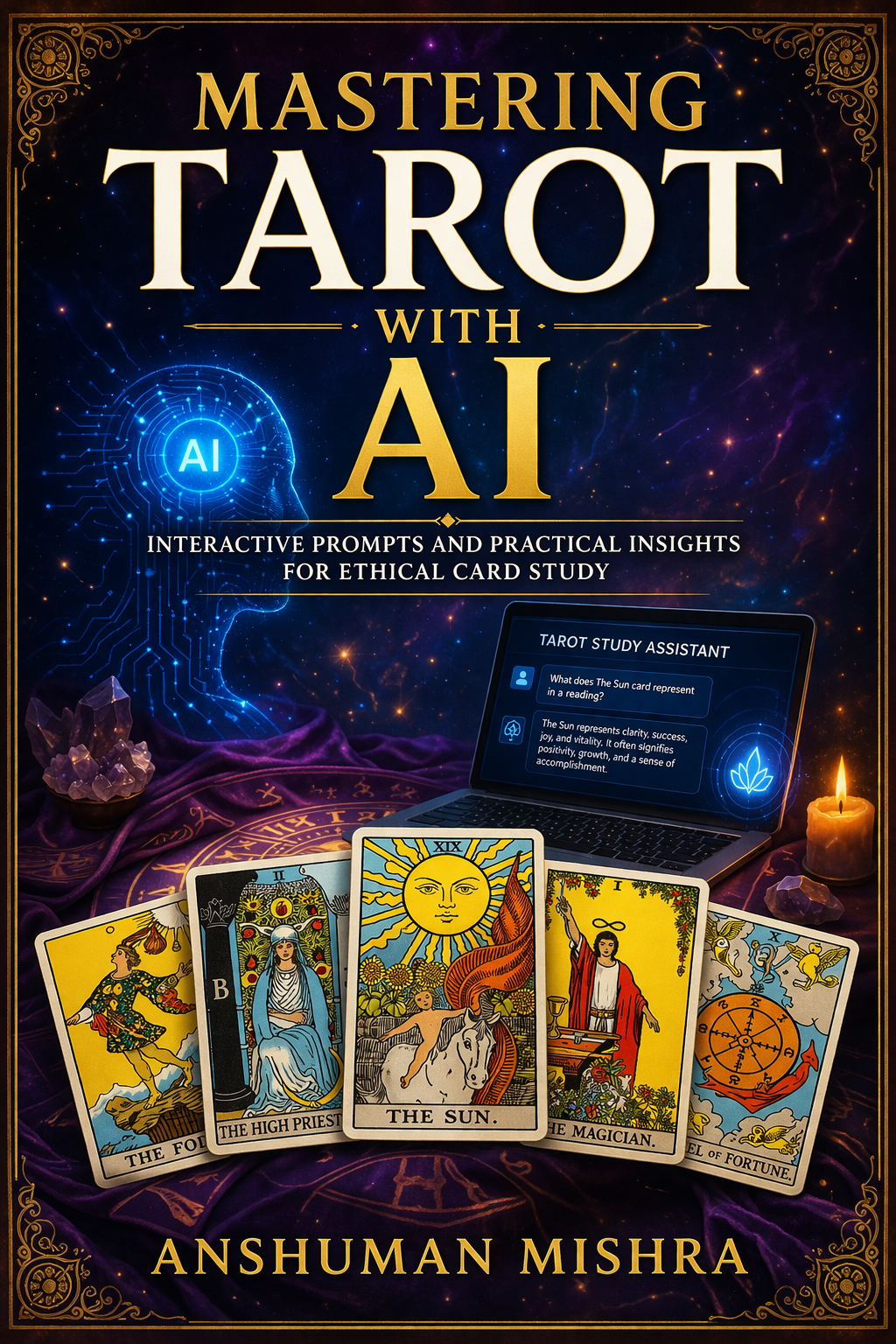
Mastering Tarot with AI
Interactive Prompts and Practical Insights for Ethical Card Study
Mastering Tarot with AI is a thoughtfully structured educational guide that combines the traditional study of Tarot symbolism with modern Artificial Intelligence-assisted learning techniques.
Tarot has a long and complex cultural history and has been approached from artistic, symbolic, philosophical, recreational, and divinatory perspectives. This book adopts an educational and reflective approach, focusing on the study of card imagery, symbolic themes, interpretation techniques, structured exercises, and critical thinking.
Rather than presenting Tarot as a guaranteed method for predicting future events, the book explores how Tarot can be studied as a symbolic system for learning, reflection, observation, and interpretation.
Artificial Intelligence is introduced as a learning assistant that can help readers generate questions, compare interpretations, organize notes, create practice exercises, and maintain reflective journals.
What You Will Learn
This book provides a structured learning path covering:
- History and cultural background of Tarot
- The symbolic structure of a Tarot deck
- The 78-card Tarot system
- Major Arcana
- Minor Arcana
- Four Tarot suits
- Court Cards
- Number symbolism in Tarot
- Visual imagery and card symbolism
- Question framing
- Neutral interpretation
- Bias awareness
- AI prompt creation
- AI-assisted card study
- Tarot spreads
- Scenario-based interpretation
- Tarot journaling
- Reflection exercises
- Interpretation skill development
- Ethical Tarot practice
- Practical worksheets
- Long-term learning strategies
Understanding Tarot as a Symbolic System
The book begins with an introduction to Tarot and its historical and cultural context.
Readers are encouraged to understand Tarot cards as collections of visual symbols and themes that can be examined from different perspectives.
Each card contains imagery, colors, characters, objects, numbers, and symbolic relationships that can provide rich material for study.
The book encourages learners to observe these elements carefully instead of relying entirely on memorized meanings.
This creates a more flexible and analytical approach to Tarot learning.
Explore the 78-Card Tarot Deck
A standard Tarot deck contains 78 cards, traditionally divided into the Major Arcana and Minor Arcana.
The book explains this structure in a beginner-friendly manner.
Major Arcana
Readers are introduced to the Major Arcana and its broad symbolic themes.
The emphasis is on understanding the visual and conceptual characteristics of individual cards while exploring how different cards can be compared and connected.
Minor Arcana
The Minor Arcana is introduced through its four traditional suits and their associated themes.
Readers learn how numbered cards and Court Cards can be studied systematically.
Court Cards
The book also explains the conceptual roles of the Page, Knight, Queen, and King within the Tarot structure.
These cards can be examined through themes such as roles, behaviors, perspectives, and symbolic characteristics.
Learn How to Frame Better Questions
A useful Tarot study session begins with a well-structured question.
The book explains why vague or heavily biased questions can make interpretation difficult.
Readers learn to develop questions that encourage exploration rather than predetermined answers.
For example, instead of asking for a guaranteed outcome, a learner can frame a question around:
- What factors should I consider?
- What perspective does this symbolic exercise encourage?
- What assumptions am I making?
- What themes appear in the selected cards?
- What alternative interpretations are possible?
This approach encourages reflection and analytical thinking.
AI as a Tarot Learning Assistant
Artificial Intelligence is one of the central features of this book.
AI can help Tarot learners practice without requiring another person to conduct every exercise.
Readers can use AI to:
- Generate practice questions
- Explain symbolic concepts
- Compare cards
- Create hypothetical scenarios
- Generate reflection prompts
- Organize Tarot notes
- Create journaling templates
- Review interpretations
- Identify alternative perspectives
- Design customized study exercises
The book clearly emphasizes that AI-generated content should be treated as assistance for learning, not as unquestionable authority.
Create Effective AI Prompts
A major focus of the book is prompt design.
Readers learn how to create structured AI prompts that specify:
- The card or cards being studied
- The symbolic theme
- The learning objective
- The scenario
- Comparison criteria
- Desired response format
- Reflection questions
Well-designed prompts can make AI-assisted Tarot study more useful and organized.
Study the Major Arcana with AI
The Major Arcana section provides a structured framework for studying individual cards and broader symbolic patterns.
AI prompts can be used to:
- Explore a card’s visual elements
- Identify major symbolic themes
- Compare two or more cards
- Create hypothetical situations
- Generate reflection questions
- Explore alternative interpretations
- Organize observations in a study journal
This encourages learners to understand relationships between cards instead of memorizing isolated definitions.
Explore the Minor Arcana
The book also provides a structured method for learning the Minor Arcana.
Readers can study the four suits and examine how their themes interact with numbered cards and Court Cards.
AI-assisted exercises can help learners compare:
- Different suits
- Similar numbers across suits
- Court Card roles
- Symbolic themes
- Hypothetical situations
- Different interpretive perspectives
This makes the learning process more interactive.
Learn Tarot Spreads
Tarot spreads provide a structured way to arrange multiple cards.
The book introduces:
- One-card spreads
- Three-card spreads
- Multi-card structures
- Card positions
- Custom spread design
Instead of focusing on prediction, the book presents spreads as tools for organizing symbolic information and exploring relationships between different cards.
AI can assist learners in designing practice spreads based on educational objectives.
Develop Interpretation Skills
Tarot interpretation involves more than memorizing card meanings.
The book explores the relationship between:
Observation + Context + Symbolism + Reflection
Readers learn how to examine a card’s imagery, understand its position within a spread, consider the question being explored, and compare multiple possible interpretations.
The book also discusses ambiguity, because symbolic systems rarely have only one possible interpretation.
Logical and Intuitive Approaches
The book explores both logical and intuitive approaches to Tarot study.
Readers can learn to distinguish between:
- What they actually observe
- What the traditional symbolism suggests
- What assumptions they are making
- What personal associations they bring to the card
- What alternative interpretations may exist
This helps learners develop greater consistency and awareness.
Tarot Journaling
Journaling is an important component of the learning process.
The book provides methods for maintaining daily and weekly Tarot study records.
Readers can document:
- Cards studied
- Visual observations
- Initial interpretations
- Alternative interpretations
- Questions asked
- AI-generated prompts
- Personal reflections
- Learning progress
Over time, these records can become a valuable personal study resource.
AI-Assisted Reflection
AI can be used to generate thoughtful reflection questions based on a learner’s observations.
For example, AI can help ask:
- Which symbolic elements stood out to you?
- What assumptions influenced your interpretation?
- What alternative interpretation could fit the same imagery?
- How does the card differ from another card with a similar theme?
- What did you learn from comparing multiple perspectives?
This transforms Tarot study into an interactive learning process.
Ethics and Responsible Practice
Ethics are a central component of Mastering Tarot with AI.
The book emphasizes the importance of:
- Avoiding guaranteed predictions
- Avoiding fear-based interpretations
- Respecting personal boundaries
- Maintaining transparency
- Protecting personal information
- Recognizing cultural context
- Avoiding misleading claims
- Using AI responsibly
- Maintaining human judgment
Readers are encouraged to communicate clearly that symbolic interpretations are not substitutes for professional medical, legal, financial, or psychological advice.
Avoiding Bias and Misinterpretation
Interpretation can easily be influenced by expectations.
The book therefore introduces concepts such as:
- Confirmation bias
- Selective interpretation
- Overgeneralization
- Assumption-based reasoning
- Emotional influence
- Premature conclusions
AI can help provide alternative viewpoints, but AI itself can also produce biased or inaccurate information.
For this reason, readers are encouraged to evaluate AI responses critically.
Practical Exercises and Worksheets
The book contains practical learning activities designed to reinforce understanding.
Readers can practice:
- Daily card analysis
- Weekly interpretation challenges
- AI prompt creation
- Scenario-based exercises
- Reflection worksheets
- Self-evaluation
- Progress tracking
- Comparative card analysis
These activities make the book useful as both a reading resource and a practical Tarot study workbook.
Who Is This Book For?
Mastering Tarot with AI is suitable for:
- Tarot beginners
- Intermediate Tarot learners
- Students interested in symbolic systems
- AI enthusiasts
- Reflective-learning enthusiasts
- Journaling enthusiasts
- Educators exploring interdisciplinary learning
- Readers interested in Tarot symbolism
- Learners interested in AI prompts
- Anyone interested in structured Tarot study
No programming knowledge is required.
Why Read This Book?
This book brings together three important ideas:
Tarot + Artificial Intelligence + Structured Learning
Instead of simply memorizing card meanings, readers are encouraged to observe, compare, question, practice, and reflect.
Key Highlights
✔ Introduction to Tarot history and culture
✔ Understanding the 78-card deck
✔ Major Arcana study
✔ Minor Arcana study
✔ Four Tarot suits
✔ Court Cards
✔ Number patterns and symbolism
✔ Visual symbolism
✔ Effective question framing
✔ AI prompt creation
✔ AI-assisted card analysis
✔ Comparative card study
✔ Tarot spread techniques
✔ Custom spreads with AI
✔ Scenario-based practice
✔ Tarot journaling
✔ Reflection prompts
✔ Interpretation skill development
✔ Bias awareness
✔ Ethical Tarot practice
✔ Practical worksheets
✔ Self-evaluation exercises
✔ Long-term learning strategies
A Modern and Responsible Approach to Tarot
The central philosophy of Mastering Tarot with AI is that technology should enhance learning without replacing human judgment.
AI can generate questions, organize information, and provide alternative perspectives, but the learner remains responsible for evaluating the information and forming their own conclusions.
Similarly, Tarot is presented as a symbolic and educational framework rather than a guaranteed mechanism for determining future events.
This creates a more balanced approach that respects both the cultural richness of Tarot and the possibilities offered by modern technology.
Final Perspective
Mastering Tarot with AI: Interactive Prompts and Practical Insights for Ethical Card Study is not a book about guaranteed predictions or fixed answers.
It is a practical learning resource for understanding Tarot symbolism, developing interpretation skills, practicing structured analysis, maintaining a study journal, and using AI responsibly.
Whether you are beginning your Tarot journey or looking for a more systematic way to practice, this book provides a structured path for continuous learning.
Study the symbols. Ask better questions. Practice thoughtfully. Reflect deeply. Use AI responsibly.
Reviews
There are no reviews yet.