Description
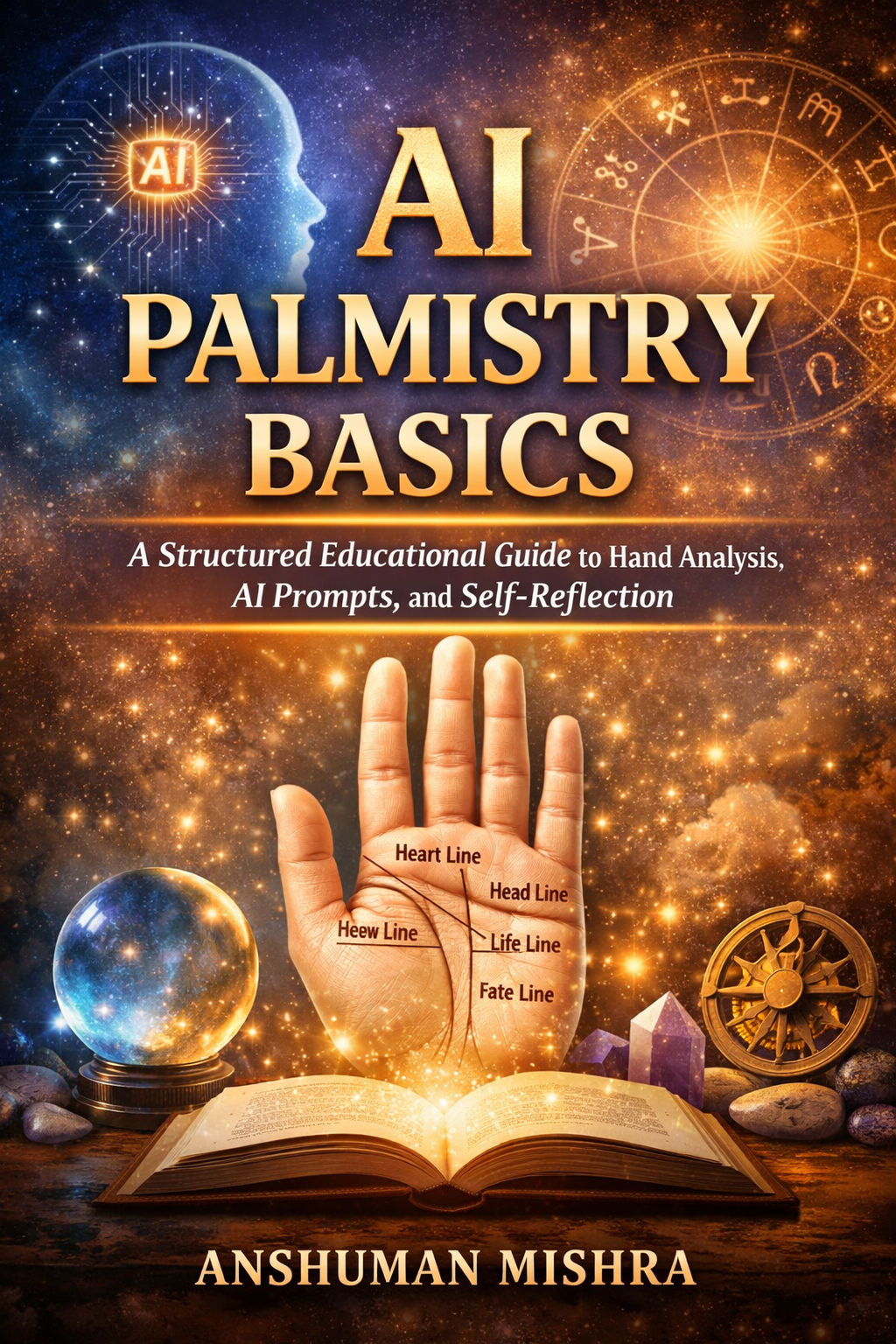
AI Palmistry Basics
A Structured Educational Guide to Hand Analysis, AI Prompts, and Self-Reflection
AI Palmistry Basics is a carefully structured educational guide that introduces readers to the traditional study of palmistry while exploring how modern Artificial Intelligence can support observation, learning, documentation, and reflective practice.
Palmistry has been studied and interpreted in different cultural traditions for centuries. Its concepts commonly involve observing features such as the shape of the hand, fingers, thumb, palm lines, mounts, textures, and other visible characteristics.
This book takes a modern, educational, and responsible approach to the subject.
Rather than presenting palmistry as a scientifically established method for predicting a person’s future, the book treats it as a symbolic and observational system that can be studied critically. Artificial Intelligence is introduced as a learning assistant rather than an authority.
What You Will Learn
This book provides a complete learning framework covering:
- Foundations and history of palmistry
- Palmistry as a symbolic observation system
- Basic anatomy of the hand
- Different hand shapes and classifications
- Finger proportions and characteristics
- Thumb position and flexibility
- Skin texture and surface patterns
- Major palm lines
- Minor palm lines
- Traditional symbolic meanings of mounts
- Systematic observation techniques
- Comparison of left and right hands
- AI-assisted palmistry learning
- AI prompt design
- Guided observation exercises
- Self-reflection and journaling
- Case-study methods
- Critical thinking
- Cognitive-bias awareness
- Ethical and responsible practice
- Privacy considerations
- Future applications of AI in educational studies
Understanding Palmistry as an Observational Discipline
The book begins by explaining the meaning, history, and scope of palmistry.
Readers are introduced to the distinction between traditional interpretations and evidence-based knowledge.
This distinction is important because it encourages learners to study palmistry without automatically treating symbolic interpretations as factual conclusions.
The book promotes observation, documentation, comparison, and questioning as core learning skills.
Learn the Structure of the Human Hand
Before studying palm lines, it is important to understand the basic structure of the hand.
Readers are introduced to observable characteristics such as:
- Palm proportions
- Finger length
- Finger relationships
- Thumb position
- Thumb flexibility
- Hand shape
- Skin texture
- Surface patterns
These features are presented primarily as things that can be observed and documented.
The book encourages readers to develop careful observation skills rather than jumping immediately to conclusions.
Explore Palm Shapes and Element-Based Categories
Traditional palmistry systems often classify hands into different categories, including element-based classifications.
The book introduces these categories and explains how learners can identify them through observable characteristics.
It also discusses the limitations of classification systems.
No single hand shape should be treated as a complete description of a person’s personality, abilities, behavior, or future.
This emphasis on avoiding overgeneralization is maintained throughout the book.
Understanding Major Palm Lines
The book provides a systematic introduction to commonly discussed major palm lines.
These include:
Life Line
Readers learn how the Life Line is traditionally identified and what types of variations are commonly discussed in palmistry literature.
Head Line
The Head Line is explored from the perspective of traditional symbolic interpretation and visual observation.
Heart Line
Readers learn how the Heart Line is identified and how different traditional systems discuss its variations.
Fate Line
The book introduces the Fate Line and explains how it is traditionally observed.
The emphasis remains on understanding the structure, appearance, variation, and traditional symbolism rather than treating any line as a guaranteed indicator of life events.
Study Minor Lines and Markings
In addition to major lines, the book introduces several secondary lines and markings commonly discussed in palmistry.
Readers explore topics including:
- Sun Line
- Mercury Line
- Relationship Lines
- Travel or movement-related markings
- Other commonly discussed signs
These are presented as subjects for study and observation.
Explore the Mounts of the Palm
Palmistry also places importance on different raised or symbolically significant areas of the palm known as mounts.
The book introduces traditional concepts associated with mounts such as:
- Mount of Venus
- Mount of Jupiter
- Mount of Saturn
- Mount of Apollo
- Mount of Mercury
Readers learn how to identify these areas and understand their traditional symbolic associations.
The book also emphasizes that symbolic interpretations should not be treated as definitive psychological or factual assessments.
Develop Systematic Observation Skills
One of the strongest practical features of the book is its focus on objective observation.
Readers learn a step-by-step process for examining a hand.
The process can include:
- Observing the overall hand shape
- Examining finger proportions
- Observing the thumb
- Reviewing major lines
- Reviewing secondary lines
- Examining mounts
- Recording unusual or notable features
- Comparing observations
- Separating observation from interpretation
- Reviewing conclusions critically
This method helps beginners avoid making assumptions before collecting observations.
Compare Left and Right Hands
The book introduces the educational practice of comparing both hands.
Readers can document similarities and differences in:
- Shape
- Lines
- Finger proportions
- Mounts
- Texture
- Visible markings
Rather than assuming that one hand automatically represents a fixed category of information, learners are encouraged to study differences carefully and consider the conventions of the particular palmistry system being studied.
AI as a Palmistry Learning Assistant
Artificial Intelligence is integrated into the book as a supportive learning technology.
AI can help learners:
- Organize observations
- Create study notes
- Generate practice questions
- Compare symbolic interpretations
- Create structured worksheets
- Generate reflection prompts
- Summarize learning materials
- Create hypothetical case studies
- Review observation records
The book clearly explains that AI responses can be incomplete, inaccurate, or influenced by the information provided.
Therefore, AI should be used as an assistant rather than as an unquestionable source of truth.
Learn to Design Effective AI Prompts
A major feature of AI Palmistry Basics is its focus on prompt design.
Readers learn how to create prompts that clearly define:
- The learning objective
- Observed hand features
- Specific palmistry concept
- Desired analysis format
- Comparison criteria
- Questions for reflection
- Limitations of interpretation
Well-structured prompts can make AI-assisted learning more organized and useful.
Guided AI Prompts for Practice
The book includes a progressive prompt-learning framework.
Beginner Prompts
Beginner exercises focus on identifying and describing observable hand features.
Intermediate Prompts
Intermediate exercises encourage comparison and structured interpretation of multiple characteristics.
Advanced Prompts
Advanced exercises focus on combining observations, identifying patterns, comparing alternative interpretations, and examining assumptions.
The purpose is to develop analytical discipline, not to generate definitive predictions.
Self-Reflection and Journaling
Learning becomes more effective when observations are documented consistently.
The book introduces a structured palmistry journal where readers can record:
- Date of observation
- Hand characteristics
- Palm shape
- Line observations
- Mount observations
- Questions
- Traditional interpretations studied
- AI-assisted reflections
- Alternative interpretations
- Personal learning notes
Over time, these records can help learners identify their own learning patterns and improve observation skills.
Case Studies for Learning
Case studies provide a useful way to practice observation without relying entirely on abstract explanations.
The book provides a framework for creating educational case studies involving hypothetical or appropriately consented observations.
Readers can practice:
- Recording hand characteristics
- Separating observation from interpretation
- Comparing features
- Identifying assumptions
- Reviewing mistakes
- Evaluating alternative interpretations
This makes the learning process more practical and structured.
Critical Thinking and Limitations
A central principle of this book is that palmistry has important limitations.
Palmistry should not be treated as a scientifically established method for predicting future events, diagnosing medical conditions, determining psychological conditions, or making important life decisions.
The book introduces critical-thinking concepts such as:
- Cognitive bias
- Confirmation bias
- Overgeneralization
- Selective observation
- Assumption-based reasoning
- Unsupported conclusions
Readers are encouraged to distinguish between what they can actually observe and what a symbolic interpretation suggests.
Ethical and Responsible Practice
Ethics are essential when studying any system involving personal information.
The book encourages readers to:
- Respect privacy
- Obtain appropriate consent when studying another person’s hand
- Avoid fear-based statements
- Avoid absolute conclusions
- Avoid misleading claims
- Communicate uncertainty clearly
- Protect personal information
- Use AI responsibly
- Respect cultural contexts
The book also emphasizes that palmistry interpretations should never be presented as replacements for qualified professional advice.
Who Is This Book For?
AI Palmistry Basics is suitable for:
- Beginners interested in palmistry
- Students exploring symbolic systems
- AI enthusiasts
- Self-reflection enthusiasts
- Curious learners
- Educators exploring interdisciplinary subjects
- Readers interested in traditional knowledge
- Learners interested in AI prompts
- Individuals interested in observation-based learning
No programming knowledge is required.
No previous palmistry experience is necessary.
Why Read This Book?
This book combines:
Palmistry + Artificial Intelligence + Observation + Self-Reflection
It provides a structured way to explore traditional palmistry concepts while developing modern skills in AI-assisted learning and critical thinking.
Key Highlights
✔ Introduction to palmistry
✔ Historical and cultural background
✔ Hand anatomy basics
✔ Hand shape classification
✔ Element-based hand categories
✔ Finger proportions
✔ Thumb observation
✔ Major palm lines
✔ Minor palm lines
✔ Traditional palm mounts
✔ Left and right hand comparison
✔ Systematic observation techniques
✔ AI prompt design
✔ AI-assisted learning
✔ Guided practice prompts
✔ Self-reflection exercises
✔ Palmistry journaling
✔ Case-study learning
✔ Critical-thinking techniques
✔ Cognitive-bias awareness
✔ Ethical practice guidelines
✔ Privacy and responsible AI use
✔ Future scope of AI-assisted learning
A Modern Approach to Traditional Knowledge
The purpose of AI Palmistry Basics is not to replace traditional knowledge with technology.
Instead, it demonstrates how modern AI tools can help learners organize, question, document, and study traditional symbolic systems in a more structured way.
The learner remains responsible for interpretation and judgment.
AI can help generate possibilities and learning exercises, but it cannot establish that a particular symbolic interpretation is objectively true.
Final Perspective
AI Palmistry Basics: A Structured Educational Guide to Hand Analysis, AI Prompts, and Self-Reflection is an educational resource for anyone who wants to explore palmistry through a modern and responsible framework.
It encourages readers to observe carefully, document systematically, question assumptions, use AI thoughtfully, and maintain awareness of the limitations of symbolic interpretation.
The book is ultimately about learning rather than prediction, observation rather than assumption, and reflection rather than certainty.
Observe carefully. Learn systematically. Ask better questions. Use AI responsibly.



Reviews
There are no reviews yet.