Description
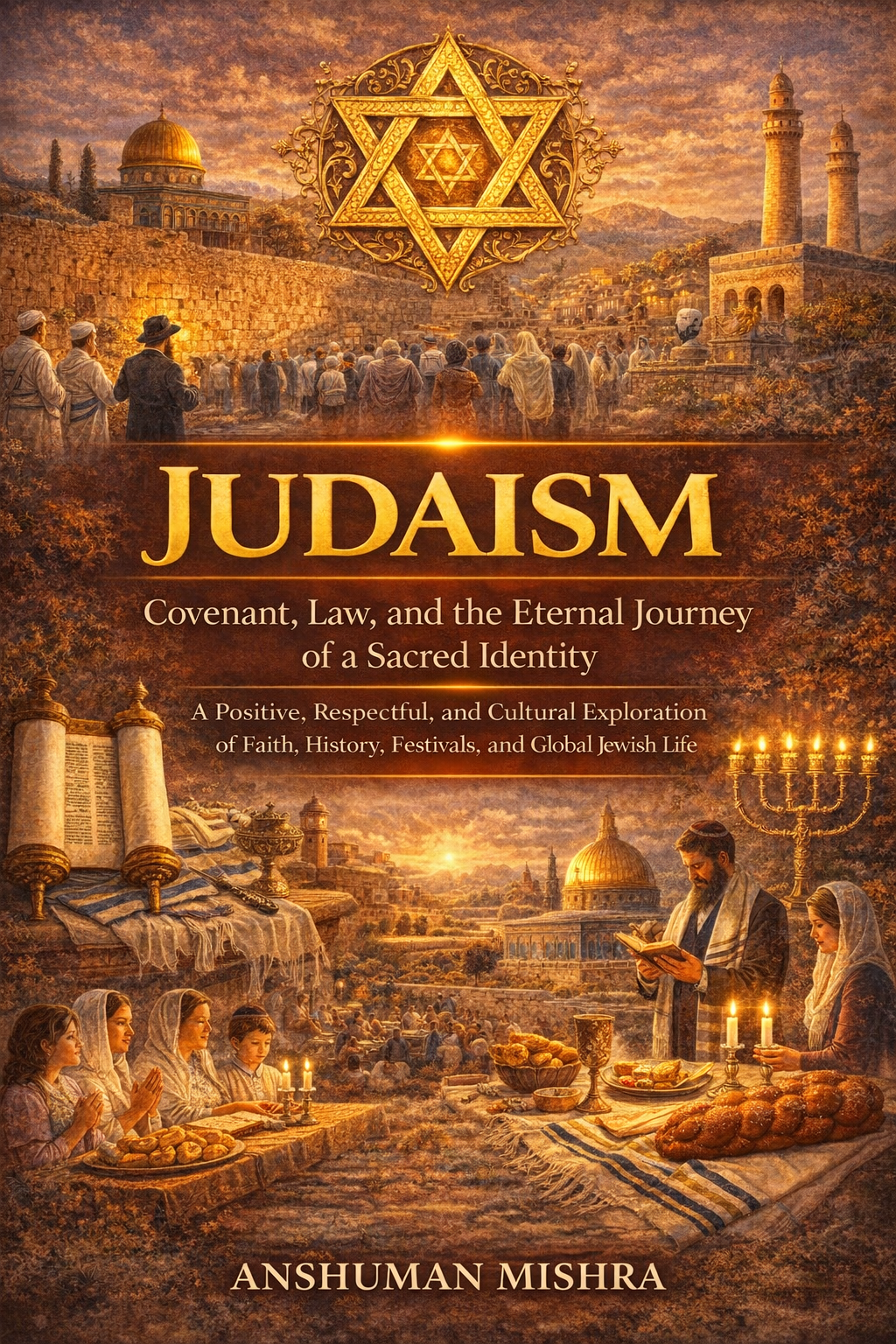
Judaism: Covenant, Law, and the Eternal Journey of a Sacred Identity
A Positive, Respectful, and Cultural Exploration of Faith, History, Festivals, and Global Jewish Life
Author: Anshuman Mishra
Judaism: Covenant, Law, and the Eternal Journey of a Sacred Identity is a respectful and educational introduction to one of the world’s oldest continuously practiced religious and cultural traditions.
The book explores Judaism not simply as a collection of beliefs, but as a rich and enduring way of life shaped by covenant, sacred texts, ethical law, prayer, family, learning, community, cultural memory, and responsibility.
Written for general readers, students, educators, and anyone interested in religious and cultural studies, this book provides an accessible overview of Jewish faith and life while maintaining a respectful and educational perspective.
Its purpose is to help readers understand Judaism on its own terms, without turning the discussion into comparisons, criticism, or religious debate.
What You Will Learn
This book introduces readers to:
- Judaism as faith, culture, and civilization
- The meaning of sacred identity
- Historical foundations of Jewish tradition
- The concept of covenant
- Torah and Jewish textual traditions
- Halakhah and ethical living
- Jerusalem and sacred geography
- Jewish prayer and worship
- Shabbat and sacred time
- Jewish family and educational traditions
- Major Jewish festivals
- Jewish life-cycle traditions
- Jewish ethics and moral philosophy
- Tzedakah and social responsibility
- Jewish communities around the world
- Important personalities in Jewish tradition
- Judaism in the modern world
- Continuity of Jewish identity
- Hope, responsibility, and future generations
Judaism as a Way of Life
The book begins by examining Judaism as a living tradition.
Jewish identity can encompass religious belief, cultural heritage, community, family traditions, language, learning, memory, and practices passed from one generation to another.
The book explores how faith can be expressed through everyday actions, ethical responsibilities, study, prayer, family life, community participation, and observance.
This perspective helps readers understand Judaism as a tradition in which spiritual ideas are closely connected with daily life.
The Concept of Covenant
One of the central concepts explored in the book is the idea of covenant.
Within Jewish tradition, covenant represents a sacred relationship involving commitment, responsibility, and faithfulness.
The book explains covenant as more than a theological concept. It also explores its connection with community, moral responsibility, sacred obligation, and continuity.
Readers are introduced to the idea that faith and responsibility are closely connected within Jewish thought.
Torah and Sacred Learning
The Torah occupies a central place in Jewish religious and cultural life.
The book introduces readers to the importance of Torah as sacred teaching and examines the long-standing Jewish emphasis on study, interpretation, learning, and transmission of knowledge.
Education is presented as an important part of Jewish cultural continuity.
Readers will also learn how Jewish textual traditions have encouraged generations of scholars and communities to engage deeply with questions of law, ethics, interpretation, and human responsibility.
Halakhah and Ethical Living
The book introduces Halakhah, the body of Jewish religious law and practice, in an accessible way.
Rather than presenting Jewish law simply as a collection of rules, the book explores how Jewish tradition connects law with daily practice, ethical responsibility, community life, and religious observance.
Themes include:
- Justice
- Compassion
- Responsibility
- Discipline
- Order
- Human dignity
- Community
- Faith expressed through action
This section helps readers understand the relationship between belief, practice, and ethical conduct.
Jerusalem and Sacred Geography
Jerusalem holds profound spiritual and historical significance within Jewish tradition.
The book explores Jerusalem through the themes of:
- Prayer
- Sacred memory
- Worship
- Learning
- Spiritual connection
- Hope
- Sacred geography
The discussion focuses on Jerusalem’s religious and cultural significance while deliberately avoiding political debate.
Prayer, Worship, and Shabbat
Jewish worship is explored through prayer, blessings, synagogue life, and sacred time.
A special focus is given to Shabbat, the Jewish Sabbath.
The book presents Shabbat as a recurring period associated with rest, worship, reflection, family, community, and renewal.
Readers are introduced to the idea of sacred time as an important feature of Jewish spiritual life.
Jewish Family and Cultural Values
Family and education have played significant roles in the preservation of Jewish identity across generations.
The book explores:
- Family traditions
- Intergenerational learning
- Education
- Respect for knowledge
- Community relationships
- Language
- Music
- Art
- Cultural symbols
- Shared traditions
These elements demonstrate how religious and cultural identity can be maintained through everyday practices and collective memory.
Jewish Festivals and Sacred Celebrations
Jewish festivals provide important opportunities for remembrance, worship, family gathering, learning, and celebration.
The book introduces major festivals and sacred occasions, including:
Passover
Explored through themes of freedom, remembrance, family, and gratitude.
Shavuot
Presented in connection with learning, revelation, and the Torah.
Sukkot
Explored through themes of faith, gratitude, hospitality, and joy.
Rosh Hashanah
Introduced as a significant period of reflection and renewal.
Yom Kippur
Explored through themes of repentance, reflection, responsibility, and spiritual renewal.
Hanukkah
Presented through themes of dedication, light, remembrance, and hope.
The book emphasizes the cultural and spiritual meanings of these celebrations.
Judaism and the Cycle of Life
Religious traditions often accompany important stages of human life.
The book introduces Jewish life-cycle traditions relating to:
- Birth and naming
- Education
- Coming of age
- Marriage
- Family
- Community
- Memory
- Continuity
These traditions demonstrate how Jewish identity can be expressed throughout different stages of life.
Jewish Ethics and Moral Philosophy
Ethics form an important dimension of Jewish thought.
The book explores concepts including:
- Justice
- Mercy
- Kindness
- Human dignity
- Charity
- Social responsibility
- Peaceful living
- Moral accountability
A special emphasis is placed on tzedakah, commonly associated with charitable giving and social responsibility.
The discussion shows how ethical action can be understood as an important part of religious life.
Jewish History and Cultural Continuity
Jewish history spans many centuries and includes diverse communities, intellectual traditions, cultural developments, migrations, and changing historical circumstances.
This book approaches historical continuity with particular attention to:
- Preservation of religious traditions
- Transmission of knowledge
- Community organization
- Cultural memory
- Family traditions
- Sacred texts
- Education
- Continuity across generations
The focus is on understanding how Jewish identity and traditions have continued to develop over time.
Global Jewish Life
Jewish communities exist in many regions of the world and have developed diverse cultural expressions while maintaining connections to shared religious and historical traditions.
The book introduces Jewish life across:
- Israel
- North America
- Europe
- Asia
- Africa
- Latin America
This global perspective highlights both shared heritage and cultural diversity.
Jewish communities in different countries may have distinctive languages, cuisines, musical traditions, customs, and historical experiences while participating in broader Jewish traditions.
Important Personalities in Jewish Tradition
The book introduces several major figures associated with Jewish religious and cultural history.
Abraham
Explored as a foundational figure associated with faith, covenant, and trust in Jewish tradition.
Moses
Presented as a central figure associated with the Exodus narrative, Torah, covenant, and Jewish law.
King David
Explored in relation to leadership, kingship, Jerusalem, and the Psalms.
Solomon
Introduced through traditions concerning wisdom, leadership, and the Temple.
The book also recognizes the contributions of generations of Jewish teachers, scholars, philosophers, writers, and community leaders.
Judaism in the Modern World
Jewish life continues to evolve within contemporary societies.
The book explores how Jewish communities engage with:
- Education
- Science
- Technology
- Professional life
- Community development
- Cultural preservation
- Modern institutions
- Contemporary identity
Rather than presenting tradition and modernity as automatically opposed, the book examines how communities can preserve important traditions while participating fully in changing societies.
Education and Knowledge
Learning has a particularly important place in Jewish intellectual and cultural traditions.
The book highlights the value placed on:
- Study
- Reading
- Questioning
- Interpretation
- Teaching
- Scholarship
- Intergenerational knowledge
This educational orientation is explored as one of the important features of Jewish cultural continuity.
A Message of Hope and Responsibility
The concluding chapters bring together several recurring themes:
Faith.
Covenant.
Learning.
Responsibility.
Community.
Memory.
Hope.
Continuity.
The book presents Judaism as a tradition in which identity is connected with both heritage and responsibility.
It emphasizes the importance of passing knowledge and values to future generations while maintaining a meaningful connection with tradition.
Who Is This Book For?
This book is suitable for:
- General readers interested in Judaism
- Students of religious studies
- Students of cultural studies
- Students of history and civilization
- Educators
- Libraries and educational institutions
- Readers interested in Jewish culture
- Readers interested in religious traditions
- Readers exploring sacred texts and ethics
- Anyone seeking a respectful introduction to Jewish life
No prior academic knowledge of Judaism is required.
Why Read This Book?
Judaism: Covenant, Law, and the Eternal Journey of a Sacred Identity offers an accessible way to explore Jewish faith, culture, history, ethics, traditions, and contemporary life.
Key Highlights
✔ Judaism as faith and culture
✔ Sacred identity and continuity
✔ Covenant and spiritual responsibility
✔ Torah and sacred learning
✔ Halakhah and ethical living
✔ Justice and compassion
✔ Jerusalem and sacred geography
✔ Jewish prayer and synagogue life
✔ Shabbat and sacred time
✔ Jewish family traditions
✔ Education and learning
✔ Major Jewish festivals
✔ Jewish life-cycle traditions
✔ Tzedakah and social responsibility
✔ Jewish ethics and moral philosophy
✔ Jewish history and cultural memory
✔ Global Jewish communities
✔ Important figures in Jewish tradition
✔ Judaism in the modern world
✔ Tradition and contemporary life
✔ Faith, hope, and continuity
✔ Future generations and cultural preservation
A Respectful Educational Approach
The book is intentionally written with an emphasis on respect, cultural understanding, and educational value.
It does not seek to rank religions, criticize other faiths, or encourage religious debate.
Instead, it focuses on helping readers understand the internal themes, practices, values, history, and cultural traditions associated with Judaism.
This makes it suitable for readers from diverse backgrounds who want to learn about Jewish civilization in a thoughtful and respectful manner.
Final Perspective
Judaism: Covenant, Law, and the Eternal Journey of a Sacred Identity is an introduction to a tradition shaped by sacred texts, covenant, law, learning, worship, family, ethics, community, cultural memory, and hope.
It invites readers to explore Judaism as a living tradition whose religious and cultural dimensions have been transmitted across generations and expressed in communities around the world.
At its heart, the book explores a simple but enduring theme:
Faith becomes meaningful through learning, responsibility, community, and the preservation of values for future generations.
This book offers readers an opportunity to learn about Judaism with curiosity, respect, cultural sensitivity, and an appreciation for the richness of human religious heritage.
Reviews
There are no reviews yet.