Description
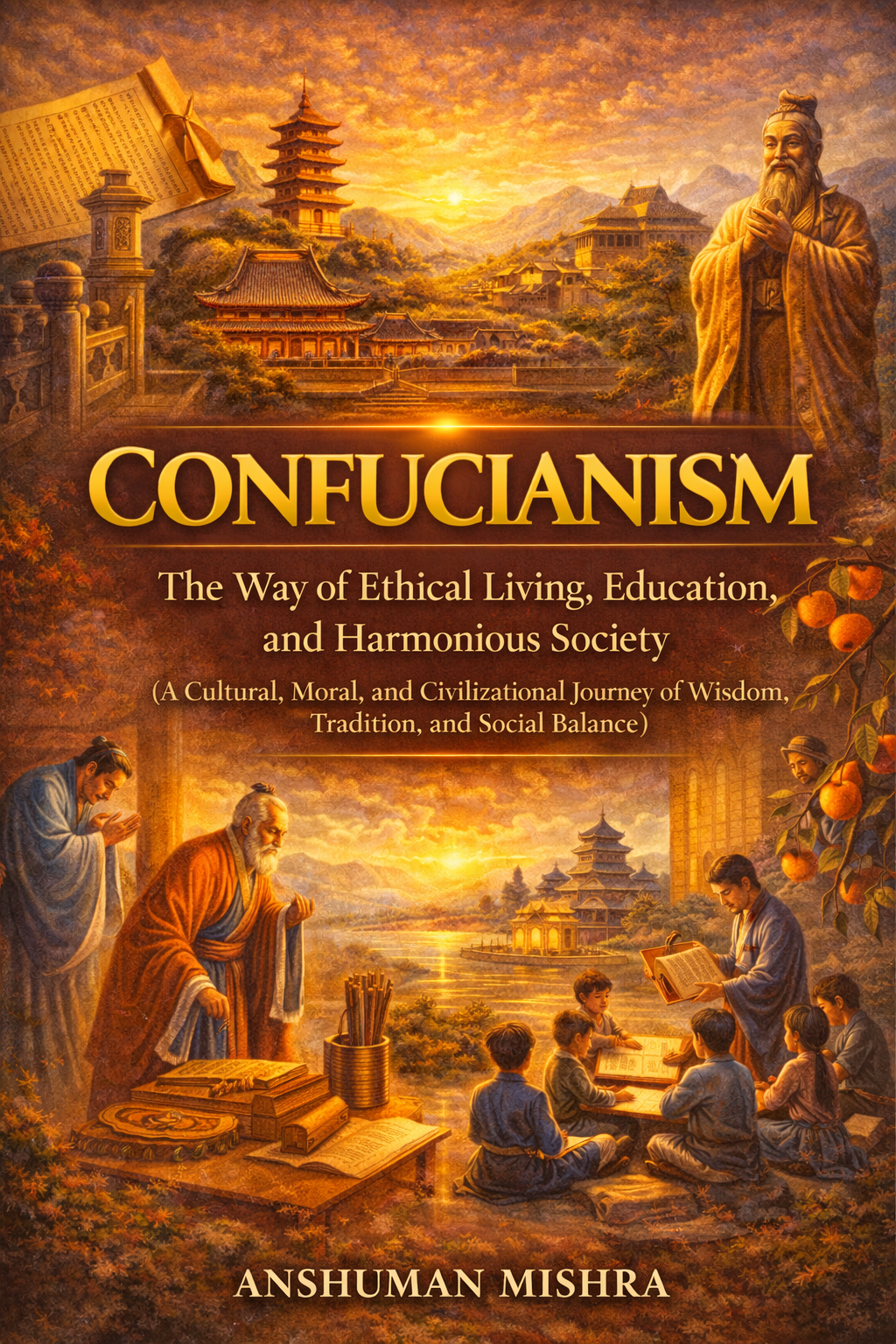
A Cultural, Moral, and Civilizational Journey of Wisdom, Tradition, and Social Balance
Author: Anshuman Mishra
Confucianism: The Way of Ethical Living, Education, and Harmonious Society is a comprehensive, accessible, and respectful exploration of one of the world’s most influential philosophical and cultural traditions.
Confucianism has shaped ideas about ethical behavior, education, family relationships, leadership, social responsibility, cultural refinement, and harmonious living for centuries. Its influence can be seen across East Asian societies and in wider discussions about education, character development, civic responsibility, and moral leadership.
This book introduces Confucianism as a practical tradition of ethical living rather than merely a historical philosophy. It examines how individuals can develop character, how families can nurture respect and responsibility, how communities can build trust, and how leaders can contribute to social harmony through moral example.
The book has been written from an educational and culturally respectful perspective. It focuses on understanding Confucianism on its own terms and does not seek to criticize, rank, or debate other religious or philosophical traditions.
What You Will Learn
Readers will explore:
- The meaning and scope of Confucianism
- Confucianism as moral philosophy and cultural tradition
- The importance of human relationships
- The pursuit of social harmony
- Classical Confucian texts
- The Analects and Confucian conversations
- The Five Classics
- Ren, Li, Yi, Zhi, and Xin
- Education and lifelong learning
- Teacher–student relationships
- Self-cultivation and character development
- Family ethics and filial respect
- Social responsibility
- Rituals and cultural practices
- Music, art, and cultural refinement
- Food, moderation, and shared dining
- Historic learning centers
- Confucian influence in different countries
- Confucius and other important scholars
- Ethical governance
- Moral leadership
- Confucianism in modern education
- Global cultural dialogue
- Peaceful coexistence and social harmony
Understanding Confucianism as a Way of Life
The book begins by examining Confucianism as a way of thinking and living.
Rather than limiting Confucianism to abstract philosophical concepts, the book explores its practical concern with everyday conduct. How should people treat their parents? How should teachers guide students? How should leaders behave? How can individuals improve their character? How can communities develop trust and cooperation?
These questions are central to the Confucian approach.
The book demonstrates how personal character and social well-being are closely connected.
The Foundations of Confucian Wisdom
Readers are introduced to the classical foundations of Confucian thought and the importance of texts such as the Analects and the Five Classics.
The book explains how teachings were preserved, studied, interpreted, and transmitted across generations.
Learning is presented as an ongoing process through which individuals can develop knowledge, discipline, humility, and moral awareness.
The Five Core Virtues
A major section of the book examines important Confucian ethical concepts.
Ren — Humaneness and Compassion
Ren is commonly associated with humaneness, benevolence, compassion, and concern for others.
The book explores how this principle encourages individuals to consider the well-being and dignity of other people.
Li — Ritual, Respect, and Proper Conduct
Li encompasses ideas associated with ritual, etiquette, appropriate conduct, and respect.
The book explains how respectful behavior can contribute to orderly and harmonious relationships.
Yi — Righteousness
Yi concerns moral appropriateness and doing what is right.
Readers explore how moral judgment involves responsibility rather than simply pursuing personal advantage.
Zhi — Wisdom
Zhi is associated with wisdom and thoughtful understanding.
The book connects wisdom with learning, reflection, observation, and responsible action.
Xin — Trustworthiness
Xin emphasizes sincerity, reliability, and trustworthiness.
The book explores why trust is essential for relationships, institutions, and communities.
Education as Character Development
Education occupies a central place in Confucian thought.
The book explores learning not merely as a path to qualifications or employment but as a process of self-improvement and character development.
Topics include:
- Lifelong learning
- Discipline
- Reflection
- Teacher–student relationships
- Respect for knowledge
- Merit
- Responsibility
- Moral education
The book also examines how education can contribute to social stability and responsible citizenship.
Family and Social Relationships
Confucian thought places considerable emphasis on relationships and responsibilities within families and society.
The book explores:
- Filial respect
- Family responsibility
- Intergenerational relationships
- Respect for elders
- Care for younger generations
- Mutual respect
- Community responsibility
The family is examined as an important environment in which individuals first learn values such as respect, responsibility, gratitude, and cooperation.
Moral Leadership and Ethical Governance
Leadership is another important theme.
The book examines the Confucian idea that leaders should demonstrate ethical conduct and serve as examples to others.
Instead of focusing exclusively on authority or punishment, the Confucian ideal emphasizes:
- Integrity
- Education
- Moral example
- Responsibility
- Justice
- Social trust
- Public welfare
This makes the discussion relevant not only to historical governance but also to modern conversations about leadership and public service.
Ritual, Culture, Music, and Daily Conduct
Confucianism has influenced cultural practices involving ritual, etiquette, education, music, literature, and social conduct.
The book explains how these cultural expressions can reinforce values such as:
- Respect
- Discipline
- Gratitude
- Community
- Harmony
- Cultural continuity
Readers gain a broader understanding of Confucianism as a cultural tradition rather than viewing it only through philosophical definitions.
Food, Moderation, and Shared Meals
The book also explores food culture from a broader cultural perspective.
Shared meals can represent family connection, hospitality, cooperation, and social harmony.
Themes of moderation, gratitude, responsible consumption, and respect for resources are discussed as part of everyday cultural life.
Confucian Cultural Centers and Learning Institutions
The book introduces readers to historic centers associated with Confucian learning and cultural heritage.
These include:
- Historic academies
- Confucian temples
- Educational institutions
- Cultural heritage sites
- Centers of scholarship
Such locations are explored as spaces connected with learning, remembrance, education, and cultural preservation.
Confucianism Across Countries
Confucian thought has had significant historical influence across several East Asian societies.
The book introduces readers to Confucian traditions and influences in:
- China
- Korea
- Japan
- Vietnam
Each society has its own historical development and cultural context. The book therefore emphasizes adaptation and diversity rather than treating Confucianism as a completely uniform tradition.
Confucius and Other Thinkers
A dedicated section examines Confucius and his contribution to moral education, learning, social relationships, and ethical leadership.
The book also introduces later scholars and educators who helped develop, interpret, and transmit Confucian ideas.
Their contributions demonstrate how philosophical traditions can evolve through generations of teaching, debate, interpretation, and cultural practice.
Confucianism in the Modern World
The relevance of Confucian values extends into contemporary discussions about:
- Education
- Family
- Leadership
- Workplace relationships
- Civic responsibility
- Character development
- Social trust
- Cultural preservation
The book explores how traditional concepts can be considered within modern social environments while recognizing that contemporary societies are diverse and continually changing.
Self-Cultivation and Personal Growth
One of the most practical themes in the book is self-cultivation.
Readers are encouraged to consider how character can be developed through everyday habits and reflection.
The book explores:
- Self-awareness
- Patience
- Discipline
- Emotional balance
- Thoughtful action
- Personal responsibility
- Continuous learning
This makes Confucian thought particularly relevant to readers interested in personal development and lifelong learning.
Confucian Values for Students and Professionals
The principles discussed in the book can also be considered in educational and professional contexts.
Students may find value in concepts relating to:
- Respect for teachers
- Discipline
- Learning
- Persistence
- Intellectual humility
Professionals may explore ideas relating to:
- Integrity
- Responsibility
- Trust
- Ethical leadership
- Respectful communication
- Team harmony
The book presents these ideas as subjects for reflection rather than rigid formulas.
Universal Values and Cultural Dialogue
The final part of the book examines Confucianism within a broader global context.
Themes such as education, respect, responsibility, compassion, trust, ethical leadership, and peaceful coexistence can contribute to conversations across cultures.
The book encourages readers to understand Confucianism as part of humanity’s wider heritage of ethical and philosophical reflection.
Who Is This Book For?
This book is ideal for:
- Students of philosophy
- Students of history and civilization
- Religious and cultural studies students
- Educators and teachers
- Researchers
- General readers interested in world philosophies
- Readers interested in Chinese culture
- Readers interested in East Asian traditions
- Professionals interested in ethical leadership
- Readers interested in personal development
- Libraries and educational institutions
No advanced background in philosophy is required.
Key Highlights
✔ Introduction to Confucianism
✔ Confucian ethics and moral philosophy
✔ Confucius and his teachings
✔ The Analects
✔ The Five Classics
✔ Ren, Li, Yi, Zhi, and Xin
✔ Education and lifelong learning
✔ Self-cultivation
✔ Family values
✔ Filial respect
✔ Social responsibility
✔ Ethical leadership
✔ Moral governance
✔ Ritual and social etiquette
✔ Music and cultural refinement
✔ Food and moderation
✔ Confucian cultural heritage
✔ Confucian temples and learning centers
✔ China, Korea, Japan, and Vietnam
✔ Confucian scholars and educators
✔ Modern applications of Confucian thought
✔ Workplace ethics
✔ Civic responsibility
✔ Global cultural dialogue
✔ Peaceful coexistence
✔ Character development
✔ Wisdom and personal growth
A Respectful Educational Approach
This book is designed primarily for learning and cultural understanding.
It presents Confucianism with respect for its historical development, philosophical concepts, cultural expressions, and continuing influence.
Rather than treating Confucianism as a rigid or isolated system, the book explores its evolution across different historical periods and societies.
This approach makes the book accessible to readers from diverse cultural and educational backgrounds.
Final Perspective
Confucianism: The Way of Ethical Living, Education, and Harmonious Society provides a structured introduction to a tradition deeply concerned with the development of character and the quality of human relationships.
Its central themes—learning, humaneness, respect, responsibility, wisdom, integrity, family, education, and harmony—offer valuable subjects for reflection in both historical and contemporary contexts.
The book invites readers to explore how personal character can influence families, how families contribute to communities, and how ethical leadership can contribute to social trust and harmony.
Learn from tradition. Cultivate character. Respect others. Pursue wisdom. Build harmony.

Reviews
There are no reviews yet.