Description
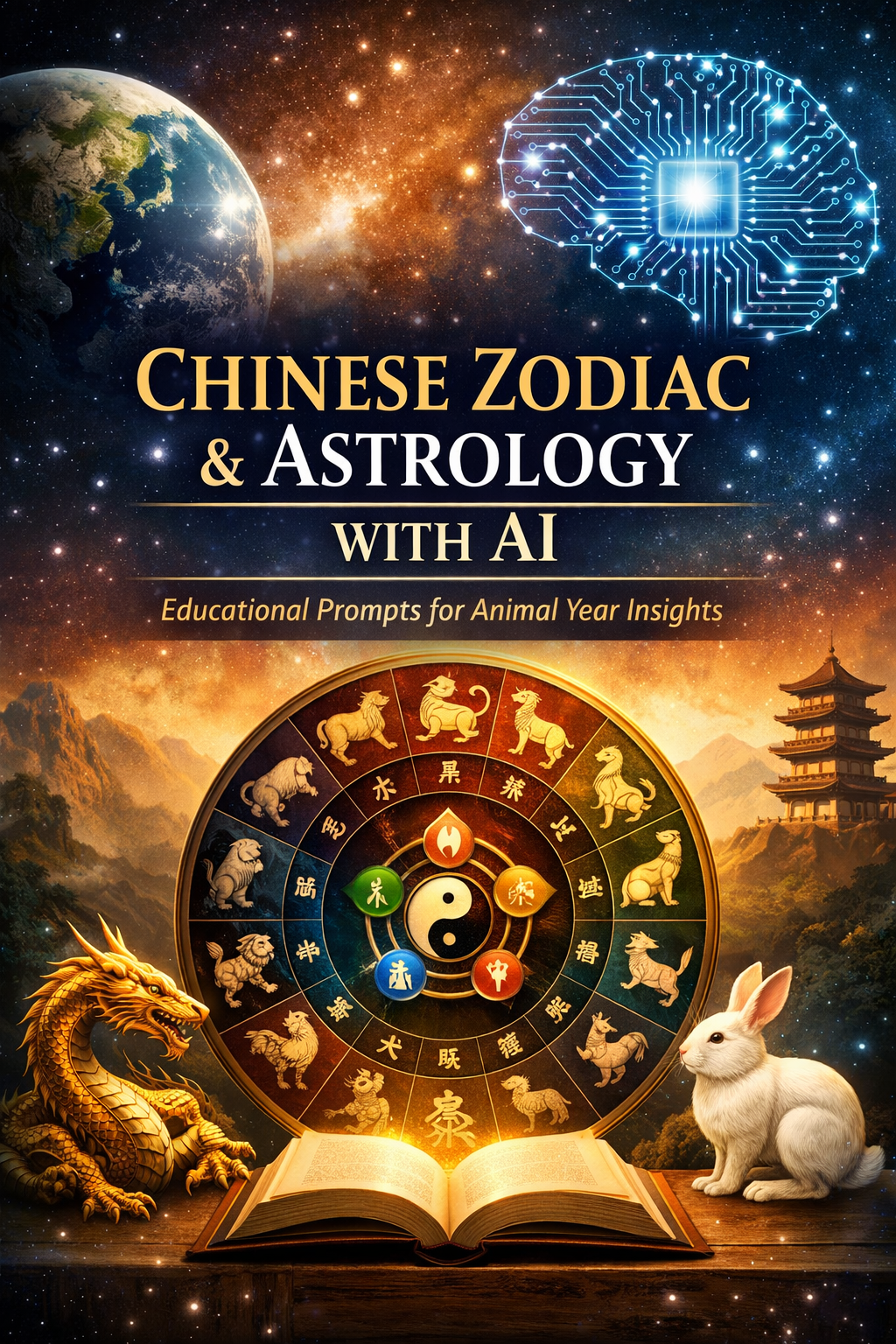
Chinese Zodiac & Astrology with AI: Educational Prompts for Animal Year Insights is a comprehensive and beginner-friendly educational guide designed to introduce readers to the fascinating world of the Chinese Zodiac, animal-year symbolism, Yin and Yang, Five Elements, cyclical time, and traditional cultural interpretation.
The book combines traditional Chinese Zodiac concepts with modern Artificial Intelligence-based learning techniques, creating an interactive framework for readers who want to explore this cultural system through observation, comparison, reflection, and structured questioning.
The approach is deliberately educational and balanced. Chinese astrology is presented as a traditional cultural and symbolic framework, rather than as a scientifically verified system for predicting personality, relationships, or future events.
What You Will Learn
This book covers:
- Chinese Zodiac fundamentals
- History and cultural background
- Twelve animal signs
- Animal-year cycle
- Yin and Yang
- Five Elements
- Wood, Fire, Earth, Metal, and Water
- Animal–element combinations
- Sixty-year cycle
- Rat and Ox
- Tiger and Rabbit
- Dragon and Snake
- Horse and Goat
- Monkey and Rooster
- Dog and Pig
- Symbolic personality frameworks
- Compatibility concepts
- Cultural interpretations
- AI prompts for Zodiac learning
- Comparative analysis
- Pattern recognition
- Reflection exercises
- Journaling techniques
- Critical evaluation
- Scientific limitations
- Ethical use of AI
Understanding the Chinese Zodiac
The book begins with the historical and cultural foundations of the Chinese Zodiac.
Readers are introduced to the twelve-year animal cycle and its importance within traditional Chinese culture.
The twelve animals are:
Rat, Ox, Tiger, Rabbit, Dragon, Snake, Horse, Goat, Monkey, Rooster, Dog, and Pig.
Each animal is explored through its traditional symbolic associations and cultural representations.
The book does not treat these associations as fixed descriptions of individuals. Instead, readers are encouraged to examine them as cultural archetypes and interpretative models.
The Twelve Animal Signs
A major portion of the book is dedicated to understanding all twelve Zodiac animals.
Rat and Ox
The Rat and Ox are introduced as foundational animal archetypes, with attention to their traditional symbolism and cultural associations.
Readers can use AI prompts to compare their characteristics and explore how different symbolic frameworks are constructed.
Tiger and Rabbit
The Tiger and Rabbit provide an interesting contrast between traditionally associated qualities such as dynamism, courage, gentleness, and sensitivity.
The book uses these contrasts as opportunities for reflective and comparative learning.
Dragon and Snake
The Dragon and Snake are examined through themes traditionally associated with transformation, wisdom, strength, and mystery.
AI prompts help learners compare the symbolic narratives associated with these two animals.
Horse and Goat
The Horse and Goat are explored through traditional themes connected with movement, creativity, independence, cooperation, and cultural symbolism.
Monkey and Rooster
These signs provide an opportunity to study traditional associations with intelligence, adaptability, observation, precision, and expression.
Dog and Pig
The Dog and Pig are discussed through cultural themes such as loyalty, sincerity, generosity, abundance, and social relationships.
Yin and Yang
An important foundation of the Chinese philosophical and cultural framework is the concept of Yin and Yang.
The book introduces Yin and Yang as complementary principles rather than simple opposites.
Readers explore how traditional systems use complementary relationships to understand:
- Balance
- Change
- Cycles
- Complementarity
- Interaction
- Harmony
The concept is presented in its cultural and philosophical context rather than as a scientific theory.
The Five Elements
The Five Elements form another important component of Chinese traditional thought.
The book examines:
Wood
Associated traditionally with growth, development, and expansion.
Fire
Traditionally connected with warmth, activity, transformation, and expression.
Earth
Associated with stability, grounding, nourishment, and balance.
Metal
Traditionally connected with structure, precision, organization, and clarity.
Water
Associated symbolically with adaptability, movement, depth, and flow.
These descriptions are presented as traditional symbolic associations rather than scientifically established personality characteristics.
The Sixty-Year Cycle
One of the fascinating features of the Chinese calendrical tradition is the interaction between animal signs and the Five Elements.
The book explains how combinations of the animal cycle and element cycle produce a traditional 60-year cyclical framework.
Readers learn how to:
- Understand the two cycles
- Identify combinations
- Observe repetition
- Study patterns
- Create reference tables
- Explore symbolic relationships
This section is particularly useful for learners interested in understanding cyclical classification systems.
Animal and Element Combinations
The book introduces a structured framework for combining an animal sign with an element.
Instead of simply memorizing descriptions, readers are encouraged to ask analytical questions such as:
- What does the animal symbolize traditionally?
- What does the element represent?
- How are the two concepts combined?
- How does the cultural interpretation change?
- What assumptions are being made?
- How should the interpretation be evaluated?
This approach turns passive reading into active learning.
Compatibility as a Cultural Concept
The book also introduces traditional ideas concerning compatibility between animal signs.
However, compatibility is treated strictly as a cultural and symbolic concept.
The book avoids presenting Zodiac compatibility as a reliable method for deciding:
- Friendships
- Marriage
- Career choices
- Financial decisions
- Personal relationships
Instead, readers are encouraged to study compatibility models as examples of how cultures develop symbolic classification systems.
Artificial Intelligence and Chinese Zodiac Learning
One of the key features of this book is the integration of Artificial Intelligence.
AI can be used as a learning assistant to:
- Explain traditional concepts
- Compare animal signs
- Generate study questions
- Create structured tables
- Identify recurring symbolic themes
- Develop reflection exercises
- Organize notes
- Generate educational case studies
- Create journaling prompts
AI is not presented as a source of absolute truth.
Readers are encouraged to verify information and critically evaluate AI-generated responses.
AI Prompts for Zodiac Study
The book provides a practical framework for creating effective AI prompts.
Readers can create prompts for:
Descriptive Learning
Ask AI to explain the traditional symbolism associated with a particular animal.
Comparative Learning
Compare two animal signs and identify similarities and differences in their traditional representations.
Element Analysis
Explore how an element is traditionally associated with a particular animal.
Cultural Analysis
Examine how a Zodiac animal appears in traditional stories, literature, or cultural narratives.
Reflection
Use symbolic descriptions as prompts for personal reflection without treating them as objective personality assessments.
Pattern Recognition
Pattern recognition is an important learning technique throughout the book.
Readers learn how to identify:
- Repeating animal cycles
- Element cycles
- Animal-element combinations
- Similar symbolic themes
- Contrasting interpretations
- Cultural patterns
AI can help organize these observations into tables, summaries, and structured notes.
Practical Exercises and Journaling
The book includes exercises designed to transform theoretical knowledge into practical learning.
Activities include:
- Animal-sign observation
- Comparative analysis
- Element mapping
- Symbolic interpretation
- AI prompt exercises
- Cultural research
- Reflection journals
- Long-term learning records
A journal can help readers document what they learn, identify recurring ideas, and distinguish between traditional descriptions and their own interpretations.
Critical Thinking and Scientific Perspective
An important feature of this book is its emphasis on critical thinking.
The book clearly distinguishes between:
Cultural or symbolic knowledge
and
Empirical scientific evidence.
Readers are encouraged to recognize that traditional Zodiac systems have cultural and historical significance, while claims about predicting personality or future events should not automatically be treated as scientifically established facts.
The book discusses:
- Confirmation bias
- Deterministic thinking
- Overgeneralization
- Selective interpretation
- Unverified claims
- Evidence-based reasoning
This balanced approach helps readers explore the subject with curiosity while maintaining intellectual independence.
Ethical Use of Chinese Zodiac and AI
The book encourages responsible use of both traditional symbolic systems and AI technology.
Readers are advised to avoid:
- Guaranteed predictions
- Fear-based interpretations
- Absolute personality judgments
- Making major decisions solely from Zodiac interpretations
- Presenting AI-generated content as authoritative
- Misrepresenting cultural traditions
- Using personal data irresponsibly
The emphasis remains on education, cultural appreciation, reflection, and responsible technology use.
Chinese Zodiac in the Modern World
The Chinese Zodiac continues to appear in contemporary:
- Literature
- Art
- Popular culture
- Festivals
- Media
- Educational discussions
- Cultural events
- International cultural exchange
The book explores how traditional symbols can continue to have cultural relevance even when studied outside their original historical contexts.
Why This Book Is Different
Many books about Zodiac systems focus primarily on predictions.
This book follows a different educational model:
Learn → Explore → Compare → Question → Reflect → Verify
The objective is not to tell readers what will happen in their lives.
Instead, the objective is to help them understand how the Chinese Zodiac system is structured, how its symbolism developed, and how modern AI can support cultural learning.
Who Should Read This Book?
This book is suitable for:
- Beginners interested in Chinese Zodiac
- Students of cultural studies
- Educators and teachers
- Researchers
- AI enthusiasts
- Readers interested in traditional knowledge
- Students of Asian culture
- Astrology enthusiasts
- Content creators
- Independent learners
- Readers interested in symbolic systems
No programming knowledge or previous expertise in Chinese astrology is required.
Key Features
✔ Complete introduction to Chinese Zodiac
✔ Twelve animal signs explained
✔ Rat, Ox, Tiger, Rabbit, Dragon, Snake
✔ Horse, Goat, Monkey, Rooster, Dog, Pig
✔ Yin and Yang principles
✔ Five Elements framework
✔ Wood, Fire, Earth, Metal, and Water
✔ Animal–element combinations
✔ Sixty-year cycle
✔ Traditional compatibility concepts
✔ Cultural interpretation framework
✔ AI prompts for Zodiac learning
✔ Comparative study prompts
✔ Pattern-recognition exercises
✔ Reflection and journaling activities
✔ Case-study learning
✔ Critical-thinking framework
✔ Scientific limitations
✔ Ethical AI usage
✔ Responsible interpretation guidelines
Final Perspective
Chinese Zodiac & Astrology with AI: Educational Prompts for Animal Year Insights provides a modern educational pathway for exploring an ancient cultural system.
By combining Chinese Zodiac symbolism, animal-year traditions, Yin and Yang, Five Elements, cyclical frameworks, AI prompts, comparative exercises, and critical thinking, the book creates an interactive learning experience for modern readers.
It respects the cultural significance of the Chinese Zodiac while maintaining a clear distinction between traditional symbolism and scientifically established knowledge.
Whether you are a beginner discovering the Chinese Zodiac for the first time or an educator looking for an organized resource for cultural studies, this book provides a structured foundation for further exploration.
Reviews
There are no reviews yet.