Description
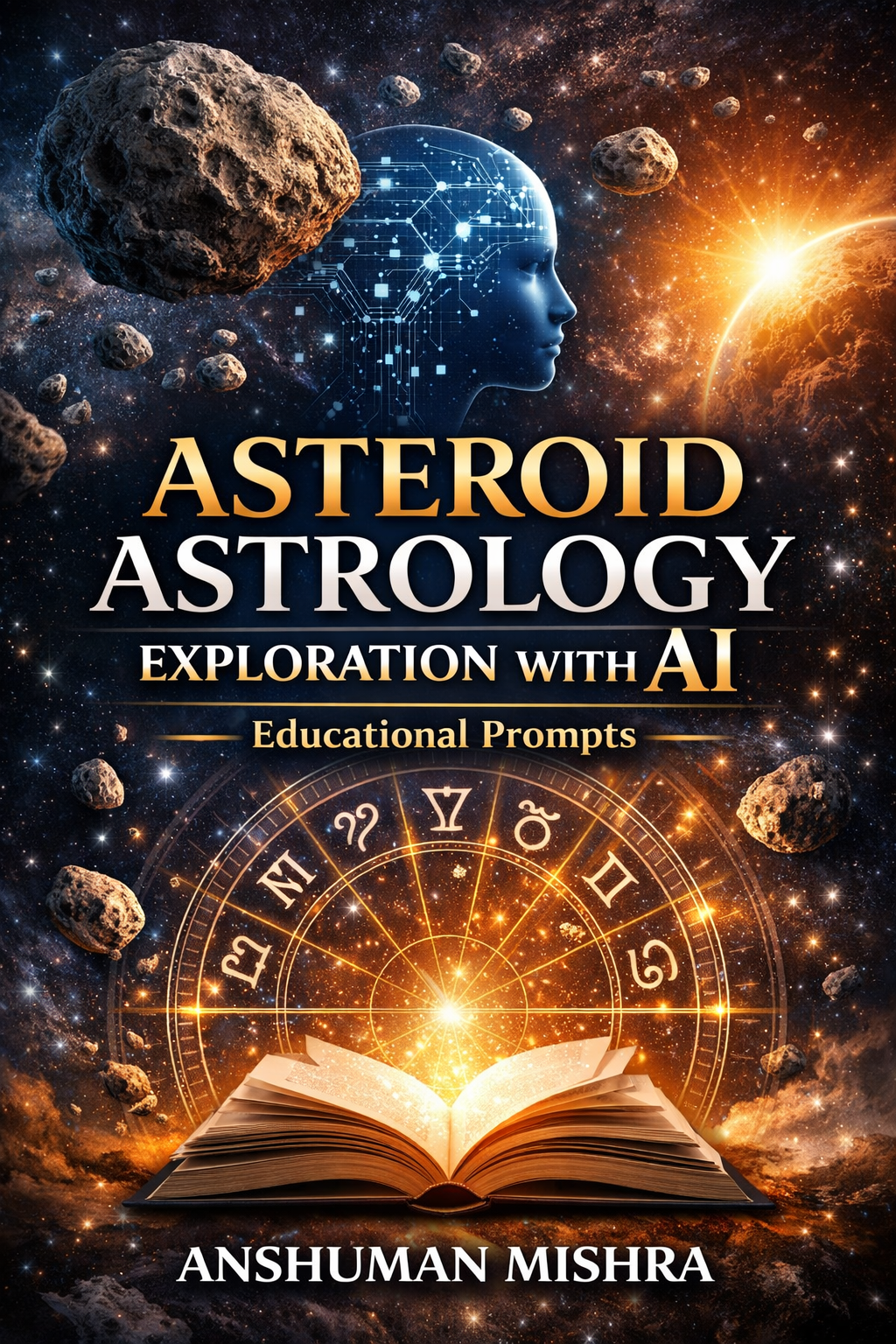
Asteroid Astrology Exploration with AI: Educational Prompts
Short Description
Asteroid Astrology Exploration with AI: Educational Prompts is a practical and ethical guide to understanding asteroid symbolism, birth-chart concepts, archetypes, and contextual interpretation with the support of Artificial Intelligence.
The book introduces learners to major asteroids such as Ceres, Pallas, Juno, Vesta, and Chiron, explains their mythological and symbolic backgrounds, and demonstrates how AI-based educational prompts can support structured learning and comparative analysis.
Designed for beginners, educators, researchers, and astrology enthusiasts, the book emphasizes critical thinking, contextual interpretation, responsible AI use, and non-deterministic learning rather than prediction or guaranteed outcomes.
Long Description
Explore Asteroid Astrology Through a Modern Educational Approach
Asteroid Astrology Exploration with AI: Educational Prompts presents a structured introduction to asteroid astrology while combining traditional symbolic study with modern Artificial Intelligence-based learning methods.
Astrology has been explored for centuries as a cultural and symbolic framework through which people have interpreted celestial patterns and associated meanings. Within modern astrology, asteroids have become an interesting area of study because of their diverse mythological associations and symbolic themes.
This book approaches asteroid astrology from an educational, cultural, symbolic, and analytical perspective. It does not present astrology as a scientifically validated predictive system. Instead, readers are encouraged to explore astrological symbolism thoughtfully while developing observation, comparison, interpretation, and critical-thinking skills.
What Will You Learn?
The book takes readers from foundational concepts to practical AI-assisted learning.
It begins by explaining:
- What astrology represents as a cultural system
- The difference between astronomy and astrology
- What asteroids are in astrological interpretation
- The historical discovery of asteroids
- The development of asteroid astrology
- Ethical considerations when studying symbolic systems
Readers then move into the foundations of asteroid astrology, including asteroid classification, mythology, symbolism, contextual interpretation, and the differences between asteroids and planets within astrological frameworks.
Understanding Major Asteroids
A central part of the book explores several well-known asteroids and symbolic archetypes.
Readers are introduced to:
- Ceres and themes associated with nurturing and care
- Pallas and symbolic patterns related to intelligence and strategy
- Juno and partnership-related symbolism
- Vesta and themes of focus and dedication
- Chiron as a symbolic archetype
Rather than assigning rigid meanings, the book encourages readers to examine these symbols within their broader context.
Birth Charts and Asteroid Study
Understanding asteroid symbolism requires familiarity with basic birth-chart concepts.
The book introduces:
- Zodiac signs
- Houses
- Planetary and astrological aspects
- Birth-chart structure
- Asteroid placements
- Contextual interpretation
The emphasis is on avoiding isolated conclusions. Readers learn to examine patterns within a larger framework instead of treating a single asteroid placement as having one fixed meaning.
AI as an Educational Learning Assistant
One of the distinctive features of this book is its integration of Artificial Intelligence into astrology education.
AI can assist learners by organizing information, generating alternative perspectives, comparing symbolic themes, and supporting structured analysis.
However, the book clearly establishes an important principle:
AI should be treated as a learning assistant, not as an unquestionable authority.
Readers are encouraged to evaluate AI-generated responses, identify possible errors, compare different interpretations, and maintain independent judgment.
Educational AI Prompts
The book provides a practical introduction to designing effective AI prompts for astrology-related learning.
Instead of using AI to generate deterministic predictions, readers learn how to create prompts that encourage exploration and analysis.
Examples of educational questions include:
- What symbolic themes are traditionally associated with a particular asteroid?
- How can two asteroids be compared from a mythological perspective?
- What different interpretations might be considered for an asteroid’s placement?
- How can zodiac signs and houses provide additional symbolic context?
- What assumptions or biases may exist in an AI-generated interpretation?
These approaches transform AI from a simple answer generator into a structured learning and brainstorming tool.
Beginner, Intermediate, and Advanced Prompt Learning
The book gradually develops prompting skills.
Beginners can start with simple questions about asteroid symbolism and mythology.
Intermediate learners can explore comparative analysis, chart context, and relationships between multiple symbolic elements.
Advanced learners can experiment with structured prompts that ask AI to provide alternative viewpoints, identify assumptions, compare interpretations, and organize observations.
This progression makes the book useful for readers with different levels of familiarity with both astrology and AI.
Contextual Interpretation
A major theme throughout the book is context.
Astrological symbolism is not treated as a collection of isolated definitions. Readers are encouraged to consider multiple factors and interpret symbols within the larger framework being studied.
The book explores how:
- Asteroids interact with zodiac symbolism
- Houses provide contextual dimensions
- Multiple asteroids can be studied together
- Mythological themes can influence symbolic interpretation
- Different cultural perspectives may produce different interpretations
This approach encourages balanced analysis instead of simplistic conclusions.
Symbolism, Mythology, and Archetypes
Asteroid astrology is closely connected with mythology and archetypal thinking.
The book explores how mythological narratives can influence symbolic associations and how readers can distinguish between symbolic meaning and literal claims.
It also recognizes that interpretations may vary across traditions and cultures.
Readers are therefore encouraged to ask:
What does this symbol represent within a particular interpretive framework?
rather than assuming that a symbolic association automatically predicts a real-world outcome.
Practical Learning Exercises
The book goes beyond theoretical discussion by providing practical learning exercises.
Readers can practice:
- Chart observation
- Symbol identification
- Pattern recognition
- AI prompt construction
- Comparative analysis
- Interpretation documentation
- Reflective learning
These activities are designed to develop independent analytical skills rather than produce predetermined answers.
Ethical and Responsible Study
Responsible learning is one of the most important principles of this book.
Astrological interpretations can sometimes be misunderstood when presented as absolute facts. Therefore, the book emphasizes:
- Avoiding deterministic thinking
- Respecting individual differences
- Avoiding exaggerated claims
- Maintaining a neutral perspective
- Evaluating AI-generated information critically
- Protecting academic integrity
- Using AI responsibly
The book encourages readers to distinguish between symbolic exploration and factual claims.
Common Mistakes to Avoid
Learners can easily become overwhelmed when studying large numbers of asteroids and symbolic associations.
The book identifies common mistakes such as:
- Overgeneralizing symbolic meanings
- Focusing on one asteroid while ignoring context
- Treating AI output as automatically correct
- Falling into confirmation bias
- Creating unnecessarily complicated interpretations
- Ignoring alternative perspectives
- Replacing personal reasoning with automated answers
Understanding these mistakes can help readers develop a more disciplined approach to learning.
Future of Astrology and AI
The final chapter considers how digital technology and Artificial Intelligence may influence the future study of astrology.
It explores possibilities such as:
- AI-assisted educational platforms
- Digital astrology learning
- Data organization and symbolic analysis
- AI-generated study exercises
- Interdisciplinary research
- Structured learning environments
At the same time, the book discusses important limitations and ethical questions surrounding the use of AI in symbolic and interpretive fields.
Who Is This Book For?
This book can be useful for:
- Beginners interested in asteroid astrology
- Astrology enthusiasts
- Students studying symbolic systems
- Educators exploring AI-assisted learning
- Researchers interested in interdisciplinary studies
- AI learners interested in prompt engineering
- Readers interested in mythology and archetypes
- Digital astrology learners
- Anyone interested in responsible exploration of astrology and AI
Key Features
- Beginner-friendly introduction to asteroid astrology
- Educational approach to astrological symbolism
- Coverage of major asteroids and archetypes
- Birth-chart fundamentals
- Context-based interpretation methods
- AI-assisted learning strategies
- Beginner to advanced educational prompts
- Practical learning exercises
- Critical-thinking techniques
- Ethical AI usage
- Discussion of common interpretation mistakes
- Future perspectives on AI and astrology
An Educational Guide, Not a Prediction Manual
Asteroid Astrology Exploration with AI: Educational Prompts is intentionally different from books that present astrology as a system of guaranteed predictions.
Its purpose is to encourage learning, exploration, reflection, comparison, and critical thinking.
AI is presented as a supportive educational technology, while human reasoning remains central to the learning process.
By combining the study of asteroid symbolism, mythology, birth-chart concepts, archetypes, and AI-based educational prompts, this book provides a contemporary framework for readers who want to explore astrology in a more structured and responsible manner.
Final Perspective
The intersection of astrology and Artificial Intelligence creates an interesting opportunity for educational experimentation. AI can help learners organize information, generate questions, compare perspectives, and explore symbolic concepts. However, responsible learning requires awareness of the limitations of both the technology and the interpretive framework.
This book therefore promotes a balanced philosophy:
Explore symbols. Ask better questions. Use AI thoughtfully. Evaluate information critically. Maintain independent judgment.
For readers interested in the intersection of Astrology, Asteroids, Mythology, Symbolism, AI, Prompt Engineering, and Educational Learning, this book offers a structured starting point for exploration.
Reviews
There are no reviews yet.