Description
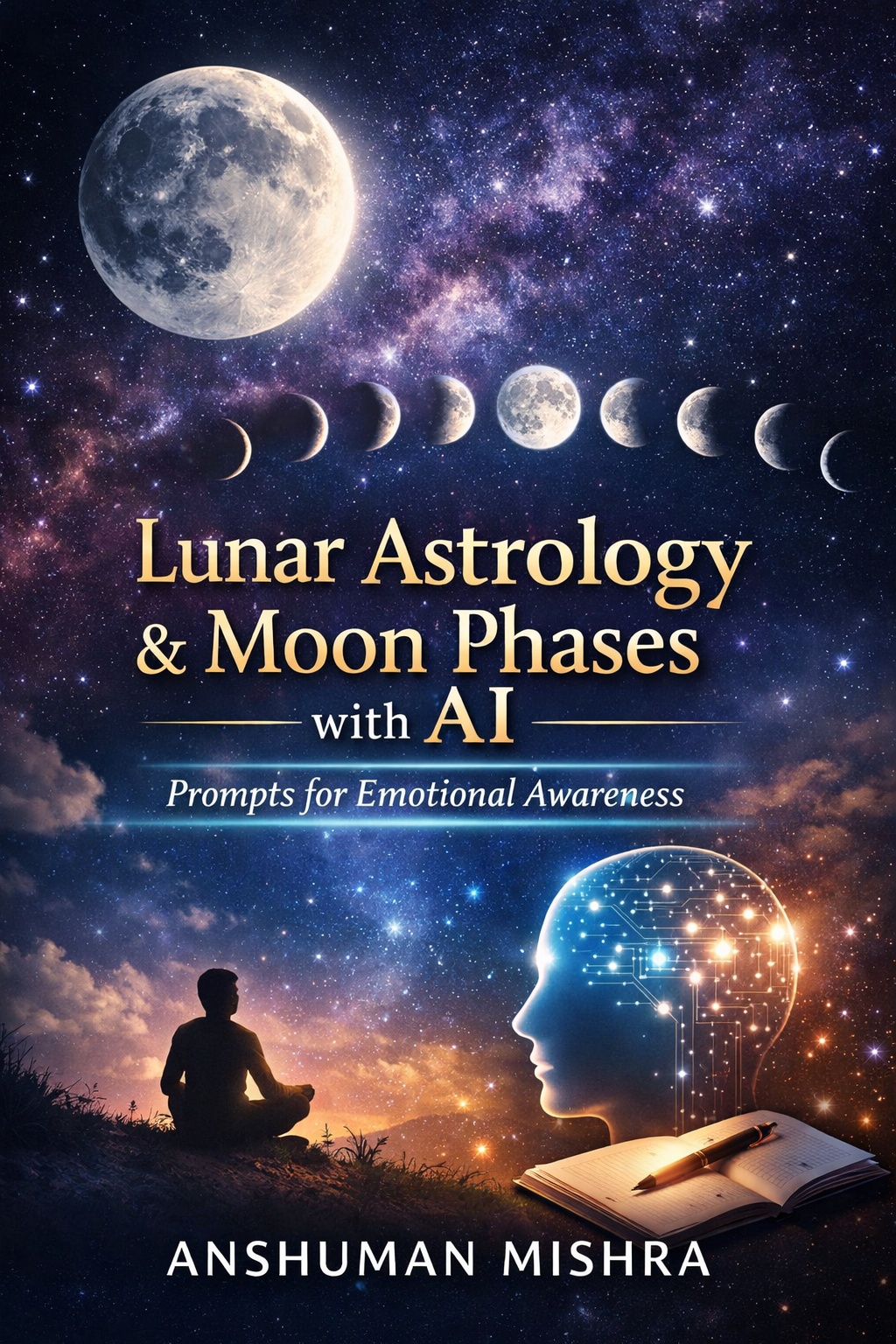
A Modern Educational Approach to Lunar Cycles, Reflection, and AI
The Moon has fascinated humanity for thousands of years. Its visible cycles have influenced calendars, cultural traditions, storytelling, observation, and symbolic systems across civilizations.
Lunar Astrology & Moon Phases with AI: Prompts for Emotional Awareness explores this fascinating subject through a modern, educational, and ethical perspective.
Rather than presenting astrology as a scientifically proven method for predicting events or controlling emotions, this book treats lunar astrology as a symbolic and reflective framework. Readers are encouraged to observe Moon phases, explore cultural symbolism, maintain journals, and use AI-generated prompts as tools for thoughtful self-reflection.
The book creates a bridge between traditional lunar symbolism, observational learning, emotional awareness, critical thinking, and modern Artificial Intelligence tools.
What Is the Purpose of This Book?
The central purpose of the book is not prediction. Instead, it is to encourage readers to develop a structured habit of observation and reflection.
The Moon’s natural cycle can provide a useful recurring framework for activities such as:
- Personal journaling
- Reflection
- Observation
- Goal review
- Emotional check-ins
- Mindfulness-oriented activities
- Self-assessment
- Learning and documentation
The book emphasizes that these practices should be understood as reflective exercises rather than evidence that Moon phases directly control human emotions or behavior.
Understanding Lunar Astrology
The opening chapters introduce the foundations of lunar astrology and explain how different cultures have interpreted the Moon throughout history.
Readers learn about:
- Lunar astrology
- Historical Moon observation
- Astronomy versus astrology
- Cultural Moon symbolism
- The Moon as a symbolic archetype
- Ethical approaches to studying astrology
This foundation helps readers understand the difference between what can be scientifically observed about the Moon and what belongs to symbolic or cultural interpretation.
Understanding the Moon Phases
A major section of the book explores the lunar cycle.
Readers are introduced to:
- New Moon — commonly used symbolically for beginnings and intention-setting
- Waxing phases — often associated symbolically with development and expansion
- Full Moon — commonly connected with illumination, completion, and awareness
- Waning phases — often interpreted symbolically through reflection and release
These meanings are presented as symbolic associations rather than scientific claims.
Readers are also encouraged to observe the actual Moon independently, creating an opportunity to combine astronomical observation with reflective learning.
Emotional Awareness and Reflection
The book carefully explores the relationship between symbolic lunar practices and emotional awareness.
Instead of claiming that Moon phases cause particular emotions, readers are encouraged to examine their own experiences through journaling and structured observation.
Topics include:
- Understanding emotions as natural human responses
- Recording personal observations
- Identifying recurring patterns carefully
- Avoiding overgeneralization
- Mindfulness-based reflection
- Non-judgmental observation
The objective is to encourage awareness without automatically assuming causation.
AI as a Reflection Assistant
Artificial Intelligence is one of the most distinctive elements of this book.
AI can help learners generate questions, organize journal entries, identify themes in their writing, and create structured reflection exercises.
However, the book establishes clear boundaries around AI use.
AI is presented as:
- A learning assistant
- A prompt generator
- A brainstorming partner
- A journaling support tool
- An organizational aid
AI is not presented as:
- A predictor of the future
- A psychological authority
- A decision-maker
- A substitute for professional support
- A source of scientifically established astrological conclusions
This balanced approach helps readers use AI more responsibly.
AI Prompts for Lunar Reflection
The book provides practical guidance for creating effective AI prompts.
Readers can learn how to formulate prompts for:
- New Moon reflection
- Full Moon review
- Daily emotional check-ins
- Weekly reflection
- Personal journaling
- Observation exercises
- Goal review
- Pattern documentation
For example, instead of asking an AI system to predict what will happen during a particular Moon phase, readers can use prompts that encourage questions such as:
What experiences have I noticed recently, and what questions could I explore through journaling?
This approach keeps AI focused on reflection and learning rather than prediction.
Moon Signs and Symbolic Meaning
The book also introduces Moon signs as part of astrological symbolism.
Readers explore:
- The concept of Moon signs
- Elements and symbolic emotional expression
- Symbolic versus literal interpretation
- Cultural differences
- Observation without assumptions
- Ethical boundaries
The purpose is to help readers understand how symbolic interpretations are constructed without treating them as universal facts.
Creating a Personal Lunar Journal
A practical lunar journal can become a valuable record of observations over time.
The book explains how readers can create a structured journal containing:
- Date
- Moon phase
- Observations
- Thoughts
- Feelings
- Activities
- Questions for reflection
- AI-generated prompts
- Personal notes
The emphasis is on recording observations objectively before interpreting them.
Readers are encouraged to look back over their journals and examine patterns carefully rather than selecting only the experiences that support an existing belief.
Understanding Cognitive Bias
One of the most valuable features of the book is its discussion of cognitive bias.
People naturally look for patterns and meaningful connections. This ability is useful, but it can also lead to inaccurate conclusions.
The book introduces concepts such as:
- Confirmation bias
- Selective thinking
- Pattern-seeking
- Overgeneralization
- The Barnum Effect
Understanding these concepts helps readers approach symbolic systems with greater intellectual discipline.
Practical Exercises
The book contains practical activities designed to transform concepts into learning experiences.
Exercises include:
- Observing the night sky
- Tracking Moon phases
- Recording personal observations
- Conducting emotional check-ins
- Reflecting without judgment
- Reviewing weekly experiences
- Creating AI-assisted reflection prompts
- Comparing observations over time
These exercises encourage readers to become active observers rather than passive consumers of interpretations.
Ethics, Privacy, and Responsible AI
Responsible use is a central theme throughout the book.
Readers are encouraged to consider:
- Privacy when entering personal information into AI tools
- Avoiding unnecessary sharing of sensitive information
- Avoiding deterministic claims
- Respecting individual differences
- Evaluating AI-generated content
- Avoiding emotional dependency on technology
- Maintaining independent judgment
The book promotes a simple principle:
Technology should support reflection, not control it.
Integrating Lunar Reflection into Daily Life
The book provides ideas for incorporating reflective practices into everyday routines.
Readers can create simple routines involving:
- Daily observation
- Weekly reflection
- Lunar-cycle journaling
- Goal review
- Personal learning notes
- Structured AI prompts
At the same time, the book warns against becoming overly dependent on any symbolic system.
The goal is to encourage balanced awareness rather than constant interpretation.
Scientific Perspective and Limitations
The final chapters provide an important scientific perspective.
The book distinguishes between:
Astronomy: the scientific study of celestial objects and phenomena.
Astrological symbolism: a cultural and interpretive framework involving symbolic associations with celestial bodies.
This distinction is essential for responsible learning.
The book does not claim that astrology has been scientifically validated as a predictive system. Instead, it encourages readers to maintain rational thinking while exploring symbolic traditions with curiosity.
Who Should Read This Book?
This book is suitable for:
- Beginners interested in lunar astrology
- Astrology enthusiasts seeking an ethical approach
- Students exploring symbolic systems
- Learners interested in AI-assisted reflection
- People interested in journaling
- Educators developing reflective learning activities
- Readers interested in Moon phases and cultural symbolism
- AI learners interested in prompt-based reflection
- Anyone curious about the intersection of technology and traditional symbolic systems
Key Features
- Practical introduction to lunar astrology
- Clear explanation of Moon phases
- Astronomy and astrology distinction
- Cultural perspectives on Moon symbolism
- Emotional-awareness framework
- AI-assisted journaling prompts
- New Moon and Full Moon reflection prompts
- Daily emotional check-in ideas
- Lunar journal structure
- Cognitive-bias awareness
- Practical observational exercises
- Ethical AI guidelines
- Privacy considerations
- Scientific perspective and limitations
- Critical-thinking approach
A Balanced Approach to Lunar Reflection
Lunar Astrology & Moon Phases with AI does not promise predictions, guaranteed outcomes, or supernatural explanations.
Instead, it provides readers with a structured way to explore lunar symbolism, observe natural Moon cycles, maintain reflective journals, and experiment with AI-assisted educational prompts.
The book’s approach can be summarized in four principles:
Observe. Reflect. Question. Think Critically.
By combining traditional symbolic exploration with modern AI tools and rational thinking, readers can develop a more thoughtful approach to lunar learning and personal reflection.
About the Author
Anshuman Mishra is an Assistant Professor in Computer Science with extensive teaching experience in programming, logical thinking, technology, and educational content development. His work focuses on creating structured, learner-friendly educational materials that connect technology with conceptual understanding.
Through this book, the author brings a technology-oriented and educational perspective to the exploration of lunar symbolism and AI-assisted reflective learning.
Final Perspective
The Moon continues to provide an extraordinary subject for both scientific observation and cultural interpretation. Its natural cycles can be studied astronomically while its symbolism can be explored through history, mythology, literature, and astrology.
Lunar Astrology & Moon Phases with AI: Prompts for Emotional Awareness brings these perspectives together in a balanced educational framework.
It encourages readers to explore symbolic ideas without abandoning critical thinking, and to use Artificial Intelligence without surrendering independent judgment.
For anyone interested in Moon phases, lunar symbolism, astrology, journaling, emotional awareness, AI prompts, and responsible self-reflection, this book offers a practical and contemporary starting point.

Reviews
There are no reviews yet.