Description
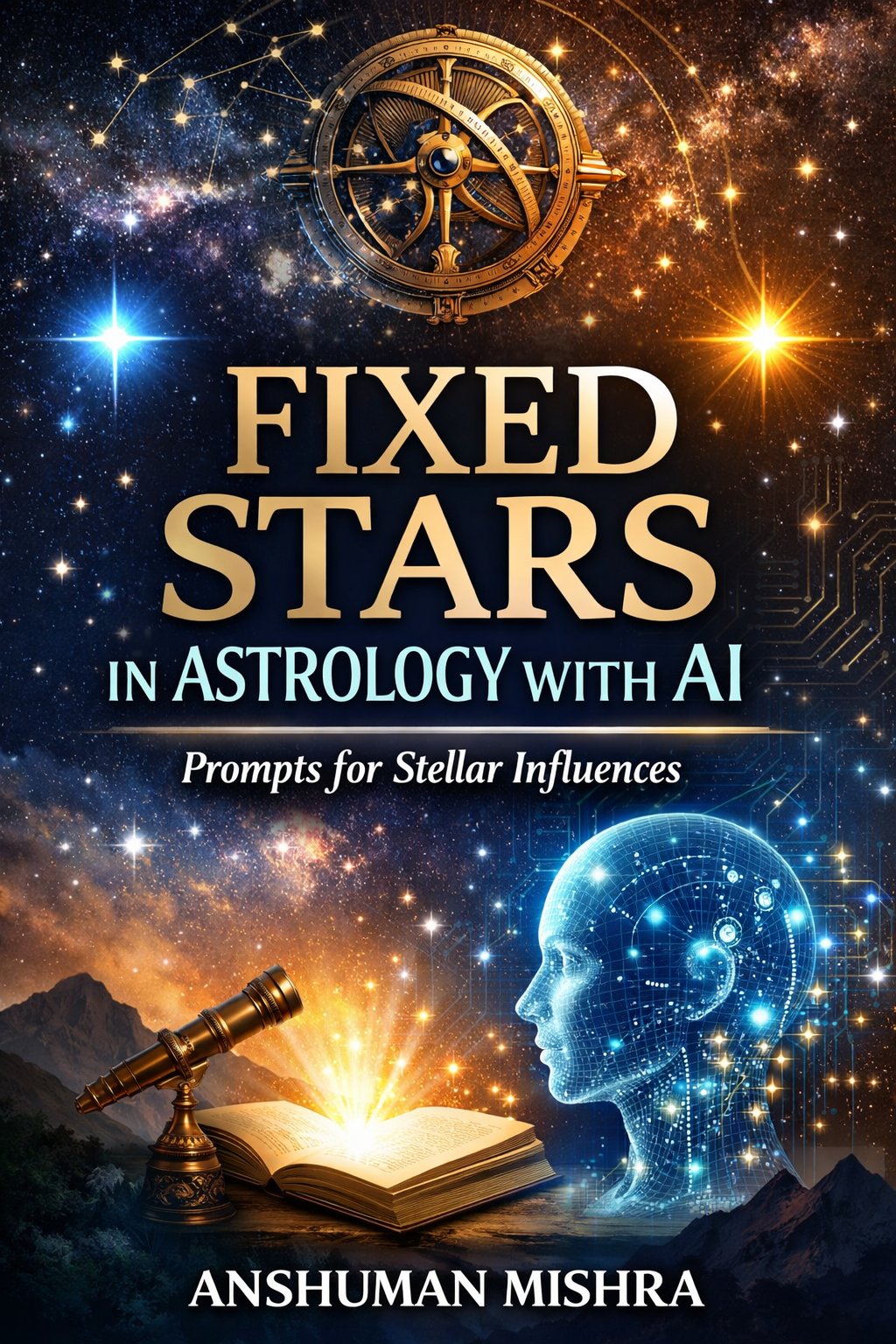
Fixed Stars in Astrology with AI: Prompts for Stellar Influences presents a structured and educational exploration of fixed stars and their place within astrological traditions.
Fixed stars have fascinated human civilizations for thousands of years. Ancient observers studied the night sky, identified recognizable star patterns, developed constellations, and connected celestial objects with mythology, cultural traditions, navigation, calendars, and symbolic systems.
This book examines the role of fixed stars in astrology from a historical, cultural, symbolic, and educational perspective.
It does not present astrology as a scientifically validated predictive system. Instead, readers are encouraged to understand astrology as a symbolic and cultural framework while developing analytical thinking and awareness of its limitations.
What Are Fixed Stars?
The book begins by explaining the concept of fixed stars and how they differ from planets within astrological traditions.
Readers explore:
- The meaning of fixed stars
- Historical observation of stars
- Difference between stars and planets
- Apparent stellar motion
- Constellations and star groupings
- Stellar magnitude and visibility
- Classification of notable stars
The term “fixed” is also placed into context, helping readers understand that it refers to their relatively stable appearance against the background of the zodiac in traditional observational frameworks rather than suggesting that stars are literally motionless.
Historical Development of Fixed-Star Astrology
Fixed stars have appeared in various historical traditions.
The book explores their development through:
- Babylonian traditions
- Greek thought
- Ptolemaic-era astrology
- Medieval interpretations
- Renaissance astrology
- Cross-cultural traditions
This historical perspective helps readers understand that symbolic meanings are not universal or static. They have evolved across periods, cultures, and interpretive schools.
Symbolism and Archetypal Meaning
A major focus of the book is the distinction between symbolic interpretation and literal prediction.
Readers learn how fixed stars may be associated with:
- Archetypal themes
- Mythological narratives
- Cultural symbolism
- Traditional qualities
- Interpretive frameworks
The book encourages readers to ask how a particular symbol developed historically instead of treating a symbolic association as a guaranteed real-world outcome.
Major Fixed Stars
The book introduces several well-known fixed stars and explores their traditional symbolic associations.
These include:
Sirius — explored through themes of brilliance and prominence.
Regulus — examined through traditional associations with leadership and authority.
Aldebaran — explored through themes such as integrity and strength.
Antares — examined through symbolic ideas involving intensity and transformation.
Spica — discussed in connection with creativity and balance.
Vega — explored through artistic and expressive symbolism.
These descriptions are presented as part of historical and symbolic study rather than as scientifically established influences.
Fixed Stars in Birth Charts
The book provides an educational introduction to studying fixed stars within birth-chart frameworks.
Readers explore:
- Natal-chart concepts
- Positioning of fixed stars
- Planetary conjunctions
- Orb concepts
- Interpretation frameworks
- Contextual analysis
- Ethical interpretation
The book emphasizes that interpretations should not be based on a single isolated factor. Readers are encouraged to consider broader context and recognize that different astrological traditions may use different methods.
AI as an Educational Assistant
One of the book’s distinctive features is its integration of Artificial Intelligence into astrology learning.
AI can assist learners by:
- Organizing historical information
- Comparing symbolic traditions
- Generating educational questions
- Structuring research notes
- Supporting comparative analysis
- Creating practice exercises
- Exploring alternative interpretations
However, AI is not treated as an unquestionable authority.
The book emphasizes that AI-generated content can contain errors, assumptions, omissions, or biases. Human judgment and critical evaluation therefore remain essential.
Learning to Design Better AI Prompts
A complete section of the book focuses on AI prompt design.
Readers learn how effective prompts can be structured using:
- Input
- Context
- Instructions
- Desired output
- Analytical criteria
Instead of asking an AI system for definitive predictions, readers are encouraged to create educational prompts such as:
- Explain the historical symbolism associated with a particular fixed star.
- Compare the traditional interpretations of two fixed stars.
- Identify differences between historical and modern interpretations.
- Explain the mythology associated with a specific star.
- Present multiple symbolic interpretations without treating any as certain.
- Analyze a hypothetical chart example from an educational perspective.
This approach transforms AI into a structured learning assistant.
Avoiding Leading and Biased Prompts
Prompt quality strongly affects AI-generated responses.
The book therefore explains how to avoid prompts that contain hidden assumptions or predetermined conclusions.
Readers learn to create prompts that:
- Encourage multiple perspectives
- Avoid confirmation bias
- Separate evidence from interpretation
- Request historical context
- Distinguish fact from symbolic association
- Encourage critical evaluation
This makes the book particularly relevant to readers interested in AI literacy and prompt engineering.
Educational Case Studies
The book includes hypothetical case studies designed for learning rather than prediction.
Readers can explore:
- Hypothetical birth charts
- Fixed-star placements
- Comparative star studies
- Multi-star symbolic analysis
- AI-assisted interpretation
- Critical evaluation of AI responses
The case studies are designed to demonstrate how to think about interpretations, not what conclusions readers must reach.
Scientific Perspective and Critical Thinking
A dedicated chapter examines the difference between scientific evidence and symbolic belief.
Readers are introduced to concepts such as:
- Scientific methodology
- Evidence versus belief
- Cognitive bias
- Confirmation bias
- Skepticism
- Analytical thinking
- Responsible learning
The book encourages readers to remain curious while also recognizing the limitations of astrological claims.
Ethical Astrology Practice
Ethics is integrated throughout the book.
The text emphasizes:
- Avoiding deterministic claims
- Respecting personal autonomy
- Avoiding fear-based interpretations
- Being transparent about AI assistance
- Avoiding misleading statements
- Maintaining educational integrity
Astrological interpretations should not be presented as unavoidable outcomes or used to pressure individuals into important life decisions.
Practical Exercises and Worksheets
The book is designed to be interactive as well as informative.
Readers can practice:
- Identifying fixed stars
- Mapping stars within chart frameworks
- Exploring symbolic meanings
- Writing AI prompts
- Comparing different interpretations
- Recording observations
- Evaluating AI responses
- Maintaining learning notes
These activities help transform theoretical knowledge into structured practice.
Future of Astrology and AI
The final chapters explore how Artificial Intelligence and digital technologies may influence astrology education and symbolic research.
Potential applications include:
- AI-assisted research
- Digital chart-learning systems
- Automated information organization
- Educational prompt systems
- Comparative symbolic analysis
- Interactive learning platforms
The book also addresses the ethical challenges that may accompany these developments.
The central principle remains:
Technology can assist learning, but it should not replace human judgment.
Who Should Read This Book?
This book is suitable for:
- Astrology beginners
- Astrology enthusiasts
- Students of symbolic systems
- Researchers interested in cultural traditions
- Educators
- AI and prompt-engineering learners
- Readers interested in mythology
- Learners studying astronomy and astrology distinctions
- Anyone curious about fixed stars and their historical symbolism
Key Features
- Structured introduction to fixed-star astrology
- Historical background across civilizations
- Explanation of stars and constellations
- Major fixed-star symbolism
- Sirius, Regulus, Aldebaran, Antares, Spica, and Vega
- Birth-chart learning framework
- AI-assisted symbolic analysis
- Educational AI prompts
- Prompt-writing techniques
- Hypothetical case studies
- Practical worksheets and exercises
- Cognitive-bias awareness
- Scientific perspective
- Ethical and responsible interpretation
- Future perspectives on AI and astrology
An Educational Guide Rather Than a Prediction Manual
Fixed Stars in Astrology with AI takes a deliberately balanced approach.
The book does not claim that fixed stars scientifically determine personality, events, success, relationships, or future outcomes. Instead, it explores how different cultures and astrological traditions have historically assigned symbolic meanings to celestial objects.
The integration of AI adds a contemporary learning dimension, allowing readers to investigate historical information, compare perspectives, organize observations, and practice structured prompting.
Final Perspective
The night sky has always inspired human curiosity. Fixed stars have played an important role in mythology, culture, astronomy, navigation, and traditional astrological systems.
This book invites readers to explore that history while maintaining a clear distinction between scientific observation and symbolic interpretation.
By combining historical knowledge, symbolic exploration, critical thinking, practical exercises, and AI-assisted learning, Fixed Stars in Astrology with AI: Prompts for Stellar Influences provides a modern educational framework for anyone interested in exploring this fascinating subject responsibly.

Reviews
There are no reviews yet.