Description
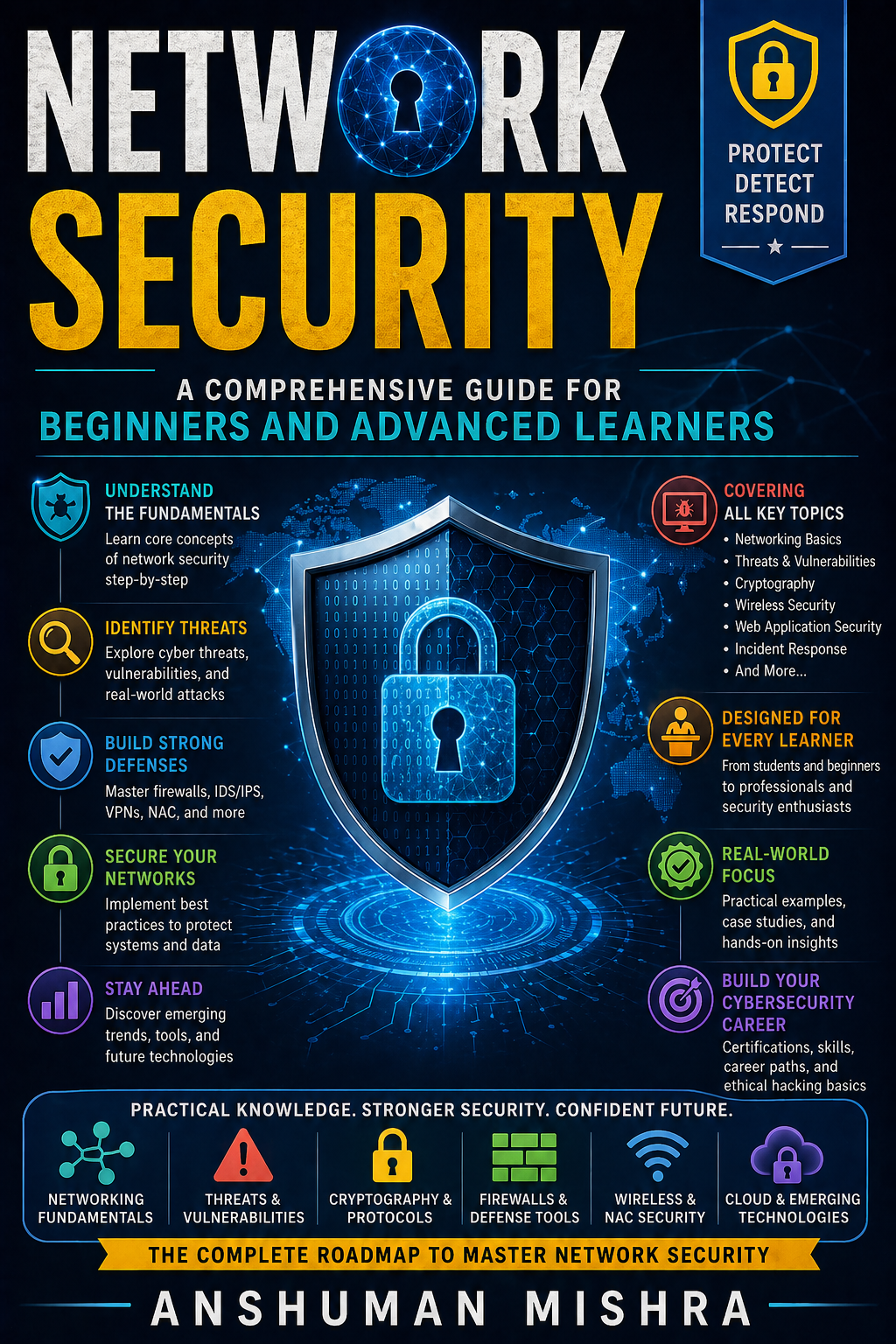
Network Security: A Comprehensive Guide for Beginners and Advanced Learners
From Networking Fundamentals to Modern Cybersecurity and Network Defense
In today’s connected world, network security has become an essential part of information technology, business operations, cloud computing, digital communication, and cybersecurity.
Network Security: A Comprehensive Guide for Beginners and Advanced Learners provides a systematic introduction to the principles, technologies, threats, tools, and practices used to protect modern computer networks.
The book is designed to help readers gradually develop their understanding—from basic networking concepts and protocols to advanced topics such as cryptography, firewalls, intrusion detection, Zero Trust Architecture, cloud security, IoT security, AI-driven security, and incident response.
It is particularly useful for undergraduate and postgraduate students, beginners entering cybersecurity, networking learners, IT professionals, and readers preparing to develop careers in network and information security.
What You Will Learn
The book begins with the foundations of network security, explaining what network security means, why it is important, and how different layers of security protect digital infrastructure.
Readers are introduced to essential networking concepts including:
- Computer networks and network topologies
- OSI and TCP/IP models
- Routers, switches, firewalls, and network devices
- IP addressing and subnetting
- TCP, UDP, HTTP, DNS, and other protocols
- Ports and network communication
The book then moves into the world of cyber threats and vulnerabilities, covering malware, phishing, social engineering, DoS and DDoS attacks, Man-in-the-Middle attacks, weak authentication, software vulnerabilities, and zero-day exploits.
Understanding Core Security Principles
A strong understanding of security principles is essential for designing reliable network defenses.
This book explains important concepts such as the:
CIA Triad – Confidentiality, Integrity, and Availability
along with:
- Authentication
- Authorization
- Accounting
- Defense in Depth
- Least Privilege
- Risk Management
- Security policies and controls
These principles provide the foundation for understanding how organizations design and manage secure information systems.
Cryptography and Secure Communication
The book introduces the fundamentals of cryptography and explains how encryption protects information during storage and communication.
Topics include:
- Symmetric and asymmetric encryption
- Key management
- SSL/TLS
- IPsec
- PGP
- Digital signatures
- Digital certificates
- Public Key Infrastructure (PKI)
These concepts help readers understand how secure communication is established across modern networks.
Firewalls and Network Defense
A dedicated section explores the technologies used to defend networks against unauthorized access and suspicious activity.
Readers learn about:
- Packet-filtering firewalls
- Stateful firewalls
- Proxy firewalls
- Firewall configuration principles
- Intrusion Detection Systems (IDS)
- Intrusion Prevention Systems (IPS)
- SIEM systems
- Virtual Private Networks (VPNs)
The book also introduces different VPN approaches, including site-to-site and remote-access VPN concepts.
Wireless and Network Access Security
Wireless networks introduce unique security challenges. The book explains common wireless threats and security mechanisms, including:
- Rogue access points
- Eavesdropping and interception
- WEP, WPA, WPA2, and WPA3
- Secure Wi-Fi configuration
- Strong authentication and password practices
The book also covers Network Access Control (NAC), including port-based access control, 802.1X authentication, endpoint security, and compliance enforcement.
Web Application and Service Security
Because modern organizations rely heavily on web applications, securing web services is an important part of network security.
The book introduces common web application vulnerabilities such as:
- SQL Injection
- Cross-Site Scripting (XSS)
- Cross-Site Request Forgery (CSRF)
- Web server security
- Database security
- Web Application Firewalls (WAF)
- HTTPS
- Secure communication
- Secure Software Development Lifecycle (SDLC)
These topics help readers understand security from both infrastructure and application perspectives.
Incident Response and Recovery
No security system can guarantee that incidents will never occur. Therefore, organizations need effective processes for detecting, responding to, and recovering from security incidents.
This book introduces the major stages of incident response:
Preparation → Detection → Containment → Eradication → Recovery
It also covers:
- Network security incident analysis
- Digital forensics concepts
- Evidence collection
- Disaster recovery
- Business continuity
- Post-incident analysis
- Lessons learned
Modern and Emerging Security Technologies
The cybersecurity landscape continues to evolve rapidly. The book therefore introduces several emerging areas, including:
- Next-Generation Firewalls
- Zero Trust Architecture
- Artificial Intelligence and Machine Learning in network security
- Cloud security
- Public, private, and hybrid cloud environments
- Internet of Things (IoT) security
These topics provide readers with a foundation for understanding the changing requirements of modern digital infrastructure.
Building a Career in Network Security
The final chapters also focus on career development in network security.
Readers are introduced to:
- Essential cybersecurity and networking skills
- Professional certification pathways
- Ethical hacking and penetration testing concepts
- Real-world security challenges
- Network security job roles
- Career opportunities in cybersecurity
The book also discusses important professional certifications and learning pathways, including certifications associated with networking and information security.
Network Security Best Practices
The book concludes with practical security management concepts such as:
- Developing network security policies
- Employee security awareness
- Security training
- Security audits
- Vulnerability assessments
- Patch management
- Secure configuration management
Additional appendices provide an overview of commonly used network security tools and resources, along with a useful glossary of network security terminology and acronyms.
Key Features of the Book
✔ Beginner-friendly introduction to network security
✔ Suitable for undergraduate and postgraduate students
✔ Covers both foundational and advanced concepts
✔ Explains networking concepts before moving into security topics
✔ Covers modern cybersecurity threats and vulnerabilities
✔ Includes cryptography, firewalls, IDS, IPS, SIEM, VPN, and NAC
✔ Introduces web application and wireless security
✔ Covers incident response and disaster recovery
✔ Explores Zero Trust, AI, cloud, and IoT security
✔ Includes career guidance for aspiring security professionals
✔ Includes security tools, resources, and terminology
Who Should Read This Book?
This book is suitable for:
- Undergraduate Computer Science students
- Postgraduate Computer Science and IT students
- Cybersecurity students
- Networking students
- Beginners learning network security
- IT and networking professionals
- Aspiring cybersecurity professionals
- Security administrators and learners
- Candidates preparing for security-related certifications
- Anyone interested in understanding how modern networks are protected
A Complete Learning Journey
Network Security: A Comprehensive Guide for Beginners and Advanced Learners is designed as a progressive learning resource. It starts with networking fundamentals, builds a strong foundation in security principles, explores defensive technologies and common threats, and finally introduces modern cybersecurity architectures and career pathways.
Whether you are beginning your journey in cybersecurity or looking to strengthen your existing networking knowledge, this book provides a structured pathway toward understanding the principles, technologies, practices, and future directions of network security.





Reviews
There are no reviews yet.