Description
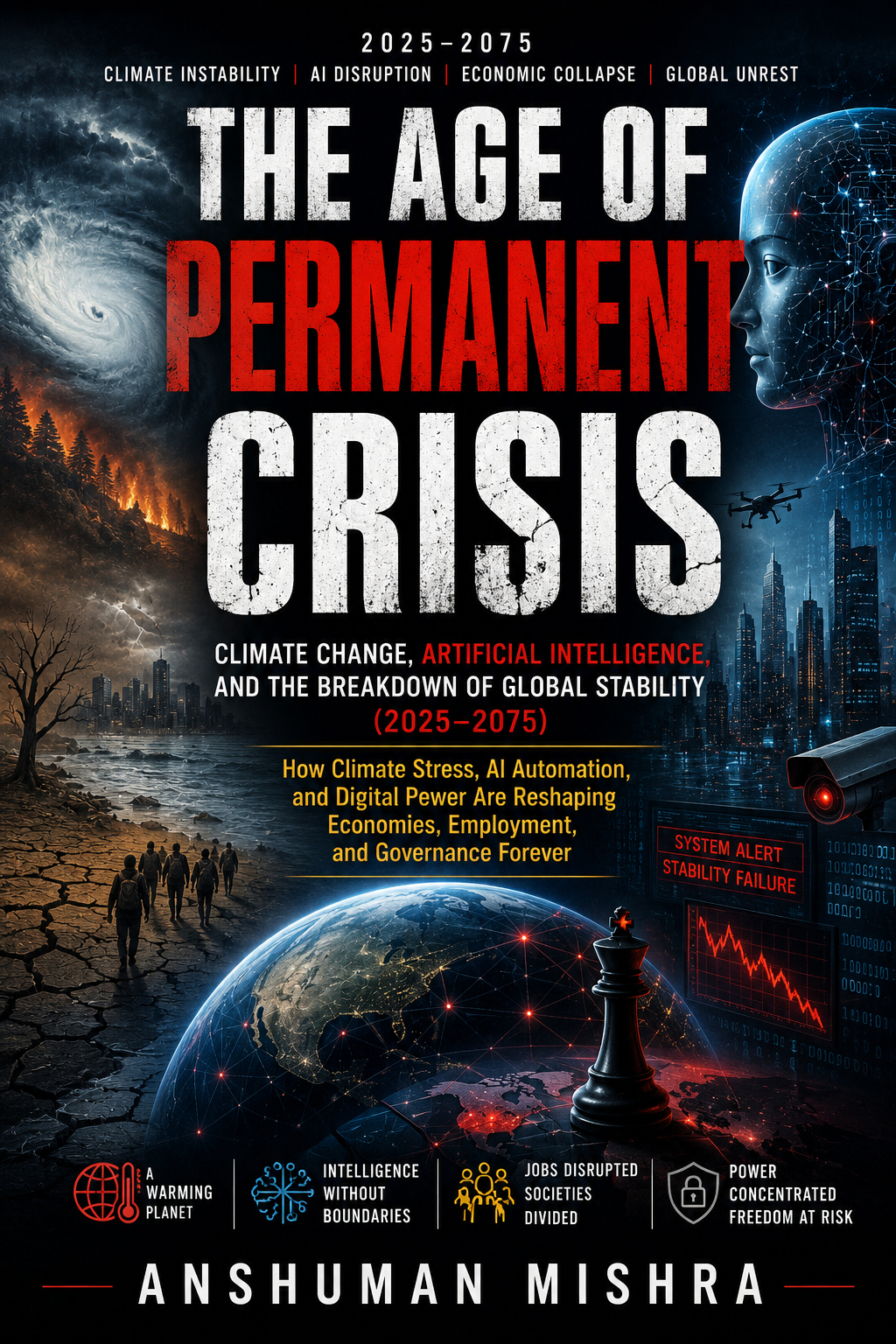
The Age of Permanent Crisis: Climate Change, Artificial Intelligence, and the Breakdown of Global Stability (2025–2075)
How Climate Stress, AI Automation, and Digital Power Are Reshaping Economies, Employment, and Governance Forever
Author: Anshuman Mishra
The twenty-first century is redefining the very meaning of stability. The expectation that societies recover from crises and eventually return to normal has become increasingly difficult to sustain. Climate emergencies, technological disruption, cyber warfare, geopolitical rivalry, economic fragmentation, and institutional fatigue are no longer isolated events—they are interconnected forces creating a world where uncertainty has become permanent.
The Age of Permanent Crisis presents a comprehensive and interdisciplinary analysis of this historic transformation. Drawing upon political science, economics, international relations, environmental studies, technology policy, cybersecurity, governance, and strategic studies, this book argues that humanity has entered an era in which crises reinforce one another, creating a continuous cycle of disruption that reshapes every aspect of modern civilization.
Rather than viewing climate change, artificial intelligence, digital surveillance, automation, resource competition, and geopolitical conflict as separate challenges, the book demonstrates how they interact to produce systemic instability that will define the global landscape between 2025 and 2075.
Beyond the Myth of Recovery
For much of modern history, governments, businesses, and international institutions operated under the assumption that crises were temporary interruptions to an otherwise stable global order.
This book challenges that assumption.
Instead of moving from crisis to recovery, societies increasingly move from one disruption to another, often before previous shocks have been fully resolved. Financial instability, climate disasters, pandemics, cyberattacks, technological disruption, migration pressures, and geopolitical competition combine to create a permanent condition of uncertainty.
Readers will explore:
- Why global equilibrium is becoming increasingly elusive
- How institutional capacity is weakening under continuous pressure
- Why traditional governance models struggle to manage persistent crises
- The emergence of crisis as the new normal
- The transformation of international politics in an age of constant disruption
Climate Change as a Driver of Global Power
Climate change is no longer simply an environmental issue.
It has become one of the defining geopolitical and economic forces of the twenty-first century.
This book examines how rising temperatures, changing weather patterns, water scarcity, food insecurity, biodiversity loss, and climate-related migration reshape international relations, national security, and global development.
Major themes include:
- Climate geopolitics
- Resource competition
- Water security
- Food systems
- Climate migration
- Border pressures
- Environmental inequality
- Energy transitions
- Climate diplomacy
- Ecological resilience
Rather than treating climate as a standalone environmental challenge, the book analyzes its far-reaching consequences for political stability, economic growth, and international cooperation.
Artificial Intelligence and the New Architecture of Power
Artificial Intelligence is rapidly becoming one of the most influential infrastructures of modern civilization.
Beyond improving productivity, AI is transforming economic competitiveness, military capability, public administration, financial systems, scientific research, and political decision-making.
The book explores:
- AI governance
- Algorithmic power
- Data sovereignty
- Computing infrastructure
- Digital monopolies
- AI competition
- Technological inequality
- Automation
- Responsible AI
- Strategic technology policy
Readers gain a balanced understanding of AI’s transformative potential while examining the risks associated with concentrated technological power and unequal access to advanced computing capabilities.
Automation, Employment, and Economic Transformation
One of the defining challenges of the coming decades will be the relationship between automation and work.
The book investigates how AI-driven technologies are reshaping labor markets across manufacturing, services, finance, healthcare, education, transportation, and creative industries.
Topics include:
- Job transformation
- Workforce adaptation
- Productivity
- Skills development
- Platform economies
- Digital labor
- Income inequality
- Middle-class change
- Workforce resilience
- Economic inclusion
The discussion emphasizes that technological progress creates both opportunities and challenges, making education, lifelong learning, and adaptive policy increasingly important.
Digital Surveillance and Cybersecurity
As governments and organizations rely more heavily on digital infrastructure, cybersecurity, data governance, and digital rights become central public policy concerns.
Readers will examine:
- Digital governance
- Privacy
- Cyber resilience
- Infrastructure security
- Election security
- Information integrity
- AI-assisted public administration
- Digital regulation
- Responsible data use
- Institutional accountability
The book also explores how cyber conflict increasingly affects critical infrastructure, financial systems, public services, and international security without following the patterns of conventional warfare.
Fragmented Globalization and Geopolitical Competition
Globalization is evolving rather than disappearing.
Supply chains, trade relationships, technology ecosystems, and international alliances are adapting to changing geopolitical realities.
This book analyzes:
- Supply chain resilience
- Economic nationalism
- Technology competition
- Digital sovereignty
- Industrial policy
- Green transitions
- Trade diversification
- Strategic industries
- International cooperation
- Global economic governance
Readers gain insight into how nations balance economic integration with national resilience in an increasingly complex global environment.
Governance in an Era of Continuous Disruption
Modern institutions were largely designed for relatively stable environments.
Persistent crises require new approaches to governance that emphasize adaptability, preparedness, institutional learning, and long-term resilience.
Key themes include:
- Crisis governance
- Public administration
- Policy innovation
- Institutional resilience
- Adaptive leadership
- Democratic accountability
- Strategic planning
- Emergency management
- Public trust
- Governance reform
The book encourages readers to think critically about how societies can strengthen institutions while preserving democratic values and individual freedoms.
Society, Inequality, and Human Well-Being
Technological and environmental transitions affect people differently across regions, occupations, and generations.
The book discusses:
- Social resilience
- Economic inequality
- Climate vulnerability
- Digital inclusion
- Public health
- Education
- Youth opportunities
- Community cohesion
- Information literacy
- Human security
Rather than presenting deterministic predictions, it examines multiple possible pathways and highlights the importance of inclusive policies that strengthen long-term social stability.
Adaptive States and Resilient Futures
One of the central questions explored throughout the book is why some societies successfully adapt to rapid change while others struggle.
Readers will discover:
- Characteristics of adaptive governance
- Institutional flexibility
- Policy learning
- Long-term planning
- Innovation ecosystems
- Disaster preparedness
- Sustainable development
- Resilience strategies
- Ethical technology governance
- Future-oriented public policy
The final chapters argue that resilience, cooperation, innovation, and responsible governance will be among the most important capabilities for navigating the decades ahead.
Key Topics Covered
- Climate Change
- Artificial Intelligence
- Automation
- Digital Transformation
- Cybersecurity
- Geopolitics
- Global Governance
- Resource Security
- Climate Migration
- Economic Transformation
- Employment Futures
- AI Ethics
- Digital Surveillance
- Supply Chains
- Sustainability
- Democracy
- Public Policy
- International Relations
- Strategic Studies
- Future Scenarios
Ideal For
This book is written for:
- Undergraduate Students
- Postgraduate Students
- Researchers
- Academicians
- Policy Analysts
- Government Officials
- Business Leaders
- Technology Professionals
- Economists
- Environmental Researchers
- International Relations Scholars
- Strategic Studies Experts
- Corporate Decision Makers
- Competitive Examination Aspirants
- General Readers Interested in Global Affairs
Why Read This Book?
Unlike books that examine climate change, artificial intelligence, or geopolitics in isolation, The Age of Permanent Crisis presents an integrated framework for understanding how these powerful forces interact to reshape the global order. It combines historical perspective, contemporary analysis, and forward-looking scenarios while avoiding simplistic conclusions or technological determinism.
Whether you are seeking to understand the future of work, global governance, cybersecurity, climate resilience, economic transformation, or international security, this book provides a rigorous yet accessible guide to one of the defining challenges of our time.
As governments, businesses, and societies navigate an increasingly uncertain future, The Age of Permanent Crisis offers readers the analytical tools needed to understand a world where adaptation, resilience, and informed decision-making become the foundations of long-term stability.


Reviews
There are no reviews yet.