Description
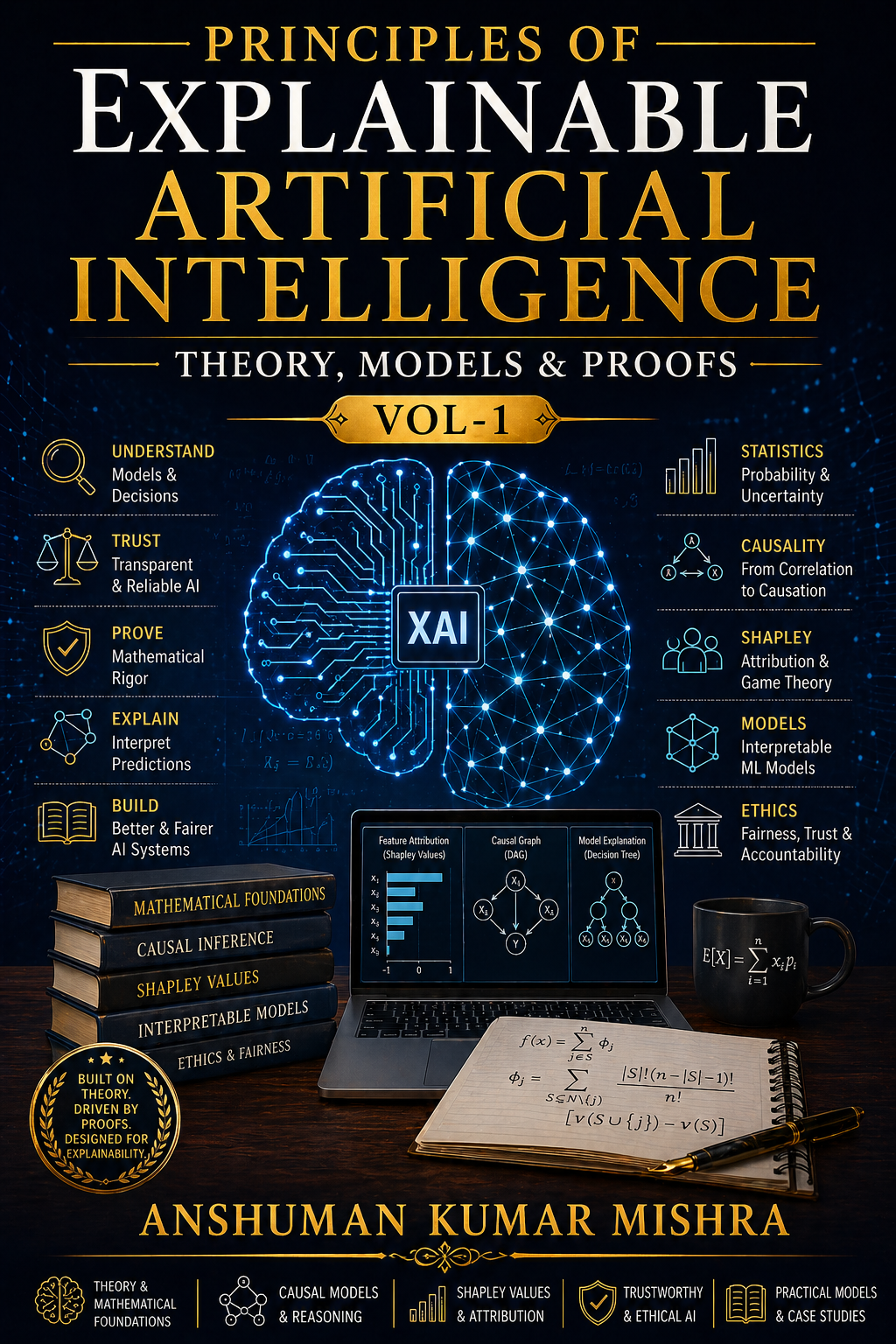
Principles of Explainable Artificial Intelligence
Theory, Models & Proofs (Vol. 1)
Artificial Intelligence is transforming every sector of society, from healthcare and finance to autonomous systems and scientific discovery. However, as AI models become increasingly powerful, they also become more complex and less interpretable. Understanding why an AI model makes a particular decision has become one of the most important challenges in modern Artificial Intelligence.
Principles of Explainable Artificial Intelligence: Theory, Models & Proofs (Vol. 1) provides a comprehensive mathematical and practical introduction to Explainable Artificial Intelligence (XAI). The book bridges mathematics, statistics, optimization, causal inference, game theory, and machine learning to develop transparent, interpretable, and trustworthy AI systems.
Beginning with the fundamental concepts of explainability, transparency, interpretability, and fairness, the book introduces the mathematical foundations required to understand explainable machine learning, including linear algebra, probability theory, optimization, statistics, causal reasoning, and feature attribution.
Readers then explore advanced topics such as Structural Causal Models (SCMs), Directed Acyclic Graphs (DAGs), Pearl’s Do-Calculus, Shapley Values, SHAP algorithms, feature importance, statistical explainability, and game-theoretic interpretation, supported by mathematical derivations, proofs, and real-world examples.
Designed for undergraduate and postgraduate students, researchers, educators, AI professionals, and industry practitioners, this book combines theoretical rigor with practical AI applications to help build transparent, ethical, and reliable intelligent systems.
What You’ll Learn
✔ Explainable Artificial Intelligence (XAI)
✔ AI Transparency
✔ Model Interpretability
✔ Black-Box vs White-Box Models
✔ Local and Global Explanations
✔ Trustworthy AI
✔ Responsible AI
✔ Mathematical Foundations for XAI
✔ Set Theory
✔ Linear Algebra
✔ Vector Spaces
✔ Probability Theory
✔ Random Variables
✔ Statistical Expectations
✔ Variance Analysis
✔ Optimization Theory
✔ Gradient-Based Methods
✔ Distance Metrics
✔ Statistical Explainability
✔ Bias-Variance Tradeoff
✔ Feature Interaction Analysis
✔ Correlation and Covariance
✔ Uncertainty Quantification
✔ Hypothesis Testing
✔ Interpretable Statistical Models
✔ Linear Regression Interpretation
✔ Logistic Regression Interpretation
✔ Bayesian Explainability
✔ Regularization Techniques
✔ Causal Inference
✔ Correlation vs Causation
✔ Structural Causal Models (SCM)
✔ Directed Acyclic Graphs (DAGs)
✔ Pearl’s Causal Hierarchy
✔ Do-Calculus
✔ Backdoor Criterion
✔ Frontdoor Criterion
✔ Instrumental Variables
✔ Causal Discovery
✔ PC Algorithm
✔ FCI Algorithm
✔ GES Algorithm
✔ Granger Causality
✔ Causal Feature Selection
✔ Cooperative Game Theory
✔ Shapley Values
✔ Feature Attribution
✔ SHAP Framework
✔ Kernel SHAP
✔ Tree SHAP
✔ Deep SHAP
✔ Gradient SHAP
✔ Explainable Machine Learning
Table of Contents
Part I – Foundations of Explainable Artificial Intelligence
Chapter 1
Introduction to Explainable Artificial Intelligence
Chapter 2
Mathematical Preliminaries
Part II – Statistical Foundations of Explainability
Chapter 3
Statistical Explainability
Chapter 4
Interpretable Statistical Models
Part III – Causality and Transparent Decision Systems
Chapter 5
Introduction to Causality
Chapter 6
Pearl’s Causal Framework
Chapter 7
Causal Discovery & Learning
Part IV – Mathematical Attribution & Shapley Values
Chapter 8
Game Theory Foundations
Chapter 9
Shapley Values — Theory & Properties
Chapter 10
SHAP Framework and Extensions
Who Should Read This Book?
This book is ideal for:
- B.Tech Students
- BCA Students
- MCA Students
- M.Tech Students
- Artificial Intelligence Students
- Machine Learning Engineers
- Data Scientists
- Deep Learning Researchers
- Explainable AI Researchers
- Computer Science Students
- Statistics Students
- Applied Mathematics Students
- AI Engineers
- Software Engineers
- Research Scholars
- University Faculty
- Business Analytics Professionals
- Healthcare AI Researchers
- Responsible AI Practitioners
- Competitive Examination Aspirants
Key Features
✅ Comprehensive introduction to Explainable Artificial Intelligence
✅ Mathematical foundations with detailed proofs
✅ Statistical and causal approaches to explainability
✅ SHAP and Shapley Value theory explained step by step
✅ Game Theory integrated with Machine Learning
✅ Causal inference and transparent decision-making
✅ Research-oriented and industry-relevant content
✅ Real-world case studies and practical AI applications
✅ University syllabus aligned
✅ Suitable for self-learning, research, graduate studies, and professional development
Why This Book?
Modern Artificial Intelligence systems increasingly influence critical decisions in healthcare, finance, autonomous vehicles, cybersecurity, and public policy. As these systems become more complex, transparency and interpretability become essential for building trustworthy AI.
Unlike traditional machine learning textbooks that focus primarily on predictive performance, Principles of Explainable Artificial Intelligence emphasizes understanding why AI models make decisions. By integrating mathematics, statistics, causal inference, optimization, and game theory, this book provides readers with a rigorous framework for designing transparent, interpretable, and responsible AI systems.
Whether you are conducting AI research, developing explainable machine learning models, or studying trustworthy Artificial Intelligence, this book offers both theoretical depth and practical guidance for mastering modern Explainable AI.
Book Details
Title: Principles of Explainable Artificial Intelligence
Subtitle: Theory, Models & Proofs
Volume: Vol. 1
Author: Anshuman Mishra
Publisher: Anshuman Mishra
Publication Year: 2025
Language: English
Category: Artificial Intelligence, Explainable AI, Machine Learning, Data Science, Statistics, Computer Science





Reviews
There are no reviews yet.