Description
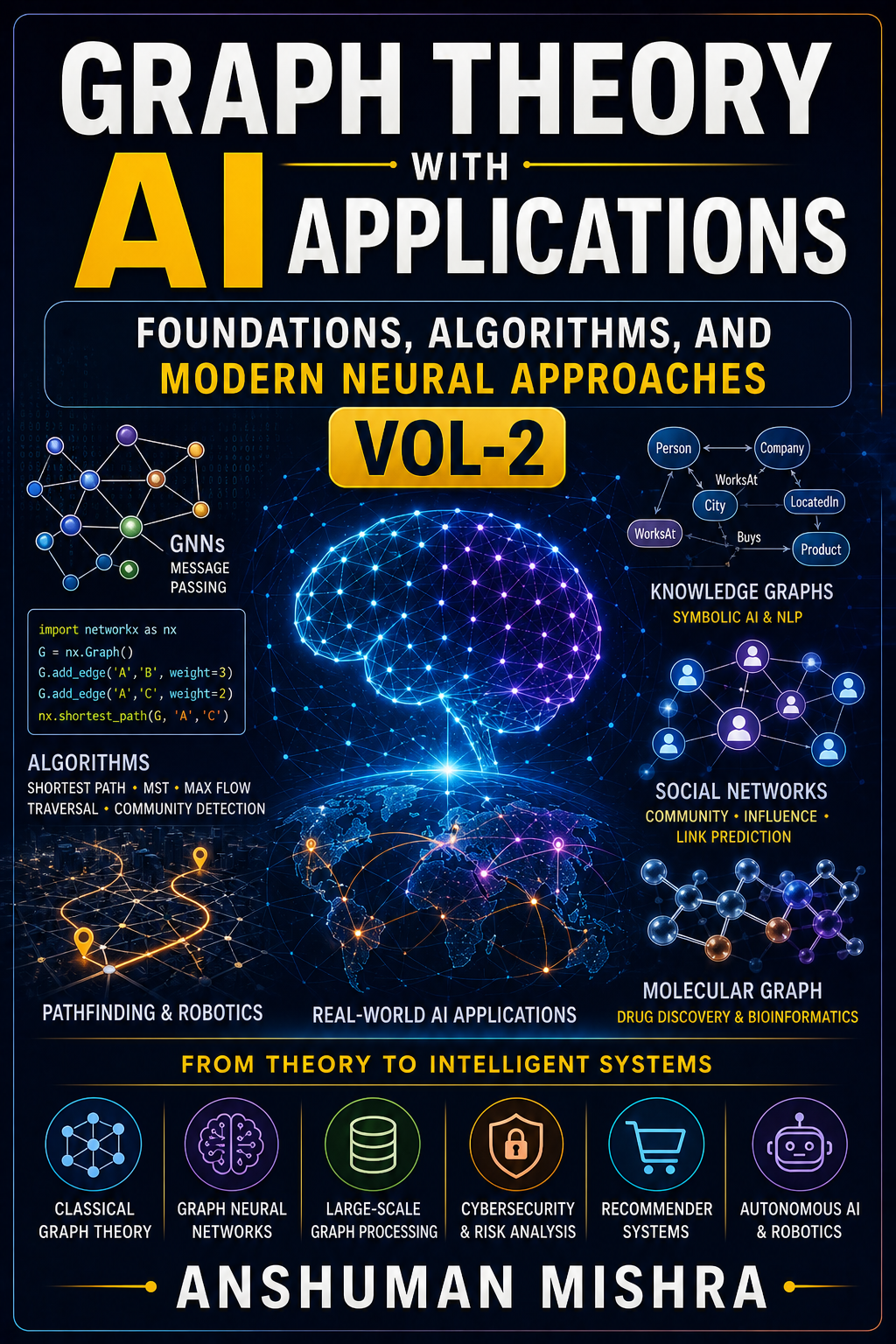
Graph Theory with AI Applications: Foundations, Algorithms, and Modern Neural Approaches – VOL-2 takes the foundations of classical Graph Theory developed in Volume-1 into the advanced world of Graph Neural Networks (GNNs), Graph Machine Learning, Graph Representation Learning, Graph Embeddings, and modern AI applications.
Graphs provide a natural way to represent relationships, interactions, dependencies, and complex structures. Social networks, transportation systems, financial transactions, molecular structures, knowledge bases, communication networks, recommendation systems, and cybersecurity environments can all be modeled using graphs.
Traditional Machine Learning methods often assume that data can be represented in regular Euclidean structures such as tables, vectors, or grids. Graph data is fundamentally different because relationships between entities are an essential part of the information. Graph Neural Networks provide powerful mechanisms for learning directly from these structured relationships.
This volume provides a bridge between classical Graph Theory and modern neural approaches to graph learning.
What You Will Learn
The book covers a broad range of topics, including:
- Machine Learning on Graphs
- Graph Representation Learning
- Node Classification
- Link Prediction
- Graph Classification
- Message Passing Neural Networks
- Graph Convolutional Networks
- Graph Attention Networks
- GraphSAGE
- GNN Training
- GNN Loss Functions
- Optimization and Regularization
- Spatial and Spectral GNNs
- Recurrent GNNs
- Relational GNNs
- Temporal GNNs
- Large-Scale GNNs
- Graph Embeddings
- DeepWalk
- Node2Vec
- LINE
- Graph Autoencoders
- Contrastive Graph Learning
- GNNs for Social Networks
- Bot and Spam Detection
- Influence Maximization
- Fake News Prediction
- GNN Recommendation Systems
- User-Item Graphs
- Graph-Based Collaborative Filtering
- Session-Based Recommendation
- Graphs in NLP
- Semantic Networks
- Knowledge Graphs
- Graph-Based Question Answering
- Graphs in Computer Vision
- Scene Graphs
- Graph-Based Object Detection
- Robotics and Autonomous Vehicles
- Multi-Robot Coordination
- Graph-Based Cybersecurity
- Attack Graphs
- Intrusion Detection
- Malware Propagation Models
- Graph-Based Risk Assessment
- Distributed Graph Processing
- Graph Partitioning
- Parallel Graph Algorithms
- Graph Databases
- Distributed GNN Training
- Explainable GNNs
- GNNExplainer
- Graph AI Fairness
- Privacy-Preserving GNNs
- Hypergraphs
- Higher-Order Networks
- Neuro-Symbolic Graph Reasoning
- Quantum Graph Neural Networks
- Graph Foundation Models
PART IV – INTRODUCTION TO GRAPH NEURAL NETWORKS
Chapter 13: Machine Learning on Graphs
This chapter introduces the transition from traditional Machine Learning to graph-based learning.
It explains why conventional machine learning approaches may not adequately capture the relational structure of graph data and introduces the foundations of Graph Representation Learning.
Major topics include:
- Why Traditional ML Struggles with Graph Data
- Graph Representation Learning
- Node Classification
- Link Prediction
- Graph Classification
The chapter establishes the conceptual foundation required for understanding Graph Neural Networks.
Chapter 14: Foundations of GNNs
Graph Neural Networks provide a neural framework for learning representations from graph structures.
This chapter introduces important GNN architectures and concepts:
- Message Passing Neural Networks
- Graph Convolutional Networks
- Graph Attention Networks
- GraphSAGE
- GNN Training
- Loss Functions
- Optimization
- Regularization
Readers learn how information can propagate between connected nodes and how neural models can generate meaningful graph representations.
Chapter 15: GNN Architectures and Variants
Different graph problems require different neural architectures. This chapter examines major variations of GNN models.
Topics include:
- Spatial GNNs
- Spectral GNNs
- Recurrent GNNs
- Relational GNNs
- Temporal GNNs
- GNNs for Dynamic Graphs
- Large-Scale GNNs
- Industrial Applications
The chapter introduces the challenges involved in applying graph learning to dynamic and large-scale networks.
Chapter 16: Graph Embeddings & Representation Learning
Graph embeddings transform graph structures into numerical representations that can be processed by machine learning algorithms.
This chapter covers:
- DeepWalk
- Node2Vec
- LINE
- Graph Autoencoders
- Contrastive Graph Learning
These techniques are important for node classification, link prediction, recommendation systems, clustering, anomaly detection, and other graph-based AI tasks.
PART V – AI APPLICATIONS USING GRAPH THEORY & GNNs
Chapter 17: GNNs for Social Network Analysis
Social networks are among the most important application areas for graph-based AI.
This chapter explores:
- Community Detection
- Bot Detection
- Spam Detection
- Influence Maximization
- Fake News Prediction
GNNs can learn from both user attributes and relationships between users, making them useful for analyzing complex social interactions.
Chapter 18: GNNs for Recommendation Systems
Recommendation systems can naturally be represented as graphs connecting users, products, services, content, and interactions.
This chapter introduces:
- User-Item Graph Modeling
- Collaborative Filtering with Graphs
- Session-Based Recommendation
- GNN-Based Recommendation
- Industrial Applications
Graph-based recommendation approaches can capture relationships that traditional recommendation methods may not fully represent.
Chapter 19: Graph Theory in Natural Language Processing
Language data can also be represented through graph structures.
This chapter covers:
- Text as Graph
- Semantic Networks
- Knowledge Graphs
- Relation Extraction
- Question Answering with Graphs
- GNN Applications in NLP
Graph-based NLP provides mechanisms for modeling relationships among words, entities, concepts, and semantic structures.
Chapter 20: Graphs in Computer Vision & Robotics
Graph structures can represent objects, spatial relationships, scenes, and interactions in computer vision and robotics.
Topics include:
- Scene Graphs
- Graph-Based Object Detection
- Autonomous Vehicle Path Planning
- Multi-Robot Coordination
- Graph-Based Robotics
These methods support intelligent perception, navigation, planning, and coordination.
Chapter 21: Graph Theory in Cybersecurity
Cybersecurity environments contain complex relationships among users, devices, systems, networks, transactions, and threats.
This chapter explores:
- Attack Graphs
- Intrusion Detection
- Malware Propagation Models
- Graph-Based Risk Assessment
Graph-based AI can help identify suspicious patterns and analyze relationships within complex cyber environments.
PART VI – ADVANCED & EMERGING TOPICS
Chapter 22: Large-Scale and Distributed Graph Processing
Modern graph datasets can contain millions or billions of nodes and relationships. Processing such datasets requires scalable computational methods.
This chapter introduces:
- Graph Partitioning
- Parallel Graph Algorithms
- Graph Databases
- Neo4j
- TigerGraph
- Distributed GNN Training
The chapter provides a foundation for understanding how graph algorithms and neural models can be scaled for large real-world applications.
Chapter 23: Explainability & Interpretability in GNNs
As graph-based AI systems become more powerful, understanding their decisions becomes increasingly important.
This chapter examines:
- Black-Box Graph Models
- Explainable AI
- GNNExplainer
- Model Faithfulness
- Model Robustness
- Interpretability Challenges
The chapter highlights the importance of transparency when deploying graph-based AI systems in practical environments.
Chapter 24: Ethical, Bias, and Fairness Issues in Graph AI
Graph-based AI can inherit or amplify biases present in the underlying data and relationships.
This chapter discusses:
- Bias in Social Graph Analysis
- Privacy-Preserving GNNs
- Fairness in Graph Machine Learning
- Fairness Metrics
- Ethical Considerations
These concepts are increasingly important for responsible development and deployment of graph-based AI systems.
Chapter 25: Future Research Directions in Graph Theory & AI
The final chapter explores emerging areas that are expected to shape the future of Graph AI.
Topics include:
- Hypergraphs
- Higher-Order Networks
- Neuro-Symbolic Graph Reasoning
- Quantum Graph Neural Networks
- Unified Graph Foundation Models
These research directions demonstrate how Graph Theory and Artificial Intelligence continue to evolve toward more expressive, scalable, intelligent, and general-purpose systems.
Practical Learning and Implementation
The book also emphasizes practical understanding and computational implementation.
Readers can explore graph-based AI using technologies and frameworks such as:
- Python
- NetworkX
- PyTorch Geometric
- Deep Graph Library
- Graph Databases
These tools help bridge the gap between mathematical concepts, algorithms, neural architectures, and practical Graph AI applications.
Major Application Areas
The concepts presented in this volume have applications in:
Social Networks
Community detection, influence analysis, spam detection, bot detection, and information propagation.
Recommendation Systems
User-item modeling, collaborative filtering, personalized recommendation, and session-based recommendation.
Natural Language Processing
Knowledge graphs, semantic networks, relation extraction, and graph-based question answering.
Cybersecurity
Attack graphs, intrusion detection, malware analysis, risk assessment, and threat modeling.
Robotics
Path planning, autonomous navigation, scene understanding, and multi-robot coordination.
Finance
Transaction networks, anomaly detection, fraud detection, and relationship analysis.
Healthcare and Bioinformatics
Biological networks, molecular structures, protein interactions, and drug discovery research.
Key Highlights
✓ Introduction to Graph Machine Learning
✓ Graph Neural Networks
✓ Message Passing Neural Networks
✓ GCN and GAT
✓ GraphSAGE
✓ Spatial and Spectral GNNs
✓ Temporal and Relational GNNs
✓ Graph Embeddings
✓ DeepWalk and Node2Vec
✓ Graph Autoencoders
✓ Contrastive Graph Learning
✓ Social Network Analysis with GNNs
✓ GNN Recommendation Systems
✓ Knowledge Graphs
✓ Graph-Based NLP
✓ Graph-Based Computer Vision
✓ Robotics and Autonomous Systems
✓ Graph-Based Cybersecurity
✓ Distributed Graph Processing
✓ Graph Databases
✓ Large-Scale GNN Training
✓ Explainable Graph AI
✓ GNNExplainer
✓ Graph AI Fairness
✓ Privacy-Preserving GNNs
✓ Hypergraphs and Higher-Order Networks
✓ Neuro-Symbolic Graph Reasoning
✓ Quantum Graph Neural Networks
✓ Graph Foundation Models
Why This Book Is Important
The growing importance of relational and structured data makes Graph AI an important area of modern Artificial Intelligence.
Graphs allow complex relationships to be modeled explicitly, while GNNs provide neural learning mechanisms for extracting useful patterns from those relationships.
This combination is increasingly relevant to:
Graph Theory + Machine Learning + Deep Learning + Artificial Intelligence
The book therefore provides a unified perspective on classical graph structures and modern neural graph learning.
Who Should Read This Book?
This volume is suitable for:
- BCA students
- MCA students
- B.Sc. Computer Science students
- Engineering students
- Artificial Intelligence students
- Machine Learning students
- Data Science students
- Computer Science researchers
- Graph Machine Learning researchers
- AI professionals
- Cybersecurity professionals
- Robotics researchers
- NLP researchers
- University teachers and educators
- Competitive examination aspirants
It can be used as a textbook, reference book, self-learning guide, teaching resource, project reference, or research foundation.
Pedagogical Features
The book is designed to support both academic and practical learning through:
- Clear conceptual explanations
- Mathematical foundations
- Algorithmic discussions
- Graph-based examples
- AI application perspectives
- GNN architecture explanations
- Practical implementation guidance
- Research-oriented topics
- Case-study perspectives
- Future research directions
Conclusion
Graph Theory with AI Applications – VOL-2 moves from classical graph algorithms toward the modern world of Graph Neural Networks, Graph Machine Learning, and intelligent graph-based systems.
The volume explores how graph structures can be transformed into learnable representations and how neural architectures can process relationships, interactions, and dependencies in complex datasets.
From GCNs, GATs, GraphSAGE, DeepWalk, and Node2Vec to social network analysis, recommendation systems, NLP, robotics, cybersecurity, explainable AI, fairness, distributed graph processing, and emerging quantum and foundation-model approaches, this volume provides a broad foundation for understanding modern Graph AI.
Together with VOL-1, this book series provides a progressive learning journey from the mathematical foundations of Graph Theory and classical algorithms to advanced Graph Neural Networks and AI-driven graph applications.
VOL-2 is an essential resource for readers who want to understand how Graph Theory is evolving into one of the important foundations of modern Artificial Intelligence and Machine Learning.


Reviews
There are no reviews yet.