Description
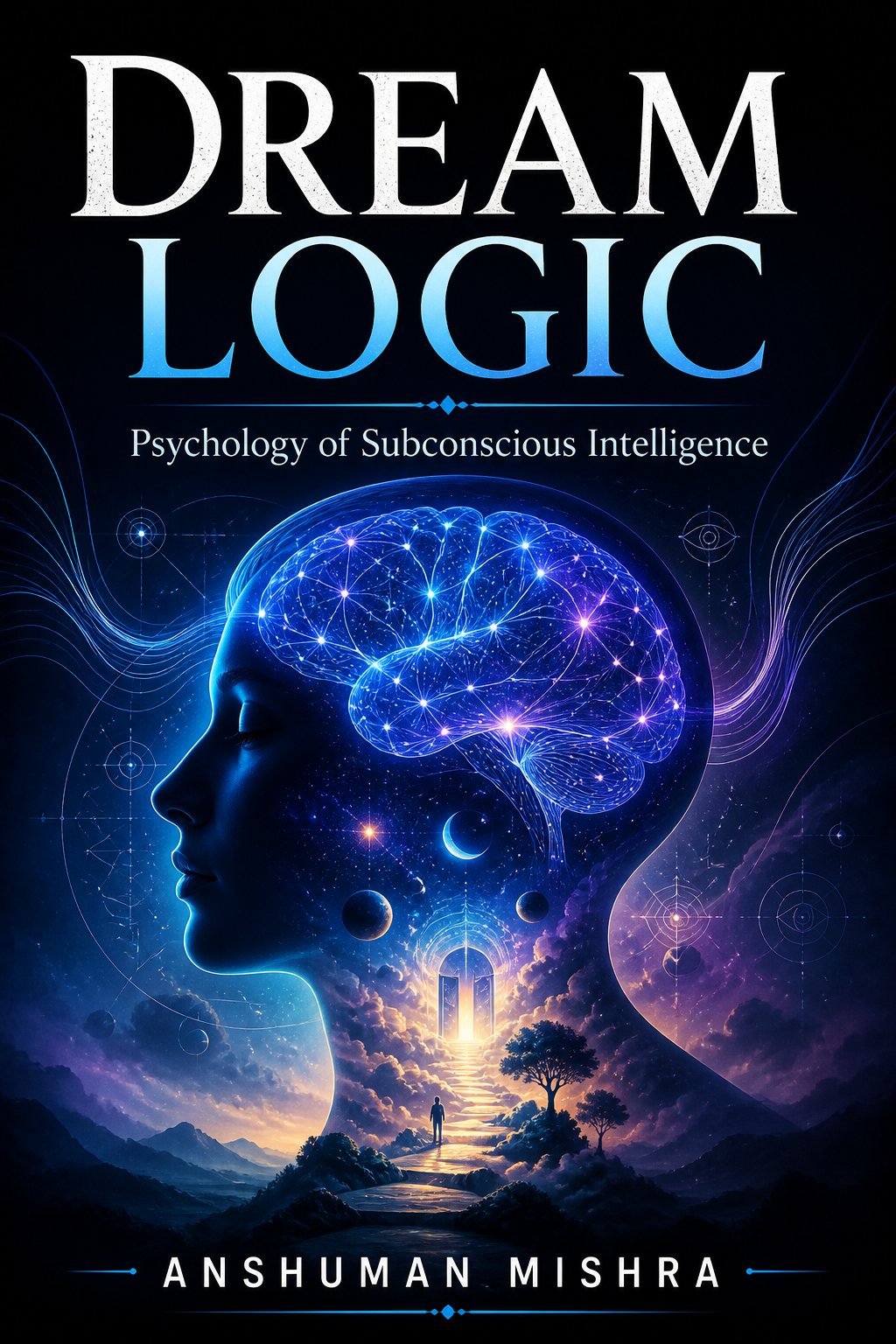
Dream Logic: Psychology of Subconscious Intelligence
Dream Logic: Psychology of Subconscious Intelligence takes readers on an interdisciplinary journey into one of the most fascinating areas of human cognition—the hidden processes that operate beneath conscious awareness.
Much of human thinking happens outside deliberate conscious control. Emotions influence decisions, intuition recognizes patterns before we can explain them, memories shape our responses, and dreams create strange but meaningful combinations of experiences, symbols, and emotions. This book explores these hidden processes through the combined perspectives of psychology, neuroscience, cognitive science, computational thinking, and artificial intelligence.
What Is the Subconscious Mind?
The opening chapters explore the architecture of subconscious cognition and examine how unconscious and implicit processes contribute to perception, learning, decision-making, emotion, and behavior. The book moves from classical psychological ideas, including Freud’s model of the mind, toward modern neural and computational perspectives.
Rather than treating the subconscious simply as a mysterious hidden world, the book explores it as a powerful information-processing system capable of prediction, pattern recognition, emotional evaluation, and adaptive learning.
Dreams as a Cognitive Laboratory
Dreams provide a unique window into the activity of the sleeping brain. The book examines dream logic, including its nonlinear narratives, unusual associations, emotional simulations, symbolic representations, and connections with memory.
It explores questions such as:
- Why do dreams combine unrelated experiences?
- How might dreams contribute to creativity and problem-solving?
- What role do emotions play during dreaming?
- How are memories processed during sleep?
- Why are some dreams remembered while others disappear quickly?
The discussion presents dreams not merely as mysterious experiences, but as a fascinating subject for understanding cognition and information processing.
Freud, Jung, and the Psychology of Dreams
The book revisits the influential ideas of Sigmund Freud and Carl Jung, examining concepts such as the Id, Ego, Superego, repression, wish-fulfillment, archetypes, Shadow, Persona, Anima, and the Self.
These classical theories are considered alongside modern neuroscience and cognitive perspectives, allowing readers to understand both their historical importance and their limitations.
The book also explores an intriguing contemporary question: Can archetypal patterns be compared with recurring structures found in modern information systems and artificial intelligence?
Emotional Computation and Intuition
Emotion is not presented simply as the opposite of rational thinking. Instead, the book investigates emotion as an important component of human information processing.
Readers will explore:
- Affective neuroscience
- Emotional learning
- Somatic markers
- Implicit knowledge
- Intuitive decision-making
- Pattern recognition
- Creative flow
- The relationship between emotion and reasoning
This section examines why people can sometimes arrive at a useful judgment without being able to consciously explain every step that produced it.
From Subconscious Algorithms to Neural Networks
One of the distinctive features of this book is its connection between subconscious cognition and computational intelligence.
The book examines the subconscious through concepts such as:
parallel processing, prediction, pattern recognition, cognitive shortcuts, Bayesian reasoning, neural networks, and implicit computation.
These concepts create a bridge between biological intelligence and artificial intelligence.
The discussion then moves toward AI systems that generate images, text, ideas, and other forms of synthetic output. This raises an important question:
Could some behaviors of generative AI provide useful computational analogies for understanding aspects of human imagination and dream formation?
Dreaming Machines and Artificial Imagination
The relationship between dreams and AI becomes even more intriguing as the book explores neural networks, generative models, symbolic compression, artificial imagination, and AI hallucinations.
The comparison does not suggest that machines literally dream like humans. Instead, it examines conceptual parallels between:
- Human imagination and generative models
- Dream associations and neural representations
- Symbolic compression and information encoding
- Memory reconstruction and generated content
- Uncertainty in human cognition and AI outputs
The chapter also considers the ethical questions surrounding increasingly autonomous and seemingly creative AI systems.
Memory, Emotion, and Insight
Memory is more than a simple storage system. It is continuously reconstructed through associations, emotions, experiences, and context.
This section examines emotional memory, implicit recall, associative networks, forgetting, and the relationship between dreams and memory processing. It presents memory as a dynamic cognitive ecosystem rather than a static archive.
The book also approaches emotionally difficult memories carefully, focusing on psychological and cognitive perspectives rather than presenting simplistic explanations or universal interpretations.
The Creative Unconscious
Many forms of creativity emerge through unexpected combinations of ideas, memories, emotions, and experiences.
The book explores the relationship between subconscious processes and:
- Art
- Literature
- Film
- Invention
- Innovation
- Surrealism
- Flow states
- Imagination
- Creative problem-solving
Readers will discover how dream-like associations can inspire new perspectives and how creative thinking can emerge from connections that are not immediately accessible to conscious reasoning.
Techniques for Exploring Subconscious Processes
The book concludes its practical exploration with techniques and practices for observing and reflecting on subconscious experiences.
Topics include:
- Dream journaling
- Symbolic reflection
- Active imagination
- Mindfulness
- Guided introspection
- Intuition awareness
- Cognitive training
- Neural feedback concepts
These approaches are presented as tools for reflection and self-understanding rather than as guaranteed methods for uncovering hidden truths. Dream symbols, in particular, should be understood in personal and contextual terms rather than through rigid universal interpretations.
The Future of Consciousness
The final chapter brings psychology, neuroscience, computation, and artificial intelligence together to explore the future of consciousness.
It asks profound questions:
Is consciousness an emergent computational phenomenon?
Can subconscious intelligence be modeled computationally?
Could AI help us understand aspects of human cognition that remain difficult to explain?
What happens when the boundary between biological intelligence and machine intelligence becomes increasingly complex?
The book ultimately presents the subconscious not as an obscure corner of the mind, but as a fascinating frontier for understanding intelligence itself.
Key Themes Covered
- Subconscious Mind
- Dream Psychology
- Cognitive Science
- Neuroscience
- Freud and Psychoanalysis
- Carl Jung and Archetypes
- Emotional Intelligence
- Intuition and Implicit Learning
- Memory and Cognition
- Creativity and Innovation
- Neural Networks
- Artificial Intelligence
- Generative AI
- Computational Psychology
- Consciousness
- Dream Logic
- Human–AI Intelligence
Who Should Read This Book?
Dream Logic: Psychology of Subconscious Intelligence is suitable for readers interested in:
- Psychology and human behavior
- Dreams and dream interpretation
- Neuroscience and cognition
- Artificial intelligence
- Consciousness studies
- Creativity and innovation
- Cognitive science
- Philosophy of mind
- Neural networks
- Human–AI interaction
- The future of intelligence
Whether you are a student, educator, researcher, technology enthusiast, psychology reader, or simply curious about how the human mind works, this book offers a thought-provoking journey from the hidden processes of the brain to the emerging intelligence of machines.
Dream Logic ultimately invites readers to look beyond conscious thought and ask a deeper question:
What if some of the most important intelligence within us is the intelligence we are not consciously aware of?

Reviews
There are no reviews yet.