Description
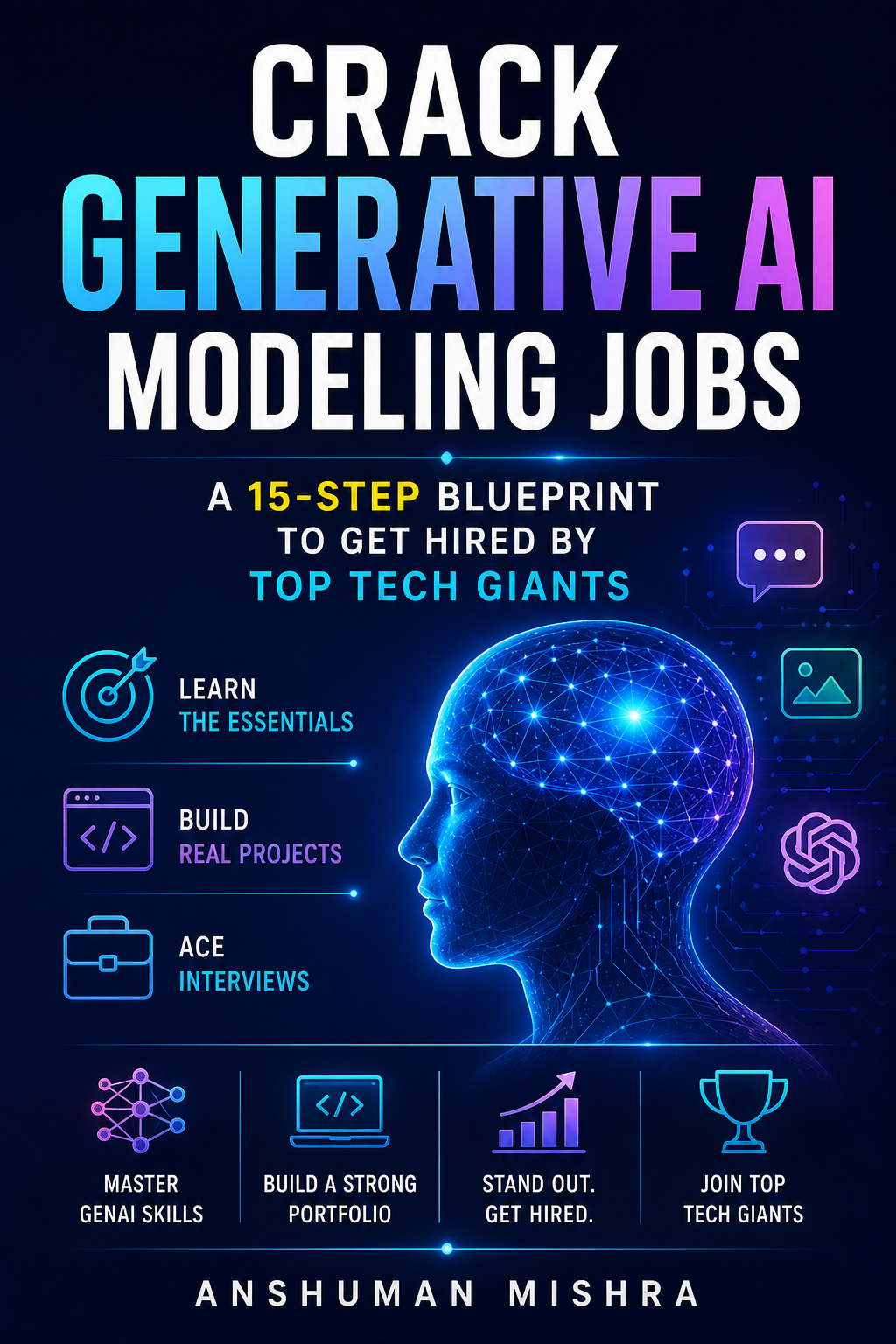
Crack Generative AI Modeling Jobs
A 15-Step Blueprint to Get Hired by Top Tech Giants
Master the Essentials, Build Real-World Projects & Ace Interviews at Top Companies
Generative Artificial Intelligence is rapidly transforming software development, business, research, content creation, automation, and digital products. As organizations increasingly adopt large language models, generative systems, AI agents, and multimodal technologies, the demand for professionals with practical Generative AI skills continues to grow.
But learning AI concepts is only one part of becoming job-ready.
To succeed in Generative AI roles, candidates need a combination of deep learning fundamentals, transformer architectures, LLM knowledge, prompt engineering, model fine-tuning, project experience, deployment skills, MLOps understanding, responsible AI awareness, and interview preparation.
Crack Generative AI Modeling Jobs is designed as a structured 15-step career blueprint that takes readers from foundational concepts to practical projects, portfolio development, and interview preparation.
Who Is This Book For?
This book is designed for:
- Jobseekers aspiring to enter Generative AI and Machine Learning
- B.Tech, MCA, M.Tech, and PhD students
- Self-learners building AI skills
- Software professionals switching to AI careers
- Machine Learning and Data Science professionals
- Learners building Generative AI portfolios
- Developers interested in LLMs and AI applications
- Candidates preparing for AI/ML interviews
Whether you are beginning your GenAI journey or looking to organize your existing knowledge into a job-focused preparation strategy, this book provides a structured learning path.
What You Will Learn
Step 1: Break into Generative AI
The book begins by establishing a strong understanding of Generative AI and its rapidly expanding ecosystem.
You will explore:
- What Generative AI is
- How modern generative models work at a high level
- Applications such as conversational AI, image generation, video generation, and creative AI
- Emerging Generative AI job roles
- Skills expected from AI/ML candidates
- A structured roadmap for becoming job-ready
This chapter establishes the career-oriented direction of the entire book.
Step 2: Master Deep Learning Fundamentals
A strong understanding of deep learning is essential for anyone targeting Generative AI modeling roles.
This section covers:
- Perceptrons
- Neural network layers
- Activation functions
- Forward propagation
- Backpropagation
- Overfitting
- Regularization
- Deep learning frameworks
- TensorFlow and PyTorch
The goal is to help readers develop the conceptual foundation required to understand modern generative models.
Step 3: Understand Transformers
Transformers have become one of the most important architectures in modern AI.
This chapter explains:
- Transformer architecture
- Self-attention
- Encoder-decoder architecture
- Positional information
- The evolution from BERT to GPT-style models
- Why transformers work so effectively with language and other sequential data
A mini-transformer implementation is also introduced to connect theory with practical understanding.
Step 4: Learn LLMs and Prompt Engineering
Large Language Models have become central to the modern Generative AI ecosystem.
Readers will explore:
- What LLMs are
- How language models are trained
- GPT-family models
- Zero-shot prompting
- Few-shot prompting
- Prompt design
- Structured prompting
- Practical prompt engineering
The chapter focuses on designing prompts that solve realistic problems rather than treating prompting as simple question-answering.
Step 5: Work with Open-Source GenAI Tools
Modern AI professionals often work with open-source models and frameworks.
This chapter introduces important tools and ecosystems such as:
- Hugging Face Transformers
- LangChain
- LlamaIndex
- Diffusers
- Open-source language models
- Model loading and experimentation
- Fine-tuning workflows
Readers are introduced to practical workflows for working with pretrained models.
Step 6: Build a Text Generation Engine
The first major practical project focuses on building a text generation application.
The project covers:
- Dataset preparation
- Text generation models
- Model training concepts
- Evaluation
- Perplexity
- BLEU and related evaluation concepts
- Application development
- Streamlit and Gradio deployment
- GitHub portfolio presentation
The objective is not simply to complete a project, but to understand how to present the project as evidence of practical AI skills to recruiters.
Step 7: Fine-Tune LLMs
Fine-tuning is an important skill for Generative AI engineers.
This section explains:
- Fine-tuning vs. instruction tuning
- Dataset preparation
- Dataset quality
- Question-answering datasets
- Custom datasets
- Parameter-efficient fine-tuning
- LoRA
- Model evaluation
- MLOps considerations
Readers also explore the types of questions recruiters may ask about model training and deployment workflows.
Step 8: Image Generation with GANs and Diffusion
Generative AI extends far beyond text.
This chapter explores the foundations of:
- GANs
- VAEs
- Diffusion models
- Stable Diffusion
- StyleGAN
- DALL·E-style image generation
- Image generation workflows
- Fine-tuning concepts
- Responsible image generation
The chapter also introduces technical and ethical considerations that may arise during interviews.
Step 9: Build Conversational AI and Agents
Conversational AI is one of the most visible applications of Generative AI.
Readers learn how to think about building AI assistants with:
- Large language models
- Conversation management
- Memory
- External tools
- Search
- Retrieval
- LangChain-based workflows
- Agent-style architectures
The practical project focuses on building a personal AI assistant and, importantly, understanding how to explain its architecture and design decisions during an interview.
Step 10: Learn MLOps for Generative AI
Knowing how to build a model is different from knowing how to deploy and maintain it.
This chapter introduces:
- FastAPI
- Docker
- Kubernetes
- Model deployment
- Model monitoring
- MLflow
- Weights & Biases
- Cloud ML platforms
- CI/CD concepts
- Production-oriented AI workflows
Understanding MLOps helps candidates move beyond experimental notebooks toward production-ready AI systems.
Step 11: Responsible AI, Ethics and Bias
Technical skills alone are not enough for modern AI careers.
This chapter explores:
- AI ethics
- Bias in training data
- Fairness
- Transparency
- Explainability
- Responsible AI
- Legal and regulatory considerations
- AI governance concepts
- Interview case studies
The goal is to help candidates develop the ability to discuss not only what an AI system can do, but also how it should be designed and deployed responsibly.
Step 12: Build a GenAI Resume Builder
The second major practical project demonstrates how Generative AI can be applied to career technology.
The project explores a workflow in which:
User Profile → AI Processing → Skills Matching → Resume Generation
Topics include:
- LLM integration
- Text rewriting
- Summarization
- Resume generation
- NLP-based skill matching
- Job-role alignment
- ATS-oriented formatting concepts
- Flask and Gradio deployment
- Recruiter-focused project presentation
This project can also serve as a practical portfolio example for demonstrating AI application development skills.
Step 13: Prepare for Generative AI Interviews
A strong technical profile still needs effective interview preparation.
This chapter examines:
- AI/ML interview formats
- Coding rounds
- Machine learning questions
- Generative AI concepts
- System design discussions
- Case studies
- Behavioral interviews
- Technical communication
- Common mistakes
- Round-by-round preparation strategies
The emphasis is on understanding how to communicate technical knowledge clearly and confidently.
Step 14: Build a Strong Resume and GitHub Portfolio
Recruiters often evaluate candidates through multiple signals—not just academic qualifications.
This chapter explains how to improve:
- AI-focused resumes
- Project descriptions
- GitHub repositories
- Portfolio structure
- Technical documentation
- LinkedIn profiles
- Achievement-oriented resume statements
- Project presentation
A central principle is emphasized throughout the chapter:
Quality of projects matters more than simply having a large number of repositories.
Step 15: Follow the 30-Day Generative AI Job Preparation Plan
The final chapter converts the knowledge from the book into a structured preparation roadmap.
It includes:
- Day-wise preparation
- Learning priorities
- Coding practice
- Generative AI revision
- Project completion
- GitHub preparation
- Mock interview questions
- Resume review
- Portfolio checklist
- Self-assessment
- Final interview preparation
The objective is to transform learning into an actionable job-preparation routine.
Key Topics Covered
- Generative AI
- Machine Learning
- Deep Learning
- Neural Networks
- Transformers
- Self-Attention
- Large Language Models
- GPT Models
- Prompt Engineering
- Hugging Face
- Open-Source AI Models
- Fine-Tuning
- LoRA
- GANs
- Diffusion Models
- Image Generation
- Conversational AI
- AI Agents
- LangChain
- LlamaIndex
- MLOps
- Docker
- Kubernetes
- FastAPI
- MLflow
- Responsible AI
- AI Ethics
- AI Bias
- Technical Interviews
- Resume Building
- GitHub Portfolio
- AI Career Preparation
Why This Book Is Different
Many AI books focus primarily on algorithms or theoretical concepts. This book takes a broader career-and-project-oriented approach.
It connects:
Learn → Build → Deploy → Document → Showcase → Interview → Get Hired
Readers are encouraged to develop not only theoretical understanding but also practical evidence of their skills through projects, portfolios, deployment concepts, and interview preparation.
Build Your Generative AI Career
Generative AI is creating new opportunities across software engineering, machine learning, data science, AI research, automation, product development, and intelligent applications.
However, getting hired requires more than knowing the latest AI terminology.
You need to understand the technology, build meaningful projects, communicate your work effectively, maintain a credible portfolio, and prepare systematically for technical and behavioral interviews.
Crack Generative AI Modeling Jobs: A 15-Step Blueprint to Get Hired by Top Tech Giants is designed to help you bring these elements together into one structured preparation journey.
Learn the fundamentals. Build real projects. Strengthen your portfolio. Prepare for interviews. Move confidently toward a Generative AI career.
Reviews
There are no reviews yet.