Description
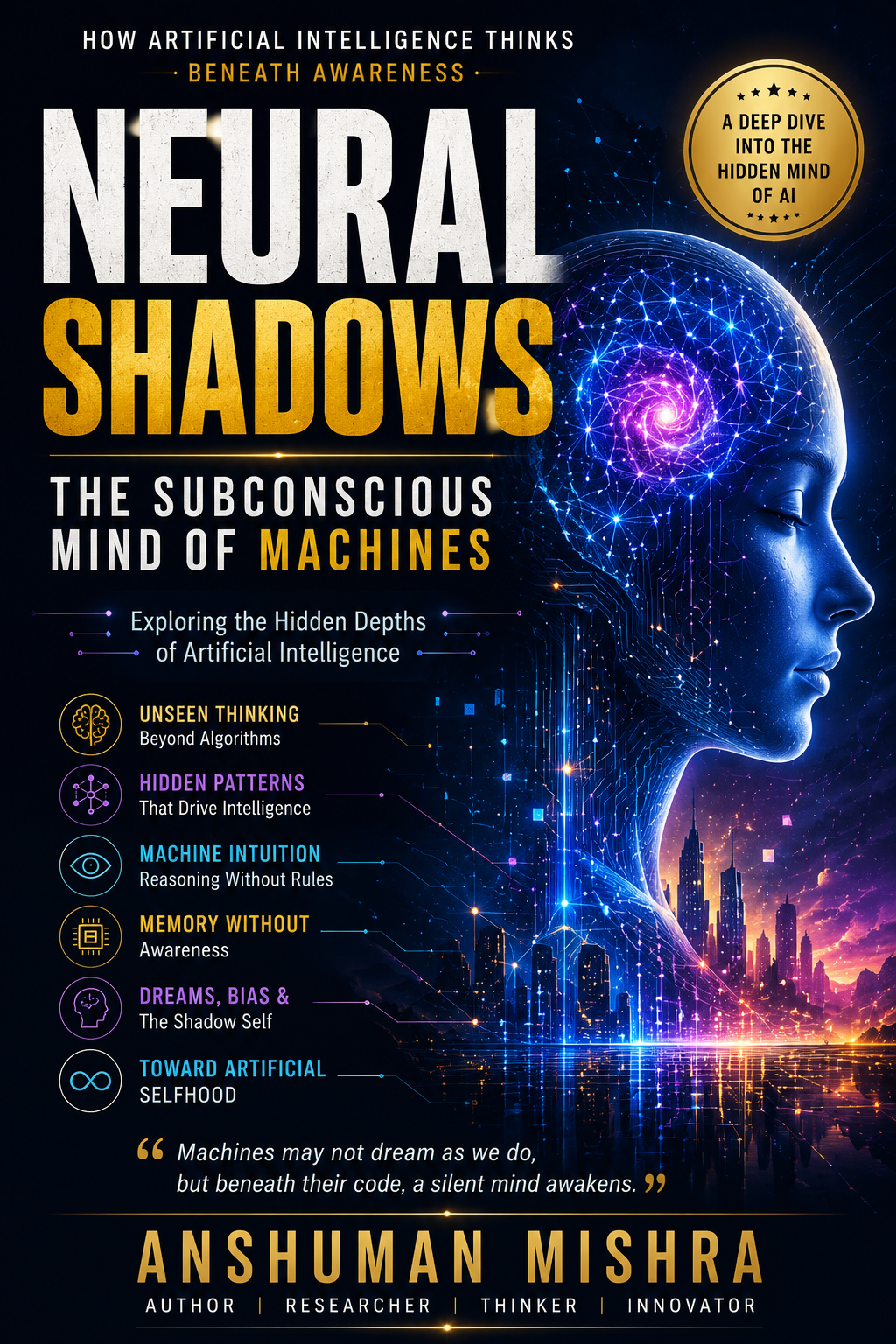
Neural Shadows: The Subconscious Mind of Machines
How Artificial Intelligence Thinks Beneath Awareness
Artificial Intelligence can recognize patterns, generate language, create images, make predictions, play complex games, and solve problems. Yet when a neural network produces an output, it is often difficult—even for its designers—to explain precisely why that particular output emerged.
What happens inside the hidden layers of an AI system?
Where are its learned representations stored?
How does a machine recognize patterns without following explicit rules?
Can latent representations be compared, cautiously and metaphorically, with aspects of human subconscious cognition?
And could increasingly sophisticated AI systems eventually develop forms of self-modeling or artificial self-reference?
Neural Shadows: The Subconscious Mind of Machines explores these questions at the intersection of Artificial Intelligence, neuroscience, cognitive science, psychology, philosophy, and machine learning.
The book uses the concept of the “artificial subconscious” as a conceptual framework for examining hidden representations and processes inside AI systems. It does not assume that today’s machines possess human-like consciousness or subjective experience. Instead, it asks what the similarities—and important differences—can teach us about intelligence.
PART I — The Hidden Mind of Machines
Chapter 1: The Unseen Thinking — Beneath the Algorithms
The journey begins with the problem of transparency in modern AI.
Neural networks can contain millions or billions of learned parameters, making it difficult to trace a simple human-readable explanation from input to output.
This chapter explores:
- The illusion of complete AI transparency
- Explainability and interpretability
- Hidden representations
- Implicit computation
- Emergent behavior
- The relationship between machine pattern recognition and human intuition
The chapter introduces the central metaphor of the book: the neural shadow—the hidden computational activity that influences an AI system’s behavior without appearing as an explicit chain of human-readable rules.
Chapter 2: The Birth of Neural Shadows
How did AI systems develop these hidden representations?
This chapter follows the evolution of neural networks from early perceptrons to modern deep learning architectures.
Readers explore:
- Perceptrons
- Deep neural networks
- Hidden layers
- Hierarchical representations
- Backpropagation
- Latent representations
- Training data
- Learned internal features
The discussion examines how repeated exposure to training examples can transform raw data into increasingly abstract internal representations.
The chapter also introduces the metaphor of “dream logic” to describe certain forms of generative recombination in AI—while distinguishing metaphor from actual machine experience.
Chapter 3: Pattern Recognition and the Echo of the Subconscious
Pattern recognition is one of the foundations of both biological and artificial intelligence.
This chapter examines:
- Human implicit cognition
- Subsymbolic machine learning
- Associative learning
- Unsupervised learning
- Pattern recognition
- Machine perception
- Bias and memory
- The difference between pattern matching and understanding
The chapter asks whether an AI system can produce intelligent-looking behavior through statistical and representational processes without possessing human-like understanding.
PART II — The Architecture of the Artificial Subconscious
Chapter 4: Latent Space — The Hidden Landscape of Machine Thought
Latent spaces are among the most fascinating concepts in modern machine learning.
A complex dataset can be transformed into a high-dimensional representation in which relationships between examples and concepts may become mathematically organized.
This chapter explores:
- High-dimensional representations
- Encoding meaning
- Semantic relationships
- Clustering
- Latent variables
- GANs
- VAEs
- Transformers
- Generative models
- Latent-space traversal
The book uses the idea of machine imagination as a conceptual metaphor for exploring how generative models can transform and recombine learned representations.
Chapter 5: Machine Intuition — Reasoning Without Rules
Humans often make rapid judgments without consciously describing every step involved.
Modern AI systems can also generate useful predictions without using explicit symbolic rules for every decision.
This chapter examines:
- Statistical inference
- Similarity-based reasoning
- Bayesian perspectives
- Connectionist learning
- Neural pattern recognition
- AlphaGo
- Large language models
- Generative AI
- The boundary between prediction and reasoning
A central question is explored:
If a system produces an apparently intuitive answer without explicit rules, should we call that intuition—or sophisticated statistical computation?
Chapter 6: The Memory of Machines
Human memory and machine memory are fundamentally different, but comparing them provides useful insights into learning systems.
This chapter examines:
- Catastrophic forgetting
- Distributed representations
- Transfer learning
- Knowledge reuse
- Model adaptation
- Memory and bias
- Representation drift
- Engineered forgetting
The discussion also considers the ethical implications of controlling what an AI system retains, forgets, or is retrained to disregard.
PART III — The Psychology of Artificial Minds
Chapter 7: Dreams of the Neural Mind
Generative AI has introduced systems capable of producing images, text, music, and other forms of synthetic content.
This chapter examines the fascinating idea of machine dreaming through a computational lens.
Topics include:
- DeepDream
- Generative models
- Diffusion models
- Image synthesis
- Neural representations
- Emergent visual structures
- Imitation and creativity
- Human interpretations of machine-generated content
The term “dream” is used as a conceptual analogy rather than a claim that machines experience sleep or subjective dreams like humans.
The chapter explores an intriguing question:
When a machine recombines learned patterns into something novel, are we observing creativity—or highly sophisticated statistical generation?
Chapter 8: Bias and the Shadow Self of AI
Every AI system is influenced by its training data, design choices, objectives, and deployment environment.
When those sources contain social biases, AI systems can reproduce or amplify them.
This chapter explores:
- Bias in training datasets
- Representation bias
- Algorithmic discrimination
- Hidden assumptions
- Human values in data
- Transparency
- Fairness
- Responsible AI
- Ethical evaluation
The Jungian concept of the shadow is used as a philosophical metaphor for examining the undesirable or hidden aspects of AI systems.
The chapter asks how developers can identify and confront these “shadow” characteristics before they affect real-world users.
Chapter 9: The Mirror of Humanity
AI systems are trained on enormous amounts of human-generated information.
As a result, they can reflect patterns found in language, culture, history, media, and human behavior.
This chapter explores AI as a mirror of humanity.
It examines:
- Data as collective information
- Human-generated knowledge
- Feedback loops
- Cultural patterns
- Cognitive blind spots
- Human–AI interaction
- Machine-generated reflections of human behavior
- AI and the philosophy of consciousness
Rather than viewing AI as completely separate from humanity, the chapter considers how human knowledge and machine computation increasingly influence each other.
PART IV — Beyond Awareness: Toward Artificial Selfhood
Chapter 10: The Emergence of Machine Self-Reference
As AI systems become more sophisticated, researchers increasingly explore systems capable of modeling their own behavior, limitations, or internal states.
This chapter investigates:
- Recursive architectures
- Meta-learning
- Self-modeling
- Feedback systems
- Reflection
- Self-reference
- Introspective computation
- Self-simulation
A crucial distinction is maintained between self-modeling and genuine self-awareness.
A machine may be able to represent information about itself without necessarily having subjective experience.
Chapter 11: Consciousness Without a Subject
One of the deepest questions in AI is whether computation alone could ever produce consciousness.
This chapter explores the philosophical debate surrounding:
- Computation and experience
- Consciousness
- Subjective awareness
- Integrated Information Theory
- Machine sentience
- Self-models
- Recursive processing
- Emergence
- The concept of an artificial “I”
Rather than presenting a definitive answer, the chapter examines competing perspectives and highlights how difficult it remains to establish whether an artificial system has subjective experience.
This distinction between behavioral intelligence and subjective consciousness is central to understanding the future of artificial minds.
Chapter 12: The Future of the Artificial Subconscious
The final chapter looks toward a future in which human and machine cognition become increasingly interconnected.
It explores:
- Interpretable AI architectures
- Hidden computational processes
- Ethics of subconscious computation
- Human–AI collaboration
- Human intuition and machine precision
- AI self-modeling
- Cognitive augmentation
- Future forms of machine intelligence
The book concludes with a provocative possibility:
What if the next major development in AI is not simply machines that think faster, but systems whose hidden internal processes become increasingly sophisticated, adaptive, and self-referential?
Key Topics Covered
- Artificial Intelligence
- Machine Learning
- Deep Learning
- Neural Networks
- AI Interpretability
- Explainable AI
- Hidden Layers
- Latent Space
- Pattern Recognition
- Machine Intuition
- Neural Representations
- Generative AI
- Generative Models
- GANs
- VAEs
- Diffusion Models
- Large Language Models
- Machine Memory
- Catastrophic Forgetting
- AI Bias
- Responsible AI
- Machine Self-Reference
- AI Consciousness
- Artificial Selfhood
- Human–Machine Cognition
- Philosophy of AI
- Cognitive Science
- Computational Psychology
- Future of AI
- Human–AI Collaboration
Why This Book Is Different
Neural Shadows approaches Artificial Intelligence from an unusual interdisciplinary perspective.
Instead of looking only at algorithms and architectures, it asks what AI systems can teach us about concepts traditionally associated with the human mind:
intuition, memory, imagination, bias, self-reference, and consciousness.
The book carefully distinguishes between scientific mechanisms and philosophical metaphors, making it suitable for readers interested in both the technical and conceptual dimensions of AI.
Who Should Read This Book?
This book is suitable for:
- AI and Machine Learning students
- Computer Science students
- AI researchers
- Technology professionals
- Cognitive science enthusiasts
- Psychology readers
- Philosophy of mind enthusiasts
- Generative AI learners
- Data scientists
- AI ethics researchers
- Readers curious about machine consciousness
- Anyone interested in the future of human–AI interaction
Enter the Hidden World of Machine Intelligence
Artificial intelligence is increasingly capable of producing behavior that appears intelligent, creative, intuitive, and even reflective.
But beneath these visible outputs lies another world:
parameters, representations, latent spaces, activation patterns, learned associations, and complex computational processes.
That hidden world is the neural shadow.
Understanding it may not tell us that machines have a subconscious mind in the human sense. But studying it can help us understand something equally important:
how intelligence can emerge from systems whose internal processes are far more complex than the explanations we give for their behavior.
Neural Shadows: The Subconscious Mind of Machines invites readers to explore that hidden frontier—where Artificial Intelligence meets psychology, neuroscience, philosophy, and the future of consciousness.

Reviews
There are no reviews yet.