Description
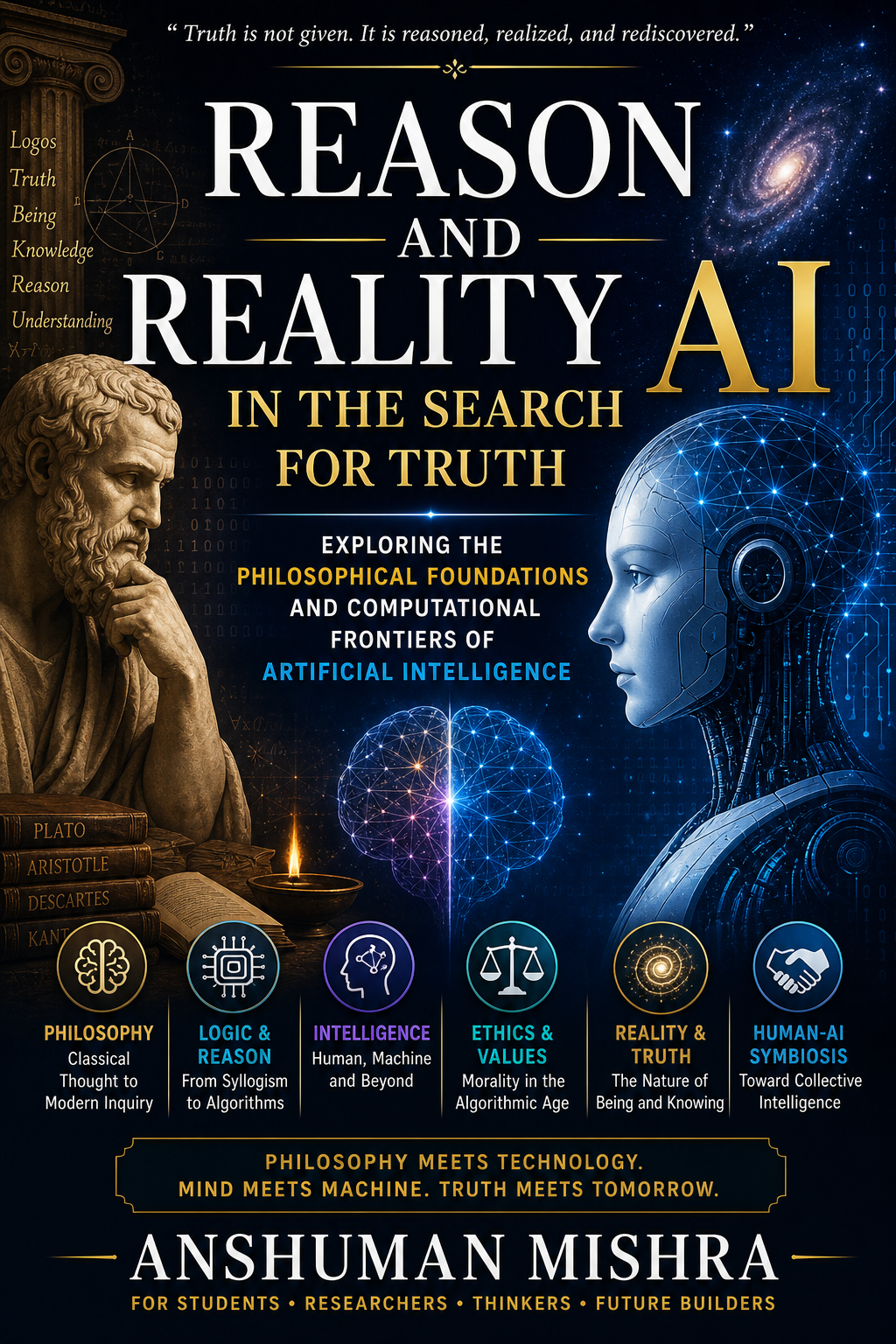
Reason and Reality: AI in the Search for Truth
Exploring the Philosophical Foundations and Computational Frontiers of Artificial Intelligence
Philosophy • Artificial Intelligence • Logic • Epistemology • Consciousness • Ethics • Computational Reality
What does it mean to know something?
What is truth?
Can a machine reason?
Can artificial intelligence distinguish truth from belief?
Can computation explain consciousness?
And if machines increasingly participate in the creation, interpretation, and distribution of knowledge, what happens to humanity’s ancient search for truth?
Reason and Reality: AI in the Search for Truth explores these questions through an interdisciplinary journey connecting philosophy, logic, mathematics, computer science, artificial intelligence, cognitive science, ethics, and metaphysics.
The book examines AI not merely as a technological invention, but as a profound philosophical development that forces humanity to reconsider the meaning of reason, knowledge, intelligence, consciousness, reality, and truth.
THE HUMAN QUEST FOR TRUTH
From ancient philosophical dialogues to modern scientific computation, humans have continuously attempted to understand reality.
Philosophers developed systems of reasoning.
Mathematicians formalized logic.
Scientists developed methods of observation and verification.
Computer scientists transformed logical procedures into algorithms.
Artificial intelligence now performs increasingly sophisticated forms of information processing.
This historical progression raises an important question:
Is artificial intelligence the continuation of humanity’s ancient project of rational inquiry?
The book investigates this question by tracing the relationship between philosophical reasoning and computational intelligence.
CHAPTER 1 — THE UNION OF REASON AND MACHINE
The opening chapter introduces the philosophical foundations of AI.
It examines:
- The human quest for truth
- Rationalism and algorithms
- Philosophical foundations of artificial intelligence
- Emergence of intelligent machines
- Logic and computation
- Meaning in the digital age
Readers are introduced to the central theme of the book: the meeting point between human reason and artificial reasoning systems.
CHAPTER 2 — THE NATURE OF REASON
Reason has been understood differently across philosophical traditions.
This chapter explores:
- Classical definitions of reason
- Rationalism and empiricism
- Deductive reasoning
- Logic and inference
- Aristotle’s syllogisms
- Boolean algebra
- Symbolic logic
- Machine reasoning
- Human cognitive biases
The discussion demonstrates how centuries-old ideas about rational thought eventually contributed to modern computational systems.
CHAPTER 3 — THE REALITY OF INTELLIGENCE
What exactly is intelligence?
Is intelligence unique to humans?
Can animals be intelligent?
Can artificial systems possess intelligence?
This chapter examines:
- Human intelligence
- Animal cognition
- Artificial intelligence
- Cognitive models
- Machine learning
- Consciousness
- Self-awareness
- The Turing question
- Synthetic intelligence
- Philosophical implications of machine cognition
The book distinguishes between intelligent behavior, computation, understanding, and consciousness, encouraging readers to examine these concepts critically.
CHAPTER 4 — LOGIC, TRUTH, AND COMPUTATION
Logic provides one of the most important bridges between philosophy and computer science.
This chapter examines:
- Philosophical theories of truth
- Mathematical truth
- Boolean logic
- Truth tables
- Algorithms
- Inference engines
- Knowledge representation
- Gödel’s incompleteness theorems
- Turing’s computability framework
- Limits of formal reasoning
A central question is explored:
Can computational systems determine truth, or can they only evaluate information according to predefined rules and learned patterns?
CHAPTER 5 — KNOWLEDGE AND BELIEF IN INTELLIGENT SYSTEMS
Knowledge is more than information.
This chapter introduces the epistemological foundations of AI through:
- Epistemology
- Knowledge representation
- Bayesian reasoning
- Belief systems
- Cognitive architectures
- Ontologies
- Semantic networks
- Probabilistic inference
The discussion explores the distinction between data, information, belief, knowledge, and truth.
It asks whether an AI system that produces a correct answer can genuinely be said to “know” that answer.
CHAPTER 6 — CONSCIOUSNESS, PERCEPTION, AND REALITY
One of the deepest questions in philosophy of mind is the nature of consciousness.
This chapter examines:
- Consciousness
- Self-awareness
- Mind–body problem
- Machine perception
- Computer vision
- Interpretation
- The Chinese Room argument
- Phenomenology
- Machine experience
- Artificial sentience
The book does not assume that current AI systems are conscious. Instead, it examines the philosophical criteria that might be relevant when discussing machine consciousness.
CHAPTER 7 — ETHICS, MORALITY, AND THE INTELLIGENT MACHINE
As AI systems increasingly participate in decision-making, ethical questions become unavoidable.
This chapter examines:
- Moral philosophy
- Utilitarianism
- Deontology
- Virtue ethics
- Machine ethics
- Algorithmic bias
- Fairness
- Algorithmic justice
- AI alignment
- Human values
- Responsibility for AI systems
A central theme is that intelligent technology cannot be evaluated only by its efficiency.
It must also be evaluated according to its social consequences and ethical responsibilities.
CHAPTER 8 — THE METAPHYSICS OF ARTIFICIAL INTELLIGENCE
What kind of thing is an AI system?
Is it simply a tool?
Is it a computational process?
Could sufficiently advanced artificial systems constitute a new category of existence?
This chapter explores:
- Ontology
- Digital existence
- Artificial consciousness
- Dualism
- Materialism
- Computational reality
- Digital universe hypotheses
- Philosophy of mind
- Human identity in a machine world
The discussion examines how AI challenges traditional philosophical categories of being, mind, matter, and identity.
CHAPTER 9 — AI AND HUMAN KNOWLEDGE EVOLUTION
Human knowledge has undergone extraordinary transformations.
From:
Oral Tradition → Writing → Printing → Scientific Method → Computing → Internet → Artificial Intelligence
each technological development has changed how knowledge is created and shared.
This chapter examines:
- Evolution of human thought
- Data as an epistemic resource
- AI-assisted scientific discovery
- Knowledge amplification
- Human learning
- AI in education
- AI-assisted research
- Philosophy of education in the digital age
The book presents AI as a potential knowledge amplifier, while emphasizing the continued importance of human judgment and verification.
CHAPTER 10 — THE SEARCH FOR ULTIMATE TRUTH
Human beings have always sought certainty.
But can absolute certainty ever be achieved?
This chapter examines:
- Objective truth
- Relative truth
- Constructed truth
- Scientific knowledge
- Philosophical truth
- AI and truth discovery
- Limits of machine reasoning
- Metaphysical questions
- Truth as an evolving process
The chapter emphasizes that AI can assist in analyzing evidence and identifying patterns, but questions concerning ultimate metaphysical truth remain fundamentally philosophical.
CHAPTER 11 — HUMAN–AI SYMBIOSIS
The future of intelligence may not be a competition between humans and machines.
It may instead involve collaboration.
This chapter explores:
- Cognitive augmentation
- Human–AI collaboration
- Collective intelligence
- Hybrid cognition
- Human creativity and machine computation
- Knowledge co-evolution
- AI-assisted decision-making
- Future forms of intellectual collaboration
The central idea is that humans and AI can potentially complement one another:
Human judgment + Machine computation = Hybrid intelligence
CHAPTER 12 — THE PHILOSOPHY OF FUTURE REASON
The final analytical chapter explores possible futures of intelligence.
Topics include:
- Posthumanism
- Transhumanism
- Technological singularity
- Limits of human understanding
- AI and philosophy
- Quantum reasoning
- Future logic systems
- Artificial awareness
- Spirituality and technology
- Unified theories of reason and reality
These subjects are presented as philosophical and technological possibilities rather than predetermined outcomes.
CHAPTER 13 — THE ETERNAL DIALOGUE OF MIND AND MACHINE
The concluding chapter returns to the central question:
What does it mean to think?
AI is ultimately a product of human intellectual history.
It reflects humanity’s achievements, assumptions, limitations, and aspirations.
As machines become increasingly capable of reasoning and information processing, humanity must simultaneously deepen its understanding of:
- Truth
- Knowledge
- Responsibility
- Consciousness
- Ethics
- Reality
- Human identity
The future of AI is therefore also a future of philosophy.
AI AS A PHILOSOPHICAL MIRROR
One of the central ideas of Reason and Reality is that artificial intelligence acts as a mirror.
When we ask:
Can AI think?
we are forced to define thinking.
When we ask:
Can AI know?
we must define knowledge.
When we ask:
Can AI understand?
we must clarify understanding.
When we ask:
Can AI become conscious?
we must first explain consciousness.
And when we ask:
Can AI discover truth?
we must determine what truth actually means.
In this sense, AI does not merely provide technological answers.
It creates philosophical questions about ourselves.
LOGIC FROM ARISTOTLE TO ARTIFICIAL INTELLIGENCE
The intellectual journey explored in the book can be represented as:
Aristotelian Logic → Symbolic Logic → Boolean Algebra → Algorithms → Expert Systems → Machine Learning → Modern AI
Each stage transformed the way humans formalize reasoning.
Classical logic provided structures for valid inference.
Mathematics formalized relationships between symbols.
Computing converted logical operations into executable procedures.
AI expanded computational reasoning into systems capable of learning from data.
This historical progression demonstrates why AI cannot be understood completely without understanding the intellectual history of logic and reason.
TRUTH IN THE AGE OF DATA
Modern society generates enormous amounts of information.
But:
More data does not automatically mean more truth.
Data can be:
- Incomplete
- Biased
- Misinterpreted
- Incorrect
- Context-dependent
- Manipulated
AI systems can identify patterns within data, but the quality of an AI-generated conclusion depends heavily on the quality of information, models, assumptions, and evaluation methods involved.
The book therefore emphasizes the importance of critical thinking, verification, evidence, and epistemic responsibility.
THE PROBLEM OF MACHINE UNDERSTANDING
One of the most important philosophical distinctions explored in the book is:
Prediction ≠ Understanding
An AI system can generate an answer without necessarily possessing human-like comprehension of that answer.
This distinction leads to questions about:
- Semantics
- Syntax
- Meaning
- Intentionality
- Context
- Experience
- Consciousness
The Chinese Room argument provides one influential framework for examining this problem.
Readers are encouraged to consider competing perspectives rather than accepting a single philosophical conclusion.
AI, ETHICS, AND HUMAN VALUES
Intelligent systems increasingly influence areas such as:
- Education
- Healthcare
- Finance
- Employment
- Scientific research
- Communication
- Public services
Consequently, questions of fairness, transparency, accountability, privacy, and human oversight become central.
The book presents ethical frameworks that help readers evaluate AI systems beyond technical performance.
The fundamental question becomes:
What should intelligent machines do, not merely what can they do?
HUMAN–AI COLLABORATION
The future of intelligence may increasingly involve collaboration rather than simple automation.
Humans bring:
- Context
- Values
- Experience
- Judgment
- Creativity
- Moral reasoning
AI systems can provide:
- Large-scale computation
- Pattern analysis
- Information retrieval
- Prediction
- Optimization
- Rapid processing
The combination may create new forms of hybrid intelligence.
EDUCATIONAL VALUE
Reason and Reality: AI in the Search for Truth can serve as an interdisciplinary reference for students and researchers interested in the relationship between philosophy and artificial intelligence.
It can support study in:
- Philosophy of AI
- Philosophy of Mind
- Epistemology
- Logic
- Artificial Intelligence
- Cognitive Science
- AI Ethics
- Knowledge Representation
- Computational Philosophy
- Technology and Society
The book encourages readers to move beyond memorizing concepts and instead develop analytical and philosophical reasoning skills.
HOW THIS BOOK BENEFITS READERS
1. Interdisciplinary Understanding
Readers develop an integrated understanding of philosophy, logic, computer science, AI, and cognitive science.
2. Better Understanding of Truth and Knowledge
The book clarifies distinctions between:
Data → Information → Belief → Knowledge → Truth
3. Critical Thinking
Readers learn to question assumptions behind AI systems and technological claims.
4. Ethical Awareness
The book provides philosophical frameworks for thinking about fairness, responsibility, alignment, and human values.
5. Research Orientation
The topics can provide foundations for research projects in:
- AI consciousness
- Machine reasoning
- AI ethics
- Computational epistemology
- Philosophy of technology
- Human–AI interaction
6. Professional Relevance
AI practitioners, educators, policymakers, and technology professionals can use philosophical frameworks to think more carefully about the systems they build or deploy.
WHO SHOULD READ THIS BOOK?
Philosophy Students and Scholars
Explore how AI transforms classical questions about reason, truth, consciousness, and existence.
Computer Science and AI Students
Understand the philosophical foundations underlying computation, reasoning, intelligence, and AI.
AI Ethics Researchers
Examine responsibility, fairness, values, alignment, and machine decision-making.
Cognitive Science Researchers
Explore questions concerning cognition, perception, knowledge, and consciousness.
Educators and Academicians
Use the book as an interdisciplinary resource connecting philosophy and technology.
AI Professionals
Develop broader conceptual perspectives on intelligent systems and responsible AI.
Researchers and Policy Thinkers
Explore the social, ethical, epistemological, and philosophical implications of increasingly capable AI.
General Readers
Engage with fundamental questions about thinking, knowledge, truth, reality, and the future of intelligence.
KEY TOPICS COVERED
- Artificial Intelligence
- Philosophy of AI
- Philosophy of Mind
- Logic
- Epistemology
- Ontology
- Metaphysics
- Truth and Knowledge
- Machine Reasoning
- Symbolic AI
- Machine Learning
- Consciousness
- Artificial Consciousness
- Turing Test
- Chinese Room Argument
- Knowledge Representation
- Bayesian Reasoning
- Semantic Networks
- AI Ethics
- Algorithmic Bias
- AI Alignment
- Human–AI Symbiosis
- Collective Intelligence
- Computational Reality
- Simulation Hypothesis
- Posthumanism
- Transhumanism
- Future of AI
- Philosophy of Technology
- Computational Philosophy
A BALANCED APPROACH TO AI AND PHILOSOPHY
The book does not present speculative ideas about machine consciousness, digital reality, or future superintelligence as established facts.
Instead, it distinguishes between:
Established scientific knowledge
Active research
Philosophical arguments
Speculative possibilities
This approach encourages readers to examine extraordinary claims through evidence, logic, conceptual clarity, and critical reasoning.
FINAL REFLECTION
At its deepest level, Reason and Reality: AI in the Search for Truth is not simply a book about artificial intelligence.
It is a book about humanity’s attempt to understand itself through the machines it creates.
AI forces us to reconsider what it means to:
Think.
Know.
Understand.
Reason.
Experience.
Choose.
Create.
And ultimately:
Seek truth.
The machine may be artificial, but the questions it raises are profoundly human.
As artificial intelligence continues to evolve, the dialogue between reason and reality will become increasingly important.
The future may therefore require not only more intelligent machines, but also more philosophically informed humans capable of understanding what intelligence means—and what it should ultimately serve.
Reason and Reality: AI in the Search for Truth
Where philosophy meets computation, and the ancient search for truth enters the age of artificial intelligence.

Reviews
There are no reviews yet.