Description
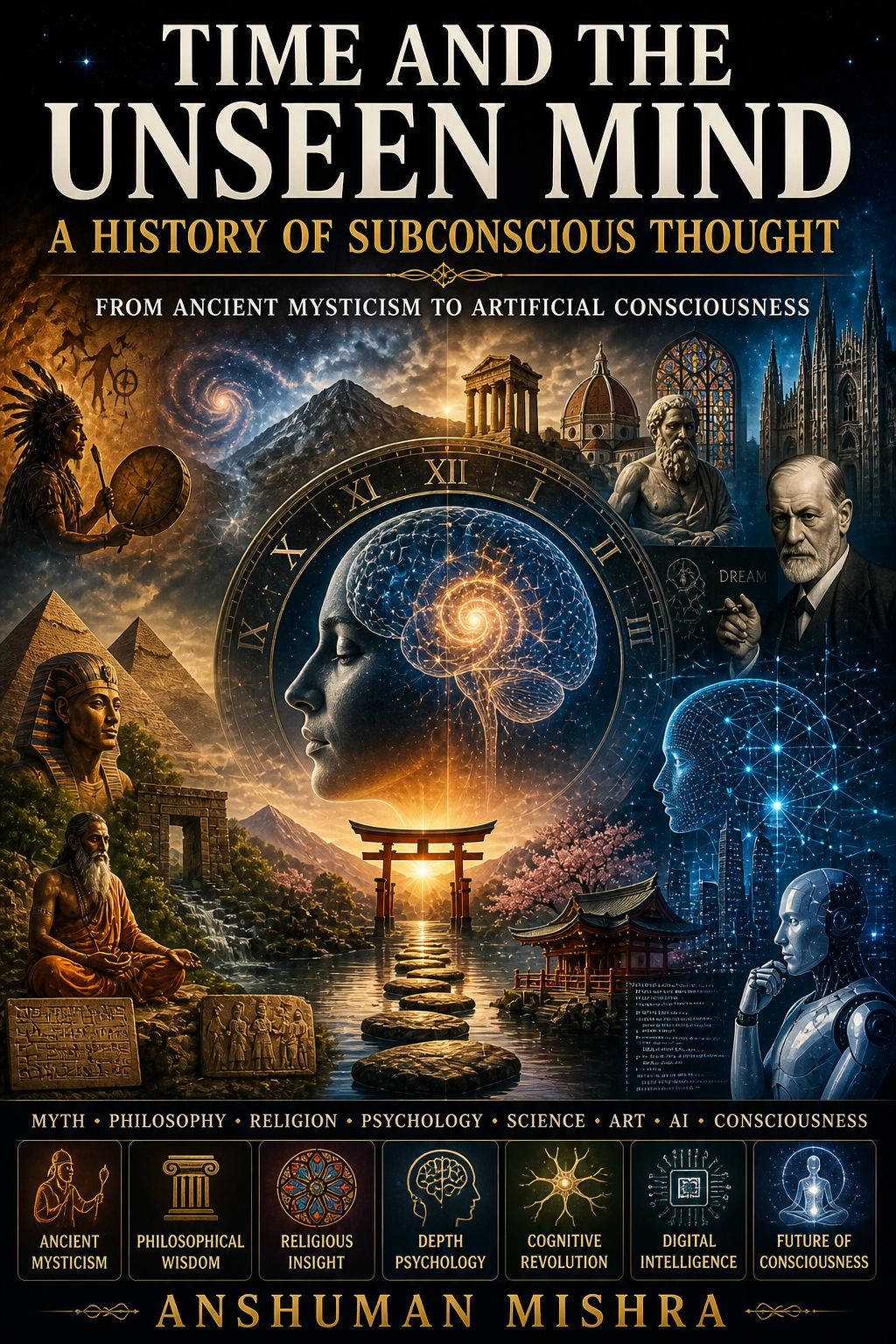
Time and the Unseen Mind: A History of Subconscious Thought
From Ancient Mysticism to Artificial Consciousness
What lies beneath conscious thought?
Before psychology gave it a scientific vocabulary, humanity had already spent thousands of years trying to understand the hidden dimensions of the mind. Dreams were interpreted as messages from gods, rituals were used to enter altered states of awareness, philosophers contemplated the nature of the soul, mystics explored the inner self, and artists transformed invisible emotions into symbols.
Time and the Unseen Mind: A History of Subconscious Thought traces this extraordinary intellectual and cultural journey—from ancient mystical traditions to modern psychology, cognitive science, artificial intelligence, and the possibility of artificial consciousness.
The book asks a fundamental question:
How has humanity’s understanding of its unseen mental life changed across time?
And perhaps an even deeper one:
What does the history of the subconscious reveal about the future of the human mind?
The Hidden History Beneath Human History
Civilizations are built not only from physical structures, political institutions, technologies, and economic systems. They are also shaped by dreams, symbols, memories, beliefs, fears, desires, and invisible models of reality.
Behind the visible history of humanity lies another history—the history of how human beings have imagined their own inner worlds.
Ancient societies expressed these ideas through:
- Myths
- Rituals
- Dreams
- Gods and spirits
- Sacred symbols
- Temples
- Religious practices
- Philosophical systems
- Art and architecture
Modern societies express similar concerns through:
- Psychology
- Neuroscience
- Cognitive science
- Digital technologies
- Algorithms
- Neural networks
- Artificial intelligence
This book follows that transformation across time.
From Ritual to Algorithm
The central journey of the book can be understood as a movement:
Ritual → Philosophy → Religion → Psychology → Cognitive Science → Artificial Intelligence
In ancient cultures, the unseen mind was often understood through gods, spirits, dreams, and cosmic forces.
In classical philosophy, questions about the inner world became questions about the psyche, soul, self, reason, and consciousness.
Religious traditions transformed these questions into investigations of morality, sin, spiritual transformation, divine presence, and inner experience.
During the modern period, the hidden dimensions of thought increasingly became subjects of psychology.
With Freud and Jung, the concept of the unconscious became central to theories of dreams, desire, repression, symbolism, and personality.
Later, cognitive science began describing the mind in terms of information processing, memory, computation, and representation.
Today, artificial intelligence provides a new mirror.
Humanity is creating systems that can process information, recognize patterns, generate language, and learn from data.
This raises a remarkable philosophical possibility:
Are intelligent machines becoming a new external representation of the human mind?
What This Book Explores
Chapter 1 — The Dawn of Inner Life
The book begins with ancient humanity and the earliest attempts to understand inner experience.
It examines shamanic consciousness, trance, dreams, oracles, mythology, ritual symbolism, and ancient theories of the soul.
The Egyptian Ka, Indian Atman, and Greek Psyche are considered as early conceptual attempts to understand dimensions of existence that could not be reduced to the visible body.
Ancient archetypal symbols—including the serpent, mother, and sun—are explored as recurring expressions of human imagination and cultural meaning.
Chapter 2 — The Philosophers’ Mind
The journey then moves into the intellectual traditions of Greece, India, and China.
The chapter explores the transition from magical explanations toward philosophical reflection.
Topics include:
- Plato’s Cave and consciousness
- Aristotle’s De Anima
- The Upanishadic conception of the self
- Indian ideas of consciousness and witnessing
- Daoist perspectives on balance and flow
- Confucian approaches to order and human nature
- Early forms of introspection
The chapter reveals that long before psychology became a scientific discipline, civilizations were already asking sophisticated questions about mind, perception, reality, and selfhood.
Chapter 3 — The Religious Unconscious
Religion created another vocabulary for understanding the hidden dimensions of human experience.
This chapter explores ideas concerning the soul, morality, sin, divine presence, spiritual transformation, and inner struggle across Judaism, Christianity, Islam, and mystical traditions.
Medieval mysticism is examined as a form of disciplined introspection, while Sufi traditions of dhikr and remembrance are discussed in the context of inner transformation.
Sacred art and architecture are also considered as symbolic representations of psychological and spiritual worlds.
Chapter 4 — Renaissance Mirrors
The Renaissance brought renewed attention to the individual.
The chapter explores how artistic, scientific, philosophical, and esoteric traditions contributed to a changing understanding of the human self.
The works and intellectual environments associated with figures such as Leonardo da Vinci and Michelangelo are considered in relation to observation, anatomy, artistic imagination, and human individuality.
Alchemy and Hermetic traditions are examined as historical examples of symbolic attempts to connect transformations in matter with transformations in the self.
The chapter also follows the gradual transition from astrology and symbolic cosmology toward anatomy and empirical investigation.
Chapter 5 — The Enlightenment and the Shadow of Reason
The Enlightenment elevated reason, observation, and systematic inquiry.
But the increasing confidence in rationality also created a new question:
What happens to everything that cannot be explained by conscious reason?
This chapter examines:
- Rationalism
- Descartes and mind-body dualism
- Locke and experience
- The concept of the self
- Romanticism
- Emotion and imagination
- Rousseau
- Goethe
- The revival of interest in irrational and intuitive experience
The chapter shows how the intellectual tensions of this period helped create conditions for modern psychology.
Chapter 6 — Freud, Jung, and the Dreaming Mind
One of the central chapters examines the emergence of depth psychology.
Freud’s theories of unconscious drives, dreams, repression, and desire are placed within the broader history of humanity’s fascination with hidden mental processes.
The chapter then explores Carl Jung’s concept of the collective unconscious, archetypes, mythology, symbolism, and individuation.
Rather than treating modern psychology as completely disconnected from the past, the book examines how psychoanalysis inherited and transformed themes that had appeared earlier in religion, mythology, philosophy, and art.
The result is a bridge between:
Myth → Symbol → Dream → Psyche
Chapter 7 — The Cognitive Revolution
The twentieth century brought a major conceptual transformation.
The mind increasingly became understood through the language of information, computation, representation, and processing.
This chapter explores:
- Behaviorism
- The computational metaphor
- Mind as software
- Brain as biological hardware
- Cognitive science
- Artificial intelligence
- Extended mind theories
- Technology as external memory
- Algorithmic processes outside conscious awareness
The chapter asks whether computational systems provide merely a metaphor for the mind—or whether they can help us develop new theories of cognition.
Chapter 8 — The Architecture of Memory
Humanity does not store memory only inside individual brains.
Civilizations externalize memory through writing, architecture, art, music, monuments, institutions, libraries, and technology.
This chapter examines:
- Pyramids and temples
- Monumental architecture
- Writing systems
- Clay tablets
- Books and archives
- Art and music
- Digital information
- The Internet
- Collective memory
- Historical forgetting
- The psychological character of cities
The Internet is considered as a remarkable form of externalized collective memory—a vast network through which humanity records, reproduces, transforms, and sometimes forgets its own experiences.
Chapter 9 — East and West
The book then brings together different intellectual traditions.
It compares ideas such as:
- Buddhist emptiness and Western existential thought
- Taoist flow and Jungian individuation
- Indian meditation and modern mindfulness
- Eastern introspection and Western psychology
- Reason and intuition
- Individual consciousness and collective models of mind
The objective is not to claim that different traditions are identical, but to examine where they raise parallel questions about awareness, selfhood, perception, and inner transformation.
This comparative perspective encourages readers to think beyond a single cultural model of consciousness.
Chapter 10 — The Digital Unconscious
The final chapter brings the historical journey into the age of artificial intelligence.
Modern neural networks and machine-learning systems process enormous quantities of information and identify patterns that are often difficult for humans to interpret directly.
This raises intriguing philosophical questions:
Can data function as a form of digital memory?
Can pattern recognition resemble aspects of subconscious processing?
Can machines produce unexpected forms of creativity?
What happens when humanity creates systems that increasingly reflect human language, culture, knowledge, and behavior?
The chapter explores the idea of a digital unconscious as a conceptual framework for thinking about AI, collective intelligence, algorithmic memory, and the externalization of human cognition.
It also considers the ethical and philosophical questions surrounding artificial introspection and the future relationship between biological and artificial intelligence.
Major Themes of the Book
🧠 The Subconscious
The book traces changing ideas about hidden mental processes from ancient traditions to modern psychology and AI.
⏳ Time and Consciousness
Time is treated not simply as chronological history but as a medium through which humanity gradually discovers and reinterprets its own inner life.
🏛 Civilization as Collective Memory
Myths, monuments, languages, cities, art, and technologies can be viewed as externalized expressions of human memory and meaning.
🌙 Dreams and Symbols
Dreams, myths, archetypes, and symbols provide recurring ways through which cultures have attempted to understand experiences beyond ordinary conscious awareness.
🔬 Psychology and Philosophy
The book connects philosophical ideas about the self and consciousness with the development of modern psychological theories.
🤖 Artificial Intelligence
AI provides a new stage in the long history of humanity’s attempt to understand intelligence by creating external models of cognition.
🌐 Collective Intelligence
The Internet and digital networks raise new questions about collective memory, shared knowledge, and the possibility of increasingly interconnected forms of intelligence.
Why This Book Matters
Understanding the history of the subconscious is not simply an academic exercise.
It helps us understand how humanity has understood itself.
Every civilization has created models of the inner world. Some called it the soul. Others called it consciousness, psyche, spirit, witness, self, unconscious, or cognition.
Today, new vocabulary is emerging:
algorithm, neural network, machine intelligence, artificial consciousness, collective intelligence.
The language has changed, but the fundamental question remains remarkably similar:
What is the nature of mind?
An Interdisciplinary Journey
Time and the Unseen Mind brings together ideas from multiple fields, including:
- History
- Philosophy
- Psychology
- Anthropology
- Religious studies
- Mythology
- Cognitive science
- Neuroscience
- Artificial intelligence
- Computer science
- Cultural studies
- Art and architecture
- Digital humanities
This makes the book particularly useful for readers interested in interdisciplinary approaches to consciousness and human thought.
Who Should Read This Book?
This book is suitable for:
- Students of philosophy
- Psychology students
- History students
- Cognitive science students
- AI and computer science students
- Researchers and academics
- Readers interested in consciousness
- Readers interested in mythology and symbolism
- Students of comparative philosophy
- AI ethics enthusiasts
- Digital humanities researchers
- Writers and artists
- General readers fascinated by the human mind
Academic and Research Value
The book can provide a conceptual foundation for research into areas such as:
- History of consciousness
- Philosophy of mind
- Subconscious thought
- Unconscious psychology
- Comparative consciousness studies
- Jungian psychology
- History of psychology
- Cognitive science
- Artificial consciousness
- AI and cognition
- Collective intelligence
- Digital memory
- Cultural memory
- Philosophy of artificial intelligence
- Human-machine cognition
- Digital humanities
It encourages readers to examine the relationship between culture, memory, consciousness, technology, and time.
The Central Idea
At the heart of the book is a powerful proposition:
Civilization may be understood as humanity’s inner world made visible.
We build temples from our ideas of the sacred.
We create myths from our attempts to explain existence.
We produce art from our emotional and imaginative worlds.
We develop philosophical systems from our attempts to understand reality.
We build technologies that extend our memory and abilities.
And now, we are building artificial systems that increasingly reflect aspects of human intelligence.
From ritual to philosophy, from philosophy to psychology, from psychology to computation, and from computation toward artificial intelligence, the history of the unseen mind continues to evolve.
Final Reflection
Time and the Unseen Mind: A History of Subconscious Thought is ultimately a journey through humanity’s changing mirror.
Ancient humanity looked toward the gods to understand the unseen.
Philosophers looked inward toward the soul.
Mystics searched for transcendence.
Psychologists explored the unconscious.
Cognitive scientists modeled information and cognition.
And today’s technologists are building machines that reflect, process, and transform human knowledge.
The story is not simply about the subconscious.
It is about humanity discovering itself through time.
The unseen mind has always been present—first in myth, then in philosophy, then in psychology, and now increasingly in technology.
The question is no longer only what lies beneath the human mind.
It is also:
What happens when humanity creates a new mirror in which intelligence itself can be reflected?
Time and the Unseen Mind invites the reader to explore that question—from the first dream to the digital future.


Reviews
There are no reviews yet.