Description
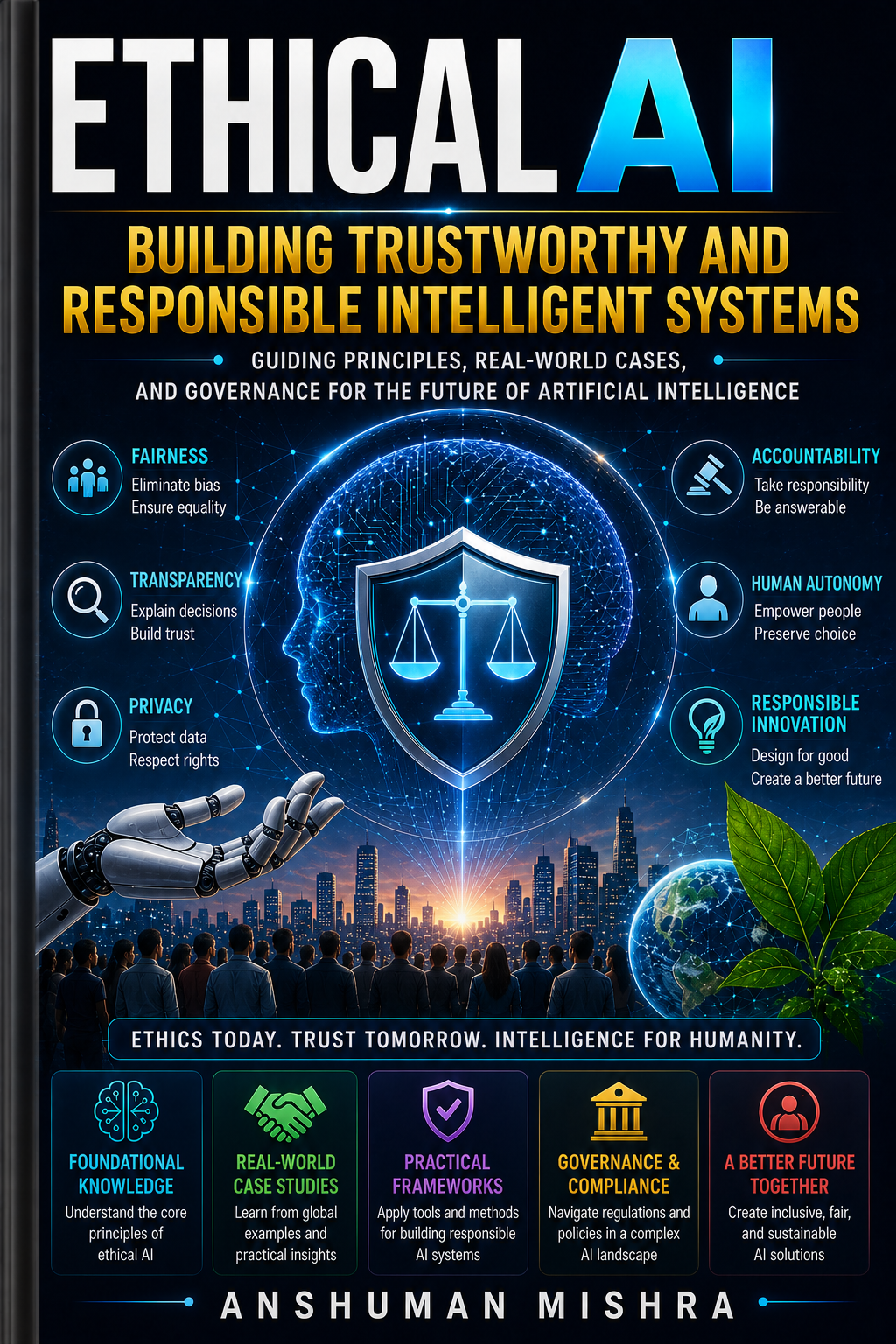
Ethical AI: Building Trustworthy and Responsible Intelligent Systems
Guiding Principles, Real-World Cases, and Governance for the Future of Artificial Intelligence
Artificial Intelligence is rapidly transforming the way people live, work, learn, communicate, and make decisions. AI systems are increasingly being used in healthcare, finance, education, transportation, employment, security, media, and public administration.
But technological capability alone is not enough.
As intelligent systems become more powerful and widespread, an equally important question emerges:
How can we ensure that AI remains fair, transparent, accountable, safe, privacy-conscious, and aligned with human values?
Ethical AI: Building Trustworthy and Responsible Intelligent Systems explores these questions through a comprehensive interdisciplinary examination of AI ethics, responsible innovation, algorithmic fairness, privacy, transparency, accountability, governance, regulation, and human-centered AI.
The book connects computer science with philosophy, law, social science, public policy, and technology governance to provide readers with both conceptual understanding and practical perspectives on responsible artificial intelligence.
Why Ethical AI Matters
Artificial intelligence can create enormous benefits, but poorly designed or improperly deployed systems can also create significant social and ethical challenges.
AI may influence decisions involving:
- Employment
- Healthcare
- Education
- Financial services
- Public services
- Security
- Criminal justice
- Advertising
- Media and information
- Personal data
Problems such as algorithmic bias, discrimination, opaque decision-making, privacy violations, misinformation, surveillance, lack of accountability, and excessive automation demonstrate why ethical considerations must become part of the AI development lifecycle.
Ethical AI is therefore not simply a theoretical subject.
It is an essential part of responsible technological development.
What This Book Covers
The book is organized into four major parts, progressing from foundational concepts to practical frameworks, governance, real-world cases, and future perspectives.
PART I — Foundations of Ethical AI
Chapter 1 — Introduction to Ethical AI
The first chapter establishes the conceptual foundation of AI ethics.
It examines:
- What Ethical AI means
- Ethics and morality
- Ethics in technological development
- The historical evolution of AI ethics
- Why ethical considerations matter in AI
- The relationship between technology and society
Readers are introduced to the idea that ethical considerations should not be treated as an afterthought. They should be incorporated throughout the design, development, deployment, and evaluation of intelligent systems.
Chapter 2 — Core Ethical Principles
This chapter introduces five central pillars of responsible AI:
Fairness and Non-Discrimination
AI systems should avoid unfair treatment and discriminatory outcomes.
The chapter explores algorithmic fairness and the challenges of ensuring equitable outcomes across different populations.
Transparency and Explainability
Users and stakeholders need meaningful information about how AI systems operate and how important decisions are produced.
The chapter introduces the importance of explainability and interpretable AI.
Accountability and Responsibility
When an AI system causes harm or produces an inappropriate decision, responsibility cannot simply be assigned to “the algorithm.”
The chapter explores organizational, developer, institutional, and governance responsibilities.
Privacy and Security
AI systems often depend on large quantities of data.
This creates important questions about data protection, consent, security, and responsible data use.
Human Autonomy and Control
AI should support human decision-making rather than unnecessarily undermine human agency.
The chapter explores human oversight, control, informed decision-making, and responsible automation.
PART II — Ethical Challenges in AI Applications
Chapter 3 — Bias and Discrimination in AI
AI systems learn from data, and data can contain historical, social, cultural, and institutional biases.
This chapter examines:
- Sources of bias in training datasets
- Data collection bias
- Algorithmic discrimination
- Model bias
- Evaluation bias
- Bias in automated decision-making
- Real-world AI case studies
- Bias detection and mitigation
Applications such as hiring, lending, predictive policing, and automated assessment demonstrate why fairness must be considered throughout the AI lifecycle.
The chapter encourages readers to view bias not merely as a technical problem but also as a social and institutional challenge.
Chapter 4 — Privacy in the Age of AI
AI has dramatically increased the ability to collect, analyze, combine, and infer information from data.
This chapter examines the ethical implications of large-scale data processing.
Key topics include:
- Data collection
- Informed consent
- Data minimization
- Personal information
- AI-enabled surveillance
- Privacy-preserving approaches
- Data security
- GDPR
- HIPAA
- Global privacy frameworks
The chapter explores the tension between the benefits of data-driven intelligence and the fundamental need to protect individual privacy.
Chapter 5 — Ethical Dilemmas in Generative AI
Generative AI has introduced a new generation of ethical challenges.
Systems capable of generating text, images, audio, video, and other forms of synthetic content raise important questions concerning authenticity, misinformation, intellectual property, creativity, and responsible use.
This chapter examines:
- Generative AI
- Deepfakes
- Synthetic media
- AI-generated misinformation
- Content authenticity
- Copyright considerations
- Creative ownership
- Responsible AI-generated content
- Misuse of generative systems
The chapter encourages readers to understand both the opportunities and responsibilities associated with increasingly powerful generative technologies.
Chapter 6 — Workplace and Automation Ethics
Automation is changing the workplace.
AI can increase productivity, support workers, automate repetitive activities, and create new forms of employment. At the same time, automation can create concerns about job displacement, worker surveillance, inequality, and algorithmic evaluation.
This chapter explores:
- Job displacement
- Job augmentation
- AI-assisted work
- Automated hiring
- Employee evaluation
- Workplace surveillance
- Labor inequality
- Responsible automation
- Ethical AI development practices
The central question is not simply whether AI will replace jobs, but how organizations can introduce AI while protecting human dignity, opportunity, and meaningful participation.
PART III — Designing and Governing Ethical AI
Chapter 7 — Ethical AI Design Frameworks
Ethics should be integrated into AI development from the beginning.
This chapter introduces practical approaches such as:
Ethics-by-Design
Ethical considerations are incorporated during system design rather than added after deployment.
Human-Centered AI
AI systems are designed around human needs, capabilities, limitations, safety, and values.
Ethics in the Software Development Lifecycle
Ethical considerations can be incorporated into:
- Requirements
- Data collection
- Model development
- Testing
- Deployment
- Monitoring
- Evaluation
- Retirement
The chapter helps readers understand how ethical thinking can become part of everyday AI engineering and project management.
Chapter 8 — Auditing and Monitoring AI Systems
AI systems can behave differently after deployment due to changing data, environments, users, or social conditions.
Continuous evaluation is therefore essential.
This chapter explores:
- AI auditing
- Risk assessment
- Model monitoring
- Red teaming
- Stress testing
- Robustness evaluation
- Interpretability
- Explainable AI
- SHAP
- LIME
- Post-deployment monitoring
The chapter emphasizes that responsible AI does not end when a model is deployed.
AI systems require ongoing evaluation and governance.
Chapter 9 — Governance and Regulation
Technology does not operate in isolation from society.
Governments, organizations, researchers, civil society, and international institutions all play important roles in shaping responsible AI.
This chapter explores:
- AI governance
- Public policy
- International cooperation
- Government regulation
- Corporate AI governance
- Internal ethics boards
- Risk management
- Regulatory frameworks
- Organizational accountability
- Future AI policy
It also examines major international approaches to AI governance and encourages readers to consider how regulation can balance innovation, safety, rights, and public interest.
PART IV — Case Studies and Future Perspectives
Chapter 10 — Global Case Studies in Ethical AI
Theoretical principles become easier to understand when examined through real-world applications.
This chapter explores case studies involving:
- Facial recognition
- Civil liberties
- Predictive policing
- Healthcare AI
- Automated diagnostics
- AI-based decision systems
Examples from different countries and sectors demonstrate that ethical AI challenges can vary according to legal systems, social values, institutional structures, and technological contexts.
The chapter encourages readers to analyze AI systems not only by technical accuracy but also by their social consequences and ethical implications.
Chapter 11 — Cultural and Social Perspectives
AI ethics cannot be separated from culture and society.
Different communities may have different expectations regarding:
- Privacy
- Autonomy
- Fairness
- Community participation
- Data ownership
- Technology
- Collective rights
- Human-machine relationships
This chapter examines ethical perspectives across the Global North and Global South, explores Indigenous knowledge systems and AI, and discusses community-driven approaches to AI development.
The goal is to encourage more inclusive approaches to technological innovation.
Chapter 12 — The Future of Ethical AI
The final chapter looks toward emerging technologies and future AI ecosystems.
Topics include:
- Artificial General Intelligence (AGI)
- Quantum AI
- Sustainable AI
- AI for climate applications
- AI in healthcare
- AI in education
- Equitable AI ecosystems
- Future governance
- Responsible innovation
As AI becomes increasingly capable, ethical frameworks will need to evolve alongside technological development.
The chapter therefore asks:
What should the future of intelligent systems look like?
And more importantly:
Who should decide what responsible AI means?
Practical and Conceptual Value
One of the distinctive features of this book is its combination of theory and practical thinking.
Readers are encouraged to move beyond simply identifying ethical problems and consider how those problems can be addressed through:
- Risk assessment
- Ethical design
- Bias evaluation
- Data governance
- Human oversight
- Explainability
- AI auditing
- Monitoring
- Organizational accountability
- Responsible deployment
This makes the book useful not only for academic study but also for understanding real-world AI development and governance.
Multidisciplinary Perspective
Ethical AI cannot be understood through computer science alone.
The book connects several disciplines:
Artificial Intelligence + Computer Science + Philosophy + Law + Social Science + Public Policy + Governance
This interdisciplinary approach helps readers understand why responsible AI requires collaboration between technical experts, policymakers, legal professionals, ethicists, researchers, organizations, and communities.
Who Should Read This Book?
Ethical AI: Building Trustworthy and Responsible Intelligent Systems is suitable for:
- Artificial Intelligence students
- Computer Science students
- Data Science students
- Machine Learning students
- Researchers
- AI developers
- Software engineers
- Technology professionals
- AI ethics researchers
- Policymakers
- Legal professionals interested in AI
- Educators and academics
- Technology managers
- Responsible AI practitioners
- Readers interested in the social impact of AI
Academic and Research Applications
The book can serve as a useful foundation for research and study in areas such as:
- AI Ethics
- Responsible AI
- Trustworthy AI
- Explainable AI
- Algorithmic Fairness
- AI Governance
- AI Regulation
- Data Ethics
- Privacy and AI
- Human-Centered AI
- AI Auditing
- Algorithmic Accountability
- Generative AI Ethics
- AI and Society
- AI Policy
- Sustainable AI
- AI Safety and Risk Management
It can also support students and researchers preparing projects, dissertations, seminars, presentations, and research discussions related to responsible artificial intelligence.
Key Learning Outcomes
After studying this book, readers can develop a stronger understanding of:
- The foundations and evolution of AI ethics.
- Core principles of fairness, transparency, accountability, privacy, and autonomy.
- Sources and consequences of algorithmic bias.
- Ethical challenges associated with AI-generated content.
- Privacy and surveillance concerns in AI applications.
- Ethical implications of workplace automation.
- Ethics-by-Design and human-centered AI approaches.
- AI auditing, monitoring, interpretability, and stress testing.
- AI governance and regulatory approaches.
- Cultural and social dimensions of AI ethics.
- Emerging challenges associated with AGI and other advanced technologies.
- Strategies for building more responsible and trustworthy AI ecosystems.
Unique Features of the Book
Multidisciplinary Approach
Brings together computer science, philosophy, law, social science, and governance.
Real-World Perspective
Uses practical scenarios and case studies to connect ethical theory with actual AI applications.
Action-Oriented Frameworks
Focuses on how ethical principles can be incorporated into AI design, development, deployment, and monitoring.
Global Perspective
Recognizes that AI ethics is shaped by different cultures, communities, legal systems, and social environments.
Future-Oriented Analysis
Explores emerging challenges involving generative AI, AGI, quantum technologies, sustainability, and future AI governance.
Why This Book Matters Today
Artificial intelligence is becoming an increasingly influential part of modern society.
The challenge is no longer simply to build systems that are more powerful.
We must also build systems that are:
Fair.
Transparent.
Accountable.
Secure.
Privacy-conscious.
Human-centered.
Inclusive.
Trustworthy.
Responsible AI requires more than technical performance. It requires an understanding of the people, communities, institutions, and values affected by intelligent systems.
This book provides a framework for thinking about that responsibility.
Final Reflection
Ethical AI: Building Trustworthy and Responsible Intelligent Systems is ultimately a guide to one of the defining challenges of the AI era:
How can humanity develop increasingly intelligent technologies without losing sight of human values?
The answer requires cooperation between technology and ethics.
AI can transform healthcare, education, business, science, and society—but the direction of that transformation depends on the choices made by the people who design, deploy, regulate, and use these systems.
The future of AI should therefore not be defined only by what machines can do.
It should also be shaped by what intelligent systems should do.
Build intelligence with responsibility.
Design technology with humanity.
Govern innovation with wisdom.
Ethical AI provides the conceptual foundation for that journey.


Reviews
There are no reviews yet.