Description
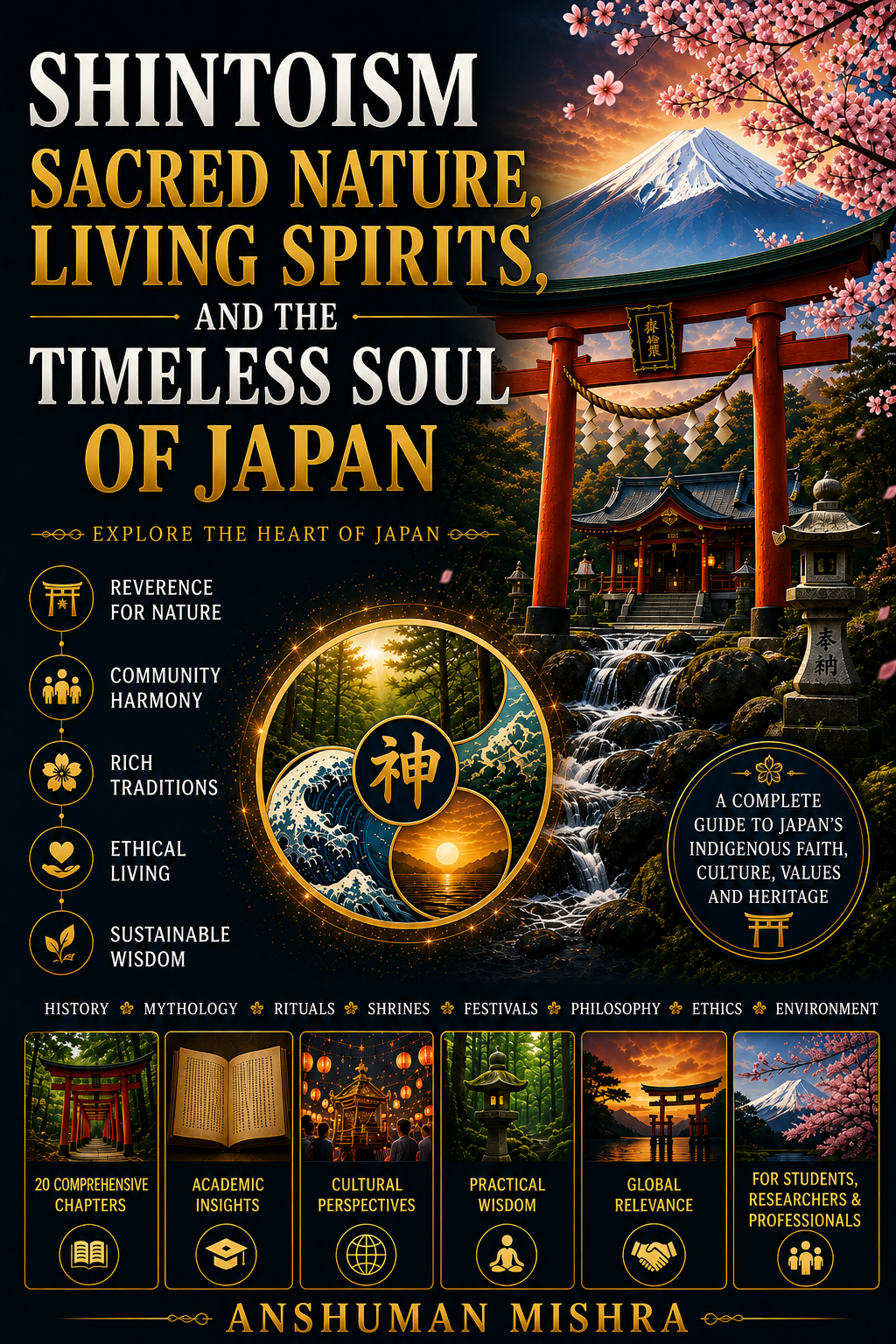
Shintoism: Sacred Nature, Living Spirits, and the Timeless Soul of Japan
An Academic and Cultural Journey into Japan’s Indigenous Spiritual Tradition
Shintoism: Sacred Nature, Living Spirits, and the Timeless Soul of Japan is a comprehensive and culturally sensitive exploration of one of Japan’s most distinctive spiritual and cultural traditions.
Rather than presenting Shinto simply as an ancient religion, this book examines it as a living tradition deeply connected with Japanese history, nature, community life, ritual, art, architecture, festivals, ethics, and cultural identity.
At the heart of Shinto is a profound relationship between human beings, nature, community, and the sacred.
The concept of Kami, the importance of sacred places, purification rituals, seasonal festivals, shrine traditions, and reverence for nature all contribute to a worldview in which the sacred can be encountered within the natural and everyday world.
This book presents these themes in an accessible academic framework while encouraging readers to approach Shintoism with cultural sensitivity and historical awareness.
What Is Shintoism?
Shinto, meaning broadly the “way of the Kami,” is deeply rooted in the cultural and religious history of Japan.
It developed through indigenous Japanese practices, local traditions, ritual customs, ancestral remembrance, and reverence for natural phenomena and sacred places.
Unlike traditions centered primarily on a single founder or a single canonical doctrine, Shinto has historically developed through ritual practice, community traditions, sacred spaces, mythology, and cultural continuity.
This book explores that distinctive character and explains how Shinto has continued to evolve alongside Japanese society.
The Central Idea: Harmony
One of the recurring themes of this book is harmony.
Shinto traditions often emphasize relationships between:
Humanity ↔ Nature
Community ↔ Individual
Past ↔ Present
Sacred ↔ Everyday Life
Tradition ↔ Renewal
This perspective makes Shinto particularly interesting for readers studying environmental ethics, cultural philosophy, comparative religion, and the relationship between spirituality and everyday life.
PART I — Foundations of Shintoism
Chapter 1 — Introduction to Shintoism
The book begins by introducing the meaning and essence of Shintoism.
Readers explore:
- The meaning of Shinto
- Shinto as a living tradition
- The relationship between humanity and nature
- Sacred awareness
- Japanese spiritual identity
- Contemporary relevance of Shinto values
The chapter establishes the foundation for understanding Shinto not simply as a collection of beliefs, but as a tradition expressed through ritual, place, community, and cultural practice.
Chapter 2 — Historical Origins of Shintoism
Shinto has deep indigenous roots in Japan.
This chapter explores:
- Early Japanese spirituality
- Indigenous ritual practices
- Community traditions
- Shrine-centered worship
- Oral transmission
- Early historical records
- Continuity and transformation
The discussion explains how practices associated with Shinto developed over long periods rather than appearing as a single, clearly defined historical system.
Chapter 3 — Sacred Sources and Foundations
Shinto mythology and historical memory provide important insights into Japanese cultural traditions.
This chapter examines:
- Sacred narratives
- Mythology
- Oral traditions
- The Kojiki
- The Nihon Shoki
- Symbolism
- Sacred storytelling
- Ritual preservation
These sources are considered as important cultural and historical texts that help readers understand how Japanese traditions have represented the sacred and remembered their past.
PART II — Kami, Nature, and Sacred Space
Chapter 4 — Kami: The Sacred Spirits of Shintoism
The concept of Kami is central to understanding Shinto.
The book explores how Kami may be associated with:
- Natural phenomena
- Mountains
- Rivers
- Forests
- Places
- Ancestral traditions
- Community protection
- Important cultural figures
Rather than reducing Kami to a single Western category such as “god” or “spirit,” the book encourages readers to understand the concept within its Japanese cultural context.
The chapter also examines how reverence for Kami can cultivate respect, gratitude, humility, and awareness of the surrounding environment.
Chapter 5 — Sacred Nature and Environmental Harmony
Nature occupies a central position in Shinto traditions.
Mountains, forests, rivers, waterfalls, trees, and other natural features can become associated with sacred presence.
This chapter explores:
- Sacred landscapes
- Mountains and forests
- Rivers and seas
- Natural cycles
- Seasonal awareness
- Ritual purity
- Environmental mindfulness
- Ecological perspectives
The book considers how Shinto’s relationship with nature can contribute to contemporary discussions about environmental responsibility and ecological awareness, while also distinguishing historical religious practices from modern environmentalism.
Chapter 6 — Shinto Shrines and Sacred Architecture
Shrines are among the most visible expressions of Shinto tradition.
This chapter explains:
- The purpose of Shinto shrines
- Sacred boundaries
- Torii gates
- Shrine spaces
- Ritual areas
- Offerings
- Daily worship
- Community functions
Special attention is given to Ise Grand Shrine, one of Japan’s most important Shinto shrine complexes.
The chapter explores its cultural importance, ritual continuity, architectural traditions, and association with renewal and preservation.
Chapter 7 — Holy Cities and Sacred Geography
Religious traditions are often connected to particular places.
This chapter explores Japan’s sacred geography through locations such as:
- Kyoto
- Nara
- Shrine landscapes
- Pilgrimage routes
- Sacred mountains
- Historic religious sites
The discussion shows how geography can become connected with memory, ritual, identity, and cultural continuity.
PART III — Ritual, Community, and Everyday Life
Chapter 8 — Rituals, Purification, and Daily Practices
Purification is an important theme within Shinto practice.
The chapter introduces:
- Ritual purity
- Purification
- Misogi
- Water purification
- Offerings
- Prayer
- Shrine visits
- Life-cycle rituals
- Everyday spiritual awareness
These practices are presented within their cultural context, helping readers understand how ritual can create a sense of renewal, respect, and connection.
Chapter 9 — Shinto Festivals and Matsuri Culture
Matsuri are an important part of Japanese cultural life.
This chapter explores festivals as occasions for:
- Community participation
- Gratitude
- Seasonal celebration
- Cultural preservation
- Ritual expression
- Local identity
- Social connection
The chapter also examines how local festivals preserve traditions across generations while adapting to contemporary society.
Chapter 10 — Food, Offerings, and Sacred Hospitality
Food can have cultural and ritual significance within Shinto contexts.
This chapter discusses:
- Offerings to Kami
- Seasonal foods
- Gratitude
- Hospitality
- Community sharing
- Respect for natural resources
- Simplicity and moderation
The broader theme is the relationship between food, nature, community, and gratitude.
Chapter 11 — Shintoism and Japanese Culture
Shinto has interacted with many dimensions of Japanese culture.
This chapter explores its relationship with:
- Art
- Poetry
- Music
- Dance
- Architecture
- Calligraphy
- Ceremonial traditions
- Aesthetic values
- Cultural identity
The chapter demonstrates how religious and cultural traditions can influence artistic expression without always being separable from broader Japanese historical development.
Chapter 12 — Shintoism in Japanese Society
This chapter focuses on the relationship between Shinto traditions and everyday social life.
Topics include:
- Family rituals
- Community relationships
- Respect
- Gratitude
- Social harmony
- Education
- Moral development
- Civic responsibility
- Contemporary society
The chapter considers how traditional values may continue to influence cultural practices in modern Japan.
PART IV — History, People, and Philosophy
Chapter 13 — Shintoism Beyond Japan
Shinto is strongly associated with Japan, but Japanese communities and cultural institutions exist around the world.
This chapter examines:
- Shinto practitioners in Japan
- Communities outside Japan
- Cultural preservation
- International appreciation
- Cultural transmission
- Nature-centered spirituality
It also considers how Shinto-related cultural practices may be understood outside their original historical and social context.
Chapter 14 — Famous Shrines, Events, and Historic Moments
The history of Shinto is closely connected with Japanese political, cultural, and institutional history.
This chapter explores:
- Shrine-centered traditions
- Ceremonial practices
- Imperial and royal rituals
- Historical developments
- Cultural change
- Continuity and adaptation
The chapter encourages readers to understand Shinto within the broader historical context of Japan rather than viewing it in isolation.
Chapter 15 — Famous Personalities and Cultural Contributors
Many individuals have contributed to the preservation, interpretation, scholarship, and cultural expression of Shinto traditions.
This chapter examines categories of contributors such as:
- Imperial patrons
- Shrine priests
- Religious figures
- Scholars
- Historians
- Artists
- Cultural interpreters
- Modern cultural ambassadors
Their work illustrates how traditions are transmitted, interpreted, preserved, and sometimes transformed across generations.
Chapter 16 — Ethics and Philosophy of Shintoism
Although Shinto does not fit neatly into a conventional philosophical system, its practices and traditions contain important ethical themes.
This chapter explores:
- Sincerity
- Purity
- Gratitude
- Respect
- Community responsibility
- Nature awareness
- Simplicity
- Self-discipline
- Ethical conduct
The chapter considers how these values can contribute to reflection on contemporary questions concerning community, environment, and responsible living.
Chapter 17 — Shintoism and the Environment
The relationship between sacred traditions and nature receives further attention in this chapter.
Topics include:
- Sacred forests
- Natural landscapes
- Land and water
- Conservation
- Environmental awareness
- Ritual relationships with nature
- Sustainability and tradition
The chapter explores the potential relevance of Shinto perspectives to modern environmental discussions while recognizing that traditional religious practice and contemporary environmental policy are not identical.
PART V — Shintoism in the Contemporary World
Chapter 18 — Shintoism in the Modern World
Shinto continues to exist within a highly modern, technological, and globalized society.
This chapter explores:
- Contemporary shrine life
- Modern religious practice
- Youth and tradition
- Cultural preservation
- Technology and heritage
- Education
- Contemporary identity
The chapter presents Shinto as a tradition capable of adapting to changing circumstances while maintaining important elements of continuity.
Chapter 19 — Global Relevance of Shinto Values
The book then considers what readers around the world may learn from Shinto traditions.
Potential areas of reflection include:
- Respect for nature
- Cultural continuity
- Community participation
- Gratitude
- Mindful living
- Respect for sacred spaces
- Cultural dialogue
- Responsible coexistence
The purpose is not to universalize Shinto or remove it from its Japanese context, but to explore how its values can contribute to broader conversations about culture, nature, and ethical living.
Chapter 20 — Conclusion: The Sacred Path of Harmony
The final chapter brings together the major themes of the book.
Shinto emerges as a tradition characterized by:
Nature
Ritual
Community
Gratitude
Purity
Continuity
Respect
Harmony
The conclusion reflects on the relationship between past and future and considers how traditional ideas can remain meaningful within a changing world.
Major Themes of the Book
🌿 Sacred Nature
Explore the relationship between spirituality and mountains, forests, rivers, trees, and seasonal cycles.
⛩️ Shrines and Sacred Spaces
Understand torii gates, shrine architecture, rituals, offerings, and sacred boundaries.
🌀 Kami
Develop a culturally informed understanding of the concept of Kami and its relationship with nature, place, ancestry, and community.
🎎 Matsuri
Explore the role of festivals in cultural identity, seasonal awareness, community life, and ritual continuity.
💧 Purification
Understand ritual purification as an important dimension of Shinto practice.
🎨 Japanese Culture
Examine connections between Shinto traditions and Japanese art, architecture, poetry, music, dance, and aesthetics.
🌏 Environment
Explore how reverence for nature can contribute to contemporary conversations about environmental awareness.
🏯 History and Heritage
Follow the development and transformation of Shinto traditions across Japanese history.
🤝 Community and Ethics
Examine themes of gratitude, sincerity, respect, responsibility, and social harmony.
Shintoism and Nature
One of the defining themes of this book is the relationship between Shinto and the natural environment.
Nature is not simply treated as a resource.
Certain natural places and phenomena may carry sacred significance within Shinto traditions.
This creates a distinctive cultural perspective in which forests, mountains, rivers, and other landscapes can become places of reverence.
The book explores this relationship historically and culturally while considering its relevance to modern discussions about ecology, conservation, sustainability, and environmental ethics.
Shinto Architecture and Cultural Heritage
Shinto shrines represent more than architectural structures.
They can function as:
- Sacred spaces
- Community centers
- Cultural heritage sites
- Places of ritual
- Locations of seasonal celebration
- Spaces for reflection and prayer
The visual simplicity and symbolic structure of shrine environments provide an important window into Japanese cultural aesthetics.
Shintoism and Japanese Identity
Shinto has played an important role in the development of Japanese cultural traditions, although Japanese religious identity is historically complex and has also been shaped by Buddhism, Confucianism, folk practices, modern secular life, and other influences.
This book therefore presents Shinto within the broader cultural history of Japan rather than treating it as an isolated tradition.
Who Should Read This Book?
Shintoism: Sacred Nature, Living Spirits, and the Timeless Soul of Japan is suitable for:
- Students of Japanese studies
- Religious studies students
- Philosophy students
- History students
- Cultural studies students
- Anthropology students
- Environmental ethics researchers
- Comparative religion scholars
- Spirituality enthusiasts
- Japan and Japanese culture enthusiasts
- Educators
- Researchers
- General readers interested in world traditions
Academic and Research Applications
The book can support study and research in areas such as:
- Shinto studies
- Japanese religious history
- Comparative religion
- Japanese culture
- Religious anthropology
- Philosophy of religion
- Environmental ethics
- Sacred geography
- Cultural heritage studies
- Japanese history
- Religious architecture
- Ritual studies
- Nature and spirituality
- Cultural identity
- East Asian studies
It can also serve as a supplementary resource for seminars, classroom discussions, cultural studies projects, research papers, and interdisciplinary studies.
Key Learning Outcomes
After studying this book, readers should be able to:
- Explain the historical and cultural foundations of Shintoism.
- Understand the concept of Kami within its Japanese context.
- Describe the role of shrines and sacred spaces.
- Understand the importance of torii gates and ritual boundaries.
- Explain the cultural significance of purification practices.
- Explore the role of matsuri festivals in Japanese communities.
- Understand Shinto’s relationship with nature and sacred geography.
- Identify connections between Shinto and Japanese arts and aesthetics.
- Examine Shinto traditions within modern Japanese society.
- Explore the relationship between spirituality, cultural heritage, and environmental awareness.
- Compare Shinto with other religious and philosophical traditions.
- Reflect critically on the continuing relevance of traditional spiritual values.
Why This Book Matters
In a rapidly changing world, traditions connected to nature, community, gratitude, cultural memory, and mindful practice provide important subjects for reflection.
Shinto offers a distinctive example of how spirituality can be embedded within:
Landscape
Ritual
Architecture
Festivals
Family
Community
Seasonal cycles
Everyday life
Studying Shinto therefore provides more than an introduction to a Japanese religious tradition.
It offers an opportunity to examine how human societies create relationships between nature, culture, identity, memory, and the sacred.
Final Reflection
Shintoism: Sacred Nature, Living Spirits, and the Timeless Soul of Japan is an invitation to understand Japan through one of its deepest cultural traditions.
Its journey moves from ancient practices to modern life, from sacred forests to urban shrines, from mythology to festivals, and from traditional rituals to contemporary cultural identity.
At the center of this journey is a simple but powerful idea:
The world around us can be approached with respect, gratitude, and awareness.
Shinto’s continuing significance lies not only in its historical heritage but also in the ways its traditions continue to connect people with place, community, nature, memory, and cultural continuity.
For students, researchers, and curious readers, this book offers a structured pathway into the history, philosophy, rituals, cultural expressions, and contemporary relevance of Shintoism.
Explore the sacred landscape of Japan.
Discover the world of Kami.
Understand the meaning of ritual and renewal.
And journey into the timeless relationship between nature, culture, and the human spirit.


Reviews
There are no reviews yet.