Description
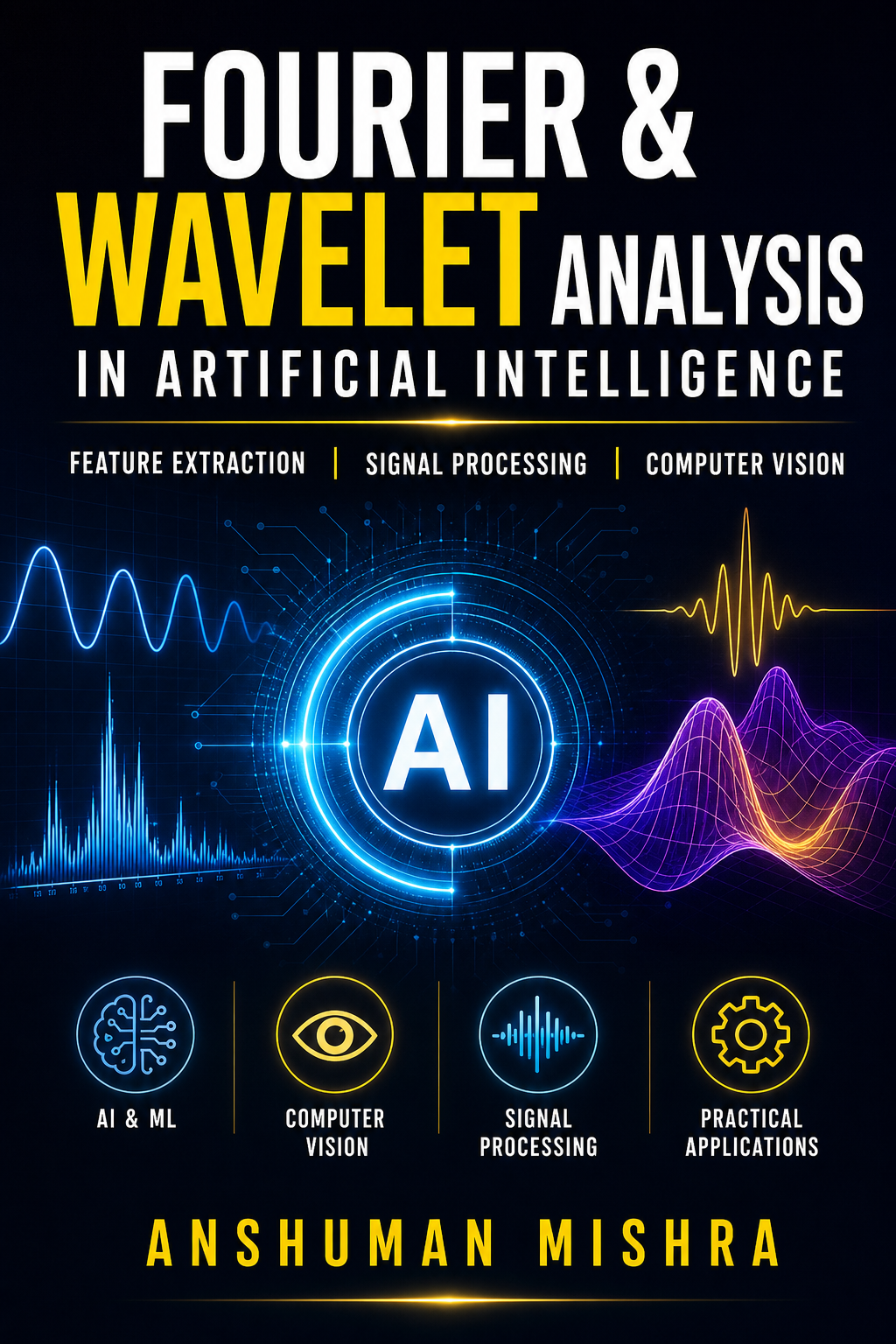
Fourier and Wavelet Analysis in Artificial Intelligence
Foundations, Techniques, and Applications in Feature Extraction and Computer Vision
Author: Anshuman Mishra
Artificial Intelligence increasingly depends on the ability to process and understand complex forms of data. Images, speech, biomedical measurements, IoT sensor streams, audio signals, and other real-world information are fundamentally signals. Before an AI system can classify, predict, recognize, or make decisions from such data, it must extract meaningful patterns and representations.
This is where Fourier Analysis and Wavelet Analysis become powerful mathematical tools.
Fourier and Wavelet Analysis in Artificial Intelligence: Foundations, Techniques, and Applications in Feature Extraction and Computer Vision presents a systematic study of these techniques and explains how they support modern Machine Learning, Deep Learning, Computer Vision, Speech Processing, Biomedical AI, and intelligent sensor systems.
The book combines mathematical foundations, signal-processing concepts, computational techniques, AI applications, practical implementations, and research directions into a unified learning resource.
Why Fourier and Wavelet Analysis Matter in AI
Modern AI systems process enormous quantities of data. However, raw data is not always the most useful representation for learning.
A signal may contain:
- Noise
- Redundant information
- Hidden periodic patterns
- Local variations
- Transient events
- Frequency-dependent characteristics
- Spatial and temporal structures
Transform methods help reveal these hidden characteristics.
Fourier Analysis
Fourier methods represent signals in terms of their frequency components. They are particularly useful for identifying periodic structures, analyzing spectral characteristics, filtering signals, and extracting frequency-based features.
Applications include:
- Speech analysis
- Image processing
- Audio classification
- Signal filtering
- Computer vision
- Time-series analysis
- Feature extraction
Wavelet Analysis
Wavelets provide a multi-resolution representation of signals. Unlike traditional Fourier analysis, wavelets can provide useful information about both where a feature occurs and at what scale it occurs.
This makes wavelets particularly valuable for:
- Non-stationary signals
- Biomedical signals
- Image processing
- Edge detection
- Denoising
- Anomaly detection
- Speech recognition
- Sensor intelligence
The book demonstrates how these mathematical methods can become powerful components of AI pipelines.
Unit I — Foundations of Fourier and Wavelet Analysis
Chapter 1 — Introduction to Fourier and Wavelet Methods in AI
The book begins with the historical development of signal analysis and its relationship with Artificial Intelligence.
Topics include:
- Evolution of signal analysis
- Fourier analysis in classical Machine Learning
- Emergence of wavelet analysis
- Signal processing in AI
- Speech and audio applications
- Computer Vision applications
- Sensor-data analysis
- Motivation for hybrid transform-based AI
Readers are introduced to the fundamental idea that mathematical transforms can convert complex raw signals into representations that are more suitable for intelligent processing.
Chapter 2 — Fundamentals of Fourier Analysis
This chapter establishes the mathematical foundation of Fourier analysis.
It covers:
- Fourier Series
- Fourier Transform
- Continuous Fourier Transform
- Discrete Fourier Transform
- Fast Fourier Transform
- Frequency-domain representation
- Spectral interpretation
- Advantages and limitations of Fourier methods
The chapter also discusses why Fourier methods can become less effective when dealing with strongly non-stationary signals.
Chapter 3 — Fundamentals of Wavelet Analysis
Wavelet analysis provides an alternative perspective for studying signals across different scales.
The chapter introduces:
- Wavelets
- Multiresolution analysis
- Continuous Wavelet Transform
- Discrete Wavelet Transform
- Wavelet packets
- Filter banks
- Time-scale analysis
- Advantages of wavelets over traditional Fourier representations
The mathematical and intuitive perspectives are presented together to help learners understand why wavelets are useful in modern AI applications.
Unit II — Signal Processing Foundations for AI
Chapter 4 — Digital Signal Processing Basics
A strong understanding of Digital Signal Processing is essential for transform-based AI.
This chapter discusses:
- Sampling theorem
- Nyquist criterion
- Aliasing
- Convolution
- Correlation
- Windowing
- Spectral leakage
- Noise filtering
- Denoising
- AI-oriented DSP pipelines
The chapter connects classical DSP principles with contemporary Machine Learning workflows.
Chapter 5 — Time-Frequency Analysis
Many real-world signals change over time. A single frequency representation may therefore be insufficient.
This chapter introduces:
- Short-Time Fourier Transform
- STFT
- Spectrograms
- Scalograms
- Time-frequency representations
- Limitations of STFT
- Wavelet-based time-frequency analysis
- Audio applications
- Biomedical signal applications
A detailed comparison between Fourier and Wavelet approaches helps readers select appropriate techniques for different AI problems.
Unit III — Fourier and Wavelets in Machine Learning
Chapter 6 — Feature Extraction with Fourier Transforms
Feature extraction is one of the most important stages of an AI pipeline.
This chapter explores:
- Fourier descriptors
- Shape analysis
- Frequency-domain texture analysis
- Signal compression
- Signal representation
- Fourier-based features
- Classification applications
A practical case study demonstrates how Fourier-derived features can be used in ECG signal classification.
Chapter 7 — Feature Extraction with Wavelets
Wavelet coefficients can provide compact and informative representations of complex signals.
The chapter covers:
- Wavelet-based texture features
- Edge features
- Signal denoising
- Dimensionality reduction
- Wavelet coefficients
- Feature selection
- Wavelet packet features
- Feature fusion
A speech-recognition case study demonstrates how wavelet features can support Machine Learning systems.
Chapter 8 — Fourier and Wavelet Transforms in Deep Learning
Transform methods are increasingly being integrated directly into Deep Learning architectures.
Topics include:
- Fourier Neural Operators
- Wavelet scattering networks
- CNN-wavelet architectures
- Frequency-domain convolution
- Transform-based Deep Learning
- Hybrid AI architectures
A case study explores image classification using a wavelet-CNN architecture.
Unit IV — Applications in Computer Vision and AI Systems
Chapter 9 — Image Processing with Fourier and Wavelets
Images contain rich spatial and frequency information.
This chapter examines:
- Frequency-domain image filtering
- Image denoising
- Image enhancement
- Image compression
- JPEG and JPEG2000
- Wavelet-based edge detection
- Corner detection
- Image watermarking
- Steganography
- Face recognition
Readers learn how mathematical transforms can contribute to practical Computer Vision pipelines.
Chapter 10 — Speech and Audio Processing
Speech and audio signals are naturally suited to frequency and time-frequency analysis.
The chapter covers:
- Fourier features
- Phoneme recognition
- Speech enhancement
- Wavelet-based speech analysis
- Noise suppression
- Real-time audio processing
- Music classification
- Speaker recognition
A practical case study demonstrates how transform-based features can be incorporated into an AI speaker-recognition system.
Chapter 11 — Biomedical and Sensor Data Analysis
Biomedical and sensor signals frequently contain complex temporal patterns.
Applications explored include:
- ECG analysis
- EEG analysis
- Biomedical signal denoising
- Frequency-domain medical analysis
- IoT sensor monitoring
- Fault detection
- Brain-Computer Interfaces
- Feature extraction
- AI-assisted disease detection
The chapter demonstrates how Fourier and Wavelet representations can support intelligent analysis of physiological and sensor data.
Chapter 12 — Advanced Applications in AI
The book then moves toward advanced AI applications.
Topics include:
- Fourier analysis in reinforcement learning environments
- Wavelet-based anomaly detection
- Wavelet compression for Edge AI
- Transform methods for data streams
- Fourier-inspired approaches in NLP
- Hybrid transform-based AI
- Quantum Fourier Transform
- Future research opportunities
This chapter provides a bridge between established mathematical techniques and emerging AI research.
Unit V — Practical Implementation and Case Studies
Chapter 13 — Tools and Frameworks
Theory becomes more useful when learners can implement it computationally.
The book introduces practical tools including:
Python
Using:
- NumPy
- SciPy
- PyWavelets
MATLAB
For:
- Signal processing
- Transform computation
- Visualization
- Numerical experimentation
Deep Learning Frameworks
Including:
- TensorFlow
- PyTorch
Computer Vision
Using:
- OpenCV
The chapter also discusses FFT libraries, computational optimization, and practical laboratory exercises.
Chapter 14 — Case Studies and Projects
The book provides application-oriented projects that help readers connect theory with complete AI workflows.
Projects include:
Real-Time Face Recognition
Using transform-based image processing as part of a Computer Vision pipeline.
AI-Based Medical Diagnosis
Using wavelet-derived biomedical features.
Music Recommendation
Using frequency-based audio features.
AI-Driven Image Compression
Applying transform methods for efficient image representation.
Hybrid Fourier-Wavelet AI Pipeline
Combining Fourier and Wavelet representations with Machine Learning or Deep Learning models.
Unit VI — Research Directions and Future Scope
Chapter 15 — Emerging Trends in Fourier and Wavelet AI
The final chapter explores the future of transform-based Artificial Intelligence.
Topics include:
- Deep wavelet scattering
- Fourier Neural Operators
- Fourier methods for large-scale learning
- Graph learning
- Cross-domain transform fusion
- Hybrid AI architectures
- Computational limitations
- Scalability
- Interpretability
- Open research problems
The chapter encourages readers to investigate how classical mathematical analysis can contribute to next-generation AI.
Why This Book Is Important
1. Connects Mathematics with Artificial Intelligence
Fourier and Wavelet analysis are not presented as isolated mathematical subjects. Their concepts are directly connected with:
- Machine Learning
- Deep Learning
- Computer Vision
- Speech Processing
- Biomedical AI
- Sensor intelligence
This makes mathematical learning more meaningful and application-oriented.
2. Focuses on Feature Extraction
The quality of representation strongly affects the performance of an AI system.
Transform-based feature extraction can help reveal:
- Frequency patterns
- Local structures
- Transient events
- Texture information
- Periodic behavior
- Signal abnormalities
The book demonstrates how these representations can become inputs for intelligent models.
3. Provides a Multi-Domain Perspective
Fourier and Wavelet methods can be applied to many different data types.
Images
Filtering, compression, texture analysis, recognition, and enhancement.
Audio
Speech recognition, speaker recognition, music classification, and noise reduction.
Biomedical Signals
ECG, EEG, disease-related signal analysis, and BCI applications.
IoT
Sensor monitoring, anomaly detection, and fault diagnosis.
Computer Vision
Feature extraction, object recognition, image processing, and face recognition.
Fourier vs. Wavelet Analysis
One of the important conceptual comparisons developed throughout the book is:
| Fourier Analysis | Wavelet Analysis |
|---|---|
| Strong frequency representation | Time-scale representation |
| Excellent for stationary patterns | Effective for non-stationary patterns |
| Global frequency information | Localized information |
| Widely used in spectral analysis | Powerful for multi-resolution analysis |
| FFT enables efficient computation | DWT enables efficient multi-scale processing |
Understanding these differences helps readers select the appropriate mathematical representation for a particular AI problem.
Fourier and Wavelets in Deep Learning
The book also demonstrates that transform methods are not competing with Deep Learning. Instead, they can complement it.
Transform-based methods can be used for:
- Preprocessing
- Feature extraction
- Denoising
- Compression
- Frequency-domain learning
- Model design
- Data representation
- Hybrid neural architectures
This leads to a powerful conceptual framework:
Raw Data
↓
Signal Processing
↓
Fourier / Wavelet Transform
↓
Feature Representation
↓
Machine Learning / Deep Learning
↓
Prediction or Decision
Such pipelines can be particularly valuable when raw data contains significant noise, redundancy, or complex temporal and spatial patterns.
Practical Learning Approach
The book follows a balanced educational approach.
Each major topic is developed through:
Concept → Mathematics → Visualization → Algorithm → Implementation → AI Application
Readers are therefore encouraged not only to memorize transform formulas but to understand:
- Why a transform is needed
- How it works
- What information it reveals
- How it can be computed
- How its output can become an AI feature
- What its limitations are
Key Features of the Book
📘 Comprehensive Coverage
From Fourier Series and DFT to Wavelets, STFT, feature extraction, and advanced AI applications.
🧮 Mathematical Foundation
Important concepts are explained through mathematical formulations and intuitive interpretations.
🤖 AI-Centric Applications
The book consistently connects signal-processing techniques with Machine Learning and Artificial Intelligence.
👁️ Computer Vision Focus
Dedicated coverage of image processing, compression, filtering, recognition, and transform-based vision systems.
🎙️ Speech and Audio Applications
Includes speech enhancement, phoneme recognition, speaker recognition, and music classification.
🏥 Biomedical Applications
Explores ECG, EEG, BCI, disease detection, and biomedical signal processing.
💻 Practical Programming
Introduces Python, NumPy, SciPy, PyWavelets, MATLAB, TensorFlow, PyTorch, and OpenCV.
🔬 Research Orientation
Covers Fourier Neural Operators, wavelet scattering, hybrid AI, graph learning, and Quantum Fourier Transform.
Learning Outcomes
After studying this book, readers will be able to:
- Understand the mathematical foundations of Fourier analysis.
- Explain Fourier Series and Fourier Transform.
- Understand DFT and FFT algorithms.
- Interpret signals in the frequency domain.
- Understand the limitations of purely frequency-based analysis.
- Explain the fundamental principles of wavelets.
- Apply CWT and DWT concepts.
- Understand multiresolution analysis.
- Perform basic time-frequency analysis.
- Understand STFT, spectrograms, and scalograms.
- Extract Fourier-based features for Machine Learning.
- Extract Wavelet-based features from complex signals.
- Apply transform methods to Computer Vision.
- Use Fourier and Wavelet methods for speech and audio analysis.
- Analyze ECG and EEG signals using transform-based techniques.
- Apply wavelet methods for denoising and anomaly detection.
- Understand transform-based Deep Learning architectures.
- Work with Python signal-processing libraries.
- Implement transform-based AI pipelines.
- Understand emerging research directions in Fourier and Wavelet AI.
Who Should Read This Book?
🎓 Undergraduate Students
Suitable for students of:
- Computer Science
- Artificial Intelligence
- Data Science
- Electronics
- Electrical Engineering
- Applied Mathematics
🎓 Postgraduate Students
Useful for MCA, M.Tech, MSc, and related postgraduate programs involving AI, signal processing, Machine Learning, and Computer Vision.
🔬 Researchers
Particularly relevant to research in:
- AI
- Computer Vision
- Signal Processing
- Biomedical AI
- Speech Recognition
- Deep Learning
- Transform-based learning
- Edge AI
💻 Industry Professionals
AI engineers, data scientists, signal-processing engineers, and Computer Vision professionals can use the book to strengthen their understanding of mathematical feature extraction and transform-based AI pipelines.
👨🏫 Educators
The structured chapter organization makes the book suitable as a reference or supplementary textbook for courses involving:
- Digital Signal Processing
- Machine Learning
- Artificial Intelligence
- Computer Vision
- Mathematical Foundations of AI
- Image Processing
Practical Applications
The knowledge developed in this book can be applied to:
- Face recognition
- Object recognition
- Image enhancement
- Image compression
- Speech recognition
- Speaker identification
- Music classification
- ECG analysis
- EEG analysis
- Disease detection
- Brain-Computer Interfaces
- IoT anomaly detection
- Sensor monitoring
- Edge AI
- Intelligent signal classification
Future Scope
The field continues to evolve toward hybrid approaches combining mathematical transforms with modern AI.
Potential research directions include:
- Fourier Neural Operators
- Wavelet Neural Networks
- Wavelet scattering
- Transform-based Transformers
- Frequency-domain Deep Learning
- Graph Fourier methods
- Hybrid CNN-Wavelet models
- Edge AI compression
- Quantum Fourier Transform applications
- Multi-resolution AI
- Explainable signal-based AI
These areas demonstrate that classical mathematical methods remain highly relevant even as AI architectures become increasingly sophisticated.
Final Perspective
Fourier and Wavelet Analysis in Artificial Intelligence: Foundations, Techniques, and Applications in Feature Extraction and Computer Vision presents Fourier and Wavelet analysis as powerful bridges between mathematics, signal processing, and intelligent computation.
The book follows a clear progression:
Signal → Transform → Representation → Feature → Learning → Intelligence
For students, it provides a structured foundation in transform-based signal analysis.
For researchers, it introduces mathematical tools and emerging AI research directions.
For professionals, it demonstrates practical applications across vision, audio, biomedical systems, and sensor intelligence.
Ultimately, the book shows that even in the age of advanced Deep Learning, classical mathematical ideas such as Fourier and Wavelet analysis continue to provide valuable tools for making AI systems more efficient, interpretable, and capable of understanding complex signals.


Reviews
There are no reviews yet.