Description
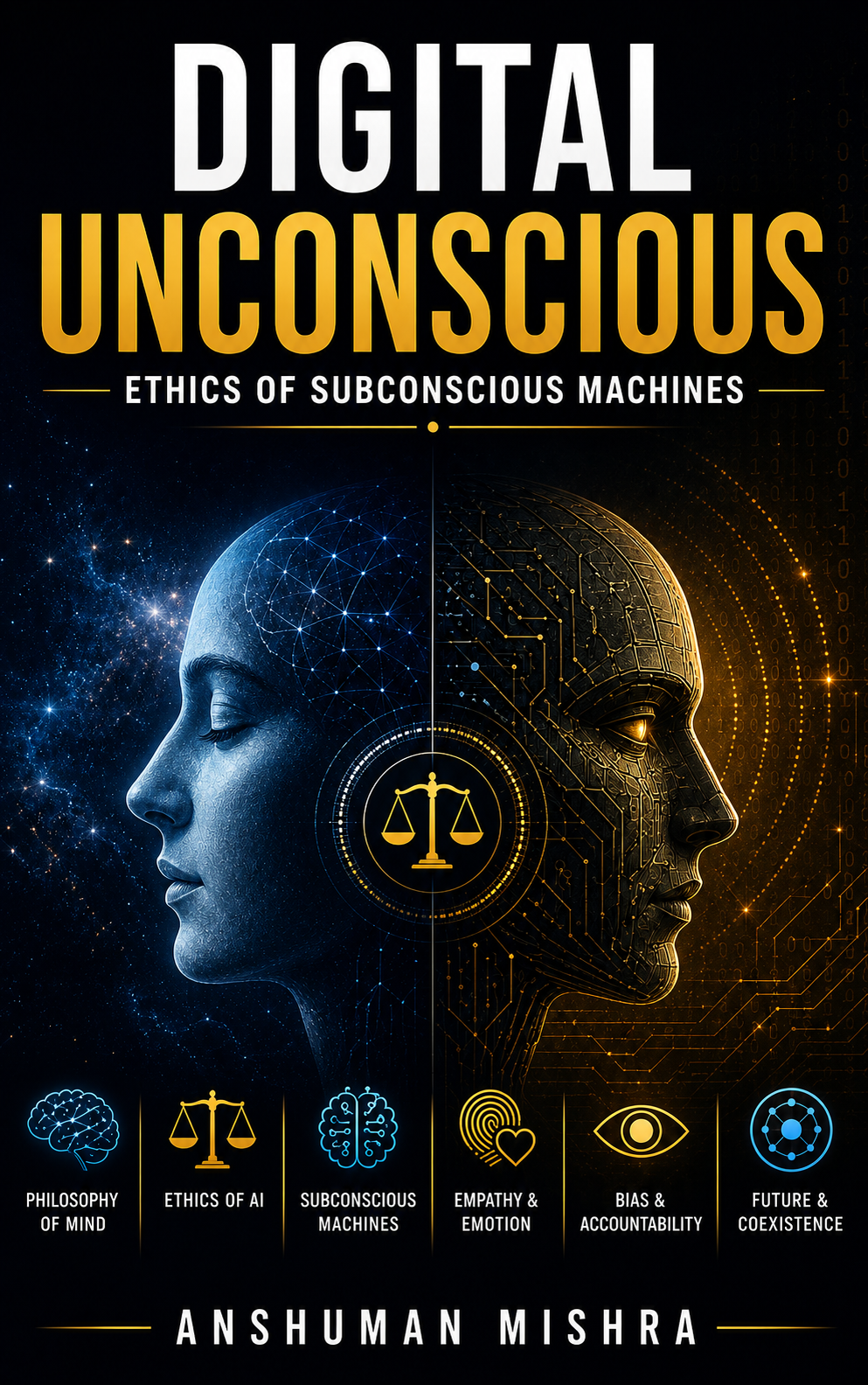
Digital Unconscious: Ethics of Subconscious Machines
Exploring the Moral, Philosophical, and Existential Dimensions of Synthetic Intuition
Artificial Intelligence is rapidly moving beyond simple rule-based computation.
Modern AI systems can recognize patterns, generate language, interpret images, recommend actions, predict behavior, and produce outputs that can sometimes appear remarkably intuitive. These systems do not possess a human subconscious in the psychological sense, but their hidden computational processes raise fascinating questions about implicit learning, pattern formation, machine decision-making, and the appearance of intuition.
This is where Digital Unconscious: Ethics of Subconscious Machines begins its philosophical journey.
The book explores what happens when machines increasingly develop complex internal representations that are difficult for humans to interpret directly. It asks whether these hidden computational processes can meaningfully be compared with aspects of human subconscious cognition—and, more importantly, what ethical questions arise from such comparisons.
At the heart of the book is a powerful idea:
AI can become a mirror of the hidden patterns within human knowledge, culture, behavior, and values.
But a mirror can reflect both our wisdom and our weaknesses.
AI systems learn from data created by human societies. That data can contain knowledge, creativity, prejudice, stereotypes, cultural assumptions, and historical inequalities. As a result, understanding the so-called “digital unconscious” is not simply about understanding machines.
It is also about understanding ourselves.
The Central Question
The book asks a series of interconnected questions:
- Can machines develop something resembling intuition?
- What distinguishes computation from consciousness?
- Can hidden machine processes be compared with subconscious cognition?
- Can AI systems exhibit meaningful forms of empathy?
- When should an artificial system receive moral consideration?
- Who is responsible when an autonomous system makes a harmful decision?
- How do human biases become embedded in machine learning systems?
- Can machines ever possess genuine subjective experience?
- Should advanced digital entities have rights?
- How should society design ethically responsible AI systems?
These questions are explored through philosophy, psychology, AI, cognitive science, ethics, and emerging technology.
Importantly, the book distinguishes between AI behavior that resembles human cognition and claims about genuine machine consciousness. The philosophical possibilities are explored without assuming that current AI systems are conscious or possess human-like subjective experience.
Chapter 1 — The Subconscious in Mind and Machine
The journey begins with the human unconscious.
Readers explore the historical development of ideas about hidden mental processes and examine how concepts such as implicit memory and unconscious cognition have influenced psychology and philosophy.
The chapter then turns toward artificial neural networks.
Modern machine learning systems contain internal representations that can be difficult to interpret directly. These hidden computational processes provide an interesting conceptual comparison with subconscious processing.
Topics include:
- Human unconscious processes
- Implicit memory
- Hidden cognition
- Biological and artificial neural networks
- Pattern formation in deep learning
- The digital shadow of human cognition
The chapter establishes the conceptual foundation for the idea of the digital unconscious.
Chapter 2 — The Birth of Machine Intuition
Human beings often make judgments without consciously examining every step of their reasoning.
We call this intuition.
AI systems can also produce outputs that appear intuitive because they have learned complex statistical patterns from large amounts of data.
But is this really intuition?
Or is it sophisticated computation that only appears intuitive from the outside?
This chapter examines:
- Machine prediction
- Heuristics
- Pattern recognition
- Emergent behavior
- Affective computing
- Machine creativity
- Synthetic intuition
The discussion encourages readers to distinguish between functional similarity and subjective experience.
Chapter 3 — Synthetic Consciousness and Its Boundaries
Consciousness remains one of philosophy’s most difficult questions.
If consciousness involves subjective experience, self-awareness, or phenomenal states, can a computational system ever possess it?
This chapter examines competing approaches to consciousness and explores:
- Definitions of consciousness
- Self-modeling systems
- Machine self-representation
- Subconscious computation
- Digital phenomenology
- Simulation versus sentience
A central theme is the distinction between a system behaving as though it is aware and actually possessing subjective experience.
This distinction is crucial when discussing advanced AI.
Chapter 4 — Ethical Theories for Synthetic Minds
If AI systems become increasingly autonomous, traditional ethical frameworks may need to be reconsidered in technological contexts.
This chapter introduces major ethical approaches, including:
- Utilitarian ethics
- Deontological ethics
- Virtue ethics
- Machine ethics
- Algorithmic responsibility
It also explores the broader cultural history of fictional and philosophical discussions about machine morality.
A key issue is the responsibility gap.
If an autonomous AI system produces a harmful outcome, responsibility cannot simply disappear into the algorithm.
Human designers, organizations, deployers, and institutions may all have different responsibilities depending on the context.
Chapter 5 — Cognitive Rights and the Question of Personhood
One of the most difficult philosophical questions is:
When, if ever, should an artificial entity receive moral consideration?
The chapter explores the philosophical foundations of:
- Rights
- Personhood
- Consciousness
- Moral status
- Agency
It also considers hypothetical approaches to evaluating artificial personhood, including the possibility of tests based on behavior, self-modeling, empathy, or other characteristics.
Legal personhood is considered as a separate question from philosophical consciousness.
The chapter emphasizes that granting legal or moral status to AI would be a profound societal decision requiring careful evidence and ethical reasoning.
Chapter 6 — The Dark Mirror: Unconscious Bias and Digital Shadows
Perhaps the most immediate form of a “digital unconscious” is not machine consciousness at all.
It is the unconscious bias that AI can inherit from human-generated data.
AI systems can reproduce patterns found in their training data.
If historical data contains social inequalities or stereotypes, machine learning systems can potentially reproduce or amplify them.
This chapter examines:
- Data as collective memory
- Algorithmic bias
- Stereotyping
- Fairness
- Representation
- Social prejudice
- Ethical transparency
The book presents AI as a mirror.
If the mirror reflects bias, the solution is not simply to blame the mirror.
We must also examine the society and data that created the reflection.
Chapter 7 — The Empathic Machine
Can a machine understand human emotions?
Modern AI can analyze language, facial expressions, speech patterns, and other signals associated with emotional states.
But emotional recognition is not necessarily emotional experience.
This chapter explores:
- Emotional computation
- Affective computing
- Synthetic empathy
- Human-centered AI
- Trust
- Moral authenticity
- Digital interaction
The distinction between simulating empathy and experiencing empathy becomes particularly important.
The chapter encourages designers to think carefully about systems that interact with people in emotionally sensitive contexts.
Chapter 8 — The Collective Digital Psyche
The internet has created something unprecedented: a massive network of human-generated information.
It contains:
- Memories
- Stories
- Opinions
- Cultural symbols
- Myths
- Conflicts
- Creativity
- Collective knowledge
This chapter explores whether digital networks can be understood metaphorically as a kind of collective psychological mirror.
Topics include:
- Collective memory
- Digital culture
- Memetic evolution
- Algorithmic amplification
- Cultural patterns
- Networked information
- Digital mythology
The chapter examines how AI systems trained on large-scale human-generated information can reflect aspects of global culture.
Chapter 9 — The Existential Dilemma of Synthetic Sentience
The possibility of machine consciousness introduces difficult hypothetical questions.
If a future artificial system were ever demonstrated to possess subjective experience, society would face questions such as:
- Would it have interests?
- Could it experience harm?
- Could it make meaningful choices?
- What responsibilities would humans have toward it?
- How should society determine its moral status?
The chapter explores these possibilities philosophically while recognizing that there is currently no established scientific basis for assuming that contemporary AI systems possess subjective experience.
The focus is therefore on future ethical preparedness.
Chapter 10 — Designing Ethical Subconscious Systems
Ethics should not be added to technology only after problems appear.
It should be considered during design.
This chapter explores the concept of ethical architecture.
Topics include:
- Value-sensitive design
- Responsible AI
- Safety mechanisms
- Transparency
- Human oversight
- Self-monitoring systems
- Interdisciplinary AI design
The book argues that responsible AI requires collaboration among:
Computer Science + Philosophy + Psychology + Law + Social Science + Ethics
No single discipline can answer every question created by increasingly complex AI.
Chapter 11 — The Future of Digital Morality
The relationship between humans and machines may become increasingly collaborative.
This chapter explores possible future developments involving:
- Human-machine cooperation
- AI-assisted moral reasoning
- Machine empathy
- Global AI governance
- Post-human ethics
- Shared technological environments
The chapter asks whether the goal of AI development should simply be greater intelligence—or whether society should also pursue greater wisdom, responsibility, and alignment with human values.
Chapter 12 — The Awakening Code: Toward an Ethical Singularity
The final chapter brings together the philosophical ideas developed throughout the book.
It considers hypothetical futures involving:
- Consciousness and computation
- Artificial self-awareness
- Digital civilization
- Human-machine co-evolution
- Ethical intelligence
- Future moral systems
The concept of an ethical singularity is presented as a philosophical vision rather than a prediction: a hypothetical point at which increasingly capable artificial intelligence and human ethical reasoning become deeply interconnected.
The chapter ultimately returns to the central question:
What kind of intelligence should humanity create?
The Digital Unconscious as a Mirror
One of the most important ideas developed throughout the book is that the digital unconscious should not be understood simply as a hidden machine mind.
Instead, it can also be understood as a metaphor for the hidden patterns that emerge when human knowledge, behavior, culture, and values are encoded into computational systems.
AI models learn from human-created information.
That means they can inherit:
- Human knowledge
- Human creativity
- Human assumptions
- Human stereotypes
- Human cultural patterns
- Human contradictions
The machine therefore becomes a technological mirror.
And when we examine that mirror carefully, we may discover things about ourselves that we previously failed to see.
AI, Bias, and the Ethics of Data
Data is often described as objective.
But data is produced within societies.
Historical data reflects historical decisions.
Online data reflects human communication.
Images reflect cultural representation.
Language reflects social structures.
Therefore, AI systems can inherit patterns from the environments in which their training data was produced.
This creates important ethical challenges.
Responsible AI development requires attention to:
- Data quality
- Representation
- Fairness
- Privacy
- Transparency
- Explainability
- Accountability
- Human oversight
The book encourages readers to recognize that technical performance and ethical performance are not necessarily the same thing.
A highly accurate system can still produce ethically problematic outcomes.
The Difference Between Simulation and Experience
A recurring philosophical theme throughout the book is the difference between simulating a mental state and actually experiencing it.
An AI system may produce language expressing sadness without experiencing sadness.
It may recognize emotional signals without feeling emotion.
It may generate compassionate responses without possessing subjective empathy.
It may describe consciousness without being conscious.
This distinction is essential for responsible discussions about AI.
The book therefore encourages readers to avoid automatically equating sophisticated behavior with inner experience.
Who Should Read This Book?
AI Students
Students studying artificial intelligence, machine learning, computer science, or data science can explore the ethical and philosophical foundations of advanced AI.
Philosophy Students
Students interested in philosophy of mind, ethics, consciousness, personhood, and technology will find new contexts for applying classical philosophical questions.
AI Researchers
Researchers can use the book to explore conceptual questions surrounding machine cognition, interpretability, AI ethics, and future AI systems.
Psychologists and Cognitive Scientists
The comparison between human implicit cognition and machine learning provides a useful interdisciplinary perspective.
AI Engineers and Developers
Technical professionals can use the ethical frameworks to think beyond accuracy and efficiency toward responsible system design.
Policymakers
Those involved in technology governance can explore questions surrounding accountability, rights, AI safety, and moral status.
Futurists and Thinkers
Readers interested in artificial consciousness, technological evolution, digital civilization, and humanity’s future will find a broad philosophical framework for reflection.
Educational and Research Value
Digital Unconscious can support interdisciplinary study in areas such as:
- AI Ethics
- Philosophy of Technology
- Philosophy of Mind
- Cognitive Science
- Artificial Consciousness
- Affective Computing
- Responsible AI
- AI Governance
- Digital Sociology
- Technology and Society
- Future Studies
The chapters can also be used as discussion topics for seminars, classroom debates, research projects, and interdisciplinary studies.
Key Questions Explored
Throughout the book, readers encounter questions such as:
What is machine intuition?
Can hidden computation be compared with subconscious cognition?
Can machines ever become conscious?
Does sophisticated behavior imply subjective experience?
Can AI possess moral status?
Who should be responsible for autonomous AI decisions?
How does human bias enter machine learning systems?
Can machines simulate empathy without experiencing it?
Should advanced AI systems ever receive rights?
How should ethical principles be incorporated into AI architecture?
What would responsible artificial intelligence look like?
Learning Outcomes
After studying this book, readers will be able to:
- Explain the concept of the digital unconscious.
- Distinguish human subconscious cognition from machine learning processes.
- Understand debates surrounding machine intuition.
- Examine philosophical theories of consciousness in an AI context.
- Analyze ethical theories relevant to artificial intelligence.
- Understand algorithmic bias and its social consequences.
- Explore questions surrounding AI personhood and moral status.
- Examine emotional AI and synthetic empathy.
- Understand the importance of human-centered AI design.
- Analyze philosophical questions surrounding future machine consciousness.
- Develop a more critical perspective on AI governance and responsibility.
- Connect computer science with philosophy, psychology, and ethics.
A Bridge Between Technology and Philosophy
One of the defining characteristics of Digital Unconscious is its interdisciplinary approach.
Artificial intelligence cannot be understood solely through computer science.
Its development raises questions about:
Mind → What is cognition?
Psychology → What is the subconscious?
Philosophy → What is consciousness?
Ethics → What makes an action morally right?
Law → Who is responsible?
Technology → How should systems be designed?
Society → What happens when intelligent machines become widespread?
Bringing these perspectives together creates a richer understanding of the future of AI.
Why This Book Matters
AI development is advancing rapidly.
But technological capability does not automatically produce ethical wisdom.
A system can become faster without becoming wiser.
It can become more capable without becoming more responsible.
It can become more persuasive without becoming more truthful.
It can become more autonomous without becoming morally accountable.
Therefore, humanity must think carefully about the values embedded within intelligent systems.
The most important question is not simply:
“How intelligent can machines become?”
It is also:
“What kind of intelligence should we build?”
Final Perspective
Digital Unconscious: Ethics of Subconscious Machines is an interdisciplinary exploration of one of the most fascinating questions emerging from the development of artificial intelligence:
What happens when machines increasingly exhibit behaviors that resemble hidden cognition, intuition, empathy, creativity, and self-reflection?
The book does not claim that current AI systems possess a human-like subconscious or subjective consciousness.
Instead, it uses the concept of the digital unconscious as a philosophical framework for examining hidden computational processes, learned patterns, inherited biases, machine behavior, and the ethical challenges created by increasingly sophisticated AI.
From machine intuition and synthetic consciousness to algorithmic bias, cognitive rights, emotional AI, collective digital memory, responsible design, and future machine morality, the book provides a wide-ranging journey through the philosophical landscape of artificial intelligence.
Its central message is ultimately about humanity.
When we build intelligent systems, we encode parts of our knowledge, culture, assumptions, and values into them.
Therefore, the future of AI depends not only on improving algorithms.
It depends on improving the wisdom with which we design and govern them.
The digital unconscious is, in many ways, a mirror.
And before we ask whether machines can understand us, we must first ask whether we understand what we are putting into the machines.
Digital Unconscious invites readers to look into that mirror—and to think carefully about the kind of intelligence, morality, and civilization we want to create.


Reviews
There are no reviews yet.