Description
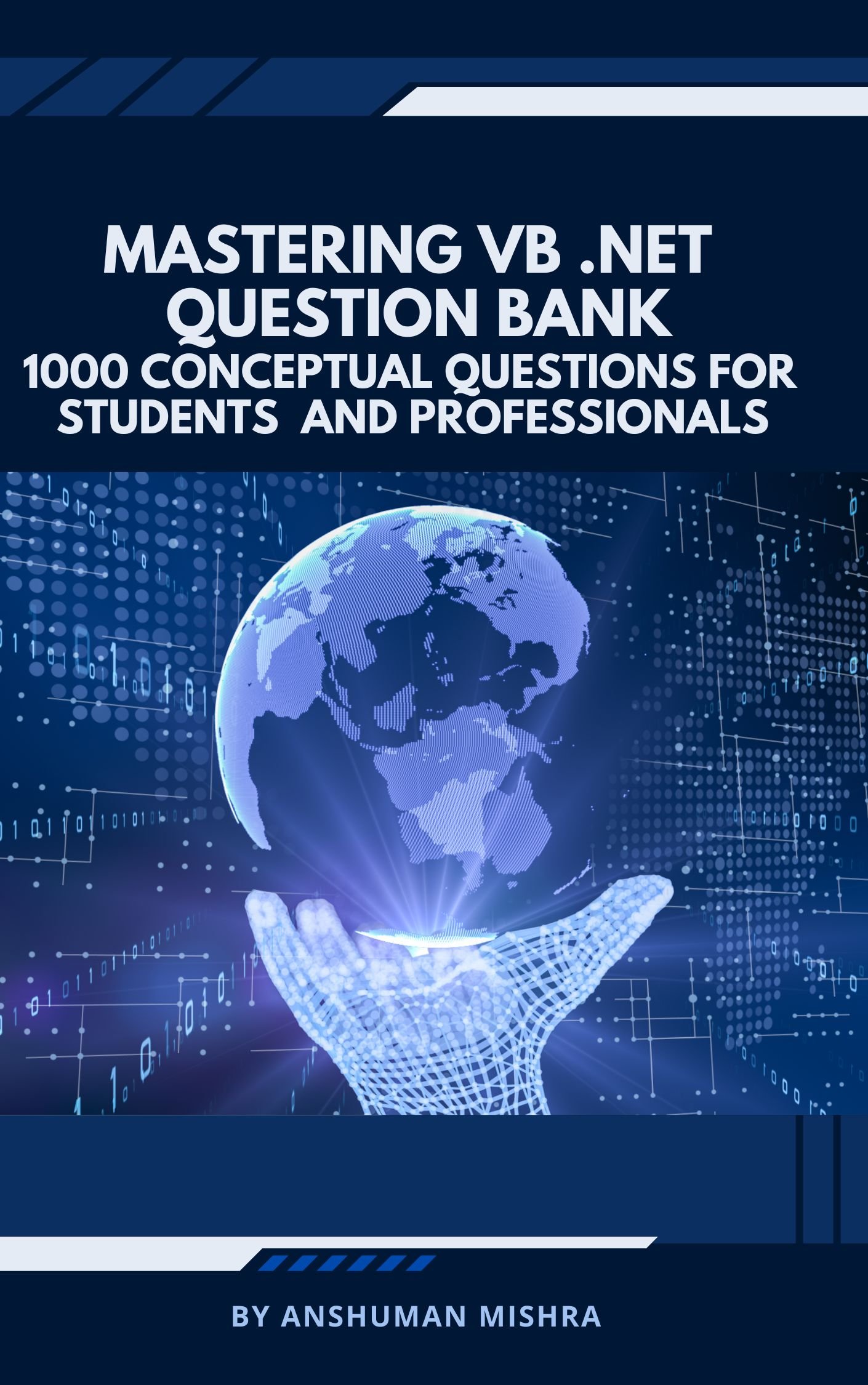
Mastering VB.NET QUESTION BANK
1000+ Conceptual Questions for Students and Professionals
A Comprehensive Question Bank with MCQs, Short and Mid-Length Questions – For BCA, MCA, B.Tech, M.Tech & Software Interviews
Mastering VB.NET QUESTION BANK is a comprehensive academic and professional resource created for learners who want to strengthen their knowledge of Visual Basic .NET (VB.NET) through systematic practice and question-based learning.
Designed for students, educators, programmers, and interview candidates, this book brings together conceptual questions, theoretical questions, programming problems, and practical application-oriented exercises in one structured resource.
The book follows a chapter-wise approach that helps readers move from fundamental VB.NET concepts to advanced programming topics while continuously testing their understanding.
Why This Question Bank Is Useful
Learning programming requires more than reading concepts. Students need regular practice to understand syntax, logic, application design, and problem-solving.
This question bank provides a structured way to revise and test VB.NET knowledge.
It covers:
- Fundamental VB.NET concepts
- Programming syntax and logic
- Object-oriented programming
- GUI development
- Database programming
- File handling
- Exception handling
- Advanced .NET concepts
- Programming exercises
- Interview-oriented questions
The combination of different question formats makes the book useful for both academic examinations and professional preparation.
1000+ Questions for Complete Preparation
The book contains 1000+ conceptual and practical questions organized across 12 major chapters.
Each chapter follows a consistent learning pattern containing:
MCQs
Multiple Choice Questions help learners quickly test their understanding of important definitions, concepts, syntax, programming principles, and VB.NET features.
Short Answer Questions
Short-answer questions encourage learners to explain important concepts in their own words and prepare for theory examinations.
Mid-Length Questions
These questions focus on conceptual clarity, comparison, explanation, reasoning, and application-oriented understanding.
Programming Questions
Hands-on programming problems help learners convert theoretical knowledge into practical coding skills.
Chapter-Wise Coverage
Chapter 1: Introduction to VB.NET
The book begins with the foundation of VB.NET programming.
Topics include:
- History and evolution of VB.NET
- Features of VB.NET
- .NET Framework overview
- Structure of a VB.NET program
- Compilation and execution
- Visual Studio environment
- Basic programming concepts
The chapter provides an essential foundation for beginners before moving into more advanced programming concepts.
Chapter 2: Data Types, Variables, and Constants
This chapter focuses on how information is represented and stored in VB.NET programs.
Readers practice questions related to:
- Variables
- Data types
- Constants
- Enumerations
- Literals
- Type conversion
- Type casting
- Variable declaration
Programming exercises reinforce the practical use of these concepts.
Chapter 3: Operators and Expressions
This chapter tests the learner’s understanding of operators and expressions used in VB.NET.
It covers:
- Arithmetic operators
- Relational operators
- Logical operators
- Assignment operators
- Bitwise operators
- Operator precedence
- Associativity
- Expressions
Programming questions encourage learners to apply operators to real computational problems.
Chapter 4: Control Structures
Control structures form the foundation of programming logic.
The question bank covers:
- If statements
- If-Else statements
- ElseIf
- Select Case
- For loops
- While loops
- Do While
- Do Until
- Exit statements
- Continue statements
- Nested structures
Programming exercises include logic-building problems such as calculations, number-based problems, pattern generation, and menu-driven applications.
Chapter 5: Procedures and Functions
This chapter focuses on modular programming and reusable code.
Learners explore:
- Sub procedures
- Functions
- Parameters
- ByVal
- ByRef
- Return values
- Recursive functions
- Modular programming
Programming questions help learners develop solutions using reusable procedures and functions.
Chapter 6: Arrays and Collections
Working with multiple values is an essential programming skill.
This chapter covers:
- One-dimensional arrays
- Multidimensional arrays
- Dynamic arrays
- Array operations
- Array methods
- ArrayList
- List(Of T)
- Dictionary
Practical questions include searching, sorting, frequency analysis, matrix operations, and data processing.
Chapter 7: Object-Oriented Programming in VB.NET
Object-oriented programming is one of the most important concepts in modern software development.
This chapter provides extensive practice on:
- Classes
- Objects
- Constructors
- Encapsulation
- Inheritance
- Polymorphism
- Abstraction
- Interfaces
- Method overloading
- Method overriding
Programming problems allow learners to model real-world entities such as students, employees, products, accounts, and geometric objects.
Chapter 8: Exception Handling
Reliable applications must be able to handle unexpected situations.
This chapter covers:
- Try
- Catch
- Finally
- Throw
- Exception classes
- Custom exceptions
- Error messages
- Debugging techniques
- Program troubleshooting
The programming questions help learners understand how errors can be detected, handled, and managed effectively.
Chapter 9: File Handling
File handling allows applications to store and retrieve information from external files.
The question bank covers:
- StreamReader
- StreamWriter
- BinaryReader
- BinaryWriter
- File class
- Directory class
- Text files
- Binary files
- Reading and writing operations
Practical problems include creating, reading, updating, copying, and searching files.
Chapter 10: Windows Forms and GUI Programming
This chapter introduces application development using graphical user interfaces.
Questions and programming exercises cover:
- Windows Forms
- Labels
- TextBoxes
- Buttons
- ComboBoxes
- DataGridView
- Menus
- Dialog boxes
- Message boxes
- Event handling
Practical exercises include designing applications such as:
- Login forms
- Registration forms
- Calculator applications
- Menu-driven applications
- Data-entry interfaces
Chapter 11: Database Connectivity with ADO.NET
Database programming is essential for developing real-world applications.
This chapter provides question-based coverage of:
- ADO.NET
- SQL Server connectivity
- Access database connectivity
- SqlConnection
- SqlCommand
- DataReader
- DataAdapter
- DataSet
- Data binding
- CRUD operations
Programming exercises help learners understand how VB.NET applications can interact with databases.
Chapter 12: Advanced Topics in VB.NET
The final chapter moves into more advanced VB.NET concepts.
Topics include:
- Delegates
- Events
- Multithreading basics
- LINQ
- XML processing
- Event-driven programming
- Advanced data processing
- Web-related concepts
These questions help learners move beyond basic programming and explore advanced features of the VB.NET ecosystem.
Ideal for University Examinations
The book can be used as a revision and practice resource for students studying:
- BCA
- MCA
- B.Tech Computer Science
- B.Tech Information Technology
- M.Tech
- Computer Applications
- Software Development
- .NET Programming
The chapter-wise organization makes it convenient for semester examinations, internal assessments, practical examinations, assignments, and revision.
Useful for Technical Interviews
VB.NET concepts are also relevant for learners preparing for software development interviews.
The question bank helps candidates revise:
- Programming fundamentals
- OOP concepts
- Exception handling
- Collections
- File handling
- Database connectivity
- GUI programming
- LINQ
- .NET concepts
The combination of conceptual and programming questions encourages candidates to prepare for both theory-based and practical interview discussions.
Benefits for Teachers and Trainers
Educators can use this book as a supplementary resource for:
- Classroom discussions
- Question-paper preparation
- Assignments
- Internal examinations
- Practical programming tests
- Lab exercises
- Revision sessions
- Student assessments
The consistent chapter-wise format makes it easier to select questions according to the difficulty and learning objectives of a course.
A Complete Practice Resource
The strength of this book lies in its balanced coverage.
It does not focus exclusively on MCQs. Instead, learners are exposed to multiple types of questions that test different levels of understanding:
Remember → Understand → Apply → Analyze → Program → Solve
This approach encourages learners to move beyond memorization and develop genuine programming knowledge.
Key Features
✓ 1000+ conceptual and practical questions
✓ 12 systematically organized chapters
✓ 50 MCQs per chapter
✓ Short-answer questions
✓ Mid-length descriptive questions
✓ Programming questions with answers
✓ VB.NET syntax and programming practice
✓ Object-oriented programming coverage
✓ Windows Forms and GUI programming
✓ ADO.NET and database connectivity
✓ File handling and exception handling
✓ LINQ, XML, delegates, and events
✓ Useful for academic examinations
✓ Suitable for technical interview preparation
✓ Helpful for programming practice and revision
Who Should Read This Book?
This question bank is especially useful for:
- BCA Students
- MCA Students
- B.Tech CS/IT Students
- M.Tech Students
- Computer Science learners
- Programming beginners
- VB.NET learners
- .NET developers
- Software interview candidates
- Teachers and trainers
- Academic researchers
- Professionals revising VB.NET fundamentals
Learning Outcomes
After working through this question bank, learners will be better prepared to:
- Explain fundamental VB.NET concepts
- Understand the .NET programming environment
- Write and analyze VB.NET programs
- Apply control structures and functions
- Work with arrays and collections
- Understand object-oriented programming
- Handle exceptions effectively
- Perform file operations
- Build basic Windows Forms applications
- Connect applications with databases
- Perform CRUD operations
- Understand LINQ and XML
- Prepare for programming examinations
- Approach technical interviews with greater confidence
From Classroom Preparation to Professional Practice
Mastering VB.NET QUESTION BANK is designed to serve multiple purposes.
Students can use it for exam preparation and revision.
Teachers can use it for assignments and assessments.
Beginners can use it for programming practice.
Professionals can use it to refresh their VB.NET fundamentals.
Interview candidates can use it to revise important technical concepts and programming problems.
With its combination of MCQs, descriptive questions, conceptual questions, and programming exercises, the book provides a structured pathway toward stronger VB.NET knowledge.
Reviews
There are no reviews yet.