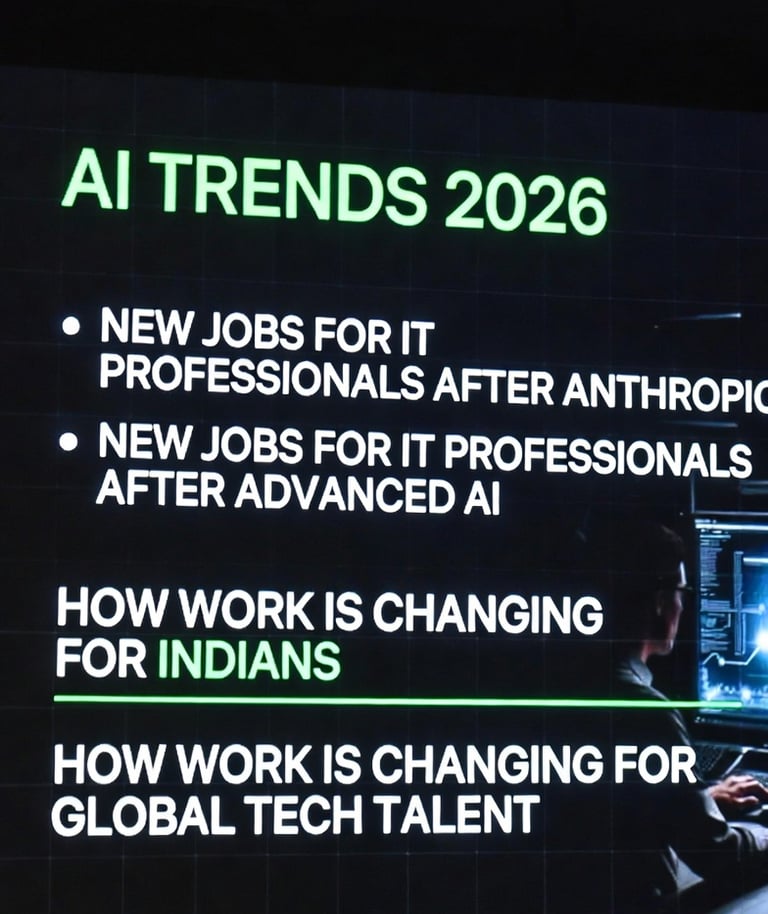
AI Trends 2026: New Jobs for IT Professionals After Anthropic and Advanced AI – How Work is Changing for Indians and Global Tech Talent
Introduction: The AI Revolution Reshaping IT Careers in 2026 As we navigate 2026, artificial intelligence (AI) trends are not just evolving—they're revolutionizing the global job market, particularly for IT professionals. With breakthroughs from companies like Anthropic and their Claude AI models, the landscape of work has shifted dramatically. What was once a field dominated by coding, data entry, and routine system maintenance is now pivoting toward AI-augmented roles that emphasize creativity, ethics, and strategic oversight. This transformation is creating new opportunities while disrupting traditional jobs, leading to a net gain in employment but with a stark skills divide. According to recent reports, AI could displace 85 million jobs globally by 2026 but create 97 million new ones, resulting in a positive shift of 12 million positions. In India, the IT sector—long a powerhouse employing millions—faces potential losses of 1.5-2 million jobs to automation by 2031, yet it could generate up to 4 million new roles through reskilling and AI adoption. Globally, IT professionals are adapting to this "AI era," where tools like Anthropic's Claude are boosting productivity by up to 1.8% annually in the US, doubling recent growth rates. This article explores AI trends 2026, focusing on how new AI technologies, including Anthropic's advancements, are changing everything for IT pros. We'll delve into emerging job opportunities, the impact on Indian and worldwide talent, and strategies for thriving in this transformed ecosystem. Keywords like "AI trends 2026," "future of AI jobs," "AI impact on IT professionals," and "Anthropic AI job market" highlight the SEO-optimized insights here, drawing from the latest data and expert predictions. 1. The Rise of Anthropic's Claude: How AI is Automating Routine IT Tasks Anthropic's Claude AI, a leading competitor to models like ChatGPT, has accelerated the automation of IT workflows in 2026. Claude's capabilities in coding, debugging, and data analysis are transforming how IT professionals operate. For instance, software engineers now spend 70% more time as "code reviewers" rather than writers, managing AI-generated outputs instead of starting from scratch. This shift means routine tasks—such as data entry, basic programming, and quality assurance—are increasingly handled by AI, freeing humans for complex problem-solving. In India, where IT services like TCS and Infosys rely on staff augmentation, this could pressure the traditional model, pushing toward outcome-based contracts. Globally, AI's "cognitive breadth" risks wiping out entry-level white-collar jobs across tech, finance, and consulting, making career pivots harder. However, this automation isn't all doom—it's birthing new roles. IT pros are evolving into "AI managers," overseeing agentic AI systems that perform tasks autonomously. Predictions for 2026 show a 40% increase in demand for AI and machine learning specialists by 2027, emphasizing the need for upskilling. 2. New Job Opportunities for IT Professionals in the AI Era Despite fears of job loss, AI trends 2026 are creating a boom in specialized IT roles. The World Economic Forum estimates a net positive impact, with new jobs outpacing displacements. Here's a breakdown of emerging positions: AI Ethicists and Governance Specialists: As AI integrates into critical systems, ensuring ethical use is paramount. These roles involve auditing AI for bias and compliance, with demand growing 22-74% for high-skill positions. In India, the IndiaAI Mission is fostering such jobs, projecting 1.2-1.5 million new AI positions by 2028. Prompt Engineers and AI Trainers: Professionals who craft precise inputs for AI models like Claude are in high demand. This role blends IT skills with linguistics, offering salaries 20-30% above traditional coding jobs. AI DevOps and Integration Experts: With AI tools like Claude's plug-ins automating sales and analytics, IT pros specializing in integrating AI into existing systems will thrive. Global demand for these roles is surging, especially in cloud environments. Data Scientists and Multimodal AI Specialists: Handling fusion of text, image, and video data, these jobs are core to 2026 trends. In healthcare and finance, multimodal AI is revolutionizing diagnostics and predictions. For Indian IT professionals, sectors like banking and manufacturing offer niches for AI solutions, moving beyond generic services. Worldwide, animation and gaming could add 2 million jobs by 2030, leveraging AI for creative augmentation. 3. How AI is Changing Work Dynamics for Global IT Professionals In 2026, AI is fostering a "human-machine workforce," where IT pros collaborate with AI agents for efficiency. Remote work, already amplified by hybrid models, is enhanced by AI tools that handle repetitive tasks, allowing focus on innovation. Globally, 49% of jobs now use AI for at least a quarter of tasks, up from 36% in early 2025. This "deskilling" effect means remaining human tasks require less education, but complementary skills like creativity and empathy are premium. Companies are investing 5-10% in reskilling, shifting to micro-credentials on platforms like Coursera. Mental fitness is a concern: AI's pressure for efficiency is causing burnout, with organizations urged to prioritize well-being. "AI workslop"—low-quality AI outputs requiring human fixes—is emerging as a productivity drain. 4. The Indian Perspective: Opportunities and Challenges for IT Talent India's IT sector, valued at billions, is at a crossroads in 2026. AI adoption is explosive, with a projected market size of $126-131 billion by 2030-2032 at a 26-42% CAGR. However, 20-30% of IT jobs in BPO and application development face automation risks. Anthropic's entry into India, including office openings, signals a shift toward research hubs rather than call centers. This could create high-paying roles in AI safety and infrastructure, boosting startups and enterprise adoption. Hiring for AI-exposed roles like developers remains strong, with AI job postings doubling from 2023-2025. Yet, only 12% of the workforce is AI-ready, widening the skills gap. Initiatives like Skill India and the 2026 AI Summit aim to bridge this, unlocking $621 billion in economic value (18% of GDP). Indian pros should focus on sovereign AI models for multilingual applications and social good sectors like agriculture. Globally, Indian talent in GCCs and startups is adding 170,000 AI/ML jobs in 2025-26. 5. Global Shifts: Where and How IT Professionals Will Work Worldwide, IT work in 2026 is omnichannel and AI-centric. AI agents handle discovery and transactions, reshaping roles toward "search everywhere optimization." Professionals will work in blended environments, managing AI in critical sectors like healthcare and transportation. In the US and EU, ethics-focused roles are booming, with 45% of activities automatable. Remote and platform-based work decouples skills from location, benefiting global talent pools. For Indians, opportunities lie in exporting AI services, with demand for AI-skilled workers surging. Challenges include geopolitical tensions and supply chain disruptions, but collaboration via forums like the World Economic Forum is key. 6. Strategies for IT Professionals to Thrive in 2026 To adapt, upskill in AI ethics, prompt engineering, and integration. Platforms like Udemy offer accessible training. Governments and companies must redesign education for AI complementarity. Embrace human-AI partnerships: IT pros should view AI as a collaborator, not a threat. In India, focusing on inclusive AI policies will mitigate risks like privacy issues for marginalized groups. Conclusion: Embracing the AI-Driven Future of IT Work AI trends 2026, propelled by Anthropic and similar innovations, are redefining IT careers from automation to augmentation. While challenges like job displacement loom, the potential for new roles in ethics, integration, and specialized AI applications offers a bright path forward. For Indian and global IT professionals, the key is reskilling, adaptability, and ethical focus. By leveraging these changes, the sector can achieve unprecedented growth, ensuring a prosperous future in the AI era.
2/22/20261 min read
Email-ibm.anshuman@gmail.com
© 2026 CodeForge AI | Privacy Policy |Terms of Service | Contact | Disclaimer | 1000 university college list|book library australia 2026|Latest AI Trends (Global & India 2026) 400 GLOBAL BOOK STORE WORLDWID|TOP 400 FREE BOOK LIBRARY USA|TOP 400 FREE BOOK LIBRARY INDIA|Audiobooks at Just ₹99 | $1.25| E-Books at Just ₹49 | $0.50| 50+ AI Expert Tutorials
All my books are exclusively available on Amazon. The free notes/materials on globalcodemaster.com do NOT match even 1% with any of my PUBLISHED BOoks. Similar topics ≠ same content. Books have full details, exercises, chapters & structure — website notes do not.No book content is shared here. We fully comply with Amazon policies.
🚀 Best content for SSC, CGL, LDC, TET, NET & SET preparation!
📚 Maths | Reasoning | GK | Previous Year Questions | Tips & Tricks
👉 Join our WhatsApp Channel now:
🔗 https://whatsapp.com/channel/0029Vb6kg2vFnSz4zknEOG1D...