China’s Explosive Adoption of Open-Source OpenClaw AI Agents: Tencent, Zhipu, and Others Launch Integrations Amid Subsidies and Security Warnings
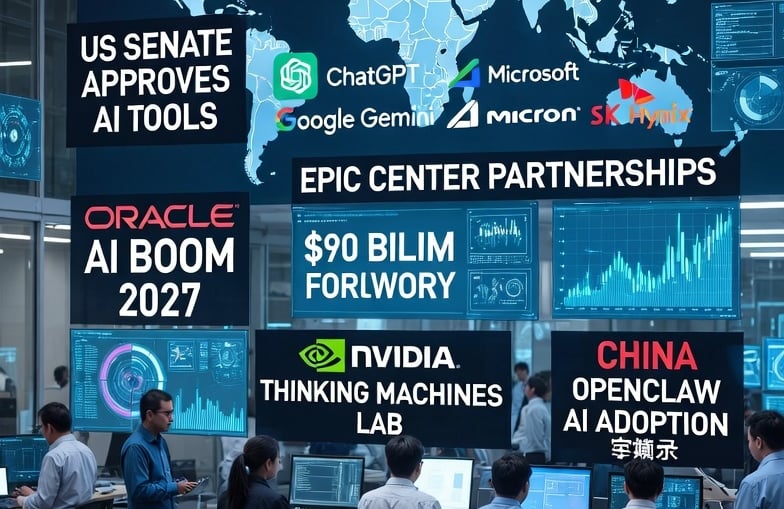
In the whirlwind of March 9–11, 2026, China's AI ecosystem erupted around OpenClaw, an open-source AI agent framework that exploded in popularity worldwide but found its most intense, rapid adoption in China. What started as a viral GitHub project (launched in late 2025/early 2026) transformed into a national phenomenon in days, with tech giants, startups, local governments, and everyday users racing to integrate, customize, and monetize it—while regulators simultaneously raised red flags. OpenClaw is not just another chatbot. It's a foundational agentic AI framework: autonomous software that uses large language models (like Claude, GLM, or others) to plan, reason, and execute multi-step real-world tasks. Users can instruct it to "book a flight, email the itinerary, update my calendar, and research hotels"—and it handles the workflow end-to-end by calling tools, browsing, writing code, or interacting with apps. Being fully open-source and runnable locally (privacy-focused, no mandatory cloud dependency), it exploded from niche developer tool to mainstream obsession. The Frenzy in the Last 72 Hours (March 9–11, 2026) Tencent's aggressive push: On March 9–10, Tencent launched WorkBuddy, a workplace AI agent fully compatible with OpenClaw skills but wrapped in a user-friendly, enterprise-grade package (download-and-run, no complex setup). They also began internal testing of QClaw, a one-click installer embedding OpenClaw agents directly into WeChat and QQ—potentially reaching over 1.3 billion users instantly. Tencent hosted massive setup events in Shenzhen, drawing nearly 1,000 people (students, retirees, developers) queuing for free installations on laptops and devices. Zhipu AI's localized surge: Zhipu (Knowledge Atlas Technology) released AutoClaw on March 10—a "one-click local version" optimized for Chinese users, with seamless integration into tools like Feishu (ByteDance's enterprise chat). Shares of Zhipu (listed in Hong Kong) surged 13–16% on the news, reflecting investor excitement. MiniMax, Moonshot, and others pile in: MiniMax dropped MaxClaw (with voice/music generator ties), Moonshot AI pushed KimiClaw (zero-code, free compute subsidies), Alibaba tested CoPaw (integrated with DingTalk, cheap cloud access), and even Global Mofy integrated OpenClaw into content production pipelines. Over a dozen firms quickly built wrappers, localizers, or compatible agents. Government incentives vs. warnings: Shenzhen's Longgang district (home to China's first AI/robotics bureau) released draft policies on March 8–9 offering subsidies up to 10 million yuan (~$1.4 million), free computing resources, discounted offices, and housing for "one-person companies" building OpenClaw apps/ecosystems. Similar moves came from Hefei and other tech hubs. Yet, by March 10–11, national regulators warned state-owned enterprises, major banks, and government agencies against installing OpenClaw on office devices due to data access risks, potential vulnerabilities, and security concerns—prompting some "on-site uninstallation" services to emerge. Market reaction was electric: Tencent shares rose 6–7.3% (best day in a year), Zhipu up 13–16%, MiniMax ~15%, and related cloud firms like UCloud surged 20%+ on policy support. What Makes OpenClaw a True Tipping Point for Agentic AI Agentic AI shifts from passive chat (answer questions) to proactive doing (execute tasks autonomously). OpenClaw democratizes this: Model-agnostic: Works with Claude, GLM, Kimi, DeepSeek, etc.—Chinese models surged on platforms like OpenRouter. Local-first: Runs on personal hardware (Mac Mini setups went viral), preserving privacy. Extensible: 5,700+ community skills, tools for web search, code execution, email, calendars. Low barrier: One-click wrappers make it accessible to non-coders. China's super-app ecosystem (WeChat, QQ, Feishu, DingTalk) allows instant distribution to billions—something closed Western agents struggle with due to app silos and privacy regs. Global Ripple Effects: The US-China AI Divide Intensifies Democratization vs. Control China leverages open-source for speed and scale: integrate into daily super-apps → agents become everyday tools for consumers/SMBs faster than in the West. This could leapfrog practical adoption, making agentic AI ubiquitous in China first. Open-Source Rapid Deployment vs. Proprietary Caution US/EU focus on controlled, compliant models (e.g., enterprise versions with audits). China's approach: embrace open, iterate wildly, subsidize ecosystems—even amid warnings. This widens the divide: speed/innovation vs. security/governance. Security & Geopolitical Tensions Warnings highlight real risks: agents access files/emails/browsers → data leakage, malware vectors, surveillance concerns. Yet local subsidies persist, showing tension between innovation push and national security. Economic & Investment Signals Stock rallies prove investors see agentic AI as the next wave. Subsidies create mini-hubs (Shenzhen, Hefei) → attract talent/startups. Global firms rethink: localize agents? Build open wrappers? Bolster security? Everyday Impact Imagine WeChat sending: "Book my train, pay bills, summarize news"—agents handle it. For SMBs: automate workflows cheaply. For developers: build once, deploy everywhere. In simple words: China turned OpenClaw into a national sprint, racing to embed autonomous AI agents into daily life for billions—potentially outpacing Western closed systems in real-world usefulness, while igniting fierce open-vs-closed debates. This isn't hype—it's a paradigm shift from models to agents, with China leading the charge in scale and speed. References (Authentic Sources – March 9–11, 2026 Coverage) Bloomberg – "China's OpenClaw Tied Stocks Rise on Policy Support, Adoption" (March 9–10, 2026) https://www.bloomberg.com/news/articles/2026-03-09/china-s-openclaw-tied-stocks-rise-on-policy-support-adoption Reuters – "Chinese tech hubs promote OpenClaw AI agent despite security warnings" (March 9, 2026) https://www.reuters.com/world/asia-pacific/chinas-shenzhen-backs-openclaw-ai-with-subsidies-despite-beijings-security-2026-03-09 China Daily Asia – "Tencent, Zhipu shares jump on AI agents tapping into OpenClaw" (March 10, 2026) https://www.chinadailyasia.com/article/630187 Nikkei Asia – "China firms launch OpenClaw rivals as Beijing warns against viral AI agent" (March 11, 2026) https://asia.nikkei.com/business/technology/artificial-intelligence/china-firms-launch-openclaw-rivals-as-beijing-warns-against-viral-ai-agent South China Morning Post – "Chinese tech giants offer cheap, easy access to OpenClaw amid 'lobster fever'" (March 10, 2026) https://www.scmp.com/tech/article/3346090/chinese-tech-giants-offer-cheap-easy-access-openclaw-amid-lobster-fever TechNode – "OpenClaw sparks boom as Chinese firms race into the AI agent era" (March 10, 2026) https://technode.com/2026/03/10/openclaw-sparks-boom-as-chinese-firms-race-into-the-ai-agent-era These draw from official launches, stock movements, and policy drafts reported March 9–11, 2026.
3/11/20261 min read
My post content
Email-ibm.anshuman@gmail.com
© 2026 CodeForge AI | Privacy Policy |Terms of Service | Contact | Disclaimer | 1000 university college list|book library australia 2026|Latest AI Trends (Global & India 2026) 400 GLOBAL BOOK STORE WORLDWID|TOP 400 FREE BOOK LIBRARY USA|TOP 400 FREE BOOK LIBRARY INDIA|Audiobooks at Just ₹99 | $1.25| E-Books at Just ₹49 | $0.50| 50+ AI Expert Tutorials
All my books are exclusively available on Amazon. The free notes/materials on globalcodemaster.com do NOT match even 1% with any of my PUBLISHED BOoks. Similar topics ≠ same content. Books have full details, exercises, chapters & structure — website notes do not.No book content is shared here. We fully comply with Amazon policies.
🚀 Best content for SSC, CGL, LDC, TET, NET & SET preparation!
📚 Maths | Reasoning | GK | Previous Year Questions | Tips & Tricks
👉 Join our WhatsApp Channel now:
🔗 https://whatsapp.com/channel/0029Vb6kg2vFnSz4zknEOG1D...