Germany's AI Leadership in March 2026: 5 Major Shifts Happening Right Now That Are Changing Jobs, Rules, Business, and Daily Life
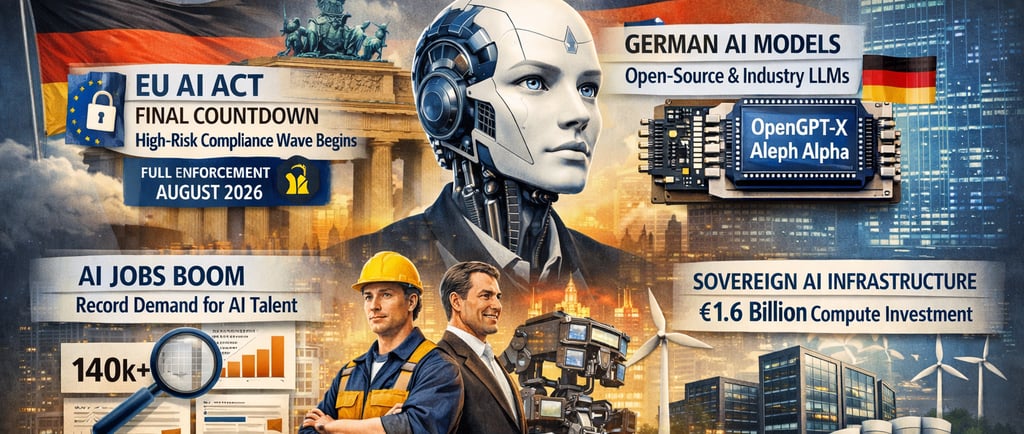
Germany is one of the strongest AI countries in Europe. It combines very strict rules (EU AI Act), huge industrial power, excellent research universities, and massive private-sector investment. In March 2026 the country is in the middle of a very active phase: the EU AI Act high-risk rules are only 5 months away from full application (August 2, 2026), the national AI Strategy 2025–2030 is being implemented at high speed, several billion euros are flowing into sovereign AI infrastructure, and companies are moving very quickly from pilot projects to productive AI systems. In the last 4–6 weeks (February–mid March 2026) the most important developments are: First official AI compliance checklists and conformity assessment bodies accredited Launch of several large German open-weight language models (especially for industry & public administration) Record number of AI-related job postings despite economic slowdown Public debate about AI’s effect on Mittelstand (mid-sized companies) and skilled trades New €1.6 billion sovereign AI compute tender decisions announced These five major trends are really shaping Germany right now. 1. EU AI Act Entering Final Countdown – High-Risk Systems Compliance Wave Has Started (March–August 2026) The EU Artificial Intelligence Act is the world’s first comprehensive horizontal AI law. In March 2026 German companies and public authorities are in the most intense preparation phase. What is happening right now: High-risk AI systems (HR recruiting tools, credit scoring, biometric identification, safety components in machinery, medical devices AI, etc.) must be fully compliant by 2 August 2026. First German conformity assessment bodies (Konformitätsbewertungsstellen) have been designated and accredited (TÜV Rheinland, TÜV Süd, DEKRA among others). The Federal Office for Information Security (BSI) and the new AI Supervisory Authority (planned under BMI) published detailed checklists and guidance documents in February–March 2026. Many large companies and automotive suppliers have started “AI Act readiness audits”. The so-called “AI regulatory sandbox” programs in Berlin, Hamburg, Bavaria and NRW are fully booked until end of 2027. Practical impact in March 2026: HR departments in banks, insurance companies and large industrial groups are reviewing or replacing AI recruiting tools that do not meet transparency & non-discrimination requirements. Machine builders (especially in automotive and mechanical engineering) are classifying their AI-based quality control and predictive maintenance systems. Many Mittelstand companies are asking: “Do we even have high-risk AI?” – and often the answer is yes (especially in product safety). Germany deliberately chose a very strict but innovation-friendly implementation path: heavy focus on existing product safety laws + sector-specific regulators instead of creating one giant new authority. 2. Sovereign German & European AI Models – Open-Source & Domain-Specific LLMs Are Reaching Production (2025–2026 Wave) Germany (and Europe) do not want to depend 100 % on US closed models. In March 2026 several important open-weight and domain-specific models are either already released or in final testing. Most important projects active right now: OpenGPT-X family (led by Fraunhofer IAIS + many partners) – largest German-led open model family (up to 70B parameters), strong focus on German & European law, engineering terminology, public administration language. Aleph Alpha Luminous series – continued fine-tuning for industrial use-cases (especially manufacturing, legal, finance). LAION / OpenEuroLLM – very large multilingual European training run finished late 2025 → first strong open models expected Q2 2026. BMBF-funded domain models for automotive (car parts documentation, error codes), healthcare (German medical reports), mechanical engineering drawings & standards. Public administration models – several Länder (Bavaria, NRW, Berlin) running their own smaller fine-tuned models on German legal & administrative texts. Why this matters in March 2026: Large DAX companies (Siemens, Bosch, SAP, Volkswagen, Deutsche Telekom, Allianz, etc.) publicly state they want to reduce dependency on US hyperscalers for critical processes. Sovereign models allow data to stay inside EU jurisdiction (very important for GDPR). Open models make AI cheaper and faster to customize for German-speaking use-cases. 3. Record Demand for AI Skills Despite Economic Headwinds – Germany Faces Massive Talent Shortage (Job Market Reality) Germany has a very strong dual education system and excellent universities, yet in March 2026 the AI talent gap is still huge. Key numbers circulating right now: ~140,000–180,000 unfilled AI-related positions (data scientists, ML engineers, prompt engineers, AI ethicists, MLOps specialists). AI job postings grew +38 % YoY (StepStone / Indeed data early 2026) while total job ads fell -11 %. Highest demand sectors: automotive & mobility, industrial manufacturing, financial services, healthcare, public sector digitization projects. Average salary premium for AI specialists: +28–42 % compared to similar non-AI roles. What changed in early 2026: Many large companies stopped general hiring but continued (or even increased) AI & data hiring. Nearshoring from US/UK to Germany is limited, but “friendshoring” inside EU (especially Poland, Romania, Portugal) is bringing more AI projects to German headquarters. Vocational training (Ausbildung) now includes mandatory AI basics in many technical professions (Mechatronics, Industrial Mechanics, IT Specialist). Short version: Germany has more open AI positions than almost any other European country right now – despite the economic slowdown in traditional industries. 4. AI in Mittelstand & Skilled Trades – From Fear to Cautious Adoption (March 2026 Reality Check) The German Mittelstand (small & medium enterprises, often family-owned, 50–500 employees) is the backbone of the economy. In March 2026 the mood towards AI is slowly shifting from “AI is dangerous for us” to “we have to do something”. Current picture: Only ~18–24 % of companies <250 employees use generative AI productively (Bitkom 2026 survey). Biggest barriers: lack of knowledge (58 %), data privacy worries (49 %), missing internal know-how (44 %), cost (31 %). Fastest adopting sectors inside Mittelstand: mechanical engineering (predictive maintenance), metal processing (quality control), logistics (route optimization), craft businesses (customer communication, scheduling). Positive momentum in March 2026: “KI für den Mittelstand” funding program (BMWK) has already approved > €320 million for SME AI projects. “AI Trainers” program – government pays part of salary for companies that hire AI specialists to train colleagues. Regional “AI Hubs” in Baden-Württemberg, Bavaria, NRW offer free consulting days for small companies. Many craft businesses (Handwerk) are surprised to learn that simple AI tools (voice-to-text in German, photo-based defect detection, chatbots for appointment booking) can save 5–15 hours per week. 5. Sovereign AI Infrastructure & Gaia-X Energy – Germany Bets Big on European Data & Compute (2026–2030) Germany is putting several billion euros into building European-controlled AI infrastructure. Most important initiatives active in March 2026: Gaia-X Federation – first productive sovereign cloud & data spaces in automotive, manufacturing, healthcare. National AI Compute tender (€1.6 billion) – decisions on who builds the first 2–3 large German AI clusters expected Q2 2026. Energy-for-AI debate – Federal Ministry for Economic Affairs wants to reserve large amounts of renewable energy for AI data centers. HPC & quantum – JUWELS, LUMI, MELUXINA supercomputers already used for German AI training; quantum-AI pilots started. Tax incentives – extended “Research Allowance Act” now covers 35 % of AI personnel costs up to €4 million per year. Goal: by 2030 Germany wants at least 20–25 % of European sovereign AI compute capacity. These five trends are shaping Germany right now in March 2026: EU AI Act high-risk compliance wave has reached peak intensity Several strong open German & European language models are reaching production maturity Extremely high demand for AI talent despite weak overall economy Mittelstand and skilled trades moving from fear to cautious first projects Multi-billion sovereign compute & energy-for-AI bets Germany is trying to do something very difficult: be the strictest regulator in the world and one of the most innovative AI economies at the same time. People who learn AI skills now (especially practical implementation, compliance, domain-specific fine-tuning, agentic workflows) will have excellent opportunities in Germany in 2026–2030. GlobalCodeMaster.com offers exactly the kind of hands-on, production-oriented AI training that German companies are desperately looking for right now. Sources (selection – February/March 2026 status): EU AI Act implementation timeline & guidance – BMI / BSI Bitkom AI Monitor 2026 & Mittelstand survey OpenGPT-X / Aleph Alpha / LAION announcements StepStone AI job market report Q1 2026 BMWK “KI für den Mittelstand” program status Gaia-X & sovereign compute tender news – BMWK / GAIA-X AISBL
3/13/20261 min read
My post content
Email-ibm.anshuman@gmail.com
© 2026 CodeForge AI | Privacy Policy |Terms of Service | Contact | Disclaimer | 1000 university college list|book library australia 2026|Latest AI Trends (Global & India 2026) 400 GLOBAL BOOK STORE WORLDWID|TOP 400 FREE BOOK LIBRARY USA|TOP 400 FREE BOOK LIBRARY INDIA|Audiobooks at Just ₹99 | $1.25| E-Books at Just ₹49 | $0.50| 50+ AI Expert Tutorials
All my books are exclusively available on Amazon. The free notes/materials on globalcodemaster.com do NOT match even 1% with any of my PUBLISHED BOoks. Similar topics ≠ same content. Books have full details, exercises, chapters & structure — website notes do not.No book content is shared here. We fully comply with Amazon policies.
🚀 Best content for SSC, CGL, LDC, TET, NET & SET preparation!
📚 Maths | Reasoning | GK | Previous Year Questions | Tips & Tricks
👉 Join our WhatsApp Channel now:
🔗 https://whatsapp.com/channel/0029Vb6kg2vFnSz4zknEOG1D...