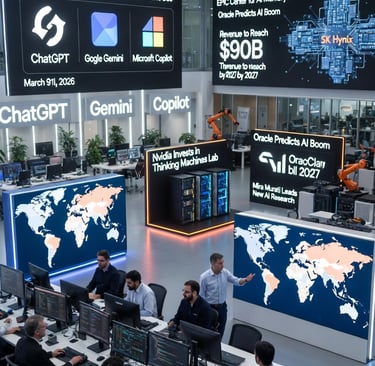
Oracle Predicts Explosive AI Boom Through 2027, Raises Revenue Forecast to $90 Billion
On March 10, 2026, Oracle Corporation delivered one of its strongest quarterly performances in recent years, stunning Wall Street with results that exceeded expectations and a bold upward revision to its long-term outlook. The company reported fiscal Q3 2026 (ended February 28, 2026) revenue of $17.2 billion, up 22% year-over-year in USD (18% in constant currency), and non-GAAP earnings per share of $1.79, up 21%. Both figures beat analyst consensus estimates (revenue ~$16.9–$17 billion, EPS ~$1.70–$1.74). The real headline, however, was Oracle's guidance update: while maintaining fiscal 2026 revenue at $67 billion and capex at $50 billion, the company raised its fiscal 2027 revenue forecast to $90 billion — a significant jump from prior internal targets and well above Wall Street's consensus expectation of around $86.6 billion (per LSEG and other analyst compilations). Shares of Oracle (NYSE: ORCL) reacted sharply, surging as much as 10–14% in after-hours and pre-market trading the following day, reflecting renewed investor confidence in the company's AI-driven trajectory. CEO Safra Catz, Chairman Larry Ellison, and the executive team attributed this momentum almost entirely to surging demand for Oracle Cloud Infrastructure (OCI) tailored for AI workloads. Key highlights from the earnings release and call include: Cloud revenue grew 44% to around $9 billion. Cloud Infrastructure (OCI) revenue exploded 84% to $4.9 billion. Remaining Performance Obligations (RPO) — a measure of future committed revenue — skyrocketed 325% year-over-year to $553 billion, with much of the increase tied to large-scale AI contracts where Oracle does not anticipate needing incremental external funding to fulfill. Management emphasized that AI demand is outpacing supply, enabling Oracle to "comfortably meet and likely exceed" its growth targets for FY2027 and beyond. Oracle has aggressively positioned itself as a go-to provider for hyperscale AI compute through massive data center builds, multi-cloud partnerships, and direct deals with major AI players. Why This Is Far Bigger Than One Company's Earnings Report Oracle's announcement is not isolated corporate news — it's powerful evidence that the AI infrastructure gold rush is accelerating, not peaking or slowing. For years, Oracle was seen primarily as a legacy database company. In recent years, under Ellison's vision, it has pivoted hard into cloud infrastructure optimized for AI training and inference, often using Nvidia GPUs and custom configurations. This earnings call confirms that strategy is paying off massively: Oracle is building and renting out enormous AI data centers at a pace that matches or exceeds hyperscalers like AWS, Azure, and Google Cloud in certain segments. Deals with OpenAI, Meta, and other major AI labs (plus multicloud arrangements) are locking in huge, long-term commitments. The $553 billion RPO backlog — equivalent to years of contracted future revenue — signals sustained demand well into 2028–2030. In simple terms: Companies building the world's biggest AI models need massive, reliable compute capacity. Oracle is proving it can deliver that at scale, faster than many expected, and profitably. Global-Level Impact: Proof the AI Boom Is Structural and Long-Term This single report has worldwide implications across multiple dimensions: Validation of Sustained AI Infrastructure Spending Oracle's raised $90 billion FY2027 guidance (implying ~34% growth from the $67 billion FY2026 target) shows the hyperscaler capex cycle is extending at least through 2027. Expect AWS, Microsoft Azure, and Google Cloud to issue similarly bullish outlooks in their upcoming quarters. This means trillions in cumulative investment over the next few years — not just in chips, but in power generation, cooling systems, fiber networks, and real estate. Energy and Sustainability Pressure Intensifies AI data centers consume enormous electricity. Oracle's $50 billion capex for FY2026 (and implied similar levels ahead) highlights the strain on global power grids. Governments and utilities worldwide will accelerate investments in renewables, nuclear, and grid upgrades. It also spotlights sustainability challenges: more efficient hardware (like the memory partnerships we discussed earlier) will be critical to avoid blackouts or skyrocketing energy costs. Job Creation and Economic Ripple Effects Building and operating these data centers creates thousands of high-paying jobs in construction, engineering, operations, and maintenance. Regions hosting Oracle's facilities (e.g., US, Europe, Asia) benefit from economic multipliers. On the flip side, it fuels inflation in energy and land prices in those areas. Geopolitical and Supply Chain Dynamics Oracle's success reduces over-reliance on any single cloud provider for AI workloads. It strengthens the US-led AI ecosystem while competing with China's domestic cloud giants. Global chip and energy supply chains feel the pull — more demand for Nvidia/AMD GPUs, custom ASICs, transformers, cables, and rare materials. Impact on Businesses and Everyday Users For enterprises: Cheaper, more accessible AI compute via OCI means faster innovation in industries like healthcare, finance, manufacturing, and autonomous systems. For consumers: The boom enables more powerful, lower-cost AI services (smarter assistants, better recommendations, advanced creative tools) rolling out quicker. Oracle's internal use of AI to optimize its own operations (e.g., efficiency gains in data centers) also demonstrates a virtuous cycle: AI powers more AI. Challenges and Risks Ahead While bullish, Oracle faces hurdles: massive debt to fund capex, potential GPU shortages, execution risks on data center timelines, and competition from hyperscalers with deeper pockets. Some reports mention adjustments in specific partnerships (e.g., OpenAI data center expansions), but the overall RPO growth and guidance override short-term noise. Looking Forward Oracle's March 10, 2026, earnings call is a watershed moment. It shifts the narrative from "Will AI spending slow?" to "How fast and how big will it get?" The $90 billion FY2027 target positions Oracle as a core player in the AI infrastructure era, with knock-on effects rippling through global economies, energy markets, tech stocks, and innovation pipelines for years. This isn't hype — it's hard numbers from a major public company proving the AI revolution is embedding itself as essential infrastructure, much like electricity or the internet did in prior eras. References (Authentic Sources – March 10–11, 2026 Coverage) Oracle Investor Relations – "Oracle Announces Fiscal Year 2026 Third Quarter Financial Results" (March 10, 2026) https://www.oracle.com/news/announcement/q3fy26-earnings-release-2026-03-10 (Official press release with full numbers and guidance) CNBC – "Oracle stock jumps 10% on earnings beat and increased guidance as cloud revenue climbs 44%" (March 10, 2026) https://www.cnbc.com/2026/03/10/oracle-orcl-q3-earnings-report-2026.html Reuters – "Oracle sees AI boom through at least 2027, sending shares up 8%" (March 10, 2026) https://www.reuters.com/technology/oracle-beats-quarterly-revenue-estimates-2026-03-10/ Morningstar – "Oracle Earnings: Solid Execution Secures Revenue Target and Mitigates Investor Concerns" (March 11, 2026) https://www.morningstar.com/stocks/oracle-earnings-solid-execution-secures-revenue-target-mitigates-investor-concerns Yahoo Finance – "Oracle beats Q3 expectations, raises 2027 revenue outlook sending stock higher" (March 10, 2026) https://finance.yahoo.com/news/oracle-to-report-q3-earnings-as-wall-street-questions-ai-spending-203555557.html Motley Fool – "Oracle's AI-Fueled Growth Silences Doubters -- for Now" (March 11, 2026) https://www.fool.com/investing/2026/03/11/oracles-ai-fueled-growth-silences-doubters-for-now These sources draw directly from Oracle's official release, earnings call commentary, and immediate market reactions. Always check the latest investor filings for any updates.
3/11/20261 min read

My post content
Email-ibm.anshuman@gmail.com
© 2026 CodeForge AI | Privacy Policy |Terms of Service | Contact | Disclaimer | 1000 university college list|book library australia 2026|Latest AI Trends (Global & India 2026) 400 GLOBAL BOOK STORE WORLDWID|TOP 400 FREE BOOK LIBRARY USA|TOP 400 FREE BOOK LIBRARY INDIA|Audiobooks at Just ₹99 | $1.25| E-Books at Just ₹49 | $0.50| 50+ AI Expert Tutorials
All my books are exclusively available on Amazon. The free notes/materials on globalcodemaster.com do NOT match even 1% with any of my PUBLISHED BOoks. Similar topics ≠ same content. Books have full details, exercises, chapters & structure — website notes do not.No book content is shared here. We fully comply with Amazon policies.
🚀 Best content for SSC, CGL, LDC, TET, NET & SET preparation!
📚 Maths | Reasoning | GK | Previous Year Questions | Tips & Tricks
👉 Join our WhatsApp Channel now:
🔗 https://whatsapp.com/channel/0029Vb6kg2vFnSz4zknEOG1D...