Description
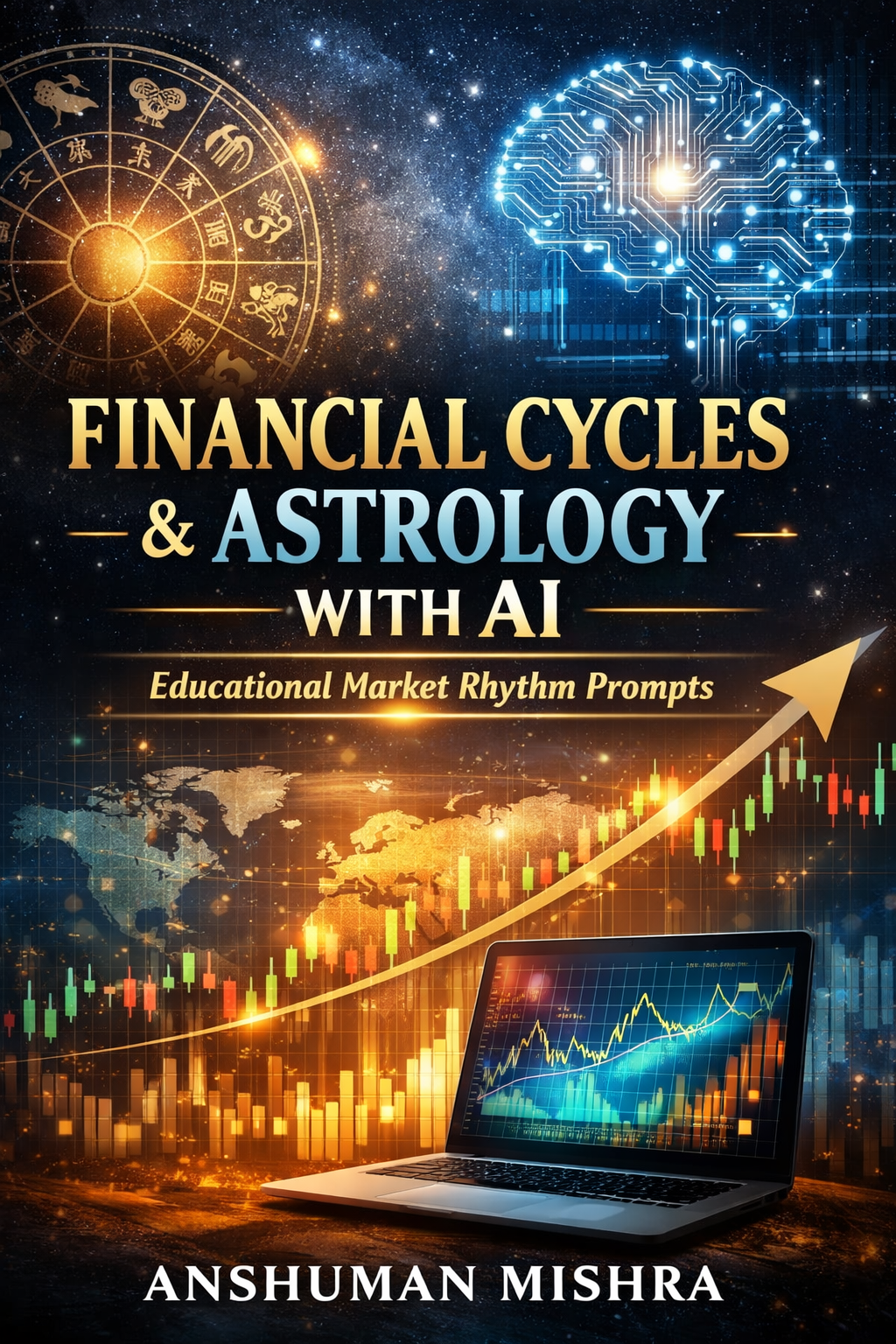
In today’s complex financial environment, understanding markets requires more than simply looking at prices, charts, or individual economic indicators. Financial systems are influenced by numerous interconnected factors, including economic conditions, investor behavior, technological developments, policy decisions, global events, market sentiment, and historical cycles.
Financial Cycles & Astrology with AI: An Educational Guide to Market Rhythms, Historical Patterns, and Analytical Prompts presents a structured approach to studying these subjects through historical observation, time-based analysis, artificial intelligence, and symbolic frameworks.
The book has been designed as an educational resource for students, educators, researchers, independent learners, and readers interested in interdisciplinary approaches to financial studies.
It is important to emphasize that this book is not an investment guide, trading manual, financial advisory resource, or market-prediction system. It does not promise profits or claim that astrology or AI can accurately predict financial markets.
Instead, its purpose is to encourage observation, research, critical thinking, responsible interpretation, and analytical learning.
Understanding Financial Cycles
The book begins with the fundamentals of financial cycles and time-based analysis.
Financial markets can exhibit different types of patterns across different time horizons. These may include:
- Short-term fluctuations
- Seasonal variations
- Business cycles
- Economic expansions and contractions
- Long-term structural changes
- Behavioral patterns
Readers learn how to study these patterns without assuming that historical behavior will necessarily repeat in the future.
The book emphasizes that financial markets are complex and non-linear systems, making simplistic assumptions potentially misleading.
Historical Perspectives on Market Timing
Historical market data can provide valuable opportunities for research and education.
The book introduces readers to the idea of studying:
- Historical market phases
- Economic cycles
- Market expansions
- Market contractions
- Seasonal observations
- Behavioral changes
- Unexpected market events
Historical analysis is presented as a way of understanding financial behavior—not as a guarantee of future market performance.
Astrology as a Cultural and Symbolic Framework
A distinctive feature of this book is its discussion of astrology in relation to time and historical cycles.
Astrology is presented as a traditional cultural and symbolic system, rather than an empirically validated method for predicting financial outcomes.
Readers are introduced to concepts such as:
- Zodiac systems
- Planetary symbolism
- Houses
- Time cycles
- Historical astrological traditions
- Symbolic interpretation
The book maintains a clear distinction between symbolic interpretation and evidence-based financial analysis.
Financial Markets and Human Behavior
Markets are influenced not only by economic information but also by human behavior.
The book explores concepts such as:
- Investor sentiment
- Fear
- Optimism
- Uncertainty
- Risk perception
- Collective behavior
- Emotional decision-making
Understanding behavioral patterns can help readers appreciate why financial markets may sometimes move in ways that appear inconsistent with simple economic explanations.
Data Versus Interpretation
A central theme of the book is the distinction between data and interpretation.
Data can provide measurable information, while interpretation involves assumptions, models, frameworks, and human judgment.
Readers are encouraged to ask:
- What does the data actually show?
- What assumptions are being made?
- Is the observed relationship meaningful?
- Could another explanation exist?
- Is the pattern statistically supported?
- Could the observation be the result of chance?
This approach helps reduce the risk of drawing unsupported conclusions.
Economic Time Cycles
The book explores both long-term and short-term economic cycles.
Topics include:
- Long-term economic cycles
- Short-term market movements
- Seasonal patterns
- Historical market phases
- Economic expansions
- Economic contractions
- Cycles versus random events
Historical case studies are used for educational observation, allowing readers to examine how markets have behaved under different conditions.
Introduction to Artificial Intelligence in Financial Analysis
Artificial intelligence has become an important technology for working with large datasets and complex information.
The book introduces AI concepts relevant to financial research, including:
- Data processing
- Machine learning
- Pattern recognition
- Time-series analysis
- Data organization
- Visualization
- AI-assisted research
The explanations are designed to be accessible to beginners while remaining useful for more advanced learners.
AI for Pattern Recognition
AI can assist researchers in organizing and exploring large quantities of historical information.
For educational purposes, readers can use AI to:
- Identify recurring patterns
- Organize historical observations
- Compare different time periods
- Summarize datasets
- Generate analytical questions
- Create research frameworks
- Assist with visualization planning
However, the book emphasizes that AI-generated patterns are not automatically meaningful or predictive.
Combining Cycle Theory with AI
One of the practical strengths of the book is its focus on combining traditional cycle-based thinking with modern AI-assisted analysis.
Readers learn a structured workflow:
Collect Data → Organize Data → Explore Patterns → Test Assumptions → Compare Results → Document Findings → Evaluate Limitations
This approach helps transform unstructured curiosity into a more disciplined research process.
Avoiding Overfitting
The book introduces the important concept of overfitting.
A pattern may appear highly convincing when examined within a particular historical dataset but fail when applied to new information.
Readers therefore learn why it is important to:
- Test observations on different periods
- Avoid excessive assumptions
- Separate exploration from confirmation
- Compare multiple datasets
- Consider alternative explanations
- Avoid treating historical coincidence as causation
Astrology-Inspired Time Mapping
The book includes a dedicated section on astrology-inspired time mapping, but this is explicitly presented as an educational and symbolic exercise.
Readers can explore how historical time intervals may be organized according to traditional planetary or calendar frameworks and then compare those observations with actual financial data.
The objective is not to generate trading signals or predictions.
Instead, the exercise encourages readers to examine how symbolic frameworks can be compared with historical datasets while maintaining intellectual caution.
AI Prompt Engineering for Market Study
A major feature of the book is its introduction to AI prompt engineering for financial research and historical analysis.
Readers learn how to create prompts that are:
- Clear
- Structured
- Neutral
- Data-oriented
- Research-focused
- Explicit about limitations
For example, instead of asking an AI system to predict whether a market will rise or fall, readers can formulate questions such as:
“Analyze this historical dataset and identify recurring patterns, unusual observations, and possible alternative explanations without making predictions.”
This type of prompt encourages analytical learning rather than speculative conclusions.
Educational Case Studies
The book includes case-study frameworks designed for learning.
These examples demonstrate how readers can:
- Select a historical period.
- Organize available information.
- Identify relevant financial variables.
- Examine potential cycles.
- Use AI to summarize observations.
- Compare different timeframes.
- Evaluate alternative explanations.
- Document findings.
- Identify limitations.
The case studies are educational simulations and should not be interpreted as financial recommendations.
Correlation Versus Causation
One of the most important analytical concepts covered in the book is the difference between correlation and causation.
Two variables may appear to move together without one actually causing the other.
This distinction becomes especially important when studying:
- Financial markets
- Historical cycles
- Planetary cycles
- Economic indicators
- Investor behavior
- AI-generated patterns
Readers are encouraged to investigate relationships carefully rather than accepting apparent associations as established causal mechanisms.
Critical Thinking and Independent Analysis
The book consistently promotes independent thinking.
Readers are encouraged to question:
- Historical assumptions
- AI outputs
- Symbolic interpretations
- Data quality
- Statistical relationships
- Confirmation bias
- Overgeneralization
AI should assist the research process—not replace human judgment.
Responsible Use of AI
Artificial intelligence can be extremely useful, but it also has limitations.
AI systems may:
- Produce inaccurate information
- Misinterpret datasets
- Identify meaningless patterns
- Reflect biases in training data
- Generate overly confident explanations
- Lack sufficient context
For this reason, the book encourages readers to verify important information independently and treat AI as an analytical assistant rather than an unquestionable authority.
Building a Responsible Research Framework
Readers are provided with a practical framework for conducting responsible studies.
This includes:
- Defining research questions
- Collecting reliable data
- Maintaining data integrity
- Documenting methodology
- Comparing multiple approaches
- Recording observations
- Testing assumptions
- Identifying limitations
- Avoiding confirmation bias
- Reviewing conclusions independently
This framework can be applied beyond astrology and financial cycles to many other areas of analytical research.
Future of AI and Cycle Studies
The final chapter explores how technological developments may influence future research.
Topics include:
- Advanced AI systems
- Automated data analysis
- Larger historical datasets
- Interdisciplinary research
- Visualization technologies
- AI-assisted academic research
- Ethical AI development
- Responsible analytical practices
The emphasis remains on using technology to improve research quality and understanding, rather than encouraging unsupported prediction.
Who Should Read This Book?
This book is suitable for:
- Students of finance and economics
- Business and management students
- Data-analysis learners
- AI enthusiasts
- Researchers
- Educators
- Independent learners
- Readers interested in financial history
- Readers interested in symbolic systems
- Individuals interested in interdisciplinary studies
No advanced knowledge of astrology or artificial intelligence is required to begin.
Key Features
✔ Introduction to financial cycles
✔ Historical market pattern analysis
✔ Time-based financial observation
✔ Behavioral finance concepts
✔ Introduction to astrology as a cultural framework
✔ Astrology-inspired time mapping
✔ AI fundamentals for financial analysis
✔ AI-assisted pattern recognition
✔ Time-series data organization
✔ Prompt engineering for market study
✔ Educational case studies
✔ Correlation vs. causation
✔ Overfitting awareness
✔ Confirmation-bias awareness
✔ Critical-thinking frameworks
✔ Responsible AI usage
✔ Ethical research practices
✔ Scientific limitations
✔ Future scope of AI-assisted analysis
Important Disclaimer
This book is strictly educational and informational.
It does not provide investment, trading, financial, tax, or legal advice. It does not recommend buying, selling, or holding any financial asset.
Astrology is discussed as a cultural and symbolic framework, not as a scientifically established method for predicting financial markets.
Artificial intelligence is presented as a research and learning support tool, not as a source of guaranteed financial predictions.
Readers should conduct independent research and, where appropriate, consult qualified financial professionals before making financial decisions.
Final Perspective
Financial Cycles & Astrology with AI offers a distinctive interdisciplinary approach to understanding financial cycles, historical patterns, human behavior, symbolic time systems, and modern artificial intelligence.
Rather than asking, “What will the market do next?”, the book encourages a more valuable educational question:
“How can we study financial patterns carefully, responsibly, and critically?”
By combining historical observation, financial-cycle concepts, behavioral analysis, symbolic frameworks, AI-assisted research, prompt engineering, and critical thinking, this book provides readers with a structured pathway for exploring complex financial systems.
It is ultimately a book about learning, observation, analytical discipline, and responsible use of technology—not prediction or speculation.

Reviews
There are no reviews yet.