Description
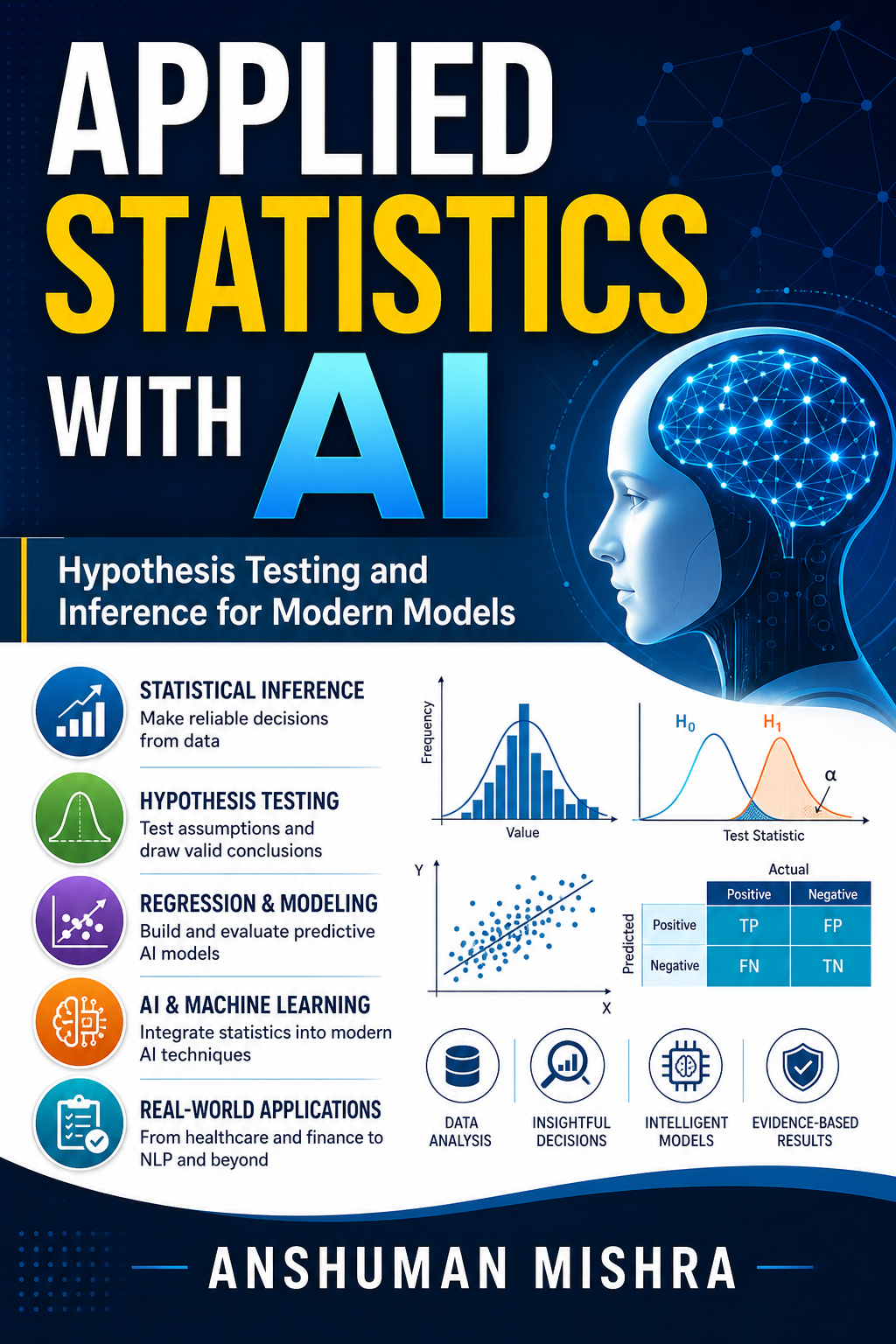
Applied Statistics with AI: Hypothesis Testing and Inference for Modern Models
About the Book
Artificial Intelligence has transformed the way organizations analyze information, make predictions, automate decisions, and solve complex problems. Yet behind every reliable AI system lies a fundamental discipline: statistics.
Machine learning models learn from data, but data is rarely perfect. It contains noise, uncertainty, variation, bias, missing information, and hidden patterns. Statistical methods provide the tools needed to determine whether observed patterns are meaningful, whether model improvements are reliable, and whether conclusions drawn from data can be trusted.
Applied Statistics with AI: Hypothesis Testing and Inference for Modern Models is designed to bridge the gap between traditional statistical methods and modern Artificial Intelligence.
The book provides a structured journey from statistical foundations to advanced AI applications. It explains how concepts such as sampling, probability, estimation, hypothesis testing, regression, Bayesian inference, causal inference, resampling, uncertainty quantification, and statistical significance can be applied to modern AI and machine learning systems.
Rather than treating statistics and AI as separate subjects, this book presents them as interconnected disciplines.
The central idea is simple:
AI can discover patterns, but statistics helps us determine how much confidence we should place in those patterns.
Why Statistics Matters in AI
Modern AI systems are increasingly used in areas where incorrect decisions can have significant consequences.
Consider a machine learning model whose accuracy increases from 80% to 82%.
Is the improvement genuinely meaningful?
Or could it simply be caused by:
- Random variation?
- Dataset differences?
- Sampling effects?
- Data leakage?
- Overfitting?
- An unsuitable evaluation procedure?
Statistical inference provides a framework for answering such questions.
Similarly, if an AI system performs differently for two demographic groups, statistical analysis can help researchers investigate whether the difference is meaningful and whether potential bias needs to be addressed.
Therefore, statistics is not merely an academic requirement. It is a practical foundation for reliable, interpretable, and responsible AI.
What You Will Learn
The book covers the complete statistical journey required for modern AI applications.
Readers will learn about:
- Data types and sampling
- Exploratory data analysis
- Probability
- Random variables
- Probability distributions
- Sampling distributions
- Central Limit Theorem
- Estimation
- Maximum Likelihood Estimation
- Bayesian estimation
- Hypothesis testing
- p-values
- Statistical significance
- Type I and Type II errors
- Parametric testing
- Non-parametric testing
- Regression
- Cross-validation
- Resampling
- Feature selection
- PCA
- Regularization
- A/B testing
- Statistical power
- Bayesian statistics
- MCMC
- Causal inference
- Deep learning uncertainty
- AI fairness
- Statistical ethics
Part I — Foundations of Applied Statistics
The first part establishes the statistical foundation required for working with AI datasets.
Chapter 1 — Introduction to Applied Statistics and AI
The opening chapter explains why statistics is fundamental to AI and Data Science.
It introduces:
- Importance of statistics in AI
- Classical and modern statistical approaches
- Statistical inference
- Model development
- Evidence-based decision-making
Readers learn how statistical reasoning can improve the development and evaluation of AI systems.
Chapter 2 — Data Types, Sampling, and Preprocessing
Good statistical analysis begins with good data.
This chapter introduces:
- Numerical data
- Categorical data
- Ordinal data
- Time-series data
- Random sampling
- Stratified sampling
- Bootstrapping
- Data cleaning
- Normalization
- Feature scaling
The chapter helps readers understand how inappropriate sampling or preprocessing can affect the reliability of AI models.
Chapter 3 — Descriptive Statistics and Visualization
Before applying advanced statistical methods, data must be understood.
This chapter covers:
- Mean
- Median
- Mode
- Variance
- Standard deviation
- Interquartile range
- Histograms
- Boxplots
- Scatter plots
- Exploratory Data Analysis
Readers learn how visualization and descriptive statistics can reveal patterns, outliers, distributions, and relationships within AI datasets.
Part II — Probability and Distributions
Probability provides the mathematical language for reasoning under uncertainty.
Chapter 4 — Probability Theory in AI
Topics include:
- Basic probability rules
- Conditional probability
- Bayes’ theorem
- Bayesian learning
- Probabilistic reasoning
The chapter connects probability concepts with practical AI methods and decision-making.
Chapter 5 — Random Variables and Probability Distributions
Readers explore important discrete and continuous distributions.
Discrete Distributions
- Bernoulli
- Binomial
- Poisson
Continuous Distributions
- Normal
- Exponential
- Uniform
The chapter also explains how probability distributions appear in machine learning and AI algorithms.
Chapter 6 — Sampling Distributions and Central Limit Theorem
This chapter explains why sampling distributions are important for statistical inference.
Topics include:
- Law of Large Numbers
- Central Limit Theorem
- Sampling distributions
- Simulation-based understanding
These concepts provide the foundation for many statistical tests and confidence intervals.
Part III — Statistical Inference
Statistical inference is at the heart of this book.
Chapter 7 — Estimation Methods
Readers learn how unknown population parameters can be estimated from data.
Topics include:
- Point estimation
- Interval estimation
- Maximum Likelihood Estimation
- Bayesian estimation
The chapter helps readers understand how statistical models learn parameters from observations.
Chapter 8 — Hypothesis Testing Fundamentals
Hypothesis testing is one of the most important tools for evaluating claims about data and AI models.
This chapter explains:
- Null hypothesis
- Alternative hypothesis
- Type I error
- Type II error
- Significance levels
- p-values
- Statistical significance
Readers learn how to formulate and evaluate statistical hypotheses.
Chapter 9 — Parametric Tests in AI Context
The book introduces widely used parametric and categorical statistical tests.
Topics include:
- One-sample t-test
- Two-sample t-test
- Paired t-test
- ANOVA
- Chi-square tests
The focus is on understanding when these tests are appropriate and how they can be applied in AI-related experiments.
Chapter 10 — Non-Parametric Tests for AI Data
Not every dataset satisfies the assumptions required by classical parametric tests.
This chapter introduces:
- Wilcoxon test
- Mann-Whitney test
- Kruskal-Wallis test
- Kolmogorov-Smirnov test
Readers learn how non-parametric methods can provide alternatives when assumptions such as normality are unsuitable.
Part IV — Applied Statistics in AI
This section directly connects statistical techniques with machine learning.
Chapter 11 — Regression Analysis for Prediction
Regression is both a statistical and machine learning technique.
The chapter covers:
- Linear regression
- Regression assumptions
- Logistic regression
- Residual analysis
- Goodness-of-fit
Readers learn how regression can be used for prediction as well as statistical interpretation.
Chapter 12 — Statistical Inference in Machine Learning Models
Machine learning performance must be evaluated carefully.
Topics include:
- Overfitting
- Underfitting
- Bias-variance tradeoff
- Cross-validation
- Resampling
- Confidence intervals
The chapter demonstrates why model accuracy alone may not be sufficient to establish reliable conclusions.
Chapter 13 — Feature Selection and Dimensionality Reduction
Statistical relationships between features can help improve machine learning models.
This chapter introduces:
- Correlation
- Mutual information
- Principal Component Analysis
- Lasso regularization
- Ridge regularization
Readers learn how statistical techniques can contribute to feature engineering and dimensionality reduction.
Chapter 14 — Hypothesis Testing in AI Research
AI research frequently involves comparing algorithms, datasets, or experimental conditions.
This chapter focuses on:
- A/B testing
- Experimental design
- Statistical power
- AI model comparison
- Reinforcement learning experiments
- NLP research evaluation
Readers learn how to design experiments that produce more defensible conclusions.
Part V — Advanced Topics and Case Studies
The fifth part takes statistical reasoning into advanced AI applications.
Chapter 15 — Bayesian Statistics for AI Models
Bayesian methods provide a powerful framework for updating beliefs based on evidence.
Topics include:
- Bayesian inference
- Posterior estimation
- Prior and likelihood concepts
- MCMC methods
- Probabilistic machine learning
The chapter provides a foundation for understanding uncertainty-aware AI systems.
Chapter 16 — Causal Inference in AI Systems
Correlation does not necessarily imply causation.
This chapter examines:
- Correlation vs causation
- Structural causal models
- Causal reasoning
- AI for policy
- AI-assisted decision-making
Understanding causality is especially important when AI systems are used to support real-world decisions.
Chapter 17 — Statistical Inference in Deep Learning
Deep learning systems can produce highly accurate predictions while still containing significant uncertainty.
This chapter explores:
- Dropout as a Bayesian approximation
- Neural-network uncertainty
- Prediction confidence
- Uncertainty quantification
The goal is to help readers think beyond simple accuracy metrics and consider the reliability of predictions.
Chapter 18 — Applied Case Studies
The book concludes its advanced section with practical case studies.
Healthcare
Statistical inference for diagnostic AI and model evaluation.
Finance
Hypothesis testing and statistical analysis for fraud detection.
NLP
Statistical significance in language-model and NLP improvements.
Computer Vision
Evaluating improvements in image classification and computer vision models.
These examples demonstrate how statistical methods can support responsible AI deployment.
Part VI — Future Directions
The final part considers the future relationship between statistics and AI.
Chapter 19 — Statistical Ethics and AI Fairness
AI systems can inherit biases from data and design choices.
This chapter discusses:
- Bias detection
- Bias mitigation
- Fairness evaluation
- Responsible statistical analysis
- Ethical use of hypothesis testing
Statistical techniques can help identify differences in model behavior and support more responsible AI evaluation.
Chapter 20 — Next-Generation Statistical Tools for AI
The final chapter explores emerging directions such as:
- Automated statistical inference
- AutoML
- AI-assisted hypothesis generation
- Automated experimentation
- Future research challenges
It considers how AI itself may increasingly assist researchers in performing statistical analysis.
The Importance of Hypothesis Testing in AI
One of the central themes of this book is the importance of hypothesis testing.
Suppose two AI models achieve different performance levels.
Model A achieves 90% accuracy.
Model B achieves 91% accuracy.
It may be tempting to conclude that Model B is better.
However, statistical analysis asks a more important question:
Is the observed difference statistically meaningful?
Hypothesis testing provides a structured framework for evaluating such claims.
This principle is essential in:
- Model comparison
- A/B testing
- Product experiments
- Algorithm evaluation
- AI research
- Clinical AI studies
- Business analytics
From Statistics to Reliable AI
The book encourages readers to follow a complete analytical workflow:
Collect Data
↓
Clean and Prepare Data
↓
Explore Data
↓
Formulate Hypotheses
↓
Select Statistical Method
↓
Analyze Evidence
↓
Evaluate Uncertainty
↓
Interpret Results
↓
Make Responsible Decisions
This approach helps prevent the common mistake of treating AI output as automatically correct.
Key Features of the Book
1. AI-Oriented Statistics
Traditional statistical concepts are explained through AI and machine learning applications.
2. Hypothesis Testing Focus
Special emphasis is placed on hypothesis formulation, significance testing, p-values, errors, and statistical power.
3. Practical Applications
Statistical methods are connected with real AI problems and datasets.
4. Progressive Learning
The book moves from basic statistical foundations to advanced inference and AI applications.
5. Research-Oriented Content
Topics such as statistical power, Bayesian inference, causal inference, and uncertainty quantification support academic research.
6. Industry Relevance
Applications include healthcare, finance, NLP, computer vision, and AI experimentation.
7. Ethical Perspective
The book addresses bias, fairness, responsible inference, and ethical statistical practices.
Who Should Read This Book?
BCA Students
Students can develop foundational statistical knowledge relevant to AI and Data Science.
B.Tech Students
The book supports students studying Artificial Intelligence, Machine Learning, Computer Science, and Data Analytics.
MCA Students
Advanced statistical inference and AI applications make the book useful for postgraduate study.
MSc Data Science and AI Students
The book provides statistical concepts required for machine learning and research.
Researchers
Researchers can use hypothesis testing, Bayesian methods, causal inference, and statistical evaluation techniques in AI studies.
Data Scientists
Professionals can strengthen their ability to validate models and interpret experimental results.
AI Engineers
Engineers can develop a better understanding of uncertainty, model evaluation, and statistical reliability.
Educators
Faculty members can use the chapter structure as a teaching and reference resource.
Benefits of Studying This Book
Academic Benefits
Students gain a structured understanding of statistics relevant to AI, ML, and Data Science courses.
Research Benefits
Researchers learn how to design experiments and evaluate AI results using statistical evidence.
Professional Benefits
Data scientists and AI professionals can make better decisions by combining machine learning with statistical reasoning.
Analytical Benefits
Readers develop stronger skills in interpreting data, uncertainty, variation, and model performance.
Ethical Benefits
Statistical fairness and bias analysis help readers understand the importance of responsible AI evaluation.
Learning Outcomes
After completing this book, readers will be able to:
- Understand the role of statistics in AI.
- Identify different types of data.
- Apply appropriate sampling techniques.
- Perform descriptive statistical analysis.
- Understand probability and distributions.
- Apply Bayes’ theorem.
- Understand sampling distributions and the Central Limit Theorem.
- Perform point and interval estimation.
- Formulate statistical hypotheses.
- Interpret p-values and significance levels.
- Understand Type I and Type II errors.
- Apply t-tests, ANOVA, and chi-square tests.
- Use non-parametric statistical tests.
- Apply regression techniques.
- Evaluate machine learning models statistically.
- Understand cross-validation and resampling.
- Apply PCA and regularization.
- Design A/B tests.
- Understand Bayesian inference and MCMC.
- Explore causal inference.
- Quantify uncertainty in deep learning.
- Evaluate AI fairness statistically.
- Apply statistical reasoning to real-world AI problems.
Real-World Applications
The concepts in this book can be applied across multiple domains.
Healthcare AI
Statistical inference can help evaluate diagnostic models and understand uncertainty in medical predictions.
Financial AI
Statistical testing can support fraud detection, risk analysis, and financial modeling.
Natural Language Processing
Statistical significance can help evaluate improvements in NLP systems.
Computer Vision
Statistical methods can be used to compare image-processing and classification models.
Reinforcement Learning
Experimental design and statistical testing can help evaluate whether an RL improvement is robust.
Business Analytics
A/B testing and statistical inference can support data-driven product and business decisions.
A Bridge Between Statistics and Artificial Intelligence
The most important contribution of this book is its interdisciplinary perspective.
Traditional statistics provides the language of:
Data + Uncertainty + Evidence + Inference
Artificial Intelligence provides:
Learning + Prediction + Automation + Decision-Making
Together, they create a framework for:
Reliable + Explainable + Evidence-Based AI
This book is designed to help readers understand that relationship.
Conclusion
Applied Statistics with AI: Hypothesis Testing and Inference for Modern Models is more than a conventional statistics textbook. It is a practical bridge between statistical reasoning and modern artificial intelligence.
From descriptive statistics and probability to hypothesis testing, regression, Bayesian inference, causal reasoning, deep learning uncertainty, and AI fairness, the book provides a progressive learning path for understanding how statistical methods support reliable AI.
Its central message is that AI should not only produce predictions—it should provide results that can be evaluated, interpreted, and questioned using evidence.
For students, the book provides academic foundations.
For researchers, it provides statistical tools for rigorous experimentation.
For professionals, it provides methods for evidence-based decision-making.
For educators, it offers a structured resource for teaching statistics in the context of AI.
In an era where algorithms increasingly influence important decisions, statistical literacy is becoming an essential AI skill.
Learn the data. Test the evidence. Understand the uncertainty. Build better AI.

Reviews
There are no reviews yet.