Description
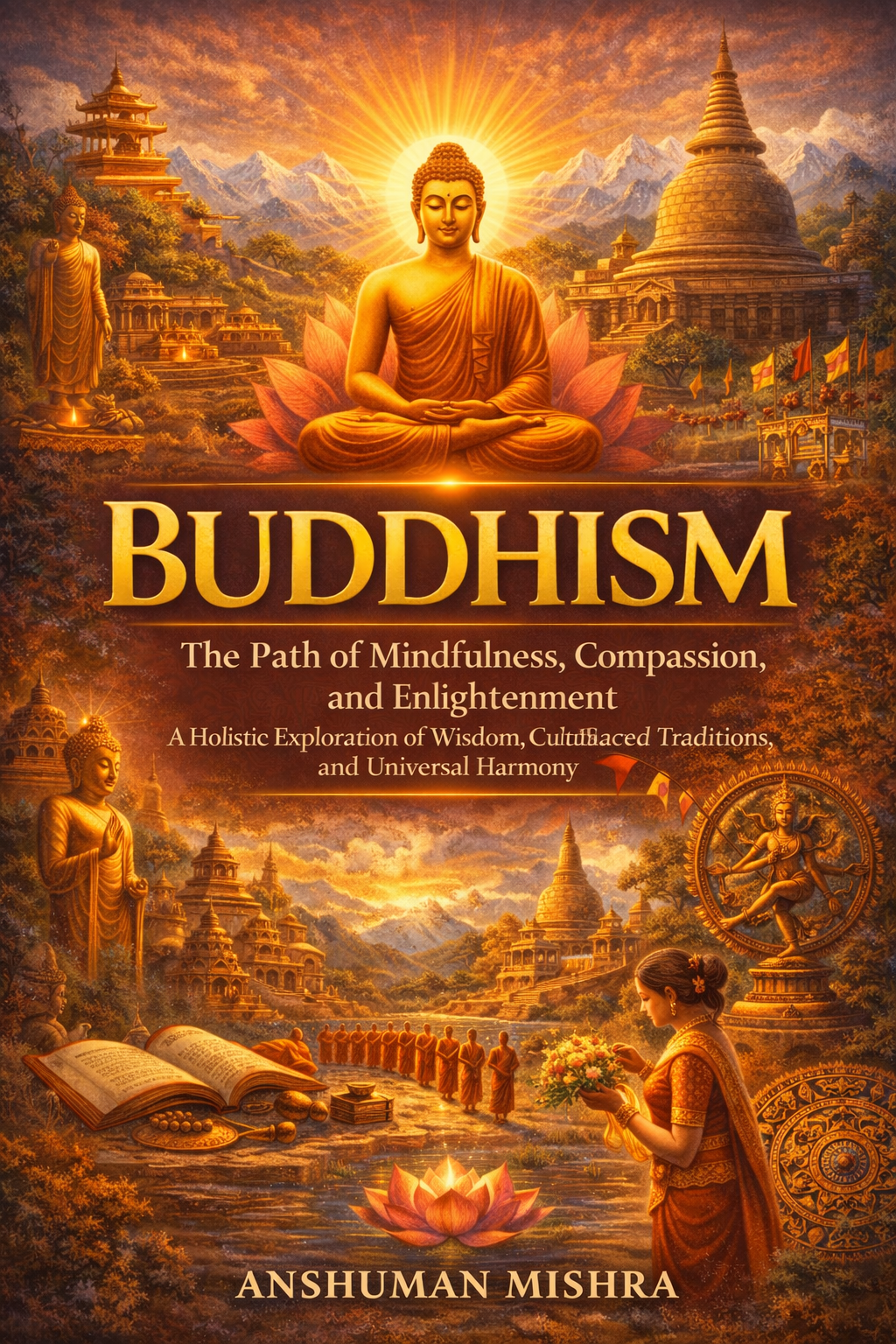
Buddhism: The Path of Mindfulness, Compassion, and Enlightenment
A Holistic Exploration of Wisdom, Culture, Sacred Traditions, and Universal Harmony
Author: Anshuman Mishra
In an increasingly fast-paced world, people are searching for greater inner peace, emotional balance, ethical clarity, meaningful relationships, and a deeper understanding of life. Buddhism: The Path of Mindfulness, Compassion, and Enlightenment offers a comprehensive introduction to one of the world’s most influential spiritual and philosophical traditions.
This book explores Buddhism not only as a historical tradition, but also as a path of wisdom, mindfulness, compassion, ethical responsibility, and inner transformation. It brings together Buddhist philosophy, the life and teachings of Gautama Buddha, meditation, sacred literature, major Buddhist traditions, ethics, social harmony, sacred geography, art, festivals, global development, science, and contemporary relevance.
Written in a clear, professional, and accessible style, the book is designed to help readers understand both the foundational principles of Buddhism and their relevance to modern life.
What You Will Discover in This Book
1. The Spiritual Foundations of Buddhism
The book begins with an exploration of Buddhism as a path of wisdom and peace. It examines the meaning and essence of Buddhism, its development as a way of life, and its emphasis on universal values such as mindfulness, compassion, awareness, balance, and peaceful coexistence.
Readers are introduced to Buddhism as a tradition that encourages thoughtful observation of life, responsible conduct, self-awareness, and the continuous development of wisdom.
2. The Origins of Buddhism
The book provides an overview of the cultural and spiritual environment of ancient India in which Buddhism emerged. It explains the historical and intellectual background associated with the emergence of Buddhism and its development as a path concerned with understanding human experience and seeking liberation.
The early Buddhist community and its emphasis on harmony, discipline, teaching, and peaceful coexistence are also discussed.
3. The Life and Enlightenment of Gautama Buddha
A central section of the book focuses on the remarkable life of Gautama Buddha—from his early life and encounter with the realities of existence to his search for truth, enlightenment at Bodh Gaya, teaching journey, and Mahaparinirvana.
Rather than presenting his life merely as a sequence of historical events, the book examines his journey as an example of spiritual inquiry, self-discovery, disciplined practice, wisdom, and compassionate service.
4. The Core Teachings of Buddhism
The book explains some of the most important concepts in Buddhist thought, including:
- The Four Noble Truths
- The Noble Eightfold Path
- The Middle Path
- The Three Jewels
- Impermanence
- Karma
- Interconnectedness
- Nirvana
- Self-awareness
- Ethical responsibility
These concepts are presented in an approachable manner so that readers can understand their philosophical significance as well as their potential relevance to everyday life.
5. Mindfulness and Meditation
Mindfulness has become increasingly important in contemporary discussions about attention, well-being, self-awareness, and personal development. This book explores Buddhist approaches to meditation, concentration, insight, and mindful living.
Readers will encounter discussions of mindfulness in:
- Thought
- Speech
- Action
- Daily activities
- Emotional responses
- Personal reflection
The objective is to help readers understand mindfulness as a disciplined practice of awareness rather than simply a modern trend.
6. Buddhist Scriptures and Sacred Literature
The book introduces readers to the development and preservation of Buddhist teachings through oral traditions, Buddhist councils, sacred literature, commentaries, and scholarly traditions.
The Tripitaka and the development of Pali and Sanskrit literary traditions are discussed as important components of Buddhist intellectual and spiritual heritage.
7. Major Buddhist Traditions
Buddhism developed across different regions and cultures, giving rise to diverse traditions and schools. The book provides an accessible overview of:
- Theravāda Buddhism
- Mahāyāna Buddhism
- Vajrayāna Buddhism
- Zen Buddhism
- Tibetan Buddhism
The discussion highlights both their distinctive characteristics and their broader connection with Buddhist values of wisdom, discipline, compassion, and spiritual development.
8. The Bodhisattva Ideal
The concept of the Bodhisattva represents one of the most influential ideals within Mahāyāna Buddhist thought.
The book explores the relationship between wisdom and compassion and examines the Bodhisattva ideal as a model of selfless service, responsibility toward others, and commitment to the welfare of sentient beings.
9. Buddhist Ethics and Moral Living
Buddhist philosophy has a strong ethical dimension. The book examines principles such as:
- The Five Precepts
- Non-violence
- Truthfulness
- Compassion
- Loving-kindness
- Right livelihood
- Responsible conduct
- Peaceful coexistence
These principles are considered in the context of modern society, where ethical decision-making and responsible citizenship remain increasingly important.
10. Buddhism and Social Harmony
Buddhism’s relationship with community life, education, social responsibility, and harmonious coexistence is also explored.
The book discusses the role of the Sangha, the relationship between monastic and lay life, education, dignity, equality, community cooperation, and the development of peaceful societies.
11. Leadership, Governance, and Emperor Ashoka
The book examines Buddhist perspectives on ethical leadership and responsible governance, including the historical example of Emperor Ashoka.
Themes such as compassion, justice, responsibility, public welfare, peaceful administration, and ethical citizenship are explored to demonstrate how spiritual values can influence ideas about leadership and society.
12. Sacred Places and Buddhist Pilgrimage
Readers are introduced to important Buddhist sacred places, including:
- Lumbini — associated with the birth of Gautama Buddha
- Bodh Gaya — associated with enlightenment
- Sarnath — associated with the Buddha’s first teaching
- Kushinagar — associated with Mahaparinirvana
The book also explains pilgrimage as a cultural, historical, and spiritual journey of reflection and remembrance.
13. Buddhist Art, Symbols, and Architecture
Buddhist philosophy has profoundly influenced art and architecture across Asia and beyond.
The book explores Buddhist symbols, stupas, monasteries, temples, sculptures, paintings, mandalas, and other cultural expressions, helping readers understand how spiritual ideas have been represented through visual and architectural traditions.
14. Buddhist Festivals and Celebrations
Major Buddhist festivals and observances are introduced, including:
- Vesak or Buddha Purnima
- Asalha Puja
- Magha Puja
- Kathina
The book examines how festivals combine spiritual reflection, remembrance, community participation, generosity, gratitude, and cultural heritage.
15. Buddhism Across Asia and the World
Buddhism developed into a global tradition while adapting to diverse cultural environments.
The book explores Buddhism in:
- India
- Sri Lanka
- Southeast Asia
- China
- Japan
- Korea
- Europe
- The Americas
- Australia
This global perspective demonstrates the cultural diversity that exists within Buddhist traditions while highlighting their shared emphasis on wisdom, compassion, ethical conduct, and inner development.
16. Buddhism, Science, and Modern Knowledge
One of the most contemporary sections of the book examines the relationship between Buddhism and modern scientific thought.
Topics include:
- Buddhism and psychology
- Mindfulness and well-being
- Meditation and neuroscience
- Environmental awareness
- Science and spirituality
- Consciousness and human experience
The discussion encourages thoughtful dialogue between ancient philosophical traditions and modern academic and scientific perspectives.
17. Buddhism in Contemporary Life
The final chapters examine how Buddhist values can remain meaningful in today’s rapidly changing world.
The book discusses mindfulness, education, personal development, stress management, peace-building, conflict resolution, digital-age challenges, youth development, interfaith harmony, cultural preservation, and the future transmission of Buddhist wisdom.
Who Should Read This Book?
This book is suitable for:
- University and college students
- Students of philosophy, religion, history, and culture
- Researchers and educators
- Competitive examination aspirants
- Readers interested in Indian heritage
- Readers interested in Buddhism and spirituality
- Meditation and mindfulness learners
- Spiritual seekers
- Readers interested in Asian history and culture
- General readers seeking knowledge and personal reflection
Why This Book Is Valuable
Buddhism: The Path of Mindfulness, Compassion, and Enlightenment brings together history, philosophy, spirituality, ethics, culture, meditation, literature, geography, art, science, and contemporary life in a single structured volume.
Its greatest strength lies in presenting Buddhism through a holistic and inclusive perspective. Instead of treating Buddhist teachings as isolated philosophical concepts, the book explores their connection with human values, personal development, social harmony, cultural heritage, and global peace.
The book is designed to encourage understanding rather than judgment, reflection rather than dogmatism, and compassion rather than division.
A Timeless Message for a Changing World
At its heart, Buddhism is deeply concerned with the human search for wisdom, awareness, freedom, and peace. Its teachings have traveled across centuries and continents, interacting with different cultures while continuing to inspire generations of learners and practitioners.
This book invites readers to explore that journey—from the spiritual landscape of ancient India to the global world of the twenty-first century.
Whether you are encountering Buddhism for the first time, studying it academically, exploring mindfulness, or simply interested in humanity’s search for peace and wisdom, this book offers a structured and thoughtful introduction.



Reviews
There are no reviews yet.