Description
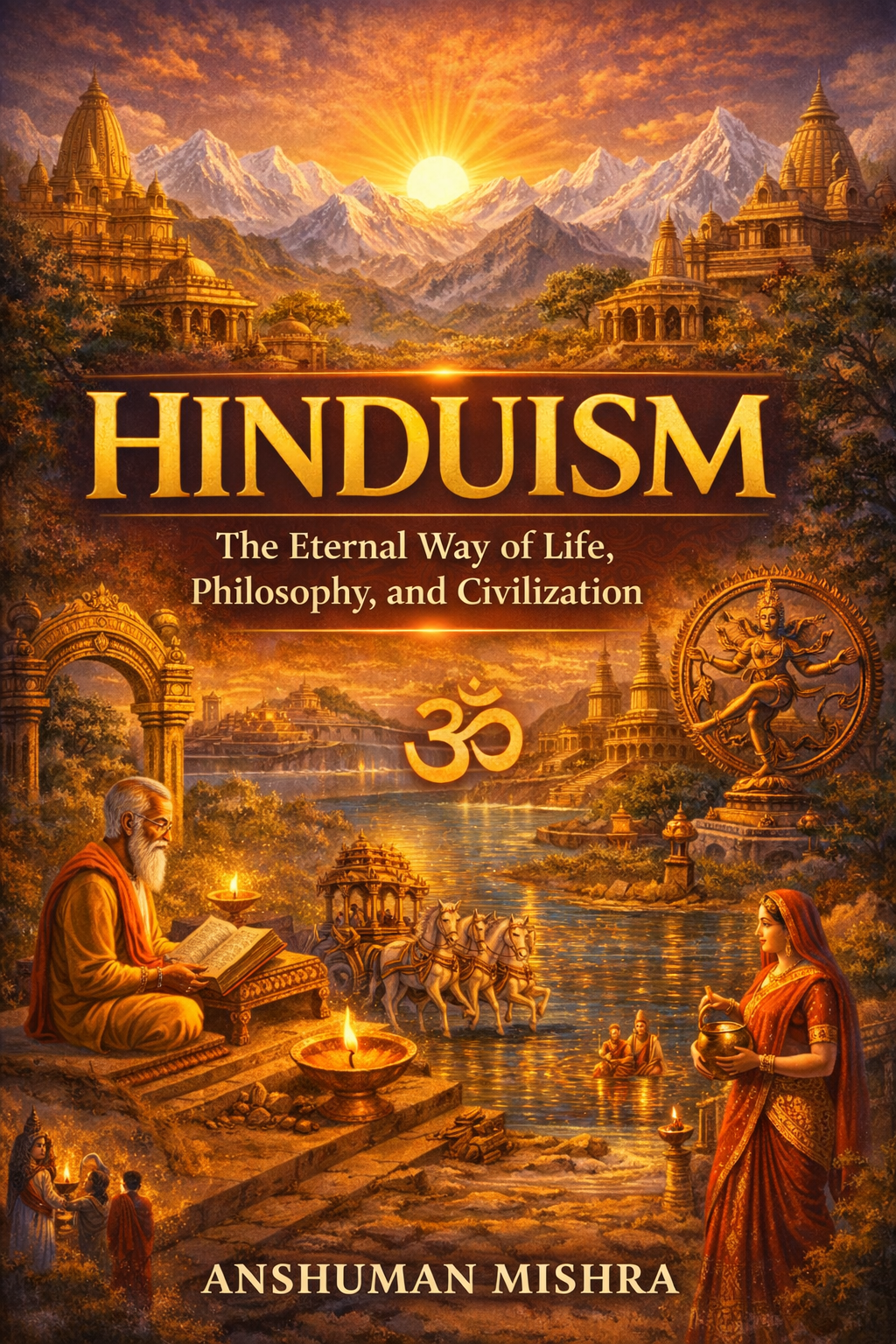
Hinduism: The Eternal Way of Life, Philosophy, and Civilization is a comprehensive, respectful, and educational exploration of Hinduism as a spiritual tradition, philosophical framework, cultural heritage, and living civilization.
With roots extending across thousands of years, Hindu civilization has developed a remarkable diversity of philosophical ideas, spiritual practices, sacred literature, artistic traditions, social values, festivals, pilgrimage traditions, and systems of knowledge.
This book provides readers with a structured introduction to these diverse dimensions while emphasizing the philosophical and practical ideas that have contributed to the continuing relevance of Hindu thought.
What This Book Covers
The book explores:
- Meaning and essence of Hinduism
- Sanātana Dharma
- Origins and evolution of Hindu civilization
- Vedas and Upanishads
- Bhagavad Gita
- Ramayana and Mahabharata
- Puranic literature
- Dharma and ethical living
- Karma and responsibility
- Samsara and the journey of existence
- Moksha and liberation
- Atman and Brahman
- Hindu concepts of time and cosmic order
- Karma Yoga
- Bhakti Yoga
- Jnana Yoga
- Raja Yoga
- Meditation and spiritual discipline
- Hindu deities and symbolism
- Divine feminine and Shakti
- Avatars and spiritual narratives
- Family and social values
- Rituals and worship
- Mantras and meditation
- Temples and pilgrimage
- Hindu festivals
- Sacred rivers, mountains, forests, and landscapes
- Temple architecture
- Indian music, dance, literature, and art
- Hindu ethics and universal values
- Traditional knowledge systems
- Mathematics, astronomy, and medicine in historical context
- Yoga and well-being
- Ecology and sustainable living
- Hinduism in the modern world
- Global Hindu communities
- Hinduism as a living cultural heritage
Hinduism as a Way of Life
Hinduism is often understood through many different dimensions—religion, philosophy, spirituality, culture, tradition, and civilization.
This book explores these dimensions together.
Rather than presenting Hinduism only through rituals or mythology, it examines the philosophical ideas and practical principles that have shaped Hindu ways of understanding life, duty, knowledge, spirituality, society, and the relationship between the individual and the larger universe.
The concept of Sanātana Dharma is introduced as an important expression within Hindu thought, associated with enduring principles of ethical and spiritual order.
Ancient Origins and Civilizational Continuity
The book explores the ancient roots and long development of Hindu civilization.
Readers are introduced to the ways in which spiritual ideas, philosophical schools, cultural traditions, literature, education, art, and social practices developed over long periods.
The discussion emphasizes Hinduism’s ability to evolve while maintaining connections with earlier traditions.
This historical continuity helps readers understand why Hinduism continues to function as a living tradition rather than simply a subject of ancient history.
Sacred Literature and Knowledge Traditions
Hindu civilization has produced an extraordinarily rich body of sacred and philosophical literature.
The book introduces readers to major sources of Hindu thought, including:
The Vedas
The Vedas are discussed as foundational bodies of sacred knowledge and ritual literature.
The Upanishads
The Upanishads are explored for their philosophical inquiry into consciousness, existence, self, reality, and ultimate knowledge.
The Bhagavad Gita
The Bhagavad Gita receives special attention as a philosophical and spiritual text addressing duty, action, knowledge, devotion, discipline, and inner balance.
The Epics
The Ramayana and Mahabharata are examined as major sources of cultural, ethical, philosophical, and literary traditions.
Puranic Literature
The book also introduces the Puranas and their role in devotional traditions, sacred narratives, cultural memory, and the understanding of divine symbolism.
Dharma, Karma, Samsara, and Moksha
A major strength of the book is its systematic explanation of some of the central concepts of Hindu philosophy.
Dharma
Dharma is explored in relation to ethical responsibility, right conduct, duty, balance, and responsible living.
Karma
The concept of Karma is presented in connection with action, responsibility, consequence, and ethical awareness.
Samsara
Samsara represents the continuing cycle of existence in many Hindu philosophical traditions and is discussed in relation to spiritual development.
Moksha
Moksha is explored as liberation and spiritual freedom, with attention to different philosophical understandings of the concept.
Together, these ideas provide an important framework for understanding Hindu approaches to human life and spiritual development.
Atman and Brahman
The relationship between Atman and Brahman is one of the most significant philosophical themes explored in the book.
Readers are introduced to different ways Hindu philosophical traditions approach questions concerning:
- Self
- Consciousness
- Ultimate reality
- Individual existence
- Universal reality
- Spiritual knowledge
The book presents these ideas in accessible language so that beginners can approach complex philosophical concepts without unnecessary difficulty.
The Four Yogic Paths
Hindu traditions offer multiple approaches to spiritual development.
The book introduces four widely discussed paths:
Karma Yoga — the path of selfless action
Bhakti Yoga — the path of devotion
Jnana Yoga — the path of knowledge
Raja Yoga — the path of meditation and mental discipline
Rather than treating these approaches as isolated systems, the book explores how they can represent complementary dimensions of spiritual practice.
Understanding the Divine
Hindu traditions contain diverse ways of understanding and representing the Divine.
The book introduces readers to:
- Supreme Reality
- Divine symbolism
- Major Hindu deities
- Shakti and the Divine Feminine
- Avatars
- Devotional traditions
- Temple worship
- Symbolic representation
The discussion focuses on understanding the meanings and cultural contexts behind these traditions rather than reducing them to simplistic interpretations.
Hindu Family and Social Life
Hindu civilization has historically connected spiritual principles with everyday life.
The book examines:
- Family responsibilities
- Community relationships
- Education
- Respect for elders and teachers
- Ethical conduct
- Social cooperation
- Responsibility toward society
- Respect for living beings
It explores how spiritual and ethical values can influence individual and community life.
Rituals, Worship, and Spiritual Practices
Hindu religious and cultural life includes a wide variety of practices.
The book introduces readers to:
- Puja
- Mantras
- Meditation
- Temple traditions
- Home worship
- Yajna and fire rituals
- Sacred offerings
- Pilgrimage
- Spiritual discipline
The purpose and symbolism of these practices are explained within their cultural and spiritual contexts.
Hindu Festivals and Celebration of Life
Festivals form an important part of Hindu cultural and spiritual life.
The book explores the significance of festivals as occasions of:
- Devotion
- Gratitude
- Family gathering
- Cultural continuity
- Seasonal awareness
- Community participation
- Spiritual reflection
- Joy and celebration
It also examines the diversity of festival traditions across different regions of India.
Major Festival Traditions
Readers can explore the cultural and spiritual dimensions associated with celebrations such as:
- Diwali
- Holi
- Navratri
- Durga Puja
- Dussehra
- Janmashtami
- Ram Navami
- Mahashivratri
- Ganesh Chaturthi
- Makar Sankranti
- Raksha Bandhan
- Pongal and related regional traditions
The book emphasizes that Hindu festivals represent a rich combination of spiritual meaning, seasonal cycles, community traditions, family life, and cultural heritage.
Sacred Geography and Pilgrimage
Nature and sacred geography occupy an important place in Hindu traditions.
The book discusses the cultural and spiritual significance associated with:
- Rivers
- Mountains
- Forests
- Temples
- Sacred cities
- Pilgrimage routes
- Natural landscapes
Important pilgrimage traditions and sacred centers are introduced as part of India’s broader cultural heritage.
The book also emphasizes the importance of preserving these sites for future generations.
Hindu Art, Architecture, and Culture
Hindu civilization has made significant contributions to visual and performing arts.
The book explores:
- Temple architecture
- Sculpture
- Painting
- Classical music
- Classical dance
- Literature
- Poetry
- Drama
- Sacred storytelling
- Aesthetic philosophy
These artistic traditions are presented as important forms of cultural expression through which philosophical and spiritual ideas have been transmitted across generations.
Hindu Ethics and Universal Values
The book examines ethical values frequently associated with Hindu philosophical and cultural traditions, including:
- Truth
- Compassion
- Non-violence
- Self-control
- Discipline
- Charity
- Service
- Responsibility
- Respect for life
- Inner balance
These principles are discussed in relation to personal development, social responsibility, leadership, and peaceful living.
Hindu Knowledge Systems
Another important section of the book explores historical Hindu and Indian knowledge traditions.
Topics include:
- Mathematics
- Astronomy
- Ayurveda
- Yoga
- Philosophy
- Linguistics
- Education
- Literature
- Traditional approaches to nature and ecology
The book presents these subjects in historical and educational context, encouraging readers to distinguish between traditional knowledge, historical contributions, and modern scientific evidence.
Yoga, Meditation, and Inner Well-Being
Yoga is explored not merely as a physical practice but as a broader family of philosophical and spiritual disciplines.
The book discusses:
- Meditation
- Mind discipline
- Self-awareness
- Concentration
- Ethical practice
- Spiritual development
- Inner balance
Readers are introduced to the historical and philosophical dimensions of Yoga while recognizing its diverse contemporary applications.
Hinduism and Nature
Respect for nature appears in many Hindu cultural and philosophical traditions.
The book explores traditional ideas concerning:
- Rivers
- Trees
- Animals
- Mountains
- Forests
- Ecological balance
- Responsible use of resources
It also considers how traditional perspectives can contribute to contemporary discussions about environmental awareness and sustainable living.
Hinduism in the Modern World
Hinduism continues to evolve within a rapidly changing global environment.
The book examines topics such as:
- Hinduism and globalization
- Hindu communities around the world
- Hindu philosophy in modern education
- Yoga and meditation
- Cultural exchange
- Research in Hindu studies
- Modern spiritual practices
- Intercultural understanding
The emphasis is on understanding Hinduism as a living tradition capable of engaging with contemporary questions while maintaining connections with its historical heritage.
Who Should Read This Book?
This book is suitable for:
- Students of religion and philosophy
- Students of Indian history and culture
- Educators and teachers
- Researchers
- General readers
- Spiritual learners
- Readers interested in Yoga and meditation
- Readers interested in Hindu philosophy
- Readers interested in Indian civilization
- Libraries and educational institutions
- International readers seeking an introduction to Hinduism
No specialized prior knowledge is required.
Key Features
✔ Introduction to Hinduism and Sanātana Dharma
✔ Hindu civilization and its historical development
✔ Vedas and Upanishads
✔ Bhagavad Gita
✔ Ramayana and Mahabharata
✔ Puranic traditions
✔ Dharma and Karma
✔ Samsara and Moksha
✔ Atman and Brahman
✔ Four paths of Yoga
✔ Hindu deities and symbolism
✔ Shakti and Divine Feminine traditions
✔ Hindu rituals and worship
✔ Meditation and Mantras
✔ Temples and pilgrimage
✔ Hindu festivals and celebrations
✔ Sacred geography
✔ Hindu art and architecture
✔ Music, dance, literature, and poetry
✔ Hindu ethics and values
✔ Traditional knowledge systems
✔ Mathematics and astronomy in historical context
✔ Ayurveda and Yoga traditions
✔ Nature and ecological awareness
✔ Hinduism in the modern world
✔ Global Hindu communities
✔ Hinduism as a living civilization
Why This Book Is Valuable
The strength of Hinduism: The Eternal Way of Life, Philosophy, and Civilization lies in its broad perspective.
It does not limit Hinduism to a single dimension. Instead, it presents the interconnected relationship between:
Philosophy + Spirituality + Ethics + Culture + Knowledge + Art + Nature + Daily Life
This approach allows readers to develop a more comprehensive understanding of Hindu civilization and its diverse intellectual and cultural traditions.
A Book for Understanding and Learning
This book has been written in a clear, structured, and educational style.
Its purpose is to encourage:
- Knowledge
- Reflection
- Cultural understanding
- Philosophical curiosity
- Respect for heritage
- Responsible learning
It presents Hinduism as a diverse and evolving tradition and recognizes that Hindu thought contains multiple philosophical schools, practices, interpretations, and cultural expressions.
Final Reflection
Hinduism: The Eternal Way of Life, Philosophy, and Civilization invites readers to explore one of the world’s most diverse and enduring spiritual and cultural traditions.
From the Vedas and Upanishads to the Bhagavad Gita, Yoga, Dharma, Karma, Moksha, temples, festivals, sacred landscapes, art, literature, and knowledge systems, the book provides a broad introduction to the many dimensions of Hindu civilization.
At its heart, the book explores themes of:
Dharma.
Knowledge.
Compassion.
Self-discipline.
Devotion.
Service.
Harmony.
Self-realization.
Respect for life.
Unity in diversity.
It is designed not simply as a book about history or religion, but as an educational journey through the philosophical, spiritual, cultural, and civilizational dimensions of Hinduism.
Reviews
There are no reviews yet.