Description
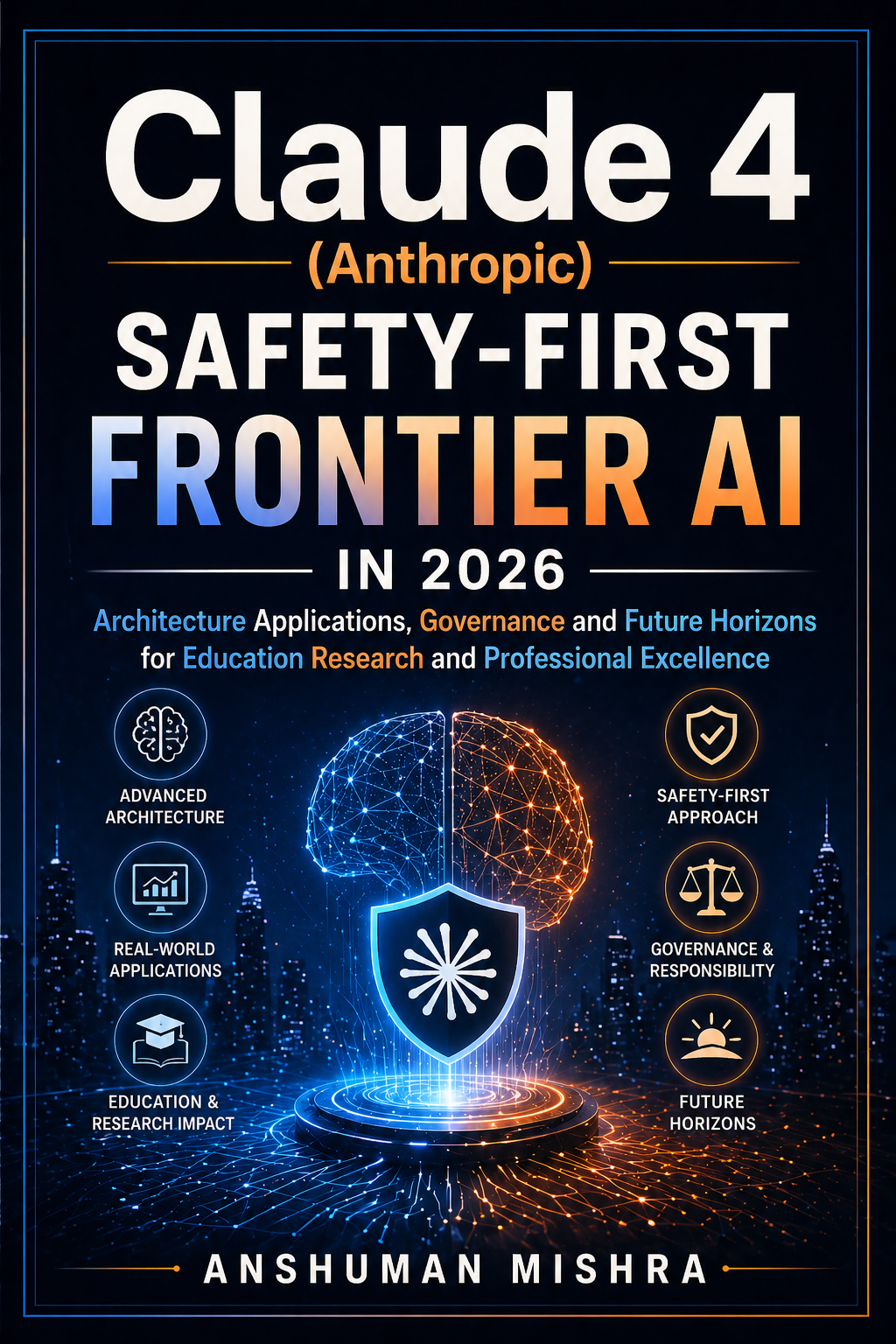
Claude 4 (Anthropic): Safety-First Frontier AI in 2026
Architecture, Applications, Governance, and Future Horizons for Education, Research, and Professional Excellence
Artificial Intelligence is rapidly moving from experimental technology toward an increasingly important component of education, research, business, software development, and digital society. Claude 4 (Anthropic): Safety-First Frontier AI in 2026 provides a structured and educational exploration of frontier AI, using the Claude 4 family as a case study for understanding advanced AI capabilities, safety-centered development, agentic systems, governance, and responsible adoption.
This book is designed for readers who want to move beyond simple AI-tool usage and develop a deeper understanding of how modern frontier AI systems are designed, evaluated, deployed, and governed.
The book combines technical concepts, practical applications, ethical considerations, governance frameworks, and future-oriented analysis in a format accessible to both technical and non-technical readers.
A Comprehensive Introduction to Frontier AI
The book begins by examining the evolution of Artificial Intelligence and Large Language Models.
Readers are introduced to:
- The historical development of LLMs
- Transformer architecture
- The emergence of frontier AI
- Safety-centered AI research
- Anthropic’s research philosophy
- The evolution of the Claude model family
- Model lifecycles and iterative development
- AI deployment ecosystems
This foundation helps readers understand why modern frontier AI systems represent a significant development in the broader history of artificial intelligence.
Understanding Constitutional AI
One of the central themes of the book is Constitutional AI, a safety-oriented approach associated with Anthropic’s research.
The book explores:
- The concept of Constitutional AI
- Principle-based AI behavior
- Self-critique concepts
- Alignment and capability
- Harm-minimization approaches
- Safety evaluation
- Ethical boundaries
- System documentation and transparency
The objective is to help readers understand how AI safety can be incorporated into the design and evaluation of advanced AI systems.
Technical Architecture and Engineering
The technical chapters introduce the major architectural and engineering concepts associated with modern frontier AI systems.
Topics include:
- Transformer scaling
- Reasoning systems
- Fast and deliberate reasoning approaches
- Long-context processing
- Context management
- Memory concepts
- Adaptive computational effort
- Distributed AI infrastructure
These concepts are presented at an educational level so that students and professionals can develop technical awareness without requiring advanced mathematical specialization.
Measuring AI Capabilities
AI capabilities cannot be evaluated solely through impressive demonstrations.
The book therefore explores different approaches to measuring frontier AI performance, including:
- Software engineering benchmarks
- Long-horizon tasks
- Multistep reasoning
- Agentic workflows
- Autonomous task execution
- Reliability evaluation
- Cost and efficiency considerations
Readers are encouraged to distinguish between benchmark performance and real-world reliability.
Agentic AI and Autonomous Workflows
The emergence of AI agents represents an important shift from simple question-and-answer systems toward systems capable of interacting with tools and completing multi-step workflows.
The book explores:
- What AI agents are
- Tool use
- Computer interaction
- Multi-agent coordination
- Enterprise automation
- Human-in-the-loop systems
- Risk-managed autonomy
A major emphasis is placed on responsible autonomy, where human supervision remains important for appropriate tasks and risk levels.
Multimodal Intelligence
Modern AI systems increasingly work across multiple types of information.
The book examines multimodal applications involving:
- Text
- Images
- Documents
- Spreadsheets
- Presentations
- Structured information
- Data interpretation
These capabilities can support a wide range of educational and professional workflows.
Claude 4 in Education
Education is one of the most important areas where advanced AI can provide meaningful assistance.
The book examines applications such as:
- Personalized tutoring
- Concept explanation
- Learning assistance
- Research support
- Academic writing guidance
- Multilingual learning
- Accessibility
- Curriculum development
- Lifelong learning
The book emphasizes that AI should augment educators and learners rather than replace human teaching, judgment, or intellectual effort.
Claude 4 for Academic Research
Researchers can potentially use advanced AI systems to support several stages of the research lifecycle.
The book explores:
- Literature review assistance
- Research idea development
- Academic writing support
- Information organization
- Data interpretation assistance
- Research workflow optimization
- Bias-aware analysis
- Academic integrity
Readers are encouraged to independently verify sources, maintain originality, and use AI responsibly within institutional and disciplinary requirements.
Professional and Industrial Applications
Frontier AI is increasingly relevant across professional sectors.
The book explores applications in:
Software Development
AI-assisted coding, debugging, documentation, system design, and development workflows.
Finance and Compliance
Structured information analysis, documentation, regulatory research support, and compliance-oriented workflows.
Healthcare
General AI-assisted information and workflow support, with appropriate professional oversight for high-stakes applications.
Legal Research
Document analysis, information organization, research assistance, and drafting support, while recognizing the importance of qualified legal professionals.
Enterprise Productivity
Workflow automation, information processing, communication, documentation, and human-AI collaboration.
Economic and Workforce Transformation
The adoption of frontier AI is changing the skills required in many knowledge-based professions.
The book examines:
- Productivity transformation
- Changing workplace skills
- Emerging AI-related roles
- AI supervision
- AI auditing
- Workforce reskilling
- Inclusive digital transformation
- Human-AI collaboration
Instead of viewing AI only through the lens of automation, the book examines how organizations can develop new models of collaboration between people and intelligent systems.
Limitations and Technical Risks
Responsible AI education requires an honest understanding of limitations.
The book addresses:
- Hallucinations
- Incorrect or unreliable outputs
- Edge-case reasoning failures
- Context limitations
- Infrastructure challenges
- Model update dependencies
- Service continuity
- Environmental considerations
- Deployment risks
Understanding these limitations helps readers make better decisions about when AI should and should not be trusted.
AI Governance and Regulation
As AI systems become more capable, governance becomes increasingly important.
The book introduces readers to:
- AI governance principles
- International regulatory approaches
- The influence of the EU AI Act
- Data governance
- Data sovereignty
- Privacy
- Enterprise compliance
- Transparency
- Reporting frameworks
- Responsible innovation
The discussion is designed to help students and professionals understand the institutional environment surrounding frontier AI.
Evaluation and Safety Testing
A major challenge in AI development is determining whether a system is safe and reliable enough for a particular application.
The book explores:
- Model evaluation methodologies
- Safety testing
- Risk-tiered evaluation
- Bias detection
- Agent autonomy measurement
- Deployment constraints
- Continuous improvement
This section encourages readers to look beyond marketing claims and consider measurable evidence, evaluation methods, limitations, and real-world performance.
Accessibility and Global Adoption
AI can provide significant opportunities for education and economic development, but access is not equally distributed.
The book examines:
- Individual versus enterprise access
- Cost considerations
- Developing-region challenges
- Multilingual accessibility
- Digital inclusion
- Public-private collaboration
- Democratization of AI capabilities
The goal is to encourage a broader discussion about how advanced AI can be made useful and accessible across diverse communities.
Future Horizons of AI
The book also looks toward the next generation of AI systems.
Future-oriented topics include:
- Advanced AI reasoning
- Adaptive systems
- Agent collaboration
- Expanded context
- Memory and context compression
- Autonomous research systems
- AI-supported education
- Responsible scaling
Rather than making unsupported predictions, the book encourages readers to evaluate future possibilities through current technological trends, research directions, and responsible innovation principles.
Preparing for the AI Era
The final chapter focuses on the skills individuals and institutions need as AI becomes increasingly integrated into society.
Readers are encouraged to develop:
- AI literacy
- Critical thinking
- Prompt and interaction skills
- Ethical reasoning
- AI oversight capabilities
- Governance awareness
- Human creativity
- Collaboration skills
- Continuous learning habits
The book emphasizes that future success will depend not simply on knowing how to use AI, but on understanding when, why, and under what conditions AI should be used.
Who Should Read This Book?
This book is suitable for:
- Students interested in Artificial Intelligence and frontier AI
- Researchers studying AI capabilities and governance
- Educators exploring AI-assisted education
- Developers interested in advanced AI systems and agents
- Professionals seeking to integrate AI into workplace workflows
- Policymakers studying AI governance
- Business leaders exploring responsible AI adoption
- AI enthusiasts seeking a structured introduction to Claude 4 and frontier AI
Key Features
Frontier AI Focus:
Explores modern advanced AI systems through the Claude 4 family.
Safety-Centered Perspective:
Introduces Constitutional AI and responsible AI development.
Technical Foundation:
Explains architecture, reasoning, context, memory, and infrastructure concepts.
Agentic AI:
Examines tools, agents, autonomous workflows, and human supervision.
Education and Research:
Explores AI-assisted learning, academic research, and knowledge work.
Professional Applications:
Discusses software development, enterprise workflows, finance, healthcare, legal research, and productivity.
AI Governance:
Introduces regulation, privacy, compliance, transparency, and responsible innovation.
Risk Awareness:
Explains hallucinations, reliability challenges, deployment constraints, and other limitations.
Future-Oriented:
Examines emerging directions in AI systems and the skills required for the AI era.
Why Choose This Book?
Claude 4 (Anthropic): Safety-First Frontier AI in 2026 is more than a guide to a single AI system. It is an educational exploration of the broader transformation taking place in frontier Artificial Intelligence.
The book connects AI architecture, safety, reasoning, agentic workflows, multimodal intelligence, education, research, professional applications, economics, governance, and future development into one structured learning resource.
It encourages readers to approach AI neither with blind enthusiasm nor unnecessary fear, but with curiosity, critical thinking, evidence-based evaluation, and responsible judgment.
For students, it provides foundational AI literacy.
For researchers, it offers analytical perspectives on evaluation and governance.
For educators, it supports AI-aware curriculum development.
For professionals, it provides strategic insights into human-AI collaboration.
For policymakers, it introduces key governance and regulatory considerations.
Educational Disclaimer
AI capabilities, model versions, product features, availability, pricing, benchmarks, policies, and deployment practices can change rapidly. Readers should verify current information through authoritative sources when making technical, commercial, institutional, or regulatory decisions.
AI-generated outputs may contain errors, omissions, or misleading information. High-stakes decisions should involve appropriate human expertise, verification, and institutional safeguards.
This book is intended for educational, research, professional-development, and general informational purposes.
Claude 4 (Anthropic): Safety-First Frontier AI in 2026 ultimately presents frontier AI as both a technological and societal development. Understanding its capabilities is important, but understanding its limitations, risks, governance requirements, and appropriate human role is equally important.
Author: Anshuman Mishra
Reviews
There are no reviews yet.