Description
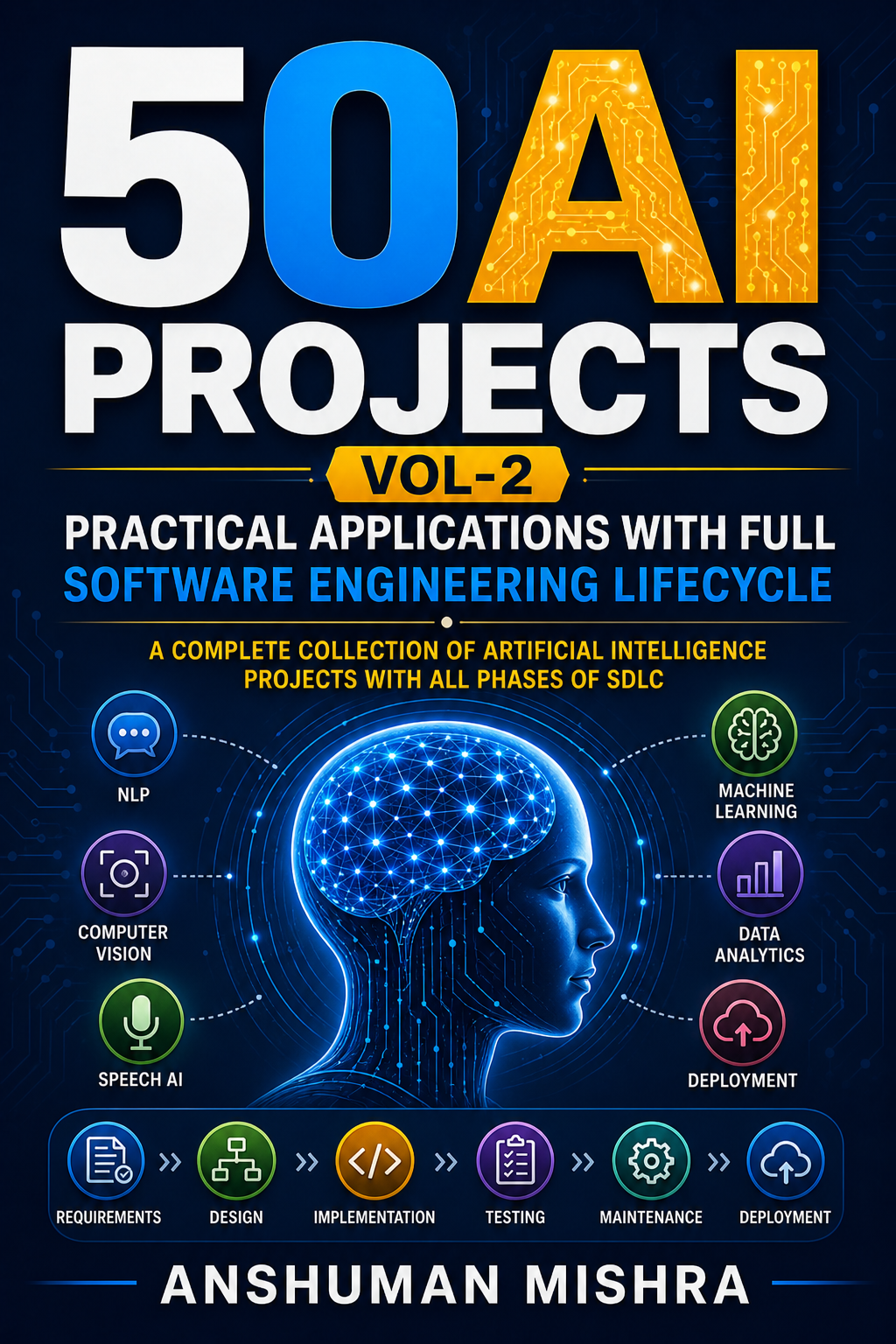
Artificial Intelligence has become an essential technology for solving complex real-world problems across education, healthcare, transportation, agriculture, finance, cybersecurity, and digital communication. Modern organizations require intelligent software systems capable of analyzing large volumes of data, recognizing patterns, making predictions, and supporting human decision-making.
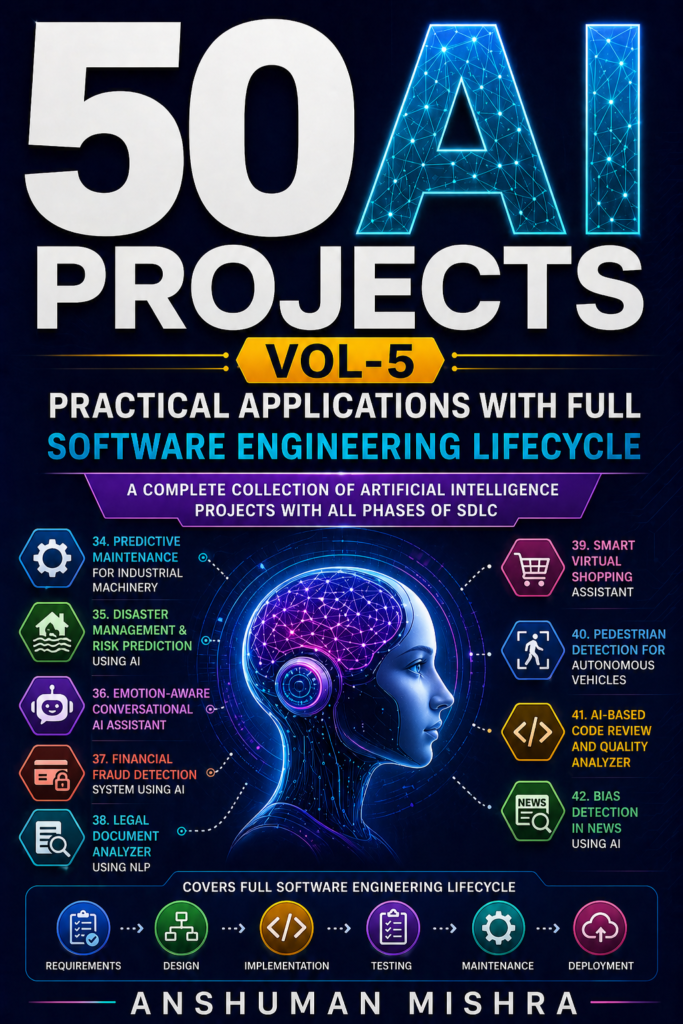
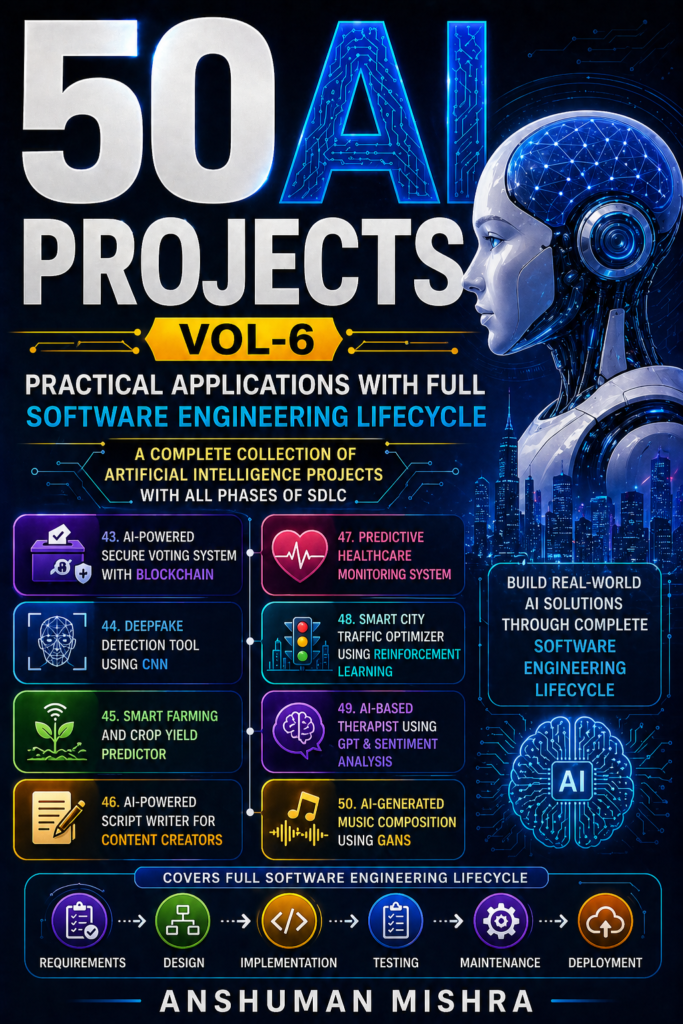
50 AI Projects: Practical Applications with Full Software Engineering Lifecycle (Vol-II) continues the journey from Volume I by introducing eight intermediate-level AI projects that combine Machine Learning, Deep Learning, Computer Vision, Natural Language Processing (NLP), Predictive Analytics, and Intelligent Decision Support Systems with professional Software Engineering practices.
Unlike traditional AI project books that focus only on coding, this volume demonstrates how real AI applications are developed using the complete Software Development Life Cycle (SDLC). Every project follows an industry-standard development methodology, covering requirement analysis, software architecture, database design, AI model development, implementation, testing, deployment, maintenance, and documentation.
Each project reflects practical applications currently used in industries such as education, e-commerce, healthcare, agriculture, cybersecurity, recruitment, transportation, and digital media. Readers gain hands-on experience in designing intelligent systems that solve meaningful business and societal challenges.
What Makes This Book Unique?
Every project follows the complete Software Development Life Cycle (SDLC), including:
✔ Problem Identification
✔ Feasibility Analysis
✔ Requirement Engineering
✔ Software Requirement Specification (SRS)
✔ Functional Requirements
✔ Non-Functional Requirements
✔ UML Modeling
✔ Use Case Diagrams
✔ Activity Diagrams
✔ Sequence Diagrams
✔ Data Flow Diagrams (DFD)
✔ Entity Relationship Diagrams (ERD)
✔ Database Design
✔ AI Model Selection
✔ Dataset Collection
✔ Data Preprocessing
✔ Feature Engineering
✔ Model Training
✔ Hyperparameter Optimization
✔ Model Evaluation
✔ User Interface Design
✔ Backend Development
✔ API Integration
✔ Software Testing
✔ Deployment Strategies
✔ Documentation
✔ Maintenance and Future Enhancements
This systematic approach prepares readers for industrial software development, academic research, capstone projects, and AI product engineering.
Projects Covered in Volume II
Chapter 11 – Fake News Detection Using Natural Language Processing
Develop an intelligent news verification system capable of detecting fake news articles using Natural Language Processing, text classification, feature extraction, and Machine Learning algorithms.
Chapter 12 – Traffic Violation Detection System
Build a Computer Vision-based intelligent traffic monitoring system capable of detecting traffic rule violations, vehicle movements, and automated enforcement using image processing and AI techniques.
Chapter 13 – Student Performance Predictor Using Machine Learning
Create a predictive analytics system that estimates student academic performance using historical educational data, attendance, assessment scores, and behavioral indicators.
Chapter 14 – Automatic Essay Grading System Using AI
Design an AI-powered educational assessment platform capable of evaluating essays using Natural Language Processing, semantic analysis, grammar evaluation, and automated scoring techniques.
Chapter 15 – AI-Based Email Spam Classifier
Develop a Machine Learning-based spam detection system capable of identifying phishing emails, promotional messages, malicious content, and legitimate communications with high accuracy.
Chapter 16 – Resume Ranking System Using Machine Learning
Build an intelligent recruitment system that automatically ranks job applicants based on resume analysis, skill extraction, job matching, and predictive candidate evaluation.
Chapter 17 – E-commerce Customer Sentiment Analyzer
Develop a customer analytics platform capable of analyzing reviews, ratings, and customer feedback using sentiment analysis to support business intelligence and product improvement.
Chapter 18 – Plant Disease Identifier from Leaf Images
Implement a Deep Learning-based agricultural diagnostic system capable of detecting plant diseases from leaf images using Computer Vision and Convolutional Neural Networks (CNNs).
What You Will Learn
✔ Artificial Intelligence Project Development
✔ Software Development Life Cycle (SDLC)
✔ Machine Learning
✔ Deep Learning
✔ Natural Language Processing
✔ Computer Vision
✔ Predictive Analytics
✔ Classification Algorithms
✔ Text Mining
✔ Sentiment Analysis
✔ Fake News Detection
✔ Email Spam Detection
✔ Resume Screening
✔ Candidate Ranking
✔ Educational Analytics
✔ Essay Evaluation
✔ Student Performance Prediction
✔ Traffic Monitoring
✔ Vehicle Detection
✔ Agricultural AI
✔ Plant Disease Detection
✔ Image Classification
✔ CNN Models
✔ Dataset Preparation
✔ Feature Engineering
✔ Data Cleaning
✔ Model Training
✔ Model Validation
✔ Performance Evaluation
✔ Hyperparameter Optimization
✔ AI Model Deployment
✔ API Development
✔ Database Design
✔ UML Diagrams
✔ Software Architecture
✔ Documentation
✔ Professional AI Development
Key Features
• Eight complete intermediate-level AI projects
• Industry-standard Software Engineering methodology
• Complete SDLC coverage for every project
• Practical Machine Learning and Deep Learning implementation
• Real-world datasets and business applications
• Computer Vision and NLP project development
• Educational, healthcare, agriculture, and business AI solutions
• UML diagrams and software documentation guidance
• Production-oriented project architecture
• Portfolio-ready AI applications
• Excellent preparation for internships and technical interviews
• Suitable for academic projects and industrial development
Who Should Read This Book?
This book is ideal for:
- BCA Students
- MCA Students
- B.Tech (Computer Science & IT)
- M.Tech Students
- Artificial Intelligence Students
- Machine Learning Students
- Data Science Students
- Computer Science Students
- Software Engineering Students
- Final Year Project Students
- AI Researchers
- Python Developers
- Machine Learning Engineers
- Data Scientists
- Software Developers
- AI Enthusiasts
- Faculty Members
- Technical Trainers
- Startup Developers
- Self-Learners
Why This Book?
Building intelligent software requires much more than understanding Machine Learning algorithms. Modern AI engineers must know how to design software systems, manage datasets, develop scalable architectures, integrate intelligent models, evaluate performance, and deploy reliable applications.
50 AI Projects: Practical Applications with Full Software Engineering Lifecycle (Vol-II) provides readers with practical experience in developing real-world AI solutions using professional software engineering methodologies.
Every project demonstrates how Artificial Intelligence, Machine Learning, Natural Language Processing, Computer Vision, and Software Engineering combine to create intelligent applications capable of solving real business and societal problems.
Whether preparing for university projects, research, technical interviews, hackathons, startup development, or professional AI careers, this book serves as a comprehensive practical guide to intermediate-level AI project development.
Suitable For
- BCA
- MCA
- B.Tech (Computer Science & IT)
- M.Tech
- B.Sc. Computer Science
- Artificial Intelligence Programs
- Machine Learning Courses
- Data Science Programs
- Software Engineering Courses
- Final Year Projects
- Academic Research
- AI Bootcamps
- Technical Interviews
- Capstone Projects
- Professional AI Training
Book Details
Title: 50 AI Projects: Practical Applications with Full Software Engineering Lifecycle (Vol-II)
Subtitle: A Complete Collection of Artificial Intelligence Projects with All Phases of SDLC
Author: Anshuman Mishra
Language: English
Subject: Artificial Intelligence, Machine Learning, Deep Learning, Software Engineering, Project Development
Level: Intermediate
Category: Artificial Intelligence | Machine Learning | Deep Learning | Software Engineering | Computer Science | Project-Based Learning
Reviews
There are no reviews yet.