Description
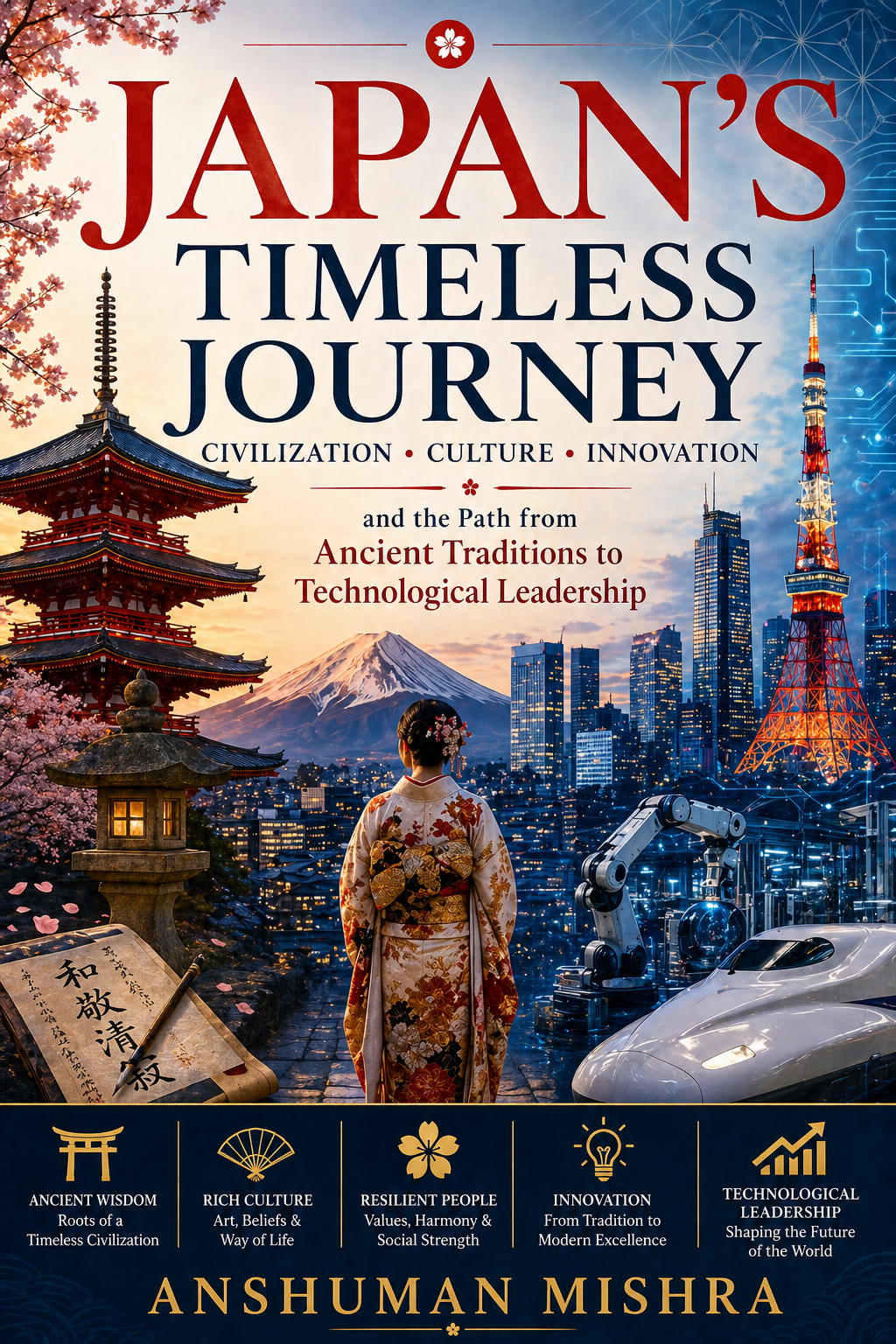
Japan’s Timeless Journey: Civilization, Culture, Innovation, and the Path from Ancient Traditions to Technological Leadership
A Comprehensive Historical and Cultural Study of Japan from Prehistory to the 21st Century
Author: Anshuman Mishra
How does a civilization preserve its identity while continuously adapting to a changing world? How did Japan transform from prehistoric island communities into a highly developed modern society and global center of technology and innovation?
Japan’s Timeless Journey explores these questions through a broad historical and cultural journey spanning thousands of years.
This book presents Japan not simply as a modern technological power, but as a civilization shaped by history, geography, nature, community, education, craftsmanship, discipline, cultural refinement, and continuous adaptation. From the Jōmon and Yayoi periods to contemporary robotics, artificial intelligence, and sustainable technologies, the book examines the major developments that have contributed to Japan’s distinctive civilizational identity.
From Prehistory to Early Civilization
The journey begins with prehistoric Japan and the foundations of early Japanese society. Readers are introduced to the Jōmon and Yayoi periods, exploring early settlements, agriculture, craftsmanship, social organization, tools, artistic traditions, and the relationship between communities and their natural environment.
The book then follows the emergence of political organization during the Kofun period and the development of more structured state institutions. Cultural interactions with mainland Asia, writing systems, administrative practices, education, Buddhism, and planned urban centers helped establish the foundations of classical Japanese civilization.
The Refinement of Classical Japan
The Asuka, Nara, and Heian periods represent important stages in Japan’s cultural development. The book examines the growth of literature, poetry, court culture, education, social etiquette, architecture, and aesthetic traditions.
Particular attention is given to Japanese ideas of beauty, balance, simplicity, harmony, and refinement, showing how these concepts influenced artistic and social life and continued to shape Japanese culture long after the classical period.
The Samurai and Warrior Tradition
Japan’s medieval history witnessed the rise of warrior governance and the samurai class. The book explores the development of military administration, feudal institutions, loyalty, duty, discipline, and ethical traditions associated with the warrior society.
It also examines the cultural achievements of medieval Japan, including Zen-influenced thought, gardens, architecture, painting, and artistic simplicity. Rather than viewing the period only through warfare, the book considers how governance, social organization, philosophy, and art developed together.
Unity, Stability, and Cultural Growth
The transition toward national unification created new forms of political and social organization. The Tokugawa period is examined as an important era of stability, learning, publishing, literacy, scholarship, theater, craftsmanship, and urban development.
The book considers how structured administration and relative internal stability contributed to the development of a sophisticated society. Education and ethical values became important components of everyday life, while merchant communities and cities became increasingly influential.
Japan Meets the Modern World
Japan’s transition into the modern era represents one of the most significant transformations discussed in the book.
The opening of Japan to increased international contact brought major institutional, educational, scientific, and economic changes. The Meiji period witnessed rapid modernization, industrialization, infrastructure development, constitutional reforms, and expansion of scientific education.
One of the book’s central themes is that modernization did not simply mean abandoning tradition. Instead, Japan developed ways of incorporating external knowledge and technologies while retaining important elements of its cultural identity.
Resilience and Reconstruction
The twentieth century brought profound changes to Japanese society. The book examines social adaptation, reconstruction, education, work culture, economic development, and international engagement.
Particular attention is given to the development of manufacturing excellence, quality-oriented production, engineering, electronics, automation, and corporate organization. These developments helped Japan establish a powerful global economic presence.
From Manufacturing Excellence to Technological Leadership
Japan’s technological journey is examined through areas such as:
- Robotics
- Automation
- Electronics
- Engineering
- Artificial intelligence
- Smart technologies
- Sustainable innovation
- Research and development
- Human-centered technology
The book explores how precision, craftsmanship, quality consciousness, continuous improvement, and long-term thinking have contributed to Japan’s reputation for technological excellence.
Culture in Contemporary Japan
Modernization did not eliminate Japan’s traditional culture. Festivals, seasonal celebrations, community practices, family values, architecture, artistic traditions, and heritage preservation continue to play important roles.
The book also examines Japan’s global cultural influence through popular culture, creative industries, literature, design, and contemporary media, demonstrating how traditional and modern cultural expressions coexist.
Nature, Sustainability, and Disaster Preparedness
Japan’s relationship with nature is another major theme. The book explores traditional attitudes toward landscapes, environmental resources, and seasonal cycles alongside modern approaches to environmental protection and sustainability.
Japan’s experience with natural disasters has also encouraged strong traditions of preparedness, community cooperation, resilience, and technological adaptation. These themes provide important insights into how societies can respond to environmental challenges.
Education and the Future
Education has played a central role throughout Japan’s modern development. The book examines the evolution of Japanese education, scientific research, lifelong learning, discipline, creativity, and international collaboration.
The final chapters look toward the future and consider how Japan can continue balancing its cultural heritage with rapidly changing technologies and global challenges.
What Readers Will Discover
Readers will gain a structured understanding of:
- Japan’s prehistoric foundations
- Jōmon and Yayoi civilization
- Formation of the early Japanese state
- Asuka, Nara, and Heian culture
- Samurai and warrior society
- Kamakura and Muromachi Japan
- Tokugawa governance and cultural growth
- Japan’s modernization and Meiji transformation
- Industrial and economic development
- Post-war reconstruction and resilience
- Manufacturing and technological excellence
- Robotics, AI, and automation
- Japanese education and research
- Cultural traditions and popular culture
- Environmental sustainability
- Disaster preparedness
- Japan’s role in the contemporary world
- The future of Japanese society and innovation
Who Is This Book For?
This book is suitable for:
- University and college students
- Teachers and educators
- Researchers and scholars
- History and culture enthusiasts
- Readers interested in Japan
- Students of Asian civilization
- Readers interested in technology and innovation
- Libraries and academic collections
- General readers seeking an accessible historical overview
Why Read Japan’s Timeless Journey?
Japan’s story is not simply a story of modernization. It is a story of continuity and transformation—of a society repeatedly adapting to new circumstances while maintaining important cultural traditions.
From ancient settlements and classical literature to samurai ethics, Tokugawa learning, Meiji modernization, post-war reconstruction, advanced manufacturing, robotics, and artificial intelligence, Japan’s journey offers a fascinating example of how history, culture, education, and innovation can interact over centuries.
Japan’s Timeless Journey provides readers with a broad, educational, and respectful perspective on this remarkable civilization and its continuing journey into the future.
Reviews
There are no reviews yet.