Description
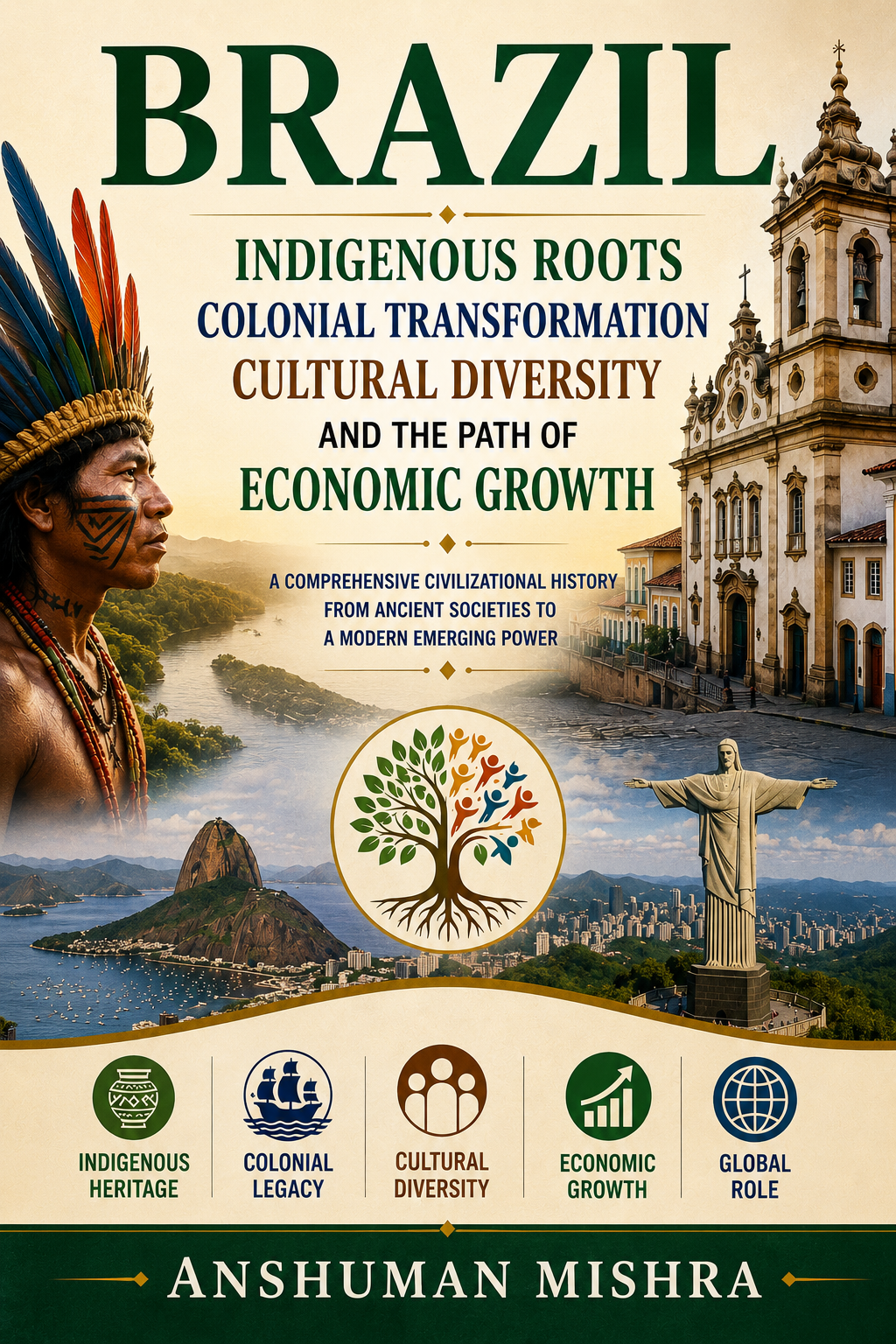
About the Book
Brazil: Indigenous Roots, Colonial Transformation, Cultural Diversity, and the Path of Economic Growth presents a comprehensive journey through the history, society, culture, economy, and political development of one of the world’s largest and most diverse nations.
Brazil is often associated with the Amazon rainforest, football, music, festivals, coffee, agriculture, and its rapidly changing economy. Yet behind these familiar images lies a much deeper story—a civilization shaped by thousands of years of Indigenous history, Portuguese colonization, the Atlantic slave trade, migration, cultural exchange, political transformation, industrialization, and continuing struggles over inequality and development.
This book explores Brazil not simply as a modern country, but as a civilizational process in which different peoples, cultures, institutions, environments, and economic systems interacted over centuries.
From Indigenous societies that developed sophisticated relationships with the land to the Portuguese colonial system; from slavery and plantation agriculture to independence and republican government; from industrialization to contemporary global economic participation—the book provides readers with a connected understanding of Brazil’s historical transformation.
Why Study Brazil?
Brazil offers an exceptionally valuable case study for understanding how geography, history, culture, politics, and economics interact.
It is:
- The largest country in South America
- One of the world’s most geographically diverse nations
- Home to enormous Indigenous and cultural diversity
- A major agricultural and natural-resource producer
- One of the world’s important emerging economies
- A significant participant in global environmental discussions
- A society shaped by Indigenous, African, European, and immigrant influences
Brazil therefore provides an opportunity to examine a central question of development:
How can a country with enormous natural resources and cultural diversity transform its historical potential into inclusive and sustainable development?
This book approaches that question from multiple perspectives.
Part I — Land, Nature, and Indigenous Foundations
The book begins before the creation of Brazil as a modern nation.
The geographical foundations of Brazil played a major role in shaping its history. Vast river systems, forests, grasslands, coastlines, plateaus, and agricultural regions created different patterns of settlement and economic activity.
Before Portuguese colonization, the territory was inhabited by numerous Indigenous communities with diverse languages, social structures, economic practices, and belief systems.
The opening chapters explore:
- Early human settlement
- Indigenous communities
- Agricultural practices
- Hunting and fishing
- Trade networks
- Oral traditions
- Spiritual beliefs
- Ecological knowledge
- Relationships between communities and nature
Rather than presenting Indigenous history merely as a prelude to European colonization, the book recognizes Indigenous societies as an essential part of Brazil’s civilizational history.
Their knowledge of forests, plants, rivers, agriculture, and ecological relationships also provides important perspectives for contemporary discussions about sustainability.
Part II — Colonial Transformation
The arrival of Portuguese explorers during the sixteenth century fundamentally transformed the region.
Colonial rule introduced new political institutions, economic structures, religious systems, settlement patterns, and international connections.
Brazil became integrated into the wider Atlantic economy through the production and export of commodities.
The book examines:
- Portuguese exploration
- Territorial expansion
- Colonial administration
- Plantation agriculture
- Resource extraction
- Sugar production
- Mining
- Indigenous displacement and adaptation
- Colonial social structures
The colonial economy generated enormous wealth but also produced deep inequalities.
Understanding this contradiction is essential for understanding Brazil’s later development.
Slavery and the Formation of Brazilian Society
One of the most important themes of the book is the history and legacy of slavery.
Brazil became a major destination within the transatlantic slave system, and millions of Africans were forcibly transported there over several centuries.
Their labor contributed substantially to Brazil’s plantation and mining economies.
But African influence was not limited to labor.
African traditions profoundly shaped Brazilian:
- Music
- Religion
- Cuisine
- Language
- Art
- Community life
- Festivals
- Cultural identity
The book also examines resistance, community formation, cultural survival, and the long-term consequences of slavery.
The end of slavery represented a major transformation, but abolition did not automatically eliminate social and economic inequality. Many structural challenges continued into the republican period.
Part III — Independence and Nation Formation
Brazil’s independence followed a distinctive path compared with many other countries in the Americas.
The transition from Portuguese colonial rule to an independent Brazilian state involved political negotiation, institutional continuity, and the challenge of maintaining territorial unity across an enormous country.
The book explores:
- The political background of independence
- Formation of the Brazilian Empire
- Nation-building
- Territorial unity
- Political institutions
- Regional power structures
- Abolition of slavery
- Transition from monarchy to republic
Brazil’s experience demonstrates that political independence does not automatically produce social equality or economic transformation.
Nation-building is a longer process involving institutions, citizenship, economic reform, and social integration.
Part IV — Cultural Diversity and National Identity
Brazil’s cultural identity is one of the most fascinating aspects of its history.
Indigenous traditions, African heritage, Portuguese influences, and later migration from different parts of the world contributed to an exceptionally diverse society.
The book explores:
- Language
- Religion
- Cultural syncretism
- Music
- Festivals
- Food
- Family structures
- Regional traditions
- Sports
- Popular culture
- Urban identities
Brazilian culture is presented as a dynamic process rather than a fixed identity.
Different communities have continuously influenced one another, creating cultural forms that are simultaneously local, national, and global.
Regional Diversity: One Country, Many Brazils
Brazil’s enormous territory means that national development cannot be understood without considering regional differences.
The book dedicates a complete section to the country’s major geographical and economic regions.
Northern Brazil
The Amazon region is examined through the perspectives of:
- Indigenous communities
- Forest ecosystems
- Environmental protection
- Natural resources
- Infrastructure
- Regional development
Northeast Brazil
The Northeast is explored through its historical relationship with:
- Colonial plantation systems
- Agriculture
- Poverty
- Migration
- Cultural traditions
- Social change
Southeast Brazil
The Southeast represents an important center of:
- Industry
- Finance
- Urbanization
- Manufacturing
- Services
- Population concentration
Southern and Central-Western Brazil
These regions demonstrate the importance of:
- Agricultural expansion
- Migration
- Infrastructure
- Urban growth
- Modernization
- Resource development
Together, these regional perspectives explain why Brazil cannot be understood through a single economic or cultural narrative.
Part V — Economic Development and Growth
Brazil’s economic history reflects a transition from an export-oriented colonial economy toward industrialization, modernization, and a diversified contemporary economy.
The book examines major stages including:
- Agricultural development
- Sugar
- Gold
- Coffee
- Rubber
- Industrialization
- Infrastructure
- Manufacturing
- Energy
- Services
- Technology
- International trade
Special attention is given to the role of the state in economic planning and industrial development.
The book also explores the limitations of development, including:
- Regional inequality
- Unequal access to opportunities
- Infrastructure gaps
- Economic instability
- Urban challenges
- Environmental pressures
This balanced approach helps readers understand both Brazil’s economic achievements and its continuing difficulties.
Part VI — Industrialization and Modernization
Industrialization transformed Brazil’s economic and social structure.
Large cities expanded, manufacturing developed, infrastructure improved, and millions of people moved toward urban centers.
This transformation created new opportunities but also generated challenges involving:
- Housing
- Employment
- Transportation
- Education
- Urban inequality
- Labor relations
- Environmental pressure
The book examines how Brazil attempted to balance rapid modernization with social development.
Part VII — Democracy, Governance, and Society
Brazil’s political development has involved periods of democratic government, institutional change, political instability, and reform.
The book explores:
- Democratic institutions
- Constitutional development
- Citizenship
- Civil society
- Public policy
- Social welfare
- Political participation
- Governance challenges
The analysis emphasizes that democracy is not only about elections. Strong democratic societies also require institutions, accountability, legal frameworks, civic participation, and protection of rights.
Brazil in the Global Economy
Modern Brazil is deeply connected to the global economy.
The country plays an important role in:
- Agriculture
- Food production
- Energy
- Mining
- Manufacturing
- Services
- International trade
- Technology
- Environmental policy
The book examines Brazil’s position as an emerging economic power and its relationships with international institutions and trading partners.
It also considers the growing importance of technology and innovation in determining Brazil’s future competitiveness.
Environment and Development
Few issues are more important to Brazil’s future than the relationship between economic development and environmental protection.
The country contains globally significant ecosystems and enormous natural resources.
This creates a complex policy challenge:
How can Brazil promote economic development while protecting ecosystems and respecting Indigenous rights?
The book examines this question through discussions of:
- Forest protection
- Natural resources
- Sustainable development
- Agriculture
- Climate policy
- Indigenous territories
- Environmental governance
The environmental question is therefore presented not as separate from economic development, but as one of its central dimensions.
Inequality and Social Challenges
Despite substantial economic potential, Brazil continues to face significant social challenges.
The book examines:
- Income inequality
- Urban poverty
- Housing
- Education gaps
- Regional disparities
- Social mobility
- Indigenous rights
- Access to public services
These issues demonstrate an important lesson:
Economic growth alone does not automatically produce equal development.
Inclusive institutions, effective public policy, education, social protection, and opportunities for disadvantaged communities are also essential.
Part IX — Comparative Development and Global Lessons
Brazil’s experience becomes even more valuable when compared with other developing and emerging nations.
The book compares Brazil’s development trajectory with:
- Other Latin American countries
- Asian economies
- African developing nations
- Different models of state-led development
- Market-oriented development strategies
The purpose is not to declare one country successful and another unsuccessful.
Instead, the comparative approach asks:
What conditions allow development strategies to succeed?
Why do similar policies produce different outcomes in different countries?
What lessons can developing nations realistically learn from Brazil?
This makes the book particularly useful for students of development studies, economics, public policy, and international relations.
Major Themes of the Book
Several themes run throughout the entire work:
1. Civilization and Continuity
Brazil’s modern identity cannot be separated from its Indigenous, colonial, African, and immigrant histories.
2. Diversity
Cultural diversity has been both a source of social complexity and a major source of national creativity.
3. Colonial Legacy
Historical patterns of land, labor, and wealth distribution continue to influence contemporary society.
4. Economic Transformation
Brazil demonstrates how agricultural economies can gradually develop industrial and service sectors.
5. State and Market
The country’s experience highlights the complicated relationship between government planning, private enterprise, and social policy.
6. Environment and Development
Brazil demonstrates why environmental sustainability must be considered alongside economic growth.
7. Inequality
Development becomes more meaningful when economic opportunities and social benefits are broadly distributed.
Why This Book Is Important
Brazil: Indigenous Roots, Colonial Transformation, Cultural Diversity, and the Path of Economic Growth is valuable because it brings together subjects that are often studied separately.
History explains Brazil’s past.
Geography explains its physical possibilities and constraints.
Culture explains its social identity.
Economics explains its transformation.
Politics explains its institutions.
Environmental studies explain its contemporary responsibilities.
Development studies help explain its opportunities and challenges.
By connecting these dimensions, the book provides a more complete understanding of Brazil.
Who Should Read This Book?
This book is suitable for:
- B.A. and M.A. students
- History students
- Political Science students
- Economics students
- Sociology students
- Geography students
- International Relations students
- Development Studies students
- Civil services and competitive examination aspirants
- Teachers and educators
- Researchers
- Policymakers
- General readers interested in world history and civilizations
It can also serve as a useful reference for comparative country studies and courses dealing with global development.
Key Learning Outcomes
After studying this book, readers will be able to:
- Understand Brazil’s Indigenous foundations.
- Explain the major effects of Portuguese colonization.
- Understand the economic and social legacy of slavery.
- Trace Brazil’s transition from colony to independent nation.
- Explain the development of the Brazilian Empire and Republic.
- Analyze Brazil’s cultural diversity.
- Understand regional differences within Brazil.
- Explain Brazil’s transition from an agrarian to a diversified economy.
- Understand the role of industrialization in national development.
- Examine Brazil’s democratic institutions and governance challenges.
- Analyze inequality and social mobility.
- Understand Brazil’s environmental challenges.
- Evaluate Brazil’s position in the global economy.
- Compare Brazil’s development experience with other emerging economies.
- Identify lessons that may be relevant to developing nations.
A Balanced View of Brazil
This book does not present Brazil as either an ideal success story or a failed development model.
Instead, it presents Brazil as a complex and evolving society.
Brazil demonstrates how a country can possess extraordinary natural resources, cultural richness, economic potential, and human creativity while simultaneously facing serious challenges involving inequality, governance, infrastructure, environmental sustainability, and social inclusion.
Its history therefore offers neither simple answers nor universal formulas.
It offers something more valuable:
A case study in complexity.
Conclusion
Brazil: Indigenous Roots, Colonial Transformation, Cultural Diversity, and the Path of Economic Growth is ultimately a story of transformation.
It is the story of Indigenous societies adapting to diverse environments.
It is the story of colonial expansion and its profound consequences.
It is the story of African communities whose culture became an essential part of Brazilian identity despite the violence and injustice of slavery.
It is the story of independence, nation-building, industrialization, urbanization, democracy, and economic modernization.
And it is the continuing story of a nation attempting to balance:
Growth with equality
Development with sustainability
Modernization with cultural heritage
National integration with regional diversity
Economic opportunity with social justice
Brazil’s journey demonstrates that national development is never a straight line.
It is shaped by history, geography, institutions, culture, political choices, economic opportunities, and the ability of societies to learn from their past.
For students and readers seeking to understand how civilizations transform over time, Brazil provides an extraordinary example.
Its story reminds us that the strength of a nation is not determined only by the resources beneath its soil or the size of its economy.
It also depends upon how effectively a society can transform its history into knowledge, diversity into strength, resources into opportunity, and challenges into institutions capable of building a better future.
Reviews
There are no reviews yet.