Description
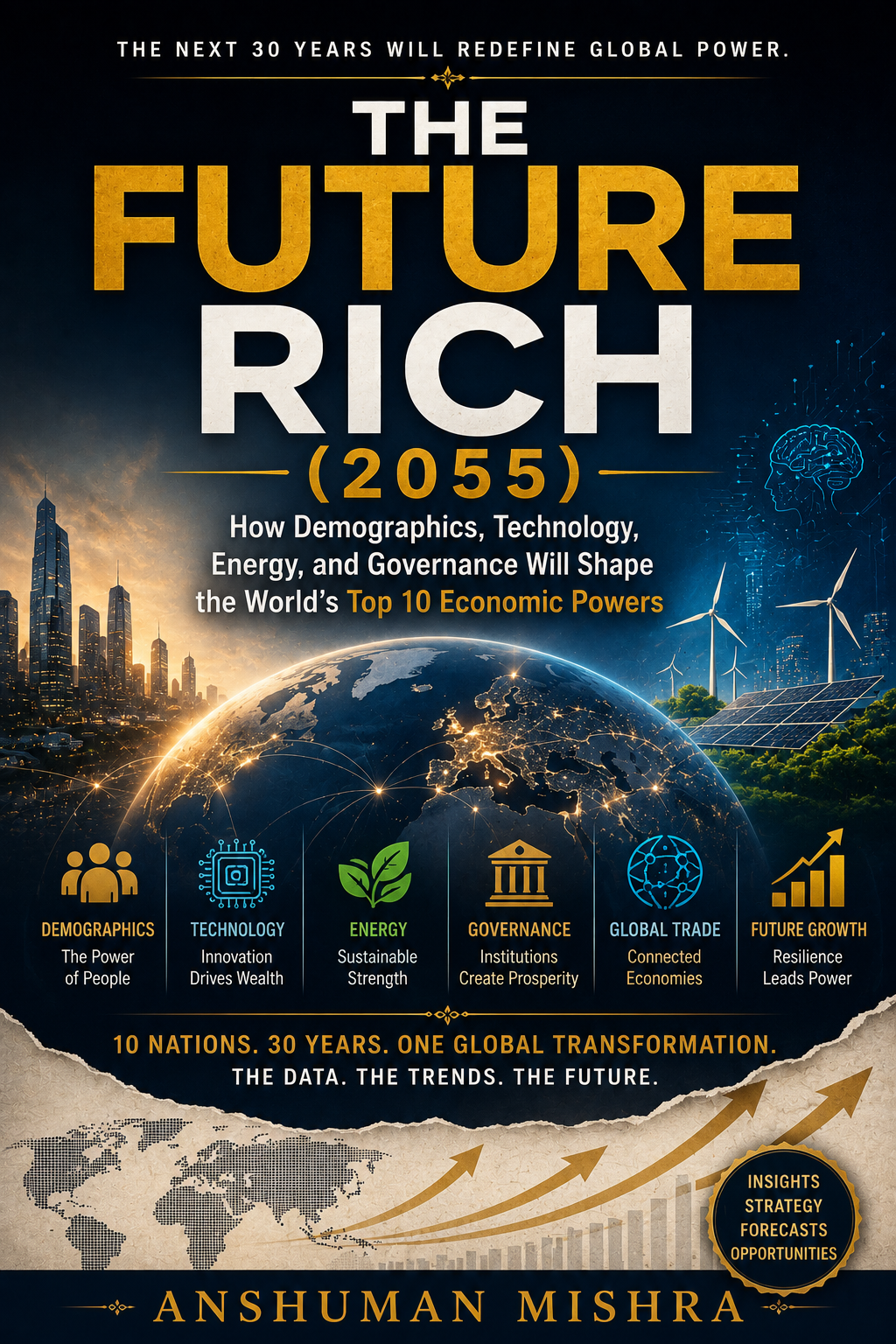
The Future Rich (2055): How Demographics, Technology, Energy, and Governance Will Shape the World’s Top 10 Economic Powers
A Data-Informed Exploration of the Structural Forces Driving the Future Global Economy
The balance of global economic power is constantly evolving. While today’s leading economies continue to influence international trade, finance, technology, and geopolitics, the economic landscape of 2055 will likely be shaped by long-term structural trends rather than short-term market performance alone. Demographic transitions, technological innovation, institutional quality, energy security, climate resilience, human capital, and governance will increasingly determine which nations sustain prosperity over the coming decades.
The Future Rich (2055): How Demographics, Technology, Energy, and Governance Will Shape the World’s Top 10 Economic Powers offers a comprehensive and analytically grounded examination of these transformative forces. Rather than relying on speculation or simplistic rankings, the book presents a multidisciplinary framework rooted in economics, public policy, political economy, development studies, and global governance to help readers understand how nations create and maintain long-term economic strength.
The journey begins by examining the foundations of economic power, explaining why measures such as Gross Domestic Product (GDP), productivity, institutional capacity, innovation, and resilience must be considered together when evaluating a country’s long-term prospects. Readers gain insight into the distinction between short-term economic cycles and the structural drivers of sustainable development.
A major focus of the book is the role of demographics. It explores how population structure, workforce participation, aging societies, migration, urbanization, education, and human capital influence productivity and economic growth. Rather than treating population size as the sole determinant of prosperity, the book demonstrates how demographic quality and effective policy shape future competitiveness.
The book also examines the knowledge economy by exploring education systems, scientific research, technological innovation, artificial intelligence, digital infrastructure, automation, and intellectual property. Readers learn how investments in STEM education, research ecosystems, and innovation capacity contribute to national competitiveness in an increasingly technology-driven world.
Energy security and resource management receive dedicated attention as the book analyzes fossil fuels, renewable energy transitions, critical minerals, water security, food systems, climate adaptation, and strategic resilience. These topics are examined not only as environmental concerns but also as essential foundations of industrial development, economic stability, and national competitiveness.
Institutional quality is presented as one of the defining factors of long-term prosperity. The book explores governance, rule of law, regulatory effectiveness, policy consistency, public administration, financial systems, fiscal sustainability, trade integration, industrial strategy, and investment confidence. Readers gain an appreciation for how effective institutions enable innovation, attract capital, and strengthen economic resilience over time.
Additional chapters explore urbanization, healthcare systems, workforce productivity, military expenditure, political stability, digital economies, platform technologies, cybersecurity, financial markets, global trade, supply chains, and climate resilience. Throughout the discussion, the book emphasizes that sustainable economic leadership depends on balancing growth with social cohesion, institutional strength, and adaptability.
The concluding chapters present a structured assessment of the countries most likely to emerge among the world’s leading economic powers by 2055. Rather than offering definitive predictions, the analysis evaluates multiple scenarios using consistent criteria such as demographic sustainability, innovation capacity, governance quality, industrial diversification, energy resilience, and long-term development potential. The book also considers uncertainty, acknowledging that future outcomes will depend on evolving policies, technologies, and global events.
Inside This Book You’ll Discover
- The structural foundations of long-term economic power
- GDP, productivity, and sustainable development
- Demographic change and workforce transformation
- Education, human capital, and innovation ecosystems
- Artificial intelligence, automation, and digital economies
- Energy security, renewable transition, and climate resilience
- Natural resources, strategic geography, and supply chains
- Governance, institutions, and rule of law
- Financial systems, capital markets, and fiscal sustainability
- Global trade, industrial policy, and economic competitiveness
- Urbanization, healthcare, and labor productivity
- Political stability, inequality, and social cohesion
- Digital infrastructure, cybersecurity, and platform economies
- Comparative analysis of future economic powers
- Long-term global trends shaping the international economy
Written in a clear, balanced, and academically accessible style, this book is ideal for students of economics, international relations, public policy, business, political science, development studies, and global affairs. It is also valuable for researchers, policymakers, investors, business leaders, and readers seeking a deeper understanding of the forces shaping the global economy.
Whether you are studying economic development, analyzing international competitiveness, planning long-term investment strategies, or exploring the future of global power, The Future Rich (2055) provides a rigorous framework for understanding how nations build lasting prosperity in an increasingly interconnected world.
Explore the structural drivers that shape economic leadership, evaluate emerging global trends, and gain a deeper perspective on how demographics, technology, governance, energy, and innovation may influence the world’s leading economies over the next three decades.


Reviews
There are no reviews yet.