Description
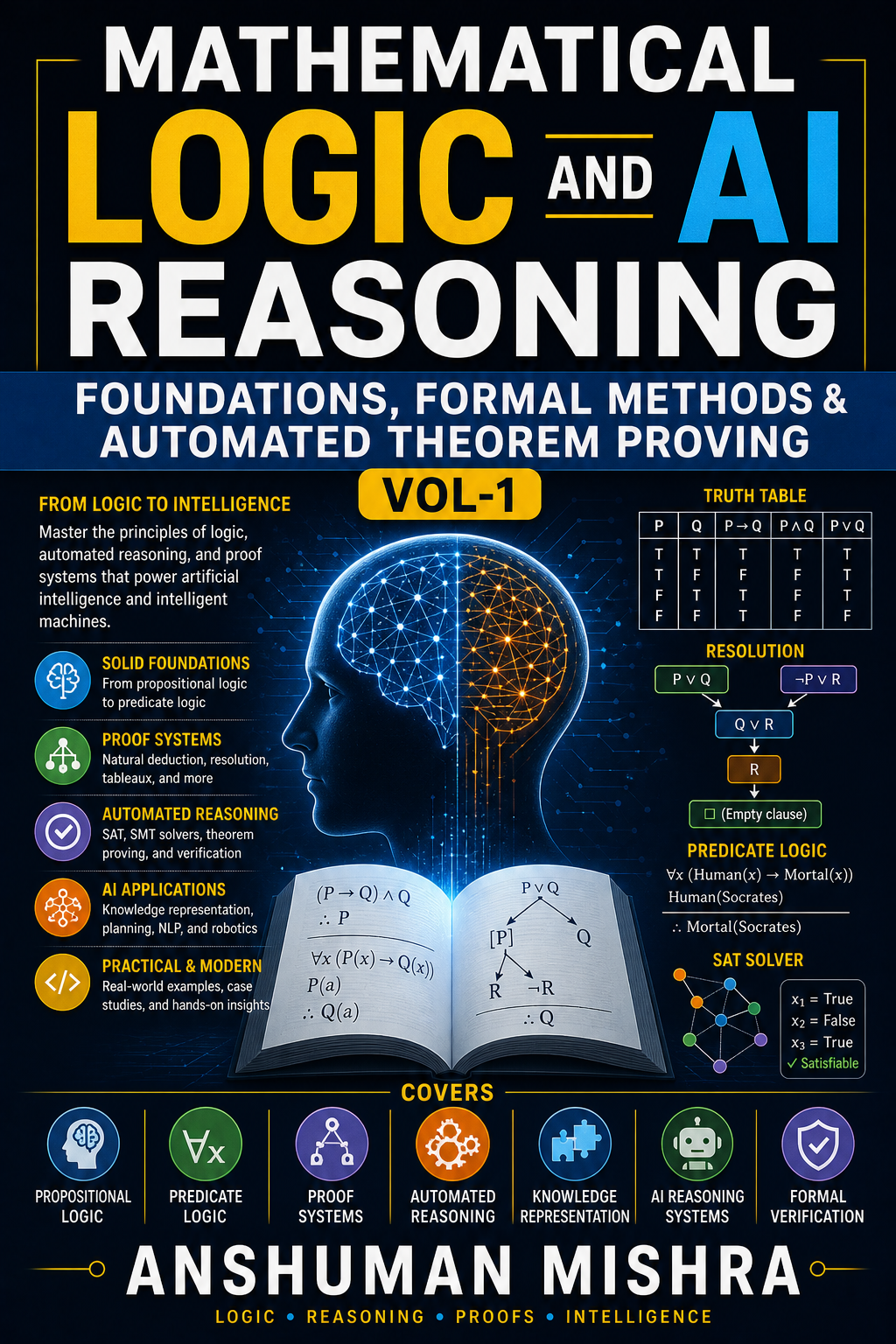
Mathematical Logic and AI Reasoning
Foundations, Formal Methods & Automated Theorem Proving (Vol. 1)
Mathematical Logic is the language of intelligent reasoning. Every Artificial Intelligence system—from expert systems and knowledge graphs to autonomous robots and intelligent software agents—depends upon formal reasoning, logical inference, and mathematically sound decision-making. As Artificial Intelligence continues to evolve toward Explainable AI, Knowledge Representation, Automated Planning, and Symbolic Intelligence, the importance of mathematical logic has become greater than ever before.
Mathematical Logic and AI Reasoning: Foundations, Formal Methods & Automated Theorem Proving (Vol. 1) provides a comprehensive introduction to the mathematical foundations of logic while demonstrating how logical reasoning forms the backbone of modern Artificial Intelligence and intelligent computational systems.
The book begins with the core concepts of logic, syntax, semantics, validity, inference, implication, and proof theory before introducing propositional logic, predicate logic, proof systems, logical inference algorithms, and formal semantics. It further explores model theory, knowledge representation, logical reasoning, and automated proof techniques that enable intelligent machines to solve complex reasoning problems.
Unlike traditional mathematical logic textbooks that focus only on formal proofs, this volume integrates modern Artificial Intelligence applications, including expert systems, robotics, software verification, databases, knowledge graphs, machine reasoning, and computational intelligence.
Readers will develop a strong understanding of deductive reasoning, theorem proving, unification algorithms, resolution methods, Horn clauses, model checking, and formal semantics while learning how these mathematical concepts power intelligent AI systems.
Designed for undergraduate and postgraduate students, researchers, university faculty, software engineers, AI professionals, and computer scientists, this book combines mathematical rigor with practical applications to prepare readers for advanced research and real-world AI development.
What You’ll Learn
✔ Foundations of Mathematical Logic
✔ Logic for Artificial Intelligence
✔ Syntax and Semantics
✔ Logical Arguments
✔ Logical Validity
✔ Inference Rules
✔ Implication and Equivalence
✔ Proof Theory
✔ Boolean Algebra
✔ Set Theory
✔ Machine Intelligence
✔ Robotics Reasoning
✔ Propositional Logic
✔ Logical Connectives
✔ Truth Tables
✔ Logical Tautologies
✔ Conjunctive Normal Form (CNF)
✔ Disjunctive Normal Form (DNF)
✔ Resolution Method
✔ Predicate Logic
✔ First-Order Logic (FOL)
✔ Quantifiers
✔ Variables and Predicates
✔ Domains and Functions
✔ Free and Bound Variables
✔ Prenex Normal Form
✔ Skolemization
✔ Knowledge Graphs
✔ Formal Proof Systems
✔ Deductive Reasoning
✔ Natural Deduction
✔ Sequent Calculus
✔ Semantic Tableaux
✔ Mathematical Induction
✔ Proof by Contradiction
✔ Soundness
✔ Completeness
✔ Consistency
✔ Forward Chaining
✔ Backward Chaining
✔ Unification Algorithm
✔ Clause Form Conversion
✔ Herbrand Universe
✔ Horn Clauses
✔ Logic Programming
✔ Term Rewriting
✔ Model Theory
✔ Formal Semantics
✔ Model Checking
✔ Knowledge Representation
Table of Contents
Part I – Introduction to Mathematical Logic
Chapter 1
Fundamentals of Logic
Chapter 2
Propositional Logic
Chapter 3
Predicate Logic (First-Order Logic)
Part II – Formal Proof Systems & Inference
Chapter 4
Proof Techniques
Chapter 5
Logical Inference Algorithms
Chapter 6
Model Theory & Formal Semantics
Who Should Read This Book?
This book is ideal for:
- B.Tech Students
- BCA Students
- MCA Students
- M.Tech Students
- Computer Science Students
- Artificial Intelligence Students
- Machine Learning Students
- Software Engineering Students
- Data Science Students
- Mathematics Students
- AI Engineers
- Software Developers
- Robotics Engineers
- Knowledge Engineers
- Research Scholars
- University Faculty
- Computational Logic Researchers
- Formal Methods Researchers
- Cybersecurity Professionals
- Competitive Examination Aspirants
Key Features
✅ Comprehensive introduction to Mathematical Logic
✅ Artificial Intelligence-oriented explanation of logical reasoning
✅ Step-by-step coverage of Propositional and Predicate Logic
✅ Mathematical proofs with practical AI applications
✅ Formal proof systems and inference algorithms
✅ Knowledge Representation and Logic Programming
✅ Model Theory and Formal Semantics
✅ Modern applications in AI, Robotics, Databases, and Knowledge Graphs
✅ Research-oriented and industry-relevant content
✅ University syllabus aligned
✅ Suitable for self-study, graduate education, research, and professional learning
Why This Book?
Modern Artificial Intelligence depends not only on statistical learning but also on logical reasoning, symbolic representation, formal verification, and explainable decision-making. While many AI textbooks focus primarily on machine learning algorithms, they often overlook the mathematical foundations that enable intelligent systems to reason correctly and consistently.
This book bridges classical Mathematical Logic with modern Artificial Intelligence by integrating formal logic, theorem proving, proof systems, inference algorithms, and knowledge representation into a unified framework. Readers will understand how logical reasoning supports expert systems, automated planning, robotics, software verification, databases, and explainable AI.
Whether you are preparing for university examinations, pursuing advanced AI research, designing intelligent reasoning systems, or studying formal methods, this book provides a complete foundation in Mathematical Logic for modern Artificial Intelligence.
Book Details
Title: Mathematical Logic and AI Reasoning
Subtitle: Foundations, Formal Methods & Automated Theorem Proving
Volume: Vol. 1
Author: Anshuman Mishra
Publisher: Anshuman Mishra
Publication Year: 2025
Language: English
Category: Artificial Intelligence, Mathematical Logic, Computer Science, Formal Methods, Automated Reasoning, Symbolic AI
Reviews
There are no reviews yet.