Description
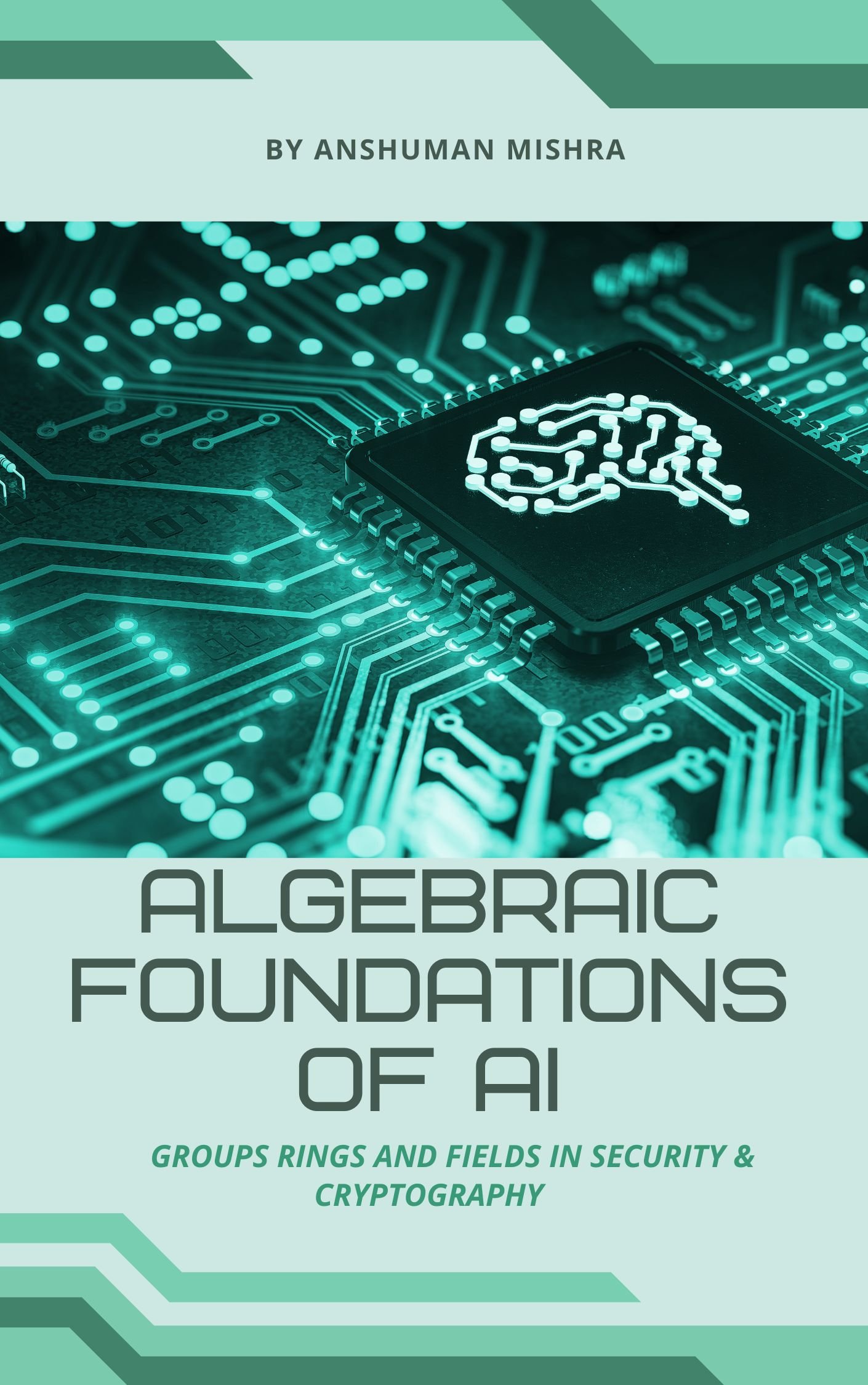
Algebraic Foundations of AI: Groups, Rings, and Fields in Security & Cryptography
Algebraic Foundations of AI: Groups, Rings, and Fields in Security & Cryptography presents an interdisciplinary journey into the mathematical structures that power modern artificial intelligence, cryptography, cybersecurity, and trustworthy computing.
Artificial Intelligence is transforming healthcare, finance, education, communication, industry, and countless other fields. However, as AI systems increasingly process sensitive and valuable information, security, privacy, reliability, and trust have become essential. Behind many of the technologies used to protect information and build reliable computational systems are fundamental concepts from algebra.
This book explores how groups, rings, fields, finite fields, modular arithmetic, polynomial structures, and algebraic methods connect with modern AI and cryptographic systems. Rather than treating algebra as purely theoretical mathematics, the book demonstrates its relevance to practical areas such as encryption, secure machine learning, error-correcting codes, blockchain, federated learning, homomorphic encryption, and post-quantum cryptography.
From Abstract Algebra to Secure AI
The book begins with the mathematical foundations of algebraic structures and gradually moves toward advanced applications in cryptography and artificial intelligence.
Readers are introduced to:
- Groups and their properties
- Cyclic groups and symmetry
- Rings and polynomial rings
- Modular arithmetic
- Fields and finite fields
- Galois fields
- Cryptographic primitives
- Discrete logarithm problems
- Diffie–Hellman key exchange
- Elliptic Curve Cryptography
- Ring-LWE and lattice-based cryptography
- Homomorphic encryption
- Algebraic methods in machine learning
- Privacy-preserving AI
- Federated learning
- Secure Multi-Party Computation
- Error-correcting codes
- Post-quantum cryptography
- Blockchain and smart contracts
- AI-assisted cryptanalysis
- Future directions in algebraic AI security
Four-Part Learning Structure
Part I — Foundations of Algebraic Structures
The first part establishes the mathematical foundation required to understand algebraic approaches to computing and security. It introduces groups, rings, fields, modular arithmetic, polynomial rings, and finite fields while connecting these concepts with applications such as hashing, data integrity, error correction, and AI computation.
Part II — Algebra in Cryptography and Security
The second part demonstrates how algebraic structures form the foundation of modern cryptography. Readers explore symmetric and asymmetric encryption, discrete logarithms, Diffie–Hellman key exchange, elliptic curve cryptography, Ring-LWE, homomorphic encryption, RSA, AES, and field-based cryptographic systems.
The section also examines the growing role of AI in cryptanalysis and secure computational systems.
Part III — Algebraic Structures in AI Applications
The third part focuses directly on the relationship between algebra and artificial intelligence. Topics include symmetry groups in deep learning, algebraic approaches to optimization, group-equivariant neural networks, privacy-preserving machine learning, federated learning, secure multi-party computation, and error-correcting codes.
This section demonstrates how mathematical structures can contribute to the development of more secure, reliable, and robust AI systems.
Part IV — Research, Case Studies, and Future Directions
The final part moves toward research and practical applications. Case studies examine algebraic methods in blockchain, smart contracts, healthcare, finance, and secure AI environments.
The book also discusses open research problems and future directions, including algebraic complexity, AI-driven cryptography, post-quantum security, and the integration of abstract mathematical structures with practical AI architectures.
Key Topics Covered
Groups and Cryptography
Understand how group theory supports cryptographic concepts such as discrete logarithms, Diffie–Hellman key exchange, and Elliptic Curve Cryptography.
Rings and Modern Security
Explore ring structures, polynomial rings, Ring-LWE, homomorphic encryption, and their relevance to privacy-preserving computation and secure AI.
Fields and Finite Fields
Learn how finite fields and Galois fields are used in coding theory and cryptographic algorithms such as AES, RSA-related mathematical structures, and ECC.
Algebra and Machine Learning
Discover the role of symmetry and algebraic structures in modern machine learning, optimization, and group-equivariant neural networks.
Privacy-Preserving AI
Examine mathematical approaches supporting federated learning, secure multi-party computation, and privacy-preserving machine learning.
Error-Correcting Codes
Explore linear codes, Hamming codes, Reed–Solomon codes, and quantum error correction for reliable AI communication and secure computational systems.
Post-Quantum Cryptography
Understand why quantum computing creates challenges for traditional cryptographic systems and explore lattice-, ring-, and module-based approaches to post-quantum security.
Why This Book is Valuable
One of the major strengths of this book is its interdisciplinary approach. It does not isolate mathematics from computer science. Instead, it shows how mathematical concepts can be connected to real technologies and research areas.
The book is particularly useful for readers who want to understand not only what cryptographic algorithms do, but also the mathematical structures that make them possible.
It provides a bridge between:
Abstract Algebra → Computer Science → Cryptography → Cybersecurity → Artificial Intelligence → Post-Quantum Security
Who Should Read This Book?
This book can be useful for:
- BCA Students studying computer science, mathematics, AI, or cybersecurity
- B.Tech/B.E. Students interested in AI, cryptography, and mathematical computing
- MCA and M.Sc. Students looking for interdisciplinary learning
- PhD Scholars and Researchers exploring AI security and algebraic cryptography
- AI and Machine Learning Professionals interested in secure AI architectures
- Cybersecurity Professionals studying cryptographic foundations
- Cryptography Enthusiasts interested in mathematical foundations
- Blockchain Developers and Researchers
- Educators and Academic Trainers
- Technology Professionals exploring post-quantum security
Key Features
✓ Interdisciplinary treatment of Algebra + AI + Cryptography + Cybersecurity
✓ Detailed coverage of Groups, Rings, Fields, and Finite Fields
✓ Applications of algebraic structures in modern cryptography
✓ Coverage of ECC, Diffie–Hellman, Ring-LWE, and Homomorphic Encryption
✓ Introduction to Privacy-Preserving Machine Learning
✓ Discussion of Federated Learning and Secure Multi-Party Computation
✓ Coverage of Error-Correcting Codes and Quantum Error Correction
✓ Introduction to Post-Quantum Cryptography
✓ Case studies involving Blockchain, Healthcare, Finance, and Secure AI
✓ Research-oriented discussion of emerging challenges and future directions
✓ Suitable for students, educators, researchers, and technology professionals
Learning Outcomes
After studying this book, readers can develop an understanding of:
- Fundamental algebraic structures used in computing
- The relationship between algebra and artificial intelligence
- Mathematical foundations of cryptographic systems
- Applications of groups, rings, and fields in security
- Finite-field mathematics and coding theory
- Algebraic foundations of privacy-preserving AI
- Secure machine learning and federated learning concepts
- Lattice and ring-based post-quantum cryptography
- Algebraic approaches to blockchain and secure computing
- Emerging research directions in AI and cryptography
A Book for the Future of Secure AI
As AI becomes increasingly integrated into critical systems, the need for secure, trustworthy, privacy-aware, and future-ready AI will continue to grow.
This book provides readers with a mathematical perspective on that challenge. By connecting the theory of algebra with modern cryptographic and AI applications, Algebraic Foundations of AI offers a pathway for understanding the deeper mathematical foundations behind secure intelligent systems.
Whether you are a student building your mathematical foundation, a researcher exploring new directions, an educator designing interdisciplinary courses, or a technology professional interested in AI security, this book offers a structured introduction to the fascinating intersection of algebra, artificial intelligence, cryptography, and cybersecurity.


Reviews
There are no reviews yet.