Description
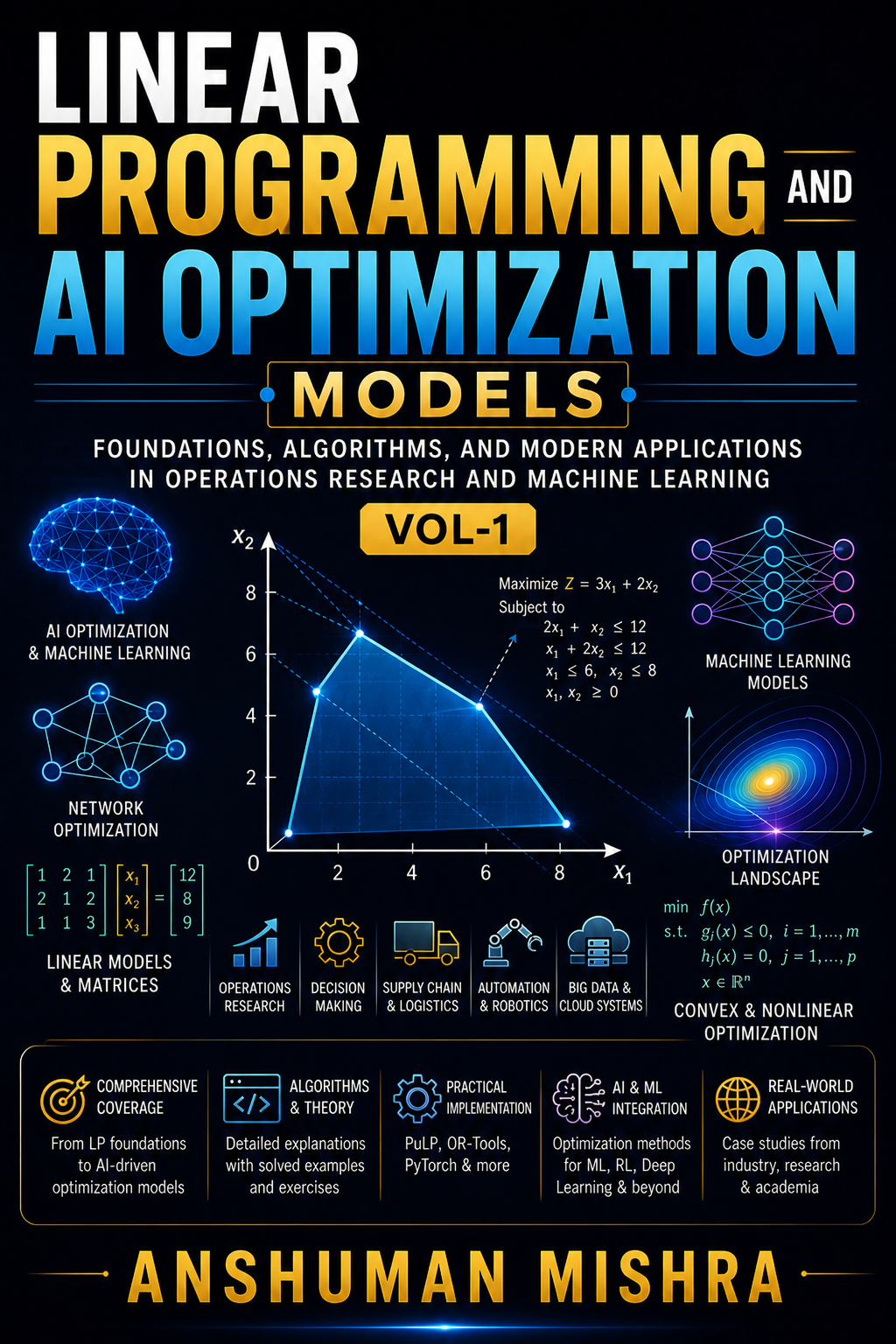
Linear Programming and AI Optimization Models – VOL-1
Foundations, Algorithms, and Modern Applications in Operations Research and Machine Learning
Author: Anshuman Mishra
Publisher: Published by Anshuman Mishra
Publication Year: 2025
Volume: VOL-1
About the Book
Linear Programming and AI Optimization Models: Foundations, Algorithms, and Modern Applications in Operations Research and Machine Learning – VOL-1 is a comprehensive academic and practical resource designed to introduce readers to the mathematical and algorithmic foundations of optimization.
Optimization is one of the most important foundations of modern Artificial Intelligence, Machine Learning, Operations Research, Data Science, Engineering, Economics, and Decision Science. From resource allocation and production planning to scheduling, routing, machine learning model development, and intelligent decision-making, optimization techniques provide systematic methods for finding the best possible solution under given constraints.
This volume begins with the fundamental concepts of optimization and gradually develops the mathematical and algorithmic understanding required to study Linear Programming, Integer Programming, Mixed-Integer Programming, and Nonlinear Programming.
What You Will Learn
The book provides a structured treatment of:
- Fundamentals of optimization
- Mathematical foundations for optimization
- Sets, functions, vectors, and matrices
- Convex sets and convex functions
- Calculus essentials for optimization
- Linear Programming formulation
- Objective functions and constraints
- Feasible regions and basic feasible solutions
- Simplex Method
- Simplex tableau and pivot operations
- Optimality conditions
- Degeneracy and unbounded solutions
- Multiple optimal solutions
- Primal and Dual Linear Programming
- Dual Simplex Method
- Complementary Slackness
- Sensitivity Analysis
- Shadow Prices and economic interpretation
- Revised Simplex Method
- Benders Decomposition
- Dantzig-Wolfe Decomposition
- Cutting Plane Methods
- Transportation Models
- Assignment Models
- Network Flow Models
- Integer Linear Programming
- Mixed-Integer Linear Programming
- Branch and Bound
- Branch and Cut
- Scheduling and routing using MILP
- Nonlinear Programming
- Convex and non-convex optimization
- Lagrange Multipliers
- Karush-Kuhn-Tucker (KKT) Conditions
- Quadratic Programming
- Quadratically Constrained Programming
- Applications of nonlinear optimization
Book Structure
PART I – FOUNDATIONS OF OPTIMIZATION
Chapter 1: Introduction to Optimization
This chapter introduces the concept of optimization, its historical development from classical Linear Programming to modern AI optimization, and its importance in Machine Learning and Operations Research. It also discusses different types of optimization problems and their applications in academia, industry, and research.
Chapter 2: Mathematical Preliminaries
Readers are introduced to the mathematical concepts required for optimization, including sets, functions, relations, vectors, matrices, convex sets, convex functions, calculus, norms, distances, and metrics.
PART II – LINEAR PROGRAMMING
Chapter 3: Formulation of Linear Programming Models
This chapter explains how real-world decision-making problems can be converted into mathematical Linear Programming models. Topics include decision variables, objective functions, constraints, standard and canonical forms, feasible regions, and basic feasible solutions.
Chapter 4: Simplex Method
The Simplex Method is explored through geometric interpretation, simplex tableaux, pivot operations, optimality conditions, numerical examples, and important special cases such as degeneracy, unboundedness, and multiple solutions.
Chapter 5: Duality and Sensitivity Analysis
This chapter develops the relationship between primal and dual Linear Programming models. It covers the Dual Simplex Method, complementary slackness, sensitivity analysis, shadow prices, and their economic interpretation.
Chapter 6: Advanced Linear Programming Techniques
Advanced optimization techniques are introduced, including Revised Simplex, Benders Decomposition, Dantzig-Wolfe Decomposition, Cutting Plane Methods, Transportation Models, Assignment Models, and Network Flow Models.
PART III – INTEGER & NONLINEAR PROGRAMMING
Chapter 7: Integer & Mixed-Integer Linear Programming
This chapter focuses on problems where decision variables must take integer or mixed-integer values. It introduces ILP/MILP formulation techniques, Branch and Bound, Branch and Cut, Cutting Plane Methods, and applications in scheduling and routing.
Chapter 8: Nonlinear Programming
The final chapter introduces Nonlinear Programming and explores convex and non-convex optimization, Lagrange Multipliers, KKT Conditions, Quadratic Programming, Quadratically Constrained Programming, and practical applications of nonlinear optimization.
Why This Book Is Useful
This book is particularly useful for readers who want to understand how mathematical optimization connects with modern computing and AI.
It can serve as a useful reference for:
- Computer Science students
- MCA and BCA students
- Engineering students
- AI and Machine Learning learners
- Data Science students
- Operations Research students
- Mathematics students
- Researchers
- University teachers and educators
- AI/ML professionals
- Optimization practitioners
The book also provides a foundation for studying more advanced optimization methods and their applications in Artificial Intelligence and Machine Learning.
Key Highlights
✓ Strong mathematical foundation
✓ Step-by-step introduction to optimization
✓ Comprehensive Linear Programming coverage
✓ Simplex and Dual Simplex Methods
✓ Duality and Sensitivity Analysis
✓ Advanced LP techniques
✓ Integer and Mixed-Integer Programming
✓ Branch and Bound and Branch and Cut
✓ Nonlinear Programming
✓ KKT Conditions and Lagrange Multipliers
✓ Transportation, Assignment, Routing, and Scheduling applications
✓ Connection between Operations Research and AI/ML
✓ Suitable for academic study, teaching, research, and professional reference
Who Should Read This Book?
This volume is suitable for students and professionals who want to build a strong foundation in mathematical optimization and understand its role in modern computational intelligence.
It can be used as a textbook, supplementary reference, teaching resource, self-learning guide, or research foundation for courses related to Operations Research, Optimization, Artificial Intelligence, Machine Learning, Data Science, and Mathematical Programming.
Conclusion
Linear Programming and AI Optimization Models – VOL-1 provides a structured journey from the fundamental concepts of optimization to important algorithms and mathematical programming techniques.
By combining classical Operations Research and Linear Programming concepts with their relevance to Artificial Intelligence and Machine Learning, the book helps readers understand how optimization serves as a powerful framework for solving complex decision-making and computational problems.
Volume-1 establishes the foundation for advanced optimization models and modern AI-oriented optimization techniques.

Reviews
There are no reviews yet.