Description
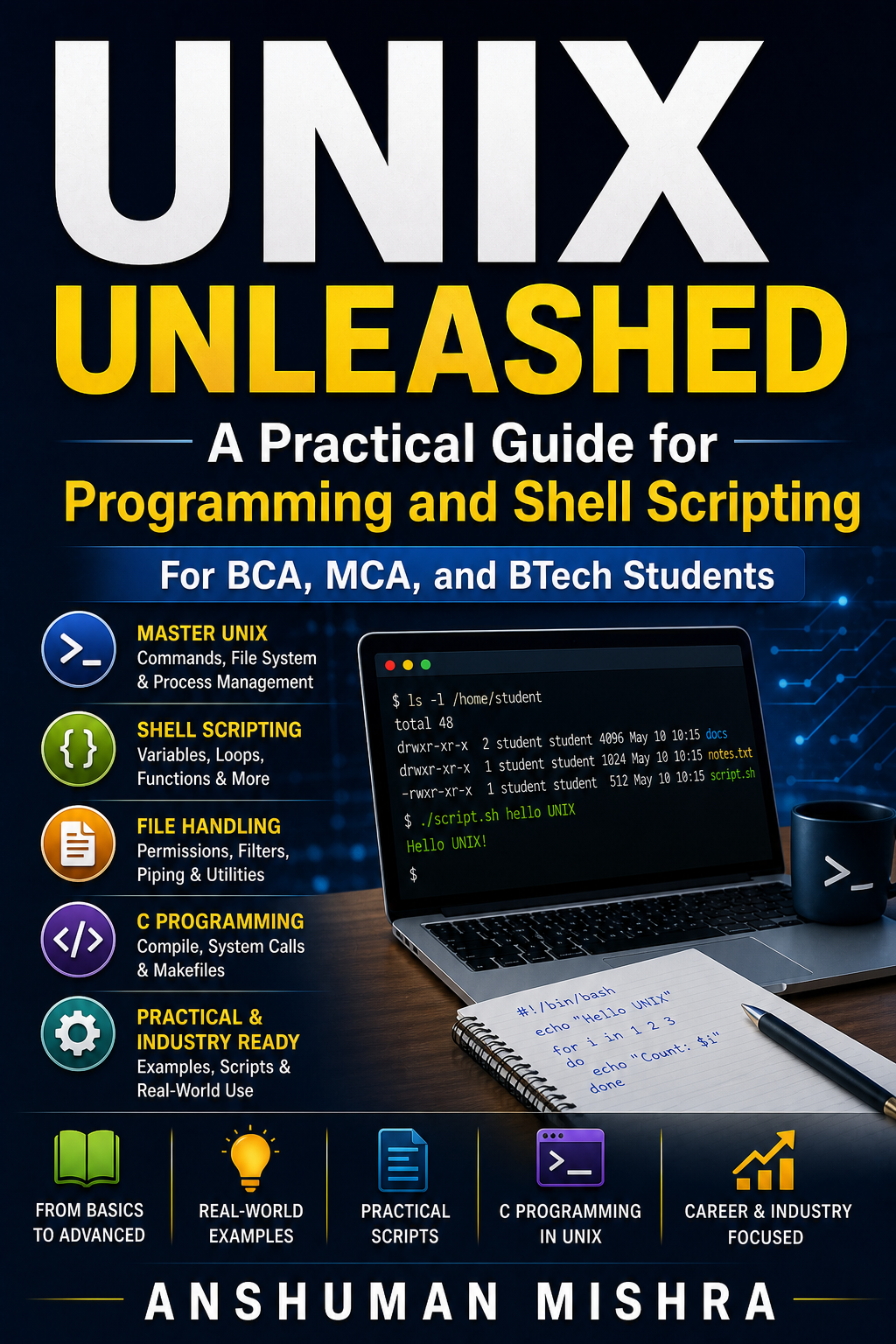
UNIX Unleashed: A Practical Guide for Programming and Shell Scripting
For BCA, MCA, and B.Tech Students | Beginners to Intermediate Learners
About the Book
UNIX is one of the most influential operating systems in the history of computing. Its design philosophy, command-line environment, process model, file system, and programming interfaces have influenced modern systems including Linux and many other UNIX-like platforms.
UNIX Unleashed: A Practical Guide for Programming and Shell Scripting is a comprehensive, practical, and student-friendly book designed to help learners understand UNIX from both a user’s perspective and a programmer’s perspective.
The book begins with the fundamentals of UNIX architecture and gradually progresses toward command-line operations, file management, permissions, process management, shell scripting, and C programming using UNIX system calls.
Rather than focusing only on theoretical concepts, the book follows a learning-by-doing approach. Readers are introduced to commands, utilities, scripting techniques, programming concepts, and practical system-level operations that can be directly explored in a UNIX/Linux environment.
What You Will Learn
This book provides a structured learning path covering:
- UNIX fundamentals and architecture
- UNIX file-system hierarchy
- Essential UNIX commands
- File and directory management
- Permissions and security
- Filters and pipelines
- Text-processing utilities
- File searching and compression
- Process management
- Shell and Bash scripting
- Variables and operators
- Conditional statements
- Loops and functions
- File processing using shell scripts
- AWK and SED basics
- C programming in UNIX
- UNIX system calls
- File descriptors
- Process creation using
fork() - Program execution using
exec() - Parent-child process management
- Signals and process control
Chapter-Wise Coverage
Chapter 1: Introduction to UNIX
The book begins with the history, evolution, and philosophy of UNIX.
Topics include:
- Evolution and history of UNIX
- UNIX design philosophy
- Major UNIX flavors
- System V
- BSD
- Linux and UNIX-like systems
- UNIX architecture
- Login and logout procedures
- Kernel and shell
- Relationship between users, shell, kernel, and hardware
This chapter establishes the foundation required for understanding the rest of the book.
Chapter 2: Working with UNIX File System
The UNIX file system is one of the most important concepts for every UNIX/Linux learner.
You will explore:
- Ordinary files
- Directory files
- Special files
- UNIX file-system hierarchy
- Absolute pathnames
- Relative pathnames
- Root directory
/bin/home/etc/tmp/usr- Creating and navigating directories
- File and directory naming conventions
Chapter 3: Basic UNIX Commands
This chapter provides hands-on practice with commonly used UNIX commands.
Topics include:
lscdpwdmkdirrmdircpmvrmcatmorelessheadtail- Wildcards and patterns
- Command history
- Aliases
Readers develop the command-line skills required for everyday UNIX/Linux work.
Chapter 4: File Permissions and Security
UNIX uses a powerful permission model to control access to files and directories.
This chapter explains:
- File ownership
- User permissions
- Group permissions
- Read permission
- Write permission
- Execute permission
chmodchownchgrp- Symbolic permissions
- Octal permissions
umask- Default permissions
The chapter connects basic permissions with practical system security.
Chapter 5: Filters and Piping
One of UNIX’s greatest strengths is its ability to combine small utilities to perform complex tasks.
Topics include:
- Filters
wcsortuniqteegrepcutpastetr- Pipes
- Output redirection
- Input redirection
- Combining multiple commands
Readers learn how command pipelines can transform and process data efficiently.
Chapter 6: Advanced File Management Utilities
This chapter introduces powerful utilities for searching, comparing, archiving, and compressing files.
Topics include:
findlocatewhichwhereiscmpdiffcommtargzipgunzipzipunzip
These tools are especially useful for system administration, software development, and automation.
Chapter 7: Process Management
Processes are at the heart of UNIX systems.
This chapter covers:
- UNIX process concepts
- Foreground processes
- Background processes
- Process identification
pstopkillnicerenicejobsfgbg- Signals
- Signal handling
Readers gain a practical understanding of how UNIX creates, monitors, controls, and terminates processes.
Chapter 8: Introduction to Shell and Shell Scripting
This chapter introduces the shell as both a command interpreter and a programming environment.
Topics include:
- Bourne Shell
- Bash
- C Shell
- Shell features
- Prompt customization
- Creating shell scripts
- Script execution
- Comments
- Shebang (
#!/bin/bash) - Command-line arguments
Chapter 9: Variables and Operators in Shell
Learners move from simple commands to programmable shell scripts.
Topics include:
- Variables
- User-defined variables
- Environment variables
read- Arithmetic operators
- Relational operators
- Logical operations
exportunset
Practical examples demonstrate how scripts can accept input and make decisions based on data.
Chapter 10: Control Structures in Shell Scripts
This chapter explains decision-making in shell programming.
Topics include:
ifif-elseif-elif-elsecase- Logical operators
&&||test[ ][[ ]]- Best practices for condition testing
These concepts provide the foundation for writing useful automation scripts.
Chapter 11: Looping Constructs and Functions
This chapter introduces reusable and repetitive programming structures.
Topics include:
forloopswhileloopsuntilloopsbreakcontinue- Shell functions
- Function parameters
- Local and global variables
- Basic recursive scripting concepts
Learners can use these techniques to create more powerful and maintainable scripts.
Chapter 12: Handling Files in Shell Scripts
This chapter combines shell scripting with practical text and file processing.
Topics include:
- Reading files
- Writing files
- Checking file existence
- Checking file types
awksed- Pattern matching
- Text substitution
- Menu-driven scripts
- Interactive shell programs
This chapter is particularly useful for automation and system-administration tasks.
Chapter 13: C Programming in UNIX Environment
The book then moves from shell programming to system-level C programming.
Topics include:
- GCC compiler
- Writing C programs in UNIX
- Compiling programs
- Executing programs
- Makefile basics
- Multi-file compilation
- Standard input/output
getchar()putchar()- Command-line arguments
This chapter establishes the foundation for UNIX system programming.
Chapter 14: File Handling with C System Calls
This chapter introduces low-level UNIX file operations.
Topics include:
open()read()write()close()- File descriptors
lseek()- File offsets
- File permissions
umaskerrnoperror()- Error handling
Readers learn how C programs interact directly with the UNIX operating system.
Chapter 15: Process Creation and Control in C
The final chapter introduces process creation and program execution at the system-programming level.
Topics include:
- Process states
fork()- Child processes
- Parent processes
exec()familywait()waitpid()- Process IDs
- Exit status
- Parent-child process relationships
This chapter provides an important foundation for advanced UNIX process programming.
Key Features of the Book
1. Practical Learning Approach
The book emphasizes practical understanding rather than memorizing UNIX commands. Concepts are connected with examples and real-world use cases.
2. Command-Line Focus
Readers develop strong command-line skills through commonly used UNIX utilities and command combinations.
3. Shell Scripting
The book progresses from basic shell commands to variables, conditions, loops, functions, file processing, and automation.
4. C Programming with UNIX
Learners are introduced to system-level C programming and important UNIX system calls.
5. Process Management
The book explains both command-line process management and process creation using C.
6. File-System Understanding
Readers gain practical knowledge of UNIX file hierarchy, permissions, ownership, paths, file descriptors, and low-level file operations.
7. Academic Support
The structured chapters make the book suitable for university courses, assignments, laboratory work, practical examinations, and viva preparation.
8. Industry-Oriented Skills
The concepts covered are useful for system administration, DevOps, backend development, cloud computing, software development, and Linux-based environments.
Benefits of Studying This Book
1. Strong UNIX Foundation
Readers develop a solid understanding of UNIX architecture, philosophy, commands, files, processes, and system operations.
2. Command-Line Proficiency
You will become comfortable navigating the terminal, managing files, searching data, controlling processes, and combining commands.
3. Shell-Scripting Skills
The book helps learners automate repetitive tasks and develop practical Bash scripts.
4. System Programming Knowledge
By learning C and UNIX system calls, readers understand how applications interact with operating-system services.
5. Problem-Solving Skills
Shell scripting and system programming encourage logical thinking, debugging, automation, and structured problem solving.
6. Career Preparation
UNIX/Linux knowledge is valuable for careers involving:
- Software Development
- System Administration
- DevOps
- Cloud Computing
- Cybersecurity
- Backend Development
- Embedded Systems
- System Programming
- Technical Support
7. Foundation for Advanced Linux Learning
The concepts provide a strong foundation for further study of Linux administration, networking, security, kernel concepts, cloud infrastructure, and DevOps.
Who Should Read This Book?
This book is suitable for:
- BCA Students
- MCA Students
- B.Tech / BE Students
- Computer Science Students
- Information Technology Students
- Beginner UNIX/Linux Learners
- Programming Students
- System Programming Learners
- Aspiring System Administrators
- Software Developers
- DevOps Beginners
- IT Professionals
- Computer Science Faculty
- Students preparing for technical interviews
Ideal For
University Courses | UNIX/Linux Labs | BCA | MCA | B.Tech | System Programming | Shell Scripting | C Programming | Practical Examinations | Viva | Technical Interviews | Self-Learning
What You Will Be Able to Do
After completing this book, readers will be able to:
✔ Navigate UNIX/Linux file systems
✔ Use essential UNIX commands confidently
✔ Manage files and directories
✔ Apply UNIX file permissions
✔ Search and process text using command-line utilities
✔ Build command pipelines
✔ Archive and compress files
✔ Monitor and control processes
✔ Work with foreground and background jobs
✔ Write Bash shell scripts
✔ Use variables, operators, conditions, loops, and functions
✔ Process files using shell scripts
✔ Use awk and sed for text processing
✔ Compile and execute C programs in UNIX
✔ Work with UNIX file descriptors
✔ Use system calls such as open(), read(), write(), and close()
✔ Create processes using fork()
✔ Execute programs using exec()
✔ Manage child processes using wait() and waitpid()
✔ Build a foundation for advanced UNIX/Linux programming
Technologies and Tools Covered
UNIX | Linux | Bash | Shell Scripting | C Programming | GCC | Makefiles | AWK | SED | UNIX Commands | UNIX System Calls | Process Management | File Management | Command-Line Programming
Book Information
Book Title: UNIX Unleashed: A Practical Guide for Programming and Shell Scripting
Target Audience: BCA, MCA, B.Tech Students and Beginners to Intermediate Learners
Subject: UNIX Operating System / System Programming
Focus Areas: UNIX Commands, Shell Scripting, Process Management, File Management, C Programming and System Calls
Learning Approach: Practical, Example-Driven and Application-Oriented

Reviews
There are no reviews yet.