Description
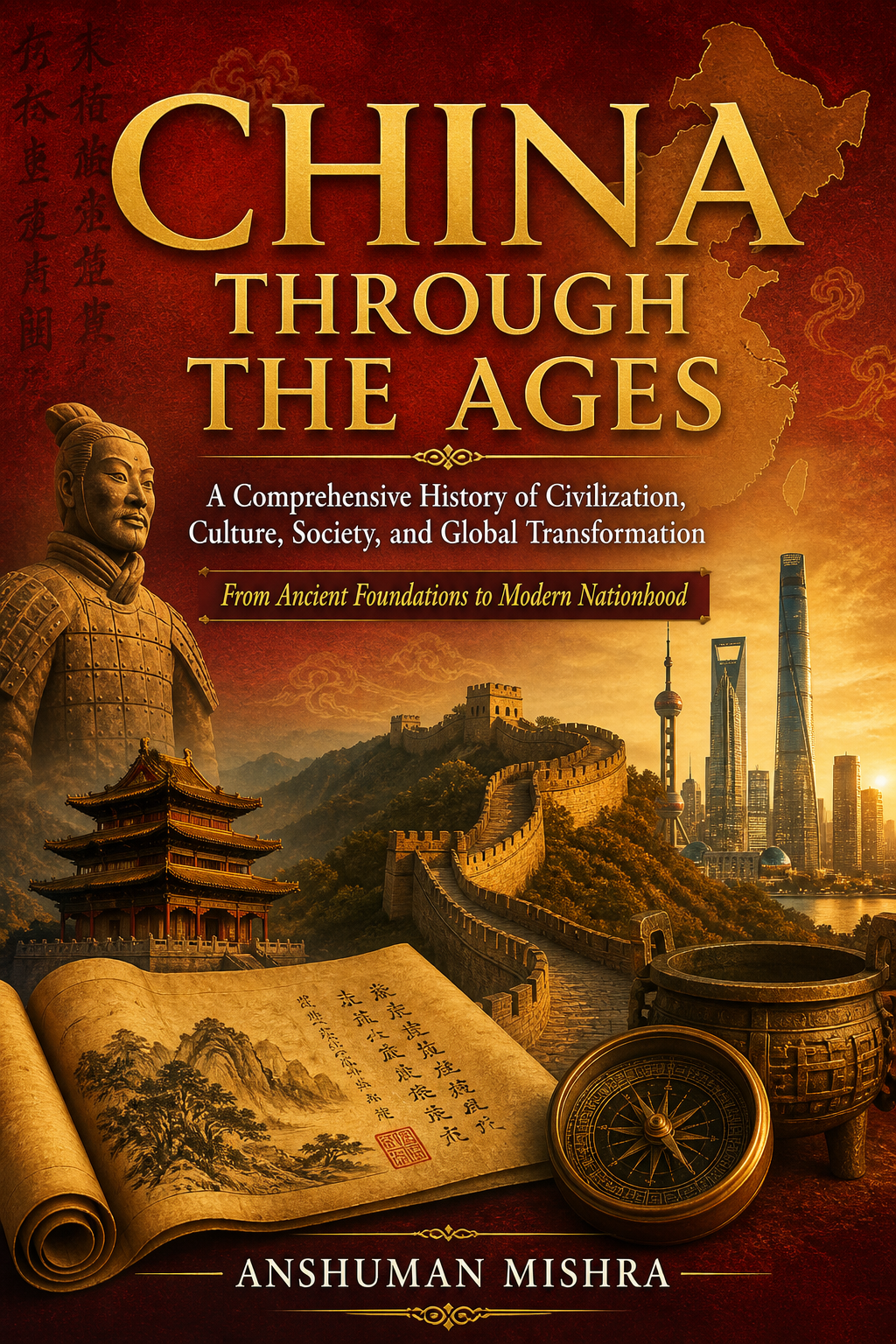
China Through the Ages: A Comprehensive History of Civilization, Culture, Society, and Global Transformation
From Ancient Foundations to Modern Nationhood
Few civilizations have experienced such remarkable continuity, transformation, and cultural influence across thousands of years as China.
China Through the Ages: A Comprehensive History of Civilization, Culture, Society, and Global Transformation presents a comprehensive journey through the development of Chinese civilization—from prehistoric settlements and ancient river cultures to imperial institutions, philosophical traditions, technological innovation, social transformation, and China’s place in the contemporary global community.
Rather than focusing exclusively on political events or individual rulers, this book takes a long-view civilizational approach. It explores how geography, agriculture, governance, philosophy, education, family structures, religion, literature, science, technology, commerce, and cultural exchange interacted to shape Chinese society across generations.
Written in an accessible and academic style, the book is designed for students, educators, researchers, history enthusiasts, and general readers who want to understand China within the broader story of world civilization.
PART I — Origins and Early Civilizations
Chapter 1: The Geography of China and Its Civilizational Influence
Geography provides one of the essential foundations for understanding Chinese civilization.
This chapter examines:
- China’s natural landscapes
- Major river systems
- The Yellow River and Yangtze River
- Climate and agriculture
- Settlement patterns
- Geographic unity
- Regional diversity
Readers discover how rivers, fertile plains, mountains, climate, and environmental conditions influenced agricultural development, settlement, transportation, political organization, and cultural exchange.
Chapter 2: Prehistoric China and Early Human Communities
The story of Chinese civilization begins long before the emergence of imperial dynasties.
This chapter explores:
- Archaeological evidence
- Early human communities
- Neolithic cultures
- Stone and other tools
- Agricultural development
- Pottery
- Early settlements
- Social organization
The chapter places prehistoric China within the wider development of early human societies and examines how agriculture and settled communities created the foundations for increasingly complex social structures.
PART II — Foundations of Chinese Civilization
Chapter 3: The Xia, Shang, and Zhou Periods
The early dynastic traditions played an important role in the formation of Chinese political and cultural identity.
This chapter examines:
- Traditional accounts of early dynasties
- Archaeological evidence
- Bronze technology
- Ritual culture
- Oracle-bone inscriptions
- Early writing
- The Mandate of Heaven
The chapter considers how political authority, ritual practices, writing, and concepts of legitimacy developed during these formative periods.
Chapter 4: Social Structure, Kingship, and Governance
Early Chinese society developed complex systems of family organization, political authority, administration, and military organization.
Topics include:
- Clan structures
- Family hierarchy
- Kingship
- Administrative practices
- Military organization
- Law
- Authority
- Social order
These developments established institutional patterns that influenced later periods of Chinese history.
PART III — Philosophy, Thought, and Cultural Identity
Chapter 5: The Hundred Schools of Thought
Few periods in intellectual history have been as influential as the era associated with the Hundred Schools of Thought.
The chapter introduces:
- Confucian philosophy
- Daoist thought
- Legalism
- Ethical philosophy
- Political philosophy
- Alternative intellectual traditions
The book examines how philosophical ideas influenced concepts of leadership, morality, family relationships, education, governance, nature, and social harmony.
Chapter 6: Education, Literature, and Language
Education and written culture became central elements of Chinese civilization.
This chapter explores:
- Development of Classical Chinese
- Education
- Literature
- Poetry
- Prose
- Preservation of knowledge
- Written traditions
Readers learn how language and literature helped preserve cultural memory and transmit knowledge across generations.
PART IV — Imperial Unity and Expansion
Chapter 7: The Qin and Han Dynasties
The Qin and Han periods were crucial to the development of imperial China.
This chapter examines:
- Political unification
- Administrative standardization
- Infrastructure
- Centralized governance
- Military organization
- Trade
- Cultural exchange
The period demonstrates how political integration and institutional development could transform diverse territories into a more interconnected imperial system.
Chapter 8: The Silk Road and Global Connections
Ancient China was deeply connected to wider networks of trade and cultural exchange.
This chapter explores:
- Origins of the Silk Road
- Long-distance commerce
- Cultural exchange
- Art
- Religion
- Science
- Technology
- China’s place in ancient global networks
The Silk Road is presented not simply as a trade route, but as a network through which people, knowledge, technologies, artistic traditions, and cultural practices moved across regions.
PART V — Cultural Flourishing and Innovation
Chapter 9: The Tang and Song Golden Ages
The Tang and Song periods witnessed remarkable developments in governance, commerce, culture, urbanization, literature, and technology.
This chapter examines:
- Political administration
- Economic development
- Urban life
- Science
- Technology
- Literature
- Art
- Cultural exchange
These periods demonstrate the relationship between economic vitality, education, urban growth, technological innovation, and cultural creativity.
Chapter 10: Science, Technology, and Inventions
Chinese civilization made significant contributions to science and technology.
The chapter explores:
- Papermaking
- Printing
- Education
- Compass technology
- Navigation
- Gunpowder
- Medicine
- Engineering
Rather than presenting inventions as isolated achievements, the book examines their development within broader social, economic, and intellectual contexts.
PART VI — Society, Beliefs, and Daily Life
Chapter 11: Religion and Spiritual Traditions
Chinese religious and spiritual life developed through multiple traditions and practices.
This chapter explores:
- Indigenous beliefs
- Ritual practices
- Buddhism
- Religious coexistence
- Temples
- Religious art
- Pilgrimage
- Cultural adaptation
The discussion focuses on the social and cultural role of belief systems and their interaction with Chinese traditions.
Chapter 12: Family, Gender, and Social Life
Family and community structures have played an important role in Chinese social history.
This chapter examines:
- Family organization
- Social values
- Roles and responsibilities
- Marriage
- Community life
- Festivals
- Social customs
By examining everyday life, the chapter moves beyond political history and provides a more complete picture of how ordinary people experienced society.
PART VII — Foreign Rule and Cultural Continuity
Chapter 13: The Yuan and Ming Periods
The Yuan and Ming periods brought significant political, economic, and cultural developments.
This chapter explores:
- Governance under the Yuan
- Cultural adaptation
- Institutional continuity
- Ming administration
- Maritime exploration
- International trade
- Art
- Architecture
- Literature
The chapter examines how institutions and cultural traditions adapted during periods of political change.
Chapter 14: The Qing Dynasty and Traditional Order
The Qing period represented another important stage in China’s imperial history.
Topics include:
- Administrative systems
- Cultural institutions
- Rural life
- Urban life
- Education
- Civil service
- Social organization
- Cultural continuity
The chapter examines the relationship between established institutions and changing social and economic conditions.
PART VIII — Transition to the Modern Era
Chapter 15: Encounters with the Modern World
China’s interaction with an increasingly industrial and interconnected world created new challenges and opportunities.
This chapter examines:
- International trade
- Cultural exchange
- Technological awareness
- Reform movements
- Intellectual developments
- Modernizing ideas
The discussion focuses on the transformation of Chinese society as new technologies, institutions, and ideas entered the country’s historical experience.
Chapter 16: Social and Economic Transformation
Modernization brought significant changes to agriculture, industry, education, cities, and social mobility.
This chapter explores:
- Agricultural transformation
- Industrial development
- Education
- Social mobility
- Urbanization
- Infrastructure
- Cultural continuity
The chapter demonstrates how societies can experience profound structural change while retaining elements of long-established cultural traditions.
PART IX — Contemporary China in Global Context
Chapter 17: Nation-Building and Modern Identity
Modern national identity emerged through complex interactions between history, language, education, culture, institutions, science, and technology.
This chapter explores:
- National cultural identity
- Education
- Language
- Media
- Science
- Technology
- Innovation
- Cultural heritage
The chapter considers how historical traditions continue to interact with modern institutions and technologies.
Chapter 18: China in the Global Community
China’s contemporary development is closely connected with international trade, education, research, technology, and cultural exchange.
This chapter examines:
- Economic development
- International trade
- Cultural exchange
- Soft power
- Science
- Education
- Research
- Global cooperation
- Contemporary challenges
The discussion places modern China within a broader international context.
PART X — Legacy and Continuity
Chapter 19: Civilization Across Millennia
The long history of China provides an opportunity to examine how civilizations survive through periods of change.
This chapter explores:
- Cultural continuity
- Adaptation
- Resilience
- Historical lessons
- Civilizational contributions
The focus is on the interaction between continuity and transformation rather than viewing civilization as completely static.
Chapter 20: Understanding China Through History
The concluding chapter brings together the major themes of the book.
It examines:
- Historical awareness
- Cultural understanding
- Education
- Global perspectives
- Civilization beyond borders
- Reflections on human history
The chapter encourages readers to approach Chinese civilization not only as a national history but also as part of the interconnected story of humanity.
Major Themes Covered
- Chinese Civilization
- Ancient China
- Prehistoric China
- Chinese Dynasties
- Xia, Shang and Zhou
- Qin Dynasty
- Han Dynasty
- Tang Dynasty
- Song Dynasty
- Yuan Dynasty
- Ming Dynasty
- Qing Dynasty
- Chinese Philosophy
- Confucianism
- Daoism
- Legalism
- Buddhism in China
- Chinese History
- Silk Road
- Chinese Culture
- Chinese Society
- Chinese Family and Social Life
- Chinese Literature
- Chinese Education
- Chinese Science and Technology
- Chinese Inventions
- Chinese Art and Architecture
- Modern China
- China and Globalization
- Chinese Cultural Heritage
China and the Story of Human Civilization
One of the central themes of this book is that Chinese history cannot be understood through political chronology alone.
Civilization develops through the interaction of many forces:
Geography + Agriculture + Governance + Philosophy + Education + Technology + Trade + Culture + Society
Across thousands of years, these forces interacted in different ways, producing periods of political unity, fragmentation, innovation, cultural exchange, reform, and transformation.
Understanding these long-term processes provides a deeper perspective on China’s historical development.
A Civilization of Continuity and Change
Chinese history contains both remarkable continuity and profound transformation.
Writing systems changed and evolved. Political institutions were reorganized. New philosophical and religious traditions entered the cultural landscape. Technologies transformed economic life. Trade connected China with distant regions. Foreign dynasties governed China at different points in history. Modernization introduced new institutions and technologies.
Yet cultural traditions, educational values, family structures, literary practices, artistic forms, and historical memory continued to influence society.
This interaction between continuity and change is one of the defining themes of the book.
China and the Wider World
China’s history has never existed entirely in isolation.
Through the Silk Road, maritime trade, migration, diplomacy, religious exchange, scientific transmission, and cultural interaction, China participated in networks extending across Asia and beyond.
The book therefore places Chinese civilization within world history, demonstrating how ideas and technologies moved in multiple directions and how civilizations influenced one another.
Educational Value
China Through the Ages has been designed as an accessible historical and civilizational resource for:
- University and college students
- History students
- Civilization studies students
- Educators
- Researchers
- Libraries
- International relations readers
- World-history enthusiasts
- General readers interested in China
Its broad chronological structure makes it suitable for readers who want to develop a foundation in Chinese history without restricting their study to a single dynasty or historical period.
Why Read This Book?
This book offers readers the opportunity to understand China through multiple dimensions rather than through political events alone.
It connects:
Ancient Civilization → Philosophy → Governance → Society → Innovation → Trade → Cultural Exchange → Modern Transformation
The result is a broad picture of one of the world’s most influential civilizations.
From Ancient Foundations to Modern Nationhood
The history of China is ultimately a story of adaptation, continuity, innovation, cultural exchange, and human experience.
From early settlements along major river systems to sophisticated imperial institutions, from philosophical traditions to technological inventions, from Silk Road exchanges to modern global engagement, China’s historical journey provides valuable insights into how civilizations evolve over time.
China Through the Ages: A Comprehensive History of Civilization, Culture, Society, and Global Transformation invites readers to explore that journey with curiosity, historical awareness, and respect.
Explore the past. Understand the civilization. Connect history with the modern world.

Reviews
There are no reviews yet.