Description
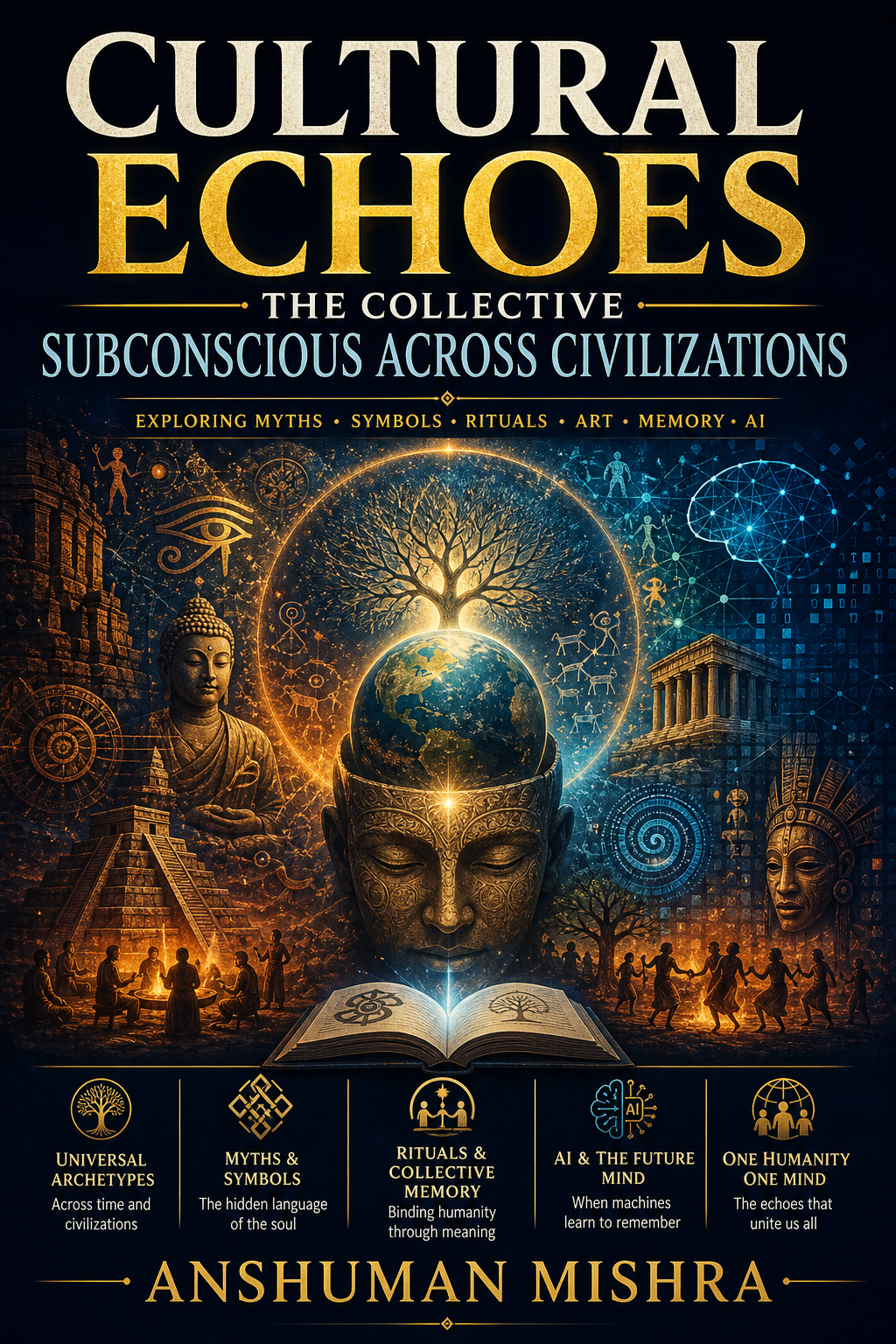
Cultural Echoes: The Collective Subconscious Across Civilizations
Jungian Archetypes • Mythology • Symbols • Rituals • Memetics • Cultural Memory • Artificial Intelligence
Every civilization carries memories that extend beyond written history. They survive through myths, symbols, rituals, stories, art, architecture, traditions, language, and collective practices.
Cultural Echoes: The Collective Subconscious Across Civilizations explores these recurring patterns and asks how humanity’s cultural memory is created, preserved, transformed, and transmitted across generations.
The book brings together ideas from psychology, comparative mythology, cultural studies, anthropology, philosophy, art, digital culture, and Artificial Intelligence to examine the hidden structures that influence collective human imagination.
At the center of the book is an important question:
Do civilizations preserve a shared psychological memory through recurring symbols, stories, and cultural patterns?
The book approaches this question as an interdisciplinary exploration rather than presenting the idea of a universal collective subconscious as an established scientific fact. It uses Jungian theory, mythology, cultural transmission, and digital culture to develop a framework for thinking about recurring patterns in human civilization.
THE MEMORY OF CIVILIZATION
Civilizations preserve their experiences in many forms.
Historical records document events.
Monuments preserve achievements.
Languages preserve ideas.
Rituals preserve practices.
Myths preserve meaning.
Art preserves emotion.
Stories preserve memory.
Together, these cultural forms create complex systems through which communities transmit knowledge and identity across generations.
The opening chapters explore civilization as a living cultural memory system, examining how collective experiences can survive long after the individuals who experienced them are gone.
From ancient oral traditions to modern digital archives, humanity has continuously developed new ways of remembering.
JUNG AND THE COLLECTIVE UNCONSCIOUS
One of the central intellectual foundations of the book is Carl Jung’s concept of the collective unconscious.
Jung proposed that beneath individual psychological experience lie deeper patterns that can influence human imagination and symbolic expression.
The book examines major Jungian concepts including:
- Collective unconscious
- Archetypes
- The Hero
- The Shadow
- The Anima and Animus
- The Mother
- The Trickster
- Symbolic transformation
These concepts are considered alongside myths and cultural traditions from different parts of the world.
The objective is not to claim that every similar symbol has a single universal origin, but to explore why similar themes repeatedly appear in different cultural contexts.
ARCHETYPES ACROSS CIVILIZATIONS
Human societies have created remarkably diverse traditions, yet certain narrative patterns appear repeatedly.
The hero confronts a challenge.
The individual enters an unknown world.
The community faces chaos.
A transformation takes place.
A lost order is restored.
These structures appear in different forms across mythology and literature.
The book compares recurring archetypal patterns while recognizing that each civilization gives them its own historical, religious, social, and cultural meaning.
This approach allows readers to explore both human similarities and cultural differences.
SYMBOLS: THE LANGUAGE OF CULTURE
Before widespread writing systems, humans communicated through images and symbols.
The book explores recurring motifs such as:
- The serpent
- The tree
- The eye
- The spiral
- The circle
- Fire
- Water
- The sun
- The moon
- Mountains
- Labyrinths
These symbols can carry different meanings in different societies.
A serpent may represent transformation in one context and danger or protection in another.
A tree may symbolize life, ancestry, knowledge, or connection.
A circle may represent unity, cycles, completeness, or time.
The book therefore emphasizes contextual interpretation, demonstrating that symbols should not automatically be assigned identical meanings across civilizations.
MYTHS AS CULTURAL MEMORY
Myths are among humanity’s oldest systems for transmitting meaning.
They preserve stories about:
- Creation
- Death
- Rebirth
- Heroes
- Gods
- Nature
- Morality
- Chaos
- Order
- Transformation
- Human destiny
The book examines mythology as a form of cultural memory and compares recurring narrative structures across different societies.
It explores how ancient stories continue to influence modern literature, cinema, television, games, and digital storytelling.
Modern popular culture frequently revisits ancient archetypal structures, transforming them for contemporary audiences.
RITUALS AND COLLECTIVE SYNCHRONY
Rituals transform ideas into collective action.
Religious ceremonies, festivals, commemorations, dances, processions, family traditions, and community practices can reinforce identity and belonging.
The book examines how repetition, rhythm, symbolism, participation, and shared emotional experience contribute to cultural continuity.
Rituals also evolve.
Traditional ceremonies may coexist with modern forms of collective participation, including online communities, digital commemorations, social campaigns, and virtual gatherings.
The medium changes, but the human desire to participate in shared symbolic experiences remains.
ART AS THE EXPRESSION OF CULTURAL MEMORY
Art provides another window into collective experience.
From prehistoric cave paintings to monumental architecture, classical sculpture, religious art, modern abstraction, surrealism, photography, cinema, and digital creation, artistic expression reflects changing human perceptions of reality.
The book explores how artists have used visual language to represent:
- Dreams
- Fear
- Beauty
- Spirituality
- Identity
- Conflict
- Transformation
- Nature
- Human existence
It also examines the emergence of AI-generated art and considers how machine-generated images interact with cultural symbolism.
MEMETICS: CULTURE AS LIVING INFORMATION
The concept of the meme, introduced into evolutionary cultural theory by Richard Dawkins, provides another framework for understanding cultural transmission.
Ideas can spread.
Stories can mutate.
Symbols can be adapted.
Images can become viral.
Language can change.
Digital communities can rapidly reproduce cultural patterns.
The book connects memetic theory with contemporary internet culture, examining how social media has accelerated the speed at which cultural information is copied, modified, and redistributed.
Modern memes may be humorous, political, emotional, commercial, or symbolic.
Their rapid circulation provides researchers with a new way to observe cultural change in real time.
THE DIGITAL COLLECTIVE MEMORY
The internet has transformed humanity’s relationship with memory.
Historically, cultural memory depended heavily on oral transmission, manuscripts, books, monuments, museums, and physical archives.
Today, enormous quantities of human communication are digitally stored.
Images, videos, conversations, articles, posts, music, and other cultural artifacts can remain accessible across geographical boundaries.
This creates a new form of distributed cultural memory.
However, digital memory also introduces challenges involving:
- Information overload
- Algorithmic filtering
- Misinformation
- Cultural representation
- Privacy
- Ownership
- Digital preservation
- Historical distortion
The book examines these issues as part of the transformation of cultural memory in the digital age.
THE AI MIRROR
Artificial Intelligence introduces a particularly important development.
Modern AI systems can process enormous collections of human-generated text, images, audio, and other forms of information.
As a result, AI can reproduce and transform cultural patterns found in its training material.
The book uses the metaphor of the AI mirror to describe this phenomenon.
AI does not necessarily possess a human-like subconscious. Instead, it can statistically model patterns present in human cultural data.
This distinction is important.
The book therefore asks:
What happens when machines become increasingly capable of representing humanity’s stories, symbols, languages, and artistic traditions?
AI AND CULTURAL MEMORY
The emergence of generative AI creates new questions about cultural preservation.
AI can potentially assist with:
- Digital preservation
- Language documentation
- Historical research
- Cultural education
- Translation
- Archive analysis
- Museum interpretation
- Artistic exploration
At the same time, AI systems can reproduce biases, misunderstand cultural contexts, or oversimplify traditions.
Responsible cultural AI therefore requires attention to:
Accuracy + Context + Diversity + Representation + Ethics
The book examines these issues from a cultural and philosophical perspective.
CROSS-CULTURAL ECHOES
Civilizations have never existed in complete isolation.
Trade, migration, travel, translation, conquest, diplomacy, and intellectual exchange have continuously moved ideas across regions.
Stories and symbols have therefore travelled between communities and changed along the way.
The book explores the concept of cultural echoes—the appearance of related themes across different societies—while recognizing that similarity does not necessarily prove direct historical connection.
This distinction is essential for responsible comparative cultural research.
EAST AND WEST: CONNECTIONS AND DIFFERENCES
The book encourages readers to examine cultural traditions comparatively without reducing them to a single universal system.
Eastern and Western traditions may share themes involving:
- Creation
- Mortality
- Transformation
- Wisdom
- Conflict
- Nature
- Order and chaos
- Human purpose
Yet the meanings attached to these themes can be profoundly different.
Understanding both similarity and difference allows readers to appreciate cultural diversity without forcing every tradition into the same interpretive framework.
DIGITAL CULTURE AND THE EVOLUTION OF SYMBOLS
Human symbolic communication continues to evolve.
Ancient images became writing.
Writing became printed text.
Printed text became mass media.
Mass media became digital communication.
Digital communication now includes emojis, GIFs, memes, avatars, virtual environments, and AI-generated media.
These new forms do not eliminate older symbolic patterns. Instead, they transform how those patterns circulate.
The book examines digital culture as a new environment in which human symbolism can evolve at unprecedented speed.
THE FUTURE OF THE COLLECTIVE SUBCONSCIOUS
The final section explores possible futures.
Digital archives may become increasingly comprehensive.
Virtual environments may create new forms of cultural participation.
AI may become an increasingly important tool for storytelling and cultural interpretation.
Human creativity may increasingly interact with machine-generated content.
These developments raise an important question:
Will technology merely preserve cultural memory, or will it actively transform the way humanity remembers itself?
The answer will depend on how societies design, govern, and use emerging technologies.
WHY STUDY THIS BOOK?
1. Interdisciplinary Understanding
The book connects psychology, anthropology, mythology, philosophy, art, sociology, digital humanities, and AI.
Readers gain a broader framework for understanding culture as a complex system rather than a collection of isolated traditions.
2. Understanding Jungian Archetypes
Readers are introduced to important Jungian concepts and their relevance to mythology, storytelling, art, and modern media.
3. Comparative Cultural Awareness
The book encourages readers to explore similarities and differences across civilizations while respecting historical and cultural context.
4. Understanding Digital Culture
Memes, social networks, digital symbols, and online communities are examined as important forms of modern cultural transmission.
5. AI and Cultural Studies
Readers gain an introduction to the emerging intersection between Artificial Intelligence and cultural memory.
6. Critical Thinking
The book encourages readers to distinguish between:
Historical evidence → Cultural interpretation → Psychological theory → Philosophical speculation
This distinction helps prevent unsupported conclusions.
7. Creative Inspiration
Artists, writers, filmmakers, educators, and storytellers can explore archetypes and symbolic structures as sources of creative inspiration.
WHO SHOULD READ THIS BOOK?
Psychology Students and Researchers
Useful for readers interested in Jungian psychology, archetypes, symbolism, collective behavior, and cultural psychology.
Anthropology and Cultural Studies Students
Provides frameworks for examining rituals, mythology, cultural memory, and cross-cultural transmission.
Philosophy Students
Explores questions about consciousness, identity, meaning, memory, and the relationship between humans and technology.
AI Researchers and Digital Humanists
Introduces cultural perspectives on machine learning, generative AI, digital archives, and cultural representation.
Artists and Writers
Provides insights into recurring narrative structures, symbols, myths, and archetypal themes.
Educators
Can serve as supplementary reading for courses involving mythology, psychology, cultural studies, digital humanities, and AI.
General Readers
Accessible to anyone interested in civilization, mythology, psychology, consciousness, culture, and the future of Artificial Intelligence.
KEY THEMES OF THE BOOK
Collective Memory
How societies preserve and transmit experiences.
Jungian Archetypes
Recurring psychological patterns in stories and symbols.
Mythology
Narrative systems through which cultures explore existence and meaning.
Symbolism
Visual and conceptual languages of cultural expression.
Ritual
Shared practices that reinforce identity and collective belonging.
Art
Aesthetic expressions of individual and cultural experience.
Memetics
The replication and transformation of cultural information.
Digital Culture
The rapid evolution of symbols and ideas through online networks.
Artificial Intelligence
A technological mirror capable of modeling patterns in human cultural data.
Global Cultural Exchange
The movement and transformation of ideas across civilizations.
A NEW WAY OF UNDERSTANDING CULTURE
Cultural Echoes: The Collective Subconscious Across Civilizations ultimately proposes a powerful way of thinking about human culture.
Civilization is not only a collection of institutions and historical events.
It is also a system of memory, meaning, symbols, stories, practices, and relationships.
Every generation inherits cultural patterns and then transforms them.
The digital age has accelerated this process.
Artificial Intelligence may accelerate it even further.
The challenge for humanity is therefore not simply to preserve the past, but to understand how memory changes when it enters digital and computational systems.
CONCLUSION: THE ECHO THAT CONTINUES
Humanity has always remembered through stories.
It remembered through paintings on stone.
Through songs and poems.
Through temples and monuments.
Through manuscripts and books.
Through photographs and films.
Today, it also remembers through databases, digital networks, algorithms, and AI systems.
The medium continues to change.
The fundamental human desire to preserve meaning remains.
Cultural Echoes invites readers to explore this extraordinary journey—from ancient myths and archetypes to memes, digital culture, and artificial intelligence.
It is a study of how humanity remembers, how cultures transform, and how emerging technologies may influence the future of collective memory.
The central question is ultimately not whether humanity has a single collective subconscious, but something equally fascinating:
What patterns of human experience continue to echo across generations—and what happens when those echoes become part of the digital world?
That question lies at the heart of this book.


Reviews
There are no reviews yet.