Description
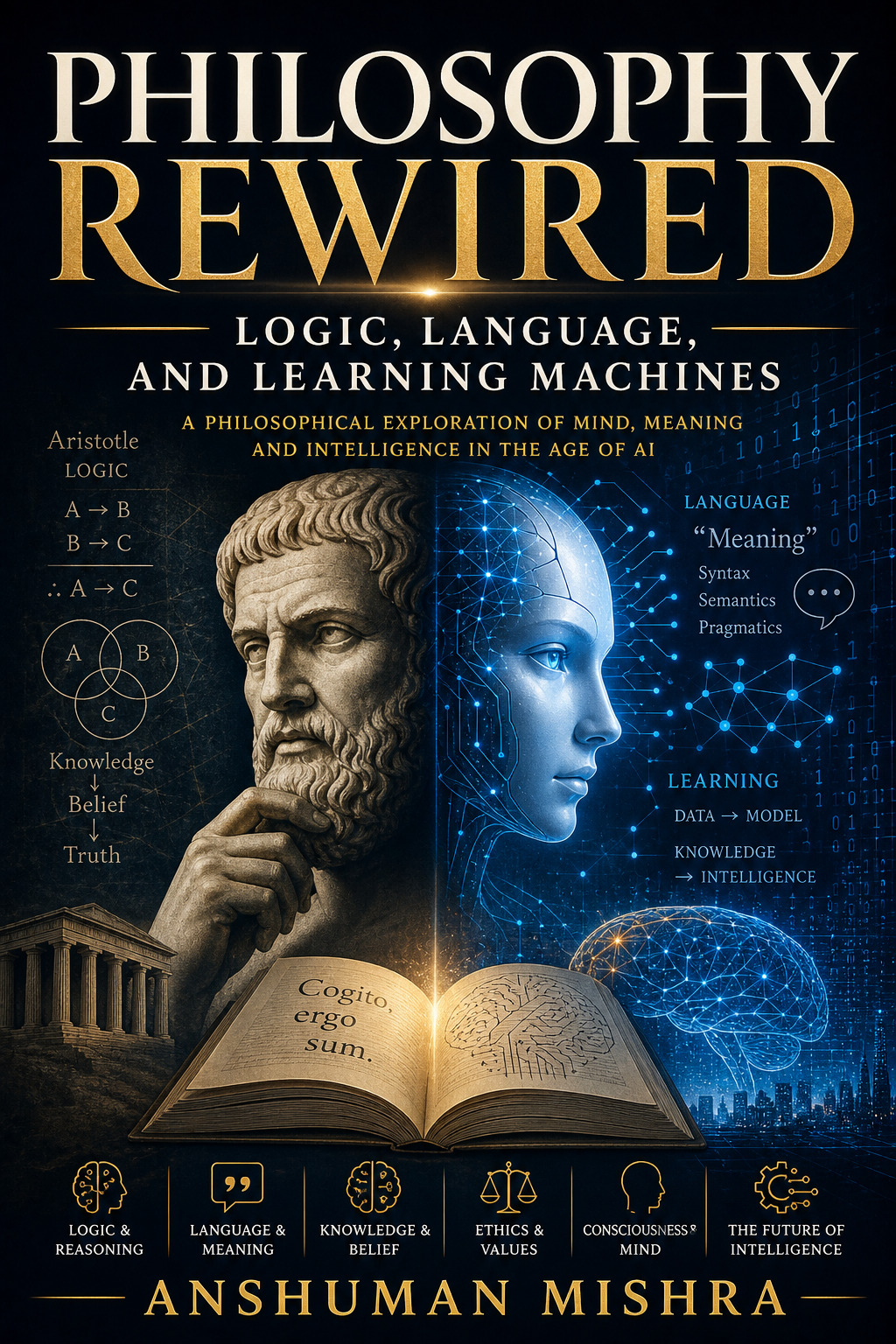
Philosophy Rewired: Logic, Language, and Learning Machines
Philosophy Rewired: Logic, Language, and Learning Machines explores the fascinating intersection of philosophy, artificial intelligence, computer science, logic, language, cognition, and machine learning. The book examines how centuries-old philosophical questions about truth, knowledge, consciousness, meaning, ethics, free will, and reality are being transformed by intelligent machines.
As artificial intelligence increasingly becomes capable of reasoning, generating language, learning from data, and making complex decisions, an important question emerges: What does it really mean to think?
This book approaches that question from both philosophical and computational perspectives.
From Aristotle and classical logic to Turing and modern artificial intelligence, from Wittgenstein’s philosophy of language to large language models, and from traditional theories of knowledge to machine learning, the book creates a conceptual bridge between human thought and artificial intelligence.
What Will You Explore?
The book investigates some of the most important philosophical questions surrounding intelligent machines:
- How did classical logic evolve into machine reasoning?
- Can machines genuinely understand language?
- What does it mean for an AI system to “know” something?
- Can computation produce consciousness?
- Can artificial systems possess beliefs or intentions?
- Can machines make moral decisions?
- How do algorithms affect human autonomy and free will?
- Is intelligence independent of biological matter?
- Can machines learn, create, or become curious?
- What happens to human identity in an age of artificial intelligence?
- How might philosophy evolve alongside increasingly intelligent machines?
Key Themes Covered
1. Philosophy and Artificial Intelligence
The opening chapters introduce the transformation of philosophical inquiry in the digital era. The book explores the convergence of philosophy and computation and examines machines as new objects of philosophical investigation.
2. Logic and Machine Reasoning
Readers are introduced to the evolution of logical thought from Aristotle to Turing. Topics include propositional logic, predicate logic, deductive reasoning, inductive reasoning, abductive reasoning, knowledge representation, and the limitations of purely logical systems.
3. Language, Meaning, and AI
The book examines the relationship between philosophy of language and modern Natural Language Processing (NLP). It explores syntax, semantics, pragmatics, symbol grounding, meaning, and the philosophical implications of large language models.
The classic Chinese Room Argument is revisited in the context of contemporary AI and machine understanding.
4. Knowledge, Belief, and Uncertainty
The book connects epistemology with artificial intelligence, asking what it means for a machine to know something. Bayesian reasoning, uncertainty, knowledge representation, ontologies, probability, truth, and belief systems are discussed from an interdisciplinary perspective.
5. Consciousness and Computation
One of the deepest questions explored is whether consciousness could exist in an artificial system.
The discussion includes:
- Philosophy of mind
- Strong AI and weak AI
- Computational theories of mind
- Functionalism
- Self-awareness
- Intentionality
- Qualia
- Integrated Information Theory
- Global Workspace Theory
- Machine consciousness and sentience
6. Ethics of Intelligent Machines
AI is not simply a technical system; it can influence human decisions, institutions, and society. This section examines AI ethics, algorithmic bias, responsibility, autonomy, surveillance, privacy, fairness, and moral decision-making.
The book considers whether concepts from virtue ethics, deontology, and consequentialism can help guide the behavior of intelligent systems.
7. Cognitive Architectures and Machine Intelligence
This section explores the relationship between human cognition and computational architectures. It examines behaviorism, connectionism, neural networks, symbolic AI, subsymbolic approaches, hybrid systems, deep learning, and embodied cognition.
8. Metaphysics of Artificial Intelligence
The book moves beyond technical questions to examine the nature of artificial existence. It explores digital ontology, virtual environments, identity, continuity, simulation, artificial beings, and the possibility that intelligence may not necessarily depend on biological matter.
9. Free Will and Algorithmic Determinism
Can human choices be predicted by algorithms? Does algorithmic decision-making challenge the idea of free will?
This section connects classical philosophical debates about free will and determinism with modern AI systems, algorithmic prediction, autonomy, and computational uncertainty.
10. Truth and Digital Reality
In an era of massive information flows, distinguishing truth from probability and interpretation has become increasingly important.
The book examines:
- Computational approaches to truth
- Verification
- Digital epistemology
- Information overload
- Post-truth environments
- Data and belief
- Machine interpretation
- Digital hermeneutics
11. AI, Society, and Power
Artificial intelligence is changing labor, governance, institutions, surveillance, and social relationships. Drawing upon ideas associated with critical theory and social philosophy, this section investigates algorithmic authority, technological rationality, automation, human autonomy, and digital humanism.
12. The Philosophy of Learning Machines
Machine learning raises a fundamental philosophical question: What does it mean to learn?
The book explores induction, experience, generalization, knowledge evolution, machine creativity, curiosity, and the philosophical foundations of learning systems.
13. The Future of Human Thought
The book considers possible futures involving increasingly capable AI, human-machine collaboration, artificial superintelligence, mind uploading, digital immortality, and post-human ideas.
Rather than presenting technological speculation as certainty, the discussion encourages readers to critically examine the philosophical assumptions behind these possibilities.
14. Research Horizons
The book identifies emerging interdisciplinary areas connecting:
Philosophy + AI + Computer Science + Cognitive Science + Neuroscience + Linguistics + Ethics
It provides a conceptual foundation for students and researchers interested in philosophy of computation, computational epistemology, AI ethics, cognitive computing, machine consciousness, philosophy of information, and related fields.
15. The Rewired Mind
The concluding chapter brings together the major themes of the book and asks what happens to philosophy when machines increasingly participate in activities traditionally associated with human intelligence.
The central message is simple:
AI does not eliminate philosophy. It gives philosophy new questions.
Who Should Read This Book?
This book is suitable for:
- Philosophy students
- Computer Science students
- Artificial Intelligence students
- Data Science students
- Cognitive Science students
- Researchers and academics
- AI and technology professionals
- AI ethics researchers
- Linguistics and NLP enthusiasts
- Teachers and educators
- Readers interested in philosophy of mind
- Readers interested in the future of AI
Academic and Research Value
The book can serve as a conceptual reference for exploring interdisciplinary research topics such as:
- Philosophy of Artificial Intelligence
- Philosophy of Computation
- Computational Epistemology
- Philosophy of Mind
- Machine Consciousness
- AI Ethics
- Cognitive Computing
- Philosophy of Language and NLP
- Digital Ontology
- Human-Machine Interaction
- AI and Society
- Logic and Knowledge Representation
It encourages readers to move beyond the question of “How does AI work?” and ask the deeper questions:
What does intelligence mean?
What is knowledge?
What is understanding?
What is consciousness?
What makes a decision intelligent or ethical?
Can intelligence exist independently of biological life?
Why This Book Matters
Artificial intelligence is not simply changing technology. It is challenging some of our deepest assumptions about human intelligence, knowledge, language, autonomy, creativity, and consciousness.
By bringing philosophy and computation together, Philosophy Rewired offers a framework for understanding these changes critically and thoughtfully.
It is a book about AI—but at a deeper level, it is a book about the nature and future of thinking itself.
In every algorithm lies a trace of logic.
In every intelligent system, a question about knowledge.
In every learning machine, a challenge to our understanding of thought.
Philosophy Rewired: Logic, Language, and Learning Machines invites readers to explore that transformation.


Reviews
There are no reviews yet.