Description
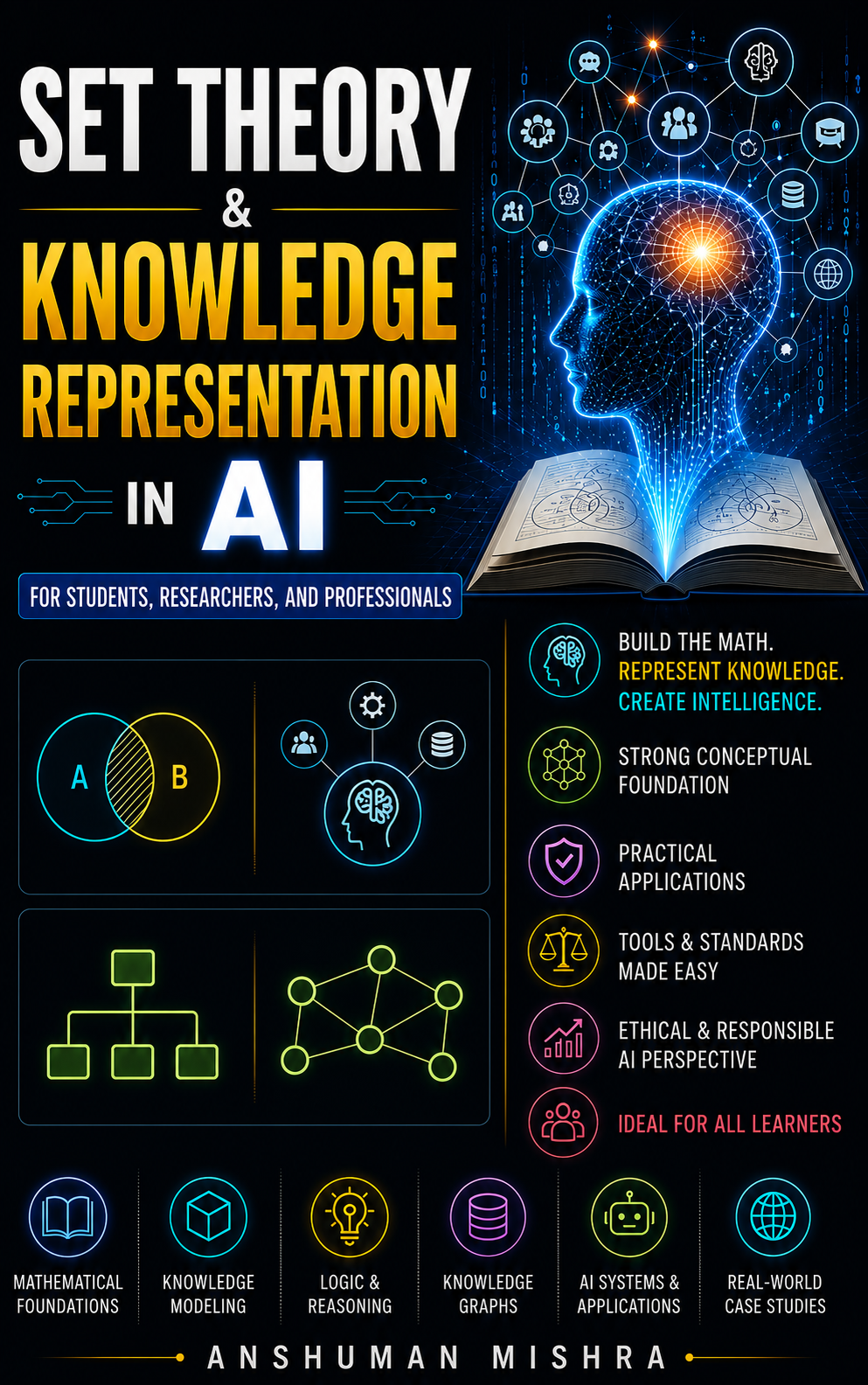
Set Theory & Knowledge Representation in AI
For Students, Researchers, and Professionals
Artificial Intelligence is not built only on algorithms and machine learning models. Beneath intelligent systems lies a deeper foundation of mathematics, logic, representation, relationships, and structured knowledge.
Set Theory & Knowledge Representation in AI: For Students, Researchers, and Professionals brings together two important foundations of modern AI: set theory and knowledge representation (KR).
Set theory provides a mathematical language for describing collections, relationships, structures, and mathematical objects. Knowledge representation, on the other hand, provides methods through which intelligent systems can organize information, represent concepts, infer relationships, and reason about the world.
Together, these areas provide an important conceptual foundation for understanding how AI systems can represent and manipulate knowledge.
This book moves progressively from fundamental set-theoretic concepts to advanced AI applications involving ontologies, semantic networks, knowledge graphs, description logics, reasoning systems, and machine learning.
Why Set Theory Matters in AI
At first glance, set theory may appear to be a purely mathematical subject.
However, many concepts used throughout computer science and artificial intelligence can be expressed naturally using sets and relations.
Examples include:
- Collections of objects
- Feature spaces
- Classes and categories
- Data relationships
- Knowledge domains
- Ontologies
- Search spaces
- Partitions
- Classification groups
- Mathematical models
- Knowledge bases
Set operations such as union, intersection, difference, and complement also provide useful mathematical tools for representing relationships and categories.
By connecting these concepts directly to AI, the book helps readers understand the mathematical structures behind intelligent systems.
Why Knowledge Representation Matters
An AI system needs more than raw data.
It needs ways to represent:
Objects → Concepts → Relationships → Properties → Rules → Knowledge
Knowledge representation provides the mechanisms required to structure this information so that machines can use it for reasoning and decision-making.
This book introduces several major approaches, including:
- Semantic networks
- Frames
- Scripts
- Ontologies
- Knowledge graphs
- Rule-based systems
- Description logics
- Inference systems
The result is a comprehensive journey from mathematical foundations to practical AI knowledge systems.
Book Structure
The book is organized into five major parts and fifteen chapters, creating a progressive path from basic set theory to advanced knowledge representation and real-world AI applications.
PART I — Foundations of Set Theory
Chapter 1 — Introduction to Set Theory
The book begins with the fundamental language of sets.
Topics include:
- What is a set?
- Set notation
- Subsets and supersets
- Set operations
- Power sets
- Universal sets
- Venn diagrams
- Set identities
- Applications in computer science and AI
The chapter demonstrates how basic mathematical concepts can be connected to AI problems involving classification, organization, grouping, and knowledge structures.
Chapter 2 — Advanced Set-Theoretic Concepts
The second chapter extends the mathematical foundation.
Readers explore:
- Cartesian products
- Ordered pairs
- Relations
- Properties of relations
- Functions as sets
- Equivalence relations
- Partitions
- Cardinality
- Infinite sets
- Introductory Zermelo-Fraenkel axioms
These concepts provide a foundation for understanding how mathematical relationships can be represented computationally.
Chapter 3 — Logic and Set Theory in AI
Logic and set theory are closely connected to knowledge representation.
This chapter introduces:
- Propositional logic
- Predicate logic
- Quantifiers
- Logical reasoning
- Inference rules
- Proof strategies
- Set-theoretic reasoning
- Knowledge representation foundations
Readers learn how logical statements and mathematical structures can be used to represent knowledge and support automated reasoning.
PART II — Core Knowledge Representation Concepts
Chapter 4 — Foundations of Knowledge Representation
What does it mean for an AI system to “know” something?
This chapter introduces the fundamental concepts of knowledge representation.
It explores:
- Knowledge in AI
- Declarative knowledge
- Procedural knowledge
- Semantic knowledge
- Characteristics of effective KR systems
- Knowledge representation vs. data representation
- Classical knowledge representation paradigms
The chapter establishes the conceptual foundation for the remaining sections of the book.
Chapter 5 — Semantic Networks
Semantic networks provide a graphical approach to representing knowledge.
The chapter explains:
- Nodes
- Links
- Labels
- Concepts
- Relationships
- Hierarchical structures
- Inheritance
- Variants of semantic networks
- Limitations
- AI implementations
Readers learn how concepts can be connected to form structured representations that support reasoning and information retrieval.
Chapter 6 — Frames and Scripts
Frames provide structured representations of concepts and situations, while scripts help represent sequences of events.
This chapter covers:
- Frames
- Slots
- Fillers
- Default values
- Procedural attachments
- Scripts
- Event-based knowledge
- Natural language understanding
These approaches demonstrate how AI systems can represent structured knowledge about objects, situations, and common events.
PART III — Ontologies and Data Modeling
Chapter 7 — Ontologies in Artificial Intelligence
Ontologies provide formal models of concepts and relationships within a particular domain.
This chapter introduces:
- Ontologies
- Classes
- Concepts
- Individuals
- Properties
- Taxonomies
- Thesauri
- Semantic Web
- AI applications
- RDFS
- OWL
The chapter explains how ontologies allow AI systems to represent the meaning and relationships of domain-specific knowledge.
Chapter 8 — Building and Modeling Ontologies
Creating an ontology requires careful modeling and design.
This chapter explores:
- Ontology design principles
- Class hierarchies
- Relationships
- Object properties
- Data properties
- Ontology development
- Protégé
- Ontology evaluation
- Ontology reuse
The focus is on understanding how abstract concepts can be converted into structured computational models.
Chapter 9 — Set-Theoretic Approach to Ontological Modeling
This chapter creates a direct bridge between the mathematical foundation of the book and practical ontology engineering.
It explores:
- Classes as sets
- Individuals as members
- Set operations in ontologies
- Intersection
- Union
- Complement
- Formal semantics
- Consistency checking
- Set-theoretic logic
This perspective helps readers understand that many ontology structures can be interpreted using mathematical relationships between sets.
PART IV — Applications and Toolkits
Chapter 10 — Knowledge Graphs and Linked Data
Knowledge graphs have become an important technology for organizing interconnected information.
This chapter explains the transition:
Ontology → Knowledge Model → Knowledge Graph
Topics include:
- Nodes
- Edges
- Triples
- RDF
- Graph databases
- RDF stores
- Linked Data
- Semantic relationships
- SPARQL
The chapter introduces the conceptual foundations behind graph-based knowledge systems used in modern search, recommendation, enterprise data integration, and AI applications.
Chapter 11 — AI Systems with Knowledge Representation
This chapter examines how knowledge representation becomes part of actual AI systems.
It covers:
- Rule-based systems
- Logic-based systems
- Case-based reasoning
- Expert systems
- Inference engines
- Intelligent agents
- Knowledge-based AI
- Robotics
- Natural language processing
Readers can see how structured knowledge can support reasoning and decision-making beyond purely statistical approaches.
Chapter 12 — KR Tools and Standards
Practical knowledge representation requires appropriate tools and standards.
This chapter introduces important technologies and ecosystems, including:
- Protégé
- TopBraid
- GraphDB
- RDF
- OWL
- SKOS
- JSON-LD
- Ontology versioning
- Ontology integration
- DBpedia
- Wikidata
- Interoperability standards
The chapter provides readers with an overview of the technologies used to build and manage modern knowledge representation systems.
PART V — Advanced Topics and Case Studies
Chapter 13 — Set Theory in Machine Learning and AI
The relationship between sets and AI extends into machine learning.
This chapter explores:
- Feature spaces
- Fuzzy sets
- Rough sets
- Set-theoretic clustering
- Classification
- Set partitioning
- Decision trees
- Multisets
- Data modeling
The chapter demonstrates how set-based thinking can support different approaches to data organization, uncertainty, classification, and machine learning.
Chapter 14 — Description Logics and Reasoning
Description Logics provide formal languages for representing structured knowledge and supporting automated reasoning.
This chapter introduces:
- Description Logic fundamentals
- TBox
- ABox
- Classes
- Individuals
- Consistency
- Subsumption
- Reasoners
- Inference engines
- Practical reasoning examples
This section provides an important foundation for understanding the formal reasoning mechanisms underlying ontology-based AI systems.
Chapter 15 — Case Studies and Applications
The final chapter connects theory with practical domains.
Applications include:
Healthcare Ontologies
The chapter explores how structured knowledge can support healthcare information systems and domain-specific representations, including examples such as SNOMED CT and HL7-related ecosystems.
E-Commerce
Product ontologies can help represent:
- Products
- Categories
- Attributes
- Brands
- Relationships
- Customer preferences
This can support search, recommendation, and information integration.
Scientific Knowledge
Knowledge representation can help organize complex relationships between scientific concepts, entities, datasets, and research information.
Semantic Web
The chapter examines how semantic technologies enable machines to process relationships and meaning across interconnected information.
Ethics and Future Directions
The book concludes by considering the broader implications of knowledge representation in increasingly intelligent systems.
Major Concepts Covered
This book brings together a wide range of mathematical and AI concepts, including:
Set Theory
Relations and Functions
Logic
Knowledge Representation
Semantic Networks
Frames and Scripts
Ontologies
Knowledge Graphs
Description Logics
Inference Systems
RDF and OWL
SPARQL
Semantic Web
Fuzzy Sets
Rough Sets
Machine Learning
AI Reasoning
Theory Meets Practice
A major strength of this book is its emphasis on connecting mathematical theory with AI applications.
Instead of treating set theory as an isolated mathematical topic, the book asks:
How does this mathematical idea appear in an intelligent system?
For example:
Sets → Classes and Categories
Relations → Knowledge Relationships
Functions → Computational Mappings
Set Operations → Ontological Operations
Logic → Automated Reasoning
Classes and Individuals → Ontologies
Relations and Triples → Knowledge Graphs
This approach helps students understand why mathematical foundations remain important even in modern AI systems.
Who Should Read This Book?
Students
The book is suitable for students pursuing:
- BCA
- B.Tech / BE Computer Science
- MCA
- Computer Applications
- Artificial Intelligence
- Data Science
- Machine Learning
- Information Technology
It can complement courses in Discrete Mathematics, Artificial Intelligence, Knowledge Representation, Databases, Semantic Web, and Computer Science Mathematics.
Researchers
Researchers can explore advanced topics including:
- Ontological modeling
- Description logics
- Knowledge graphs
- Semantic reasoning
- Formal knowledge representation
- Set-theoretic AI
- AI knowledge systems
AI and ML Professionals
Professionals can gain a stronger understanding of the knowledge layer behind intelligent systems, particularly when working with:
- Knowledge graphs
- Ontologies
- Semantic search
- Recommendation systems
- Expert systems
- Enterprise knowledge systems
- Natural language processing
Educators
The structured organization makes the book useful as a teaching and reference resource for courses involving:
- Artificial Intelligence
- Knowledge Representation
- Semantic Web
- Discrete Mathematics
- Logic
- Ontologies
- Intelligent Systems
Interdisciplinary Researchers
The book is also relevant to researchers working at the intersection of:
Philosophy + Linguistics + Mathematics + Computer Science + AI + Data Science
Key Learning Outcomes
After studying this book, readers should be able to develop a stronger understanding of:
- Fundamental and advanced concepts of set theory.
- Relations, functions, equivalence relations, and partitions.
- The relationship between logic and set theory.
- Knowledge representation fundamentals.
- Semantic networks, frames, and scripts.
- Ontology concepts and modeling principles.
- Set-theoretic approaches to ontology construction.
- Knowledge graphs and linked data.
- RDF, OWL, SKOS, JSON-LD, and SPARQL concepts.
- Rule-based and logic-based AI systems.
- Description logics and automated reasoning.
- Fuzzy sets, rough sets, and set-based AI approaches.
- Practical applications of knowledge representation.
- The role of mathematical foundations in modern AI.
Practical Tools and Technologies
The book introduces readers to important technologies in the knowledge representation ecosystem, including:
- Protégé
- TopBraid
- GraphDB
- Neo4j
- RDF
- RDFS
- OWL
- SKOS
- JSON-LD
- SPARQL
- DBpedia
- Wikidata
These technologies provide practical context for understanding how theoretical concepts are implemented in real-world AI and semantic information systems.
Why This Book Matters
Modern AI increasingly combines statistical learning with structured knowledge.
Large datasets and machine learning models can identify patterns, but structured knowledge can provide explicit concepts, relationships, constraints, and reasoning mechanisms.
Understanding both sides is therefore valuable.
Set theory provides structure.
Logic provides reasoning.
Knowledge representation provides meaning.
Ontologies provide conceptual organization.
Knowledge graphs provide interconnected information.
Together, these ideas form an important foundation for intelligent information systems.
Research and Career Relevance
Knowledge representation is relevant to emerging areas such as:
- Knowledge Graph Engineering
- Semantic Search
- Enterprise AI
- Natural Language Processing
- Explainable AI
- Intelligent Agents
- Expert Systems
- Healthcare Informatics
- Recommendation Systems
- Semantic Web
- Data Integration
- AI Reasoning
- Ontology Engineering
- Information Retrieval
- Scientific Knowledge Graphs
For students and professionals seeking deeper knowledge of AI beyond machine learning alone, these concepts provide an important complementary perspective.
Final Reflection
Set Theory & Knowledge Representation in AI demonstrates that intelligent systems are built not only from algorithms but also from structures of meaning.
A machine can process enormous amounts of data, but knowledge representation asks a deeper question:
How should that information be organized so that an intelligent system can understand relationships and reason about them?
Set theory provides one of the mathematical languages for expressing collections and relationships.
Logic provides mechanisms for reasoning.
Ontologies organize concepts.
Knowledge graphs connect information.
Inference systems transform represented knowledge into conclusions.
Together, these components contribute to the architecture of knowledge-driven artificial intelligence.
This book provides a structured journey from the mathematical foundations of sets and relations to the practical world of ontologies, knowledge graphs, semantic technologies, and intelligent reasoning systems.
Understand the sets.
Understand the relationships.
Represent the knowledge.
Build the intelligence.

Reviews
There are no reviews yet.