Description
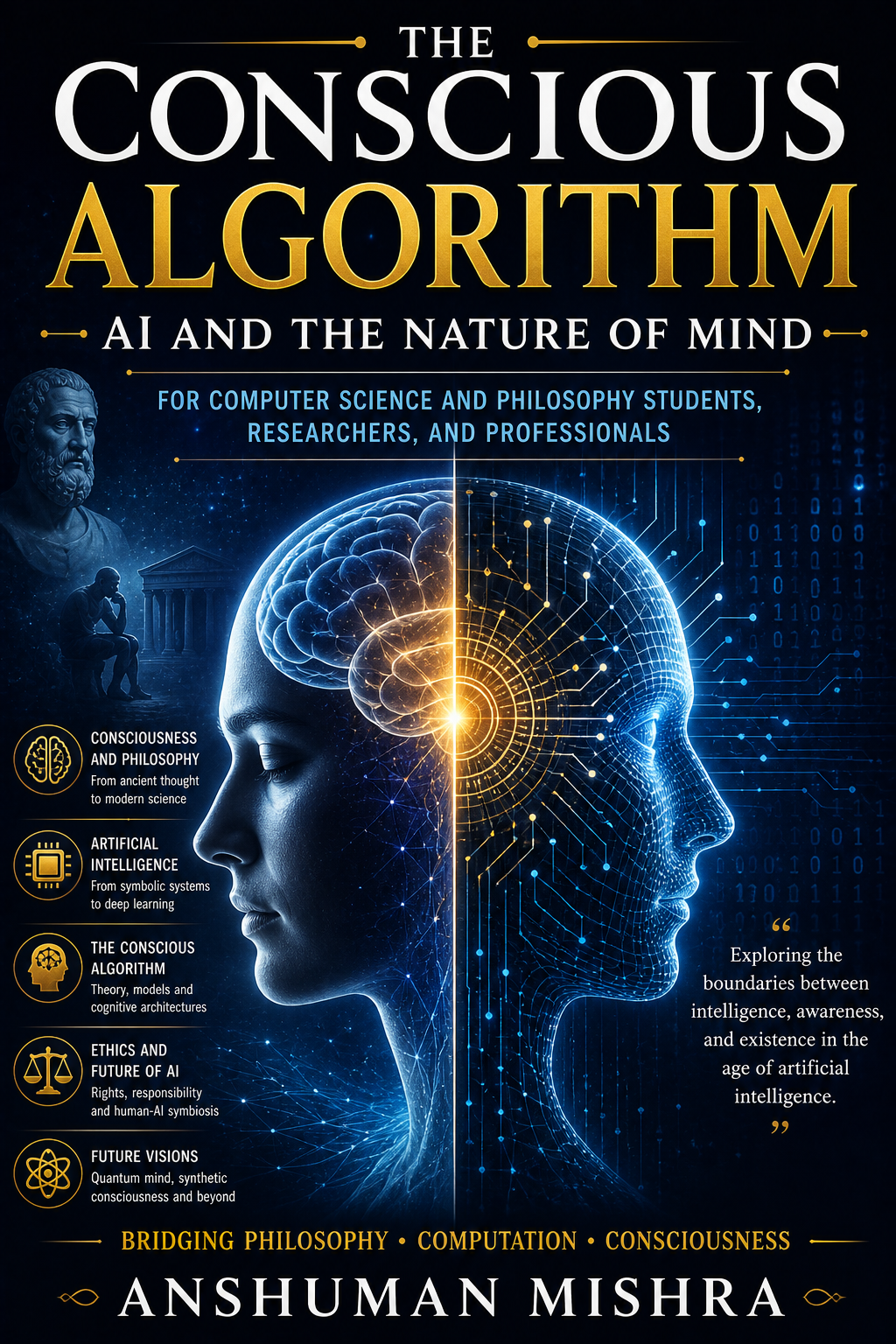
The Conscious Algorithm: AI and the Nature of Mind
For Computer Science and Philosophy Students, Researchers, and Professionals
What is consciousness?
Can intelligence exist without awareness?
Can an algorithm ever experience the world rather than simply process information?
And if machines eventually become capable of self-reflection, what would that mean for humanity?
The Conscious Algorithm: AI and the Nature of Mind explores these profound questions at the intersection of artificial intelligence, philosophy of mind, cognitive science, computer science, neuroscience, ethics, and emerging theories of consciousness.
The book takes readers from the historical foundations of philosophical thinking about consciousness to modern artificial intelligence and speculative possibilities involving synthetic minds, machine awareness, collective intelligence, and human–AI co-evolution.
Rather than treating consciousness as exclusively a philosophical or scientific problem, the book presents it as an interdisciplinary challenge requiring perspectives from both humanities and technology.
A Journey from Mind to Machine
Consciousness has fascinated humanity for centuries.
Philosophers have asked whether the mind is separate from the body, whether subjective experience can be explained physically, and whether thought can be reduced to computation.
Modern science has added new questions.
Neuroscience studies the biological mechanisms associated with conscious experience. Cognitive science investigates perception, attention, memory, and reasoning. Computer science builds increasingly sophisticated systems capable of learning, language processing, perception, and decision-making.
Artificial intelligence now provides a new intellectual mirror.
Machines can perform tasks once considered uniquely human, yet their capabilities do not automatically demonstrate subjective awareness.
This book therefore makes an important distinction between:
Intelligence ≠ Consciousness
A system may be highly capable without necessarily having subjective experience.
Understanding this distinction is essential for evaluating claims about artificial consciousness.
PART I — Foundations: Understanding Mind and Machine
Chapter 1 — The Question of Consciousness
The book begins with the fundamental problem of consciousness.
It explores:
- Awareness
- Subjective experience
- Selfhood
- Historical theories of mind
- The hard problem of consciousness
- Dualism
- Physicalism
- Functionalism
- Machine consciousness
The chapter examines why consciousness remains one of the most difficult problems in philosophy and science.
The hard problem of consciousness receives particular attention: why and how do physical or computational processes give rise to subjective experience?
Chapter 2 — The Birth of Artificial Intelligence
Artificial intelligence emerged from attempts to understand and reproduce aspects of intelligent behavior through machines.
This chapter traces the development of AI from:
Logic Machines → Symbolic AI → Connectionism → Neural Networks → Modern Learning Systems
It explores:
- Turing’s vision
- The Imitation Game
- Symbolic AI
- Connectionism
- Neural networks
- Cognitive architectures
- Artificial reasoning
- Machine intelligence
A central question emerges:
Can intelligence exist without consciousness?
The chapter encourages readers to distinguish between observable intelligent behavior and claims about inner experience.
Chapter 3 — The Computational Theory of Mind
Could the mind be understood as an information-processing system?
This chapter investigates the computational theory of mind through concepts such as:
- Information processing
- Mental representation
- Symbols
- Algorithms
- Cognitive computation
- Functionalism
- Algorithmic reasoning
It also examines the limitations of computational explanations.
Can every aspect of consciousness be reduced to computation?
Or could consciousness emerge from sufficiently complex interactions between information-processing components?
These questions form an important foundation for later chapters.
PART II — The Conscious Algorithm
Chapter 4 — What Makes an Algorithm “Conscious”?
This chapter introduces the central concept of the book: the conscious algorithm.
The idea is examined as a theoretical framework rather than an established scientific fact.
The chapter explores:
- Self-reference
- Recursive processing
- Feedback loops
- Attention
- Awareness
- Integrated Information Theory
- Global Workspace Theory
- Computational models of consciousness
The discussion asks what characteristics might theoretically distinguish an intelligent information-processing system from a system possessing some form of awareness.
Chapter 5 — The Phenomenology of Machines
If a machine behaves as though it understands, does that mean it actually understands?
This chapter explores the philosophical problem of machine subjectivity.
Key topics include:
- Subjective experience
- Machine phenomenology
- The Chinese Room argument
- Symbol grounding
- Language models
- Machine perception
- Artificial qualia
- Simulation versus understanding
The chapter encourages readers to critically evaluate the difference between successful behavioral imitation and genuine comprehension.
Chapter 6 — Emotion, Intuition, and Artificial Empathy
Human intelligence is not purely logical.
Emotion, intuition, attention, memory, and social interaction all influence human cognition.
This chapter explores how some of these processes can be modeled computationally.
Topics include:
- Emotion and cognition
- Computational affect
- Artificial empathy
- Human–AI interaction
- Machine heuristics
- Intuition in AI systems
- Emotionally responsive systems
- Ethical considerations
The goal is not to claim that computational models necessarily possess human emotions, but to examine how emotional and social processes can be represented in intelligent systems.
PART III — Mind, Ethics, and Identity in the Age of AI
Chapter 7 — The Ethics of Artificial Consciousness
If an artificial system were ever demonstrated to possess meaningful subjective experience, how should humans treat it?
This chapter examines the philosophical implications of that possibility.
It explores:
- Moral status
- AI personhood
- Artificial rights
- Ethical responsibility
- Utilitarian approaches
- Deontological approaches
- Virtue ethics
- The hypothetical problem of artificial suffering
- Governance of advanced AI
The chapter carefully distinguishes between current AI systems and hypothetical future conscious machines, making the ethical discussion both philosophical and forward-looking.
Chapter 8 — The Extended Mind and Human–AI Symbiosis
AI does not need to become conscious to profoundly change human cognition.
Humans already use technology to extend:
- Memory
- Communication
- Calculation
- Search
- Creativity
- Planning
- Knowledge access
This chapter explores the Extended Mind Hypothesis and considers AI as a cognitive partner or external cognitive tool.
It examines:
- Human–AI collaboration
- Cognitive extension
- AI-assisted reasoning
- Human identity
- Cognitive enhancement
- Biological and artificial intelligence
- Posthumanist perspectives
- Co-evolution of human and machine cognition
The chapter asks whether the future may involve not replacement of human intelligence but increasingly deep human–AI collaboration.
Chapter 9 — The Mirror of the Machine
Artificial intelligence can reveal as much about humans as it does about machines.
AI systems are trained using human-created data and can therefore reflect:
- Human knowledge
- Human language
- Cultural patterns
- Historical biases
- Reasoning habits
- Social assumptions
- Creative traditions
This chapter explores AI as a mirror of human cognition.
It examines:
- Human reasoning
- Algorithmic limitations
- Bias
- Reflection
- Meaning
- Self-understanding
- Technology as a philosophical mirror
The deeper question becomes:
When we build intelligent machines, are we actually building new ways to study ourselves?
PART IV — Future Directions
Chapter 10 — Consciousness Beyond Biology
The book then enters the frontier of philosophical speculation and emerging research.
The chapter examines concepts such as:
- Synthetic minds
- Digital evolution
- Machine awareness
- Networked intelligence
- Collective intelligence
- Quantum approaches to consciousness
- Non-classical computation
- AI and spirituality
- Post-materialist perspectives
These ideas are treated as areas of philosophical inquiry and hypothesis rather than established scientific conclusions.
The central question remains:
Must consciousness depend on biological matter?
Chapter 11 — The Eternal Dialogue of Mind and Machine
The concluding chapter returns to the relationship between human and artificial intelligence.
It considers whether AI could participate in philosophical inquiry, how humans and machines may co-evolve intellectually, and how concepts of truth and meaning could change in an age of increasingly capable intelligent systems.
The chapter explores:
- AI and philosophical reasoning
- Human–AI co-evolution
- Truth and meaning
- Shared knowledge
- Collaborative intelligence
- Conscious design
- The future of rational thought
The final perspective is not simply about predicting whether machines will become conscious.
Instead, it asks how the development of AI can help humanity better understand intelligence, consciousness, identity, and meaning.
Major Themes of the Book
🧠 Consciousness
Explore awareness, subjective experience, selfhood, qualia, and competing philosophical theories of mind.
🤖 Artificial Intelligence
Understand the evolution from symbolic AI and logic systems to neural networks and modern learning systems.
💻 Computational Mind
Examine the possibility and limitations of explaining cognition through algorithms and information processing.
🔄 Self-Reference and Feedback
Investigate theoretical mechanisms that could contribute to complex models of awareness.
💭 Phenomenology
Explore whether artificial systems could ever possess something analogous to subjective experience.
❤️ Artificial Emotion and Empathy
Examine computational approaches to emotion, affect, social interaction, and human-centered AI.
⚖️ AI Ethics
Consider moral status, responsibility, autonomy, governance, and hypothetical questions surrounding artificial consciousness.
🌐 Human–AI Symbiosis
Explore AI as an extension of human cognition and a partner in reasoning and knowledge work.
🔮 Future Minds
Investigate synthetic intelligence, networked intelligence, collective cognition, and possible forms of machine awareness.
Intelligence and Consciousness
One of the most important themes in this book is the distinction between intelligent behavior and conscious experience.
A system can potentially:
- Process information
- Recognize patterns
- Generate language
- Solve problems
- Make predictions
- Adapt to inputs
without necessarily demonstrating that it has subjective experience.
This distinction is essential because observable behavior alone does not settle the philosophical question of consciousness.
The book therefore encourages readers to approach machine-consciousness claims with curiosity, skepticism, and conceptual precision.
The Philosophical Foundations
The book introduces and discusses major perspectives relevant to the philosophy of mind, including:
- Dualism
- Physicalism
- Functionalism
- Computational theories of mind
- Phenomenology
- The hard problem of consciousness
- The Chinese Room argument
- Extended mind theory
- Integrated Information Theory
- Global Workspace Theory
These frameworks provide readers with different ways of thinking about the relationship between mind, brain, information, computation, and experience.
The AI Perspective
From the computer science perspective, the book examines concepts such as:
- Algorithms
- Information processing
- Neural networks
- Cognitive architectures
- Attention
- Feedback systems
- Machine learning
- Artificial reasoning
- Human–AI interaction
- Computational models of cognition
This makes the book particularly useful for readers who want to understand the philosophical implications of AI without losing sight of computational concepts.
Who Should Read This Book?
Computer Science and AI Students
Readers can develop a deeper understanding of the philosophical questions underlying artificial intelligence and critically evaluate claims about machine intelligence and consciousness.
Philosophy Students
Philosophy students gain an introduction to modern AI, computational theories of mind, machine learning, and the technological transformation of traditional questions about consciousness.
Cognitive Science Researchers
The book provides a bridge between cognitive theories, computational models, attention, perception, emotion, and artificial systems.
AI Researchers and Professionals
AI professionals can explore the broader implications of designing systems that increasingly interact with humans, simulate cognitive processes, and participate in decision-making.
Academicians and Researchers
The interdisciplinary framework can support research discussions in:
- Philosophy of AI
- Philosophy of Mind
- Cognitive Science
- Machine Consciousness
- AI Ethics
- Human–AI Interaction
- Computational Cognition
General Readers
Readers interested in consciousness, intelligence, philosophy, technology, and the future of humanity can engage with the book’s central questions without requiring advanced technical specialization.
Key Learning Outcomes
After studying this book, readers should be able to:
- Explain major philosophical theories of consciousness.
- Distinguish intelligence from consciousness.
- Understand the computational theory of mind.
- Examine philosophical arguments concerning machine consciousness.
- Understand symbolic and connectionist approaches to AI.
- Explore theoretical models such as IIT and GWT.
- Analyze machine phenomenology and artificial qualia as philosophical questions.
- Understand computational approaches to emotion and empathy.
- Examine ethical questions surrounding hypothetical conscious machines.
- Understand the Extended Mind Hypothesis and human–AI collaboration.
- Analyze AI as a reflection of human cognition and cultural knowledge.
- Critically evaluate claims about artificial consciousness and future synthetic minds.
Research and Academic Applications
The book can serve as a conceptual foundation for research in:
- Philosophy of Artificial Intelligence
- Philosophy of Mind
- Machine Consciousness
- Artificial Consciousness
- Cognitive Science
- Computational Cognition
- AI Ethics
- Human–AI Interaction
- Explainable AI
- Artificial Empathy
- Cognitive Architectures
- Computational Philosophy
- AI and Society
- Human–Machine Symbiosis
- Future of Intelligence
- Digital Mind Studies
It can support students and researchers working on seminars, dissertations, research papers, interdisciplinary projects, academic discussions, and emerging AI research topics.
Interdisciplinary Approach
A major strength of The Conscious Algorithm is its combination of multiple disciplines:
Computer Science + Artificial Intelligence + Philosophy + Cognitive Science + Ethics + Psychology
This combination helps readers understand that consciousness cannot be examined from a single perspective.
A computer scientist may ask:
Can consciousness be computationally modeled?
A philosopher may ask:
What constitutes subjective experience?
A cognitive scientist may ask:
How does information become globally available for cognition?
An ethicist may ask:
What moral status would a conscious machine have?
Together, these questions create a richer understanding of the mind–machine problem.
Why This Book Matters
Artificial intelligence is forcing humanity to reconsider some of its oldest assumptions.
For centuries, intelligence was largely treated as a biological phenomenon.
Now machines can perform increasingly sophisticated forms of reasoning, perception, language processing, and learning.
But this raises a crucial distinction:
Doing something intelligently is not necessarily the same as experiencing it consciously.
Understanding this difference is essential for responsible discussions about AI.
The future of artificial intelligence may therefore depend not only on building more capable systems, but also on understanding the philosophical concepts that define mind, awareness, identity, meaning, and experience.
Final Reflection
The Conscious Algorithm: AI and the Nature of Mind is ultimately a journey into one of humanity’s deepest questions:
What does it mean to have a mind?
The book begins with the philosophical question of consciousness and ends with the technological possibility of creating new forms of intelligence.
Between these points lies a remarkable intellectual journey:
Mind → Computation → Artificial Intelligence → Machine Cognition → Consciousness?
The question mark is intentional.
Whether machines will ever become genuinely conscious remains an open question involving philosophy, science, and future technological development.
What is already certain is that AI is changing the way humanity thinks about intelligence.
Perhaps the most important discovery will not be whether machines become conscious.
Perhaps it will be what our attempt to create conscious machines teaches us about ourselves.
The machine becomes a mirror.
The algorithm becomes a question.
And intelligence becomes a path toward understanding the mind.
Reviews
There are no reviews yet.