Description
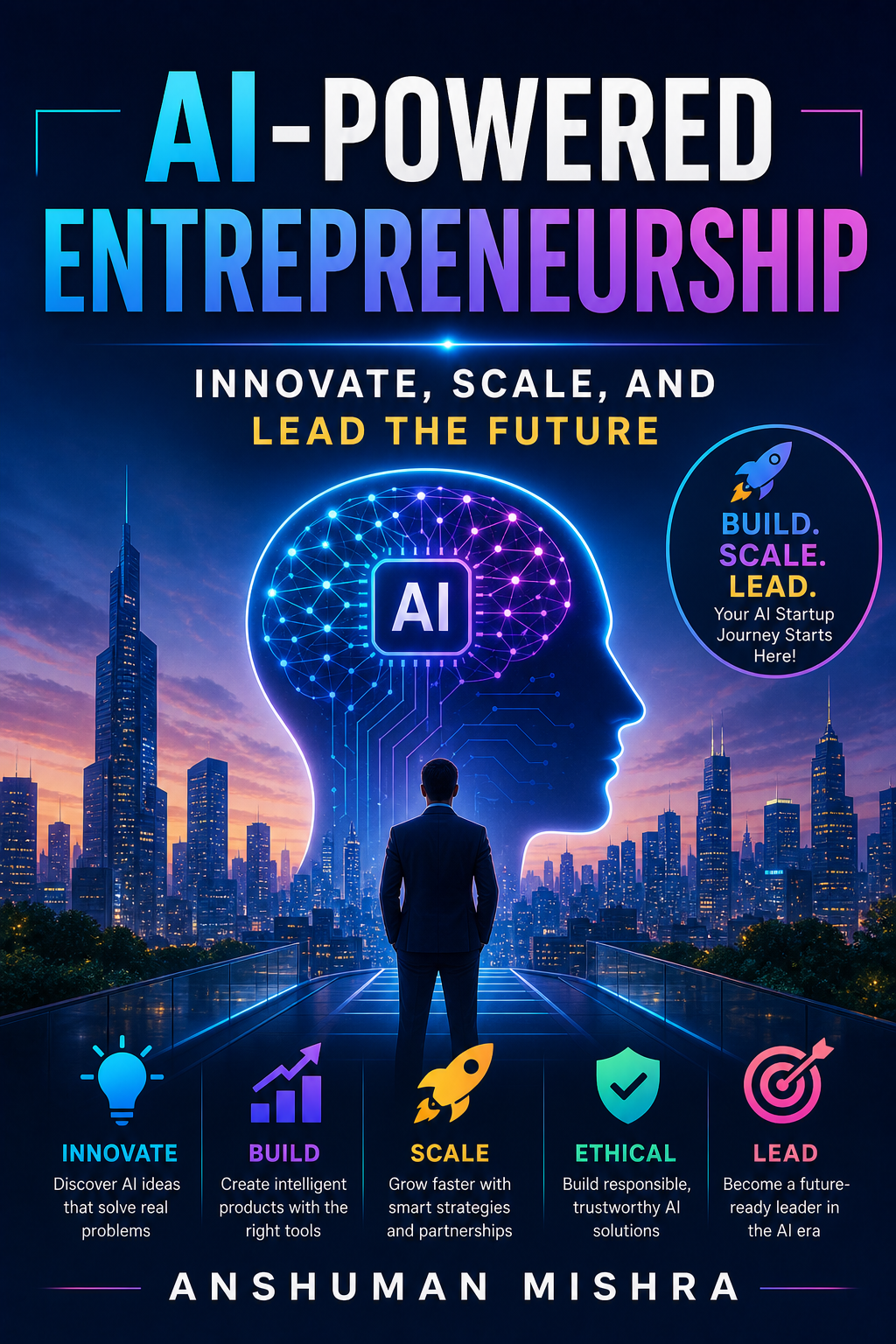
Artificial Intelligence is transforming the way businesses are created, operated, marketed, and scaled. From healthcare and finance to education, retail, manufacturing, and digital services, AI is creating new markets while changing existing business models.
But identifying an AI opportunity is only the beginning.
Building a successful AI startup requires a combination of business strategy, technology, product development, data, funding, marketing, leadership, responsible AI, and execution.
AI-Powered Entrepreneurship: Innovate, Scale, and Lead the Future provides a practical and structured guide for entrepreneurs and aspiring founders who want to understand how AI can be transformed from a technological capability into a sustainable business opportunity.
The book takes readers from the initial startup idea through validation, business-model design, product development, funding, marketing, scaling, compliance, and long-term growth.
Who Is This Book For?
This book is useful for:
- Aspiring AI entrepreneurs
- Startup founders and co-founders
- Technology entrepreneurs
- Students interested in entrepreneurship and AI
- Business professionals exploring AI opportunities
- Innovation and product managers
- Developers interested in building AI businesses
- Investors and startup ecosystem participants
- Educators and researchers interested in AI entrepreneurship
- Professionals planning an AI-powered business
Whether you are starting with an idea or already developing an AI product, the book provides a structured framework for thinking about the entrepreneurial journey.
Chapter 1: Introduction to AI Startups
The book begins with the foundations of AI entrepreneurship.
Readers explore:
- Artificial Intelligence and its impact on business
- Why AI is becoming a major entrepreneurial opportunity
- Global AI startup trends
- Emerging AI markets
- Opportunities across healthcare, finance, education, retail, and other industries
- The mindset required to build an AI startup
The chapter establishes an important principle: successful AI entrepreneurship begins with understanding both technology and real-world business problems.
Chapter 2: Identifying and Validating AI Startup Ideas
A great technology does not automatically create a great business.
This chapter introduces a problem-first approach to startup ideation.
You will learn how to:
- Identify meaningful real-world problems
- Match AI capabilities to business challenges
- Conduct market research
- Analyze competitors
- Identify potential customers
- Validate startup assumptions
- Use Minimum Viable Data (MVD) to test ideas
- Learn from successful AI startup examples
The emphasis is on validating demand before investing significant resources into development.
Chapter 3: Building an AI-Ready Business Model
Once an opportunity has been identified, entrepreneurs need a sustainable business model.
This chapter covers:
- AI value chains
- Business Model Canvas
- AI-based SaaS models
- Licensing
- AI-as-a-Service
- Subscription models
- Cost structures
- Resource planning
- Scalability strategies
Readers learn how to connect technology → customer value → revenue → sustainable growth.
Chapter 4: AI Product Development
Turning an idea into a usable product requires careful technology and product decisions.
This chapter explores how entrepreneurs can select appropriate technologies such as:
- Machine Learning
- Natural Language Processing
- Computer Vision
- Generative AI
- Predictive Analytics
- AI APIs and platforms
It also discusses:
- MVP development
- AI development tools
- Data collection
- Data cleaning
- Data annotation
- AI development teams
- Outsourcing
- Product iteration
- User feedback loops
The objective is to help founders move from an idea toward a functional AI product.
Chapter 5: Funding AI Startups
AI startups often require significant investment in technology, infrastructure, data, and talent.
This chapter explains the major funding paths available to entrepreneurs, including:
- Bootstrapping
- Angel investment
- Seed funding
- Venture capital
- Series funding
- Government grants
- Innovation funds
Readers also learn how to:
- Prepare an investor pitch
- Explain an AI startup’s value proposition
- Present market opportunity
- Discuss business metrics
- Understand AI-specific investment considerations
The chapter helps founders approach funding as a strategic process rather than simply a search for capital.
Chapter 6: Marketing and Growth for AI Startups
Even an excellent AI product needs customers.
This chapter explores strategies for building awareness, credibility, and adoption.
Topics include:
- AI product branding
- Building trust around AI
- Content marketing
- Thought leadership
- Social media
- Community building
- Public relations
- Media strategy
- Growth experiments
- Referral and viral marketing concepts
Readers learn how startups can communicate complex AI technology in ways that customers can understand and value.
Chapter 7: Scaling AI Startups
Moving from an early-stage startup to a growing company introduces new challenges.
This chapter examines:
- AI infrastructure scaling
- Cloud infrastructure
- Hiring AI professionals
- Building technical teams
- Leadership
- Global market expansion
- Enterprise partnerships
- Institutional collaborations
- Strategic alliances
- Mergers and acquisitions
The focus is on building an organization that can scale without losing product quality, customer trust, or operational efficiency.
Chapter 8: Ethics, Compliance, and AI Regulations
Responsible innovation is increasingly important as AI becomes part of everyday products and services.
This chapter explores:
- AI ethics
- Responsible AI
- Data privacy
- Data security
- AI governance
- Global AI regulatory developments
- Bias
- Transparency
- Explainability
- Consumer trust
The discussion introduces regulatory considerations, including frameworks such as the EU AI Act and relevant policy developments in other markets.
The goal is to help entrepreneurs recognize that compliance and responsible design should be considered from the beginning rather than added after a product has been built.
Chapter 9: AI Startup Case Studies
Real-world examples can provide valuable lessons for entrepreneurs.
This chapter examines:
- Successful AI startups
- Unicorn-level companies
- Startup failures
- Lessons from unsuccessful products
- AI startups in emerging economies
- HealthTech
- FinTech
- EdTech
- Industry-specific AI opportunities
- Founder perspectives and insights
The case-study approach encourages readers to examine not only what successful startups did correctly, but also what failed ventures can teach future founders.
Chapter 10: The Future of AI Entrepreneurship
AI entrepreneurship is evolving rapidly.
This chapter explores emerging opportunities involving:
- Next-generation AI technologies
- Generative AI
- AI agents
- AI + IoT
- AI + blockchain
- AI and immersive technologies
- Sustainable AI
- AI for social good
- Industry disruption
- Human-AI collaboration
The chapter encourages entrepreneurs to think beyond today’s technologies and develop a long-term perspective on innovation.
Chapter 11: Practical Resources for AI Entrepreneurs
Starting an AI business requires access to the right tools, knowledge, communities, and support networks.
This chapter provides a practical resource framework covering:
- AI development platforms
- AI tools
- Datasets
- APIs
- Learning resources
- AI communities
- Incubators
- Accelerators
- Startup networks
- Pitch deck resources
- Founder checklists
These resources can help entrepreneurs organize their learning, development, fundraising, and startup-building activities.
Chapter 12: Your AI Startup Action Plan
The final chapter transforms the concepts discussed throughout the book into an actionable roadmap.
The centerpiece is a 90-day AI startup launch plan covering the major stages of startup development.
Readers are guided through:
Idea → Validation → Business Model → MVP → Customer Feedback → Refinement → Launch
The chapter also addresses:
- Founder roadmap development
- Common AI startup mistakes
- Time and productivity management
- Prioritization
- Execution strategies
- Measuring progress
- Planning the next stage of growth
The purpose is to move readers from simply learning about AI entrepreneurship toward actually planning their entrepreneurial journey.
Key Topics Covered
- AI Entrepreneurship
- AI Startups
- Startup Ideation
- AI Business Models
- AI Product Development
- MVP Development
- Market Research
- Competitor Analysis
- AI SaaS
- AI-as-a-Service
- Generative AI Business
- Machine Learning Startups
- AI Funding
- Venture Capital
- Startup Pitching
- AI Marketing
- Growth Strategies
- Startup Scaling
- AI Infrastructure
- AI Teams
- Enterprise Partnerships
- Responsible AI
- AI Ethics
- AI Regulations
- Data Privacy
- AI Governance
- Startup Case Studies
- AI Innovation
- AI Resources
- 90-Day Startup Roadmap
From AI Idea to AI Business
The biggest challenge for an entrepreneur is often not discovering a new technology, but identifying where that technology can create meaningful value.
This book encourages readers to think beyond the question:
“What can AI do?”
and instead ask:
“What important problem can AI solve, for whom, and through what sustainable business model?”
That shift—from technology-first thinking to value-first entrepreneurship—is central to building successful AI ventures.
Why This Book Matters
AI is creating opportunities for entrepreneurs across industries and around the world. However, successful AI entrepreneurship requires more than technical knowledge.
A founder must understand:
Problem + Technology + Customer + Business Model + Data + Product + Funding + Marketing + Scale + Trust
This book brings these elements together in one structured entrepreneurial framework.
Whether you are planning your first startup, exploring an AI-powered business idea, building an MVP, looking for investment, or preparing for the next wave of AI innovation, AI-Powered Entrepreneurship: Innovate, Scale, and Lead the Future provides a practical foundation for turning AI opportunities into business possibilities.
Your AI Entrepreneurial Journey Starts Here
The future of entrepreneurship will increasingly involve collaboration between human creativity, business strategy, data, and artificial intelligence.
The opportunity belongs to entrepreneurs who can recognize meaningful problems, experiment quickly, build responsibly, and scale sustainably.
Learn AI. Identify opportunities. Build solutions. Create value. Scale intelligently. Lead the future.
Reviews
There are no reviews yet.