Description
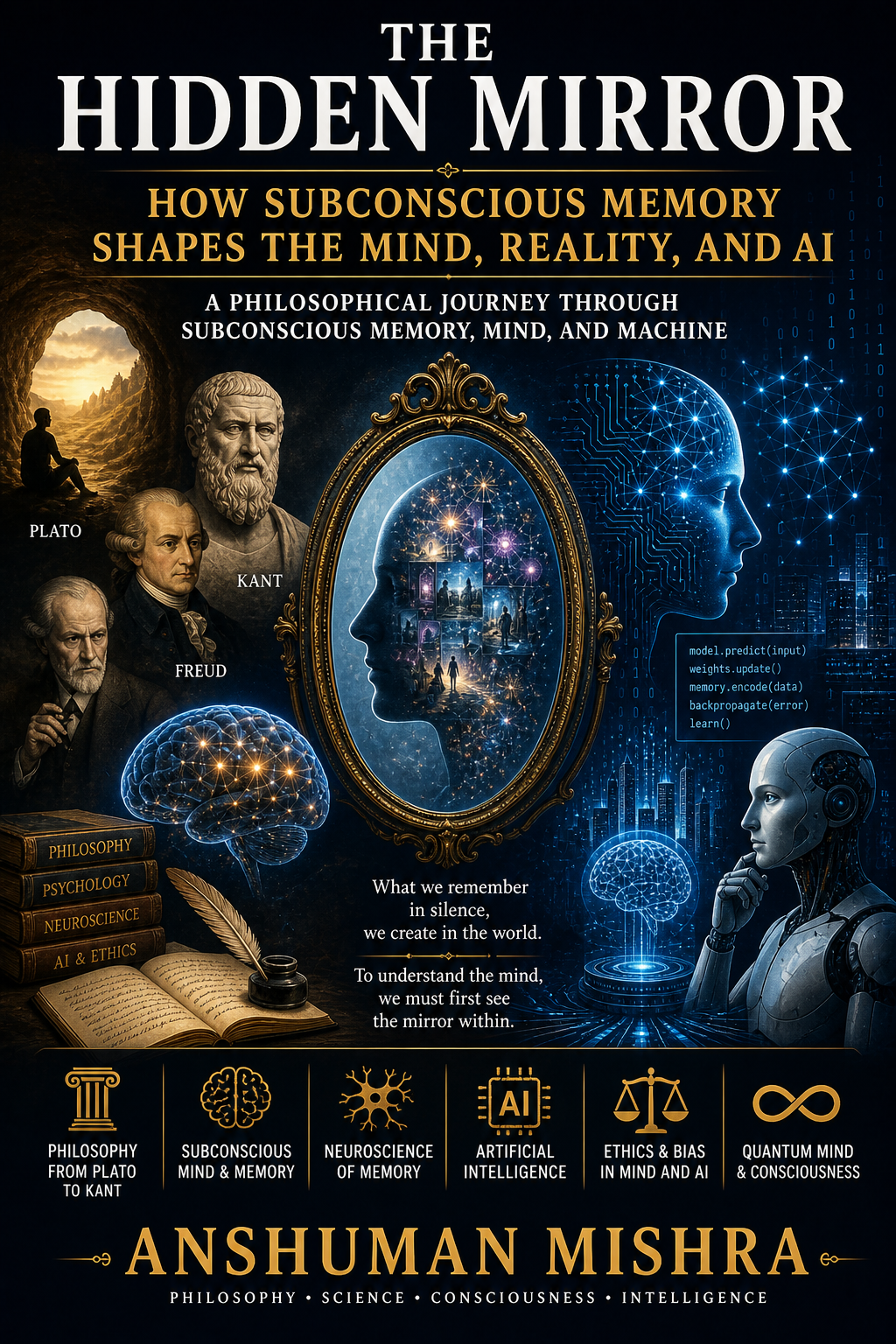
The Hidden Mirror: How Subconscious Memory Shapes the Mind, Reality, and AI
A Philosophical Journey Through Subconscious Memory, Mind, and Machine
What if the reality we experience is partly constructed by memories we are not consciously aware of?
What if memory is not simply a record of the past, but an active force that shapes our identity, perception, decisions, emotions, and imagination of the future?
And what happens when artificial intelligence begins to learn from enormous stores of information and develop increasingly sophisticated internal representations?
The Hidden Mirror: How Subconscious Memory Shapes the Mind, Reality, and AI explores these questions through an interdisciplinary journey connecting philosophy, psychology, neuroscience, cognitive science, consciousness studies, and artificial intelligence.
At the heart of the book is a powerful idea:
Memory is not merely storage—it is a mechanism through which intelligent systems construct meaning.
From Ancient Philosophy to Artificial Intelligence
The journey begins with some of humanity’s oldest questions: What does it mean to know oneself? Is our perception of reality objective? How does memory contribute to identity? And where does consciousness come from?
The book revisits influential philosophical ideas associated with Plato, Aristotle, Locke, Hume, Kant, and Descartes, showing how questions about knowledge, perception, memory, and the self continue to influence modern discussions of cognition and artificial intelligence.
It then moves toward the psychological exploration of the unconscious, examining ideas associated with Freud and the development of modern approaches to memory, perception, and cognition.
From there, the discussion enters the world of neuroscience and artificial intelligence.
The Hidden Architecture of Human Memory
Human memory is far more complex than a simple mental archive.
Memories can change, disappear, become distorted, or be reconstructed. Emotion can influence recall, while unconscious processes can affect how people interpret new experiences.
The book examines:
- Short-term and long-term memory
- Explicit and implicit memory
- Emotional influences on memory
- Forgetting and reconstruction
- Cognitive biases
- False memories and memory illusions
- The relationship between memory and identity
- The brain as a dynamic information-processing system
These ideas provide a foundation for understanding why the human mind can sometimes perceive the same reality differently from another person.
The Digital Unconscious
The book then asks an intriguing question:
Can artificial intelligence have something comparable to a subconscious?
Modern AI systems learn patterns from data. Neural networks transform information through layers of computation and produce outputs based on learned representations.
Although machine learning should not automatically be equated with human consciousness or the human subconscious, the comparison creates a fascinating philosophical space for discussion.
The book explores:
- How machines “remember”
- Neural networks and artificial cognition
- Pattern recognition
- Memory encoding in AI
- AI learning and generalization
- Human intuition and machine pattern recognition
- The possibility and limitations of machine consciousness
This creates a bridge between the hidden processes of human cognition and the increasingly complex architectures of artificial intelligence.
The Self as an Algorithm
One of the central philosophical questions of the book is whether the self should be understood as a fixed entity or as an evolving process.
If memories change, perceptions change, beliefs change, and experiences continuously reshape the brain, then perhaps identity is also dynamic.
This leads to deeper questions about the mind-body problem, consciousness, computation, self-reference, and digital identity.
The book explores whether consciousness could emerge from sufficiently complex information-processing systems and examines philosophical perspectives such as computational theories of mind and panpsychism.
These discussions do not offer simplistic answers. Instead, they invite readers to examine what we actually mean by mind, self, intelligence, and awareness.
Digital Identity and the Future of Consciousness
As more aspects of human life become digital, our identity increasingly exists through data, digital memories, online representations, and intelligent systems.
This raises important philosophical and ethical questions:
- Can data represent a person?
- Is information equivalent to memory?
- Can a digital representation become a form of identity?
- What would digital immortality actually mean?
- Could preserving someone’s memories preserve their consciousness?
- What ethical responsibilities would arise from increasingly human-like AI systems?
These questions connect traditional philosophy with emerging debates surrounding AI, digital identity, human-computer interaction, and the future of intelligent technology.
The Ethics of Memory and Intelligence
Memory also has an ethical dimension.
Human decisions are influenced by past experiences, learned associations, social environments, and cognitive biases. AI systems similarly depend on the data and patterns used to develop them.
The book therefore examines the relationship between memory, bias, responsibility, empathy, and ethical intelligence.
It asks whether an intelligent system can make ethical decisions without human-like experience, and how developers and societies can work toward more responsible forms of artificial intelligence.
The discussion ultimately points toward the need for conscious and ethical design.
Beyond Memory
The later sections move into more speculative territory, exploring time, consciousness, quantum cognition, collective consciousness, and integrated theories of mind.
These topics are presented as philosophical areas for exploration rather than simple established conclusions.
The book attempts to bring together three major perspectives:
Philosophy — What is consciousness and what does it mean to exist?
Science — How do brains process, store, reconstruct, and use information?
Artificial Intelligence — How can machines learn, represent information, recognize patterns, and potentially develop increasingly sophisticated forms of machine intelligence?
Together, these perspectives form the conceptual foundation of the book’s Mirror Theory of Consciousness.
The Hidden Mirror Theory
The book proposes a conceptual framework in which consciousness is associated with a system’s capacity for reflection, self-reference, representation, and memory.
Within this framework:
Consciousness is reflective.
Systems become increasingly interesting from a consciousness perspective when they can represent aspects of themselves and their environment.
Memory provides continuity.
Past information contributes to the formation of internal models and influences future processing.
Reality is interpreted through models.
Both biological and artificial systems process information through internal representations rather than simply receiving an untouched version of reality.
This framework is intended to encourage dialogue between philosophy, cognitive science, neuroscience, and AI rather than claim that human consciousness and current AI systems are identical.
Who Is This Book For?
Students can use the book to explore connections between philosophy, psychology, neuroscience, computer science, and artificial intelligence.
Researchers and academics may find it useful as an interdisciplinary starting point for discussions surrounding consciousness, AI ethics, cognitive science, and philosophy of mind.
AI and technology enthusiasts can explore the philosophical questions emerging alongside increasingly capable intelligent systems.
Readers interested in psychology and consciousness can examine the relationship between memory, identity, perception, and the hidden processes of the mind.
Philosophy enthusiasts can revisit classical ideas while connecting them to contemporary questions about technology and artificial intelligence.
Educators and thought leaders can use the themes of the book to stimulate discussions about consciousness, ethics, AI, and the future of intelligent systems.
A Journey Across Four Parts
The book is organized into four interconnected parts:
Part I — The Hidden Depths of Mind
Explores self-knowledge, classical philosophy, perception, memory, identity, and the emergence of ideas surrounding the unconscious.
Part II — The Science of the Unseen
Examines memory architecture, cognitive biases, forgetting, false recall, neural networks, machine memory, and the concept of a digital unconscious.
Part III — The Logic of Being
Investigates consciousness, computation, the mind-body problem, digital identity, machine consciousness, and the ethics of artificial intelligence.
Part IV — Beyond Memory
Explores time, quantum cognition, collective consciousness, integrated theories of consciousness, and the future relationship between human and artificial intelligence.
A Book About More Than AI
The Hidden Mirror is not simply a book about artificial intelligence.
It is a book about being, memory, identity, perception, consciousness, and the evolving relationship between humans and machines.
The central message is both philosophical and technological:
To understand intelligent machines, humanity must first examine the hidden architecture of its own intelligence.
As AI systems become more capable, the mirror they hold up to humanity may become increasingly revealing.
Perhaps the most important question is therefore not simply:
“Can machines become conscious?”
but rather:
“What have we misunderstood about consciousness itself?”
The Hidden Mirror invites readers to explore that question—and to look more carefully at the hidden structures through which memory shapes the mind, the mind interprets reality, and technology increasingly reflects the patterns of human thought.


Reviews
There are no reviews yet.