Description
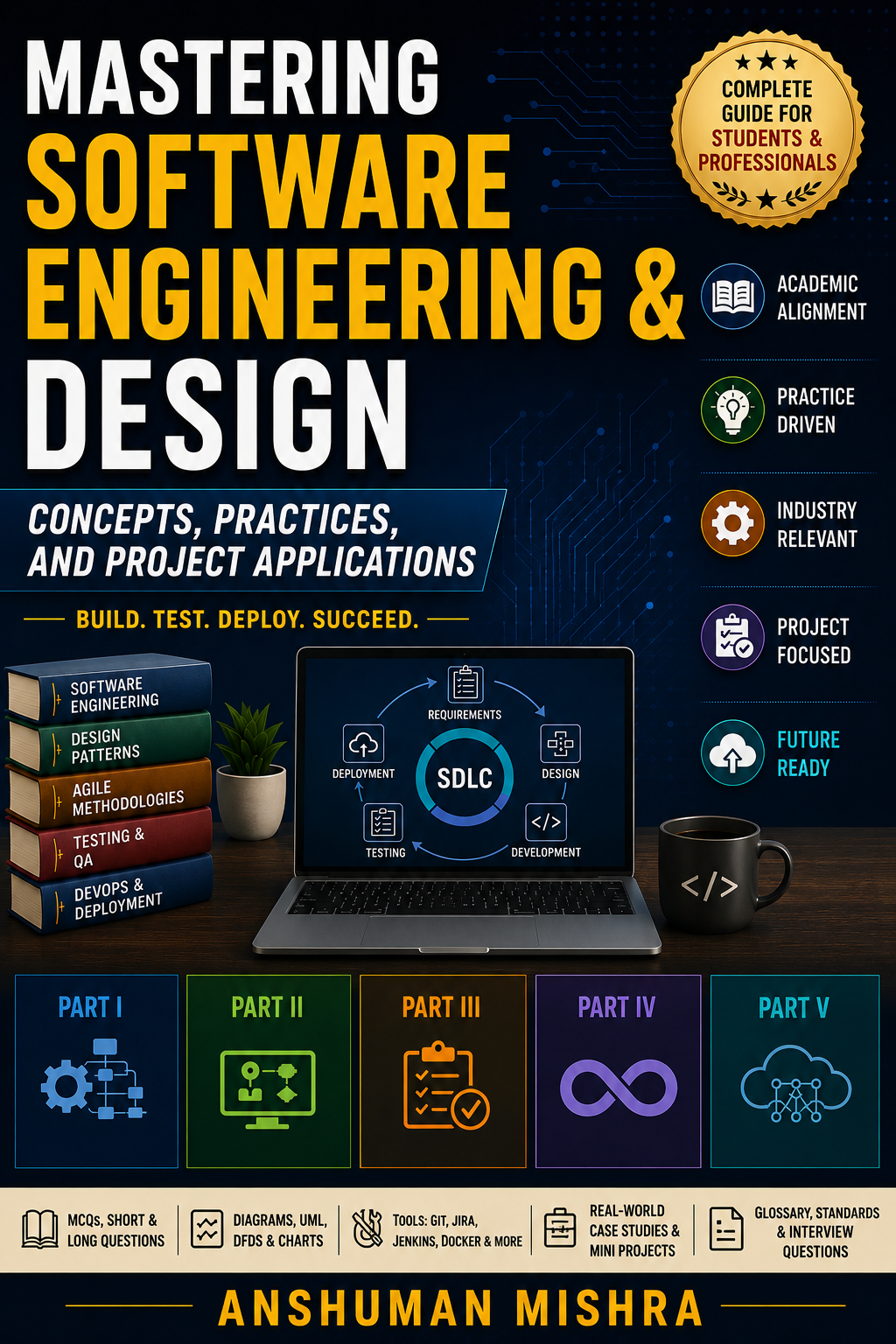
Mastering Software Engineering & Design: Concepts, Practices, and Project Applications
Concepts, Practices, Methodologies, Tools, and Real-World Project Applications
Software is now at the heart of almost every modern organization. From banking and healthcare to education, e-commerce, communication, transportation, government services, and artificial intelligence, software systems influence how people work, communicate, learn, and make decisions.
As software systems become larger and more complex, simply knowing how to write code is no longer enough. Successful software development requires a systematic understanding of requirements, architecture, design, development processes, testing, quality assurance, security, project management, deployment, maintenance, and continuous improvement.
Mastering Software Engineering & Design: Concepts, Practices, and Project Applications is designed as a comprehensive learning and reference resource for students, educators, software developers, testers, project managers, and technology professionals.
The book combines fundamental software engineering theory with practical development methodologies, industry tools, project applications, case studies, and modern software practices.
Its objective is to help readers understand not only what software engineering concepts are, but also why they matter and how they are applied in real-world projects.
A Complete Journey Through Software Engineering
The book follows the complete software development journey.
It begins with the fundamentals of software engineering and gradually progresses through:
Requirements → Analysis → Design → Architecture → Development → Testing → Quality Assurance → Project Management → Deployment → Maintenance → Process Improvement
The final sections explore modern areas such as:
- DevOps
- CI/CD
- Cloud-based development
- Microservices
- AI/ML software engineering
- Secure software development
- DevSecOps
- Green software engineering
- Agile maturity
- Software process improvement
This structured approach makes the book useful both as an academic textbook and as a practical professional reference.
Part I — Foundations of Software Engineering
The first part establishes a strong foundation in software engineering.
Readers begin by understanding what software is, why software engineering is necessary, and how software differs from other engineered products.
The book discusses:
- Definition and characteristics of software
- Need for software engineering
- Software crisis
- Software engineering principles
- Common software myths
- Software processes
- Software development models
Understanding these foundations helps learners appreciate why disciplined development practices are essential for building reliable and maintainable systems.
Software Development Life Cycle
A major focus of the foundational section is the Software Development Life Cycle (SDLC).
Different development models are examined, including:
- Waterfall Model
- Prototyping Model
- Iterative Enhancement Model
- Spiral Model
- V-Model
- Agile Methodology
- Scrum
- Extreme Programming (XP)
- Kanban
The book explains the strengths, limitations, applications, and characteristics of these models so that learners can understand why different projects may require different development approaches.
Requirement Engineering
A successful software project begins with a clear understanding of what the customer and users actually need.
The book provides detailed coverage of Requirement Engineering, including:
- Functional requirements
- Non-functional requirements
- Requirement elicitation
- Requirement analysis
- Requirement specification
- Software Requirement Specification (SRS)
- Use cases
- Functional modeling
- Requirement management tools
Readers learn how poorly defined requirements can lead to cost overruns, delays, defects, and project failure.
The emphasis is on transforming user needs into structured and measurable software requirements.
Part II — Software Design Principles and Techniques
Once requirements have been identified, the next challenge is designing a system that can satisfy those requirements effectively.
Part II introduces the principles and techniques used to transform requirements into software designs.
The book explains important design principles such as:
- Abstraction
- Modularity
- Encapsulation
- Cohesion
- Coupling
- Separation of concerns
- Design strategy
These principles help developers create software that is easier to understand, test, modify, and maintain.
Software Architecture
Modern applications often consist of multiple components and services. Good architecture provides the structure needed to manage this complexity.
The book introduces software architecture and explores several important architectural styles, including:
- Layered architecture
- Client-server architecture
- Microservices architecture
Readers learn how architectural decisions affect:
- Scalability
- Performance
- Maintainability
- Reliability
- Security
- Deployment
The section also introduces approaches to documenting software architecture and communicating architectural decisions.
Component-Level Design
The book then moves from high-level architecture to detailed software design.
Readers explore:
- Structured design
- Function-oriented design
- Data Flow Diagrams (DFDs)
- Structure charts
- Object-oriented design
- Design patterns
Important design patterns such as Factory, Singleton, Observer, and MVC are introduced as reusable approaches to common software design problems.
The goal is to help readers develop the ability to select appropriate design techniques instead of approaching every software problem from scratch.
UI, UX, and Human-Computer Interaction
Software quality is not determined only by backend functionality.
A successful application must also provide an interface that users can understand and operate effectively.
The book introduces:
- UI design principles
- UX fundamentals
- UI vs. UX
- Prototyping
- Human-Computer Interaction
- Usability
- Accessibility
These concepts help readers understand how software design can consider both technical requirements and human needs.
Part III — Software Testing and Quality Assurance
Software that appears to work is not necessarily reliable software.
Testing and quality assurance are therefore critical components of professional software engineering.
Part III introduces software testing fundamentals and explains:
- Testing objectives
- Testing principles
- Unit testing
- Integration testing
- System testing
- Acceptance testing
- Black-box testing
- White-box testing
- Grey-box testing
The book emphasizes that testing should be integrated into the software development lifecycle rather than treated as an activity performed only at the end.
Test Case Design Techniques
Effective testing requires more than creating random test inputs.
The book introduces systematic techniques for designing effective test cases, including:
- Equivalence partitioning
- Boundary value analysis
- Decision table testing
- State transition testing
- Path testing
- Control flow testing
These techniques help learners identify important test scenarios and improve the effectiveness of software testing.
Software Quality Assurance
Quality assurance focuses on establishing processes that help prevent defects and improve software quality.
The book discusses:
- Software quality factors
- McCall’s quality model
- ISO-based quality concepts
- Reviews
- Audits
- Software metrics
- Measurement
- Defect management
- Root cause analysis
The emphasis is on understanding quality as a continuous process rather than simply the absence of software bugs.
Part IV — Advanced Software Engineering Practices
Part IV moves into advanced and professional software engineering practices.
It introduces concepts that are particularly important for large-scale software projects and industry environments.
Software Project Management
Developing software involves managing more than technical tasks.
Projects must be estimated, scheduled, monitored, controlled, and managed against risks.
The book covers:
- Project planning
- Software estimation
- COCOMO
- Function Point Analysis
- Gantt charts
- PERT
- CPM
- Risk management
- Configuration management
- Project monitoring
- Project control
These concepts help learners understand the managerial side of software engineering and prepare them for responsibilities beyond individual programming tasks.
Software Maintenance and Reengineering
Software does not end when it is deployed.
Applications must evolve as business requirements, technologies, security expectations, and user needs change.
The book covers:
- Corrective maintenance
- Adaptive maintenance
- Perfective maintenance
- Preventive maintenance
- Legacy systems
- Software reengineering
- Reverse engineering
- Refactoring
This section helps readers understand how existing software can be analyzed, improved, modernized, and extended.
DevOps and Software Deployment
Modern software organizations increasingly combine development and operations into integrated workflows.
The book introduces DevOps and explores:
- DevOps principles
- Continuous Integration
- Continuous Deployment
- CI/CD pipelines
- Jenkins
- GitHub Actions
- Docker
- Kubernetes
- Release management
- Delivery models
Readers gain an understanding of how automated development and deployment pipelines can improve software delivery speed, consistency, and reliability.
Part V — Modern Trends and Tools
Software engineering continues to evolve rapidly.
Part V introduces modern trends and practices that are shaping the future of software development.
Topics include:
- CMMI
- ISO/IEC standards
- Six Sigma
- Agile maturity models
- Cloud-based software development
- AI/ML software engineering
- Green software engineering
- Secure software development
- DevSecOps
The section helps learners understand how traditional software engineering principles are being adapted to modern technology environments.
Software Engineering for AI and Cloud Projects
Artificial intelligence and cloud computing have introduced new challenges for software engineering.
AI/ML projects require considerations related to:
- Data pipelines
- Model development
- Testing
- Deployment
- Monitoring
- Versioning
- Scalability
- Security
Similarly, cloud-native applications often require new approaches to architecture, deployment, monitoring, and resource management.
The book introduces these emerging areas from a software engineering perspective, helping readers understand how established engineering principles can be applied to modern technology projects.
Real-World Case Studies and Projects
A major strength of the book is its emphasis on practical application.
Readers are introduced to software engineering scenarios involving domains such as:
- Banking
- Healthcare
- Education
- E-commerce
- Technology platforms
These case studies demonstrate how software engineering principles can be applied to real-world systems.
The book also introduces collaboration and project management tools such as:
- Git
- JIRA
- Trello
- Jenkins
- GitHub
Through these examples, readers can better understand how software teams plan, collaborate, develop, test, and deliver software.
Project-Based Learning
The book encourages readers to move beyond theoretical study and apply their knowledge through projects.
A complete software project can involve:
Problem Identification → Requirement Gathering → SRS → System Design → Architecture → Development → Testing → Deployment → Documentation
Templates and structured guidance can help students prepare:
- SRS documents
- Design documents
- Test cases
- Project reports
- Architecture documentation
- Project plans
- Final project documentation
This makes the book particularly useful for students completing academic projects and for professionals looking to improve their software development workflow.
Academic and Competitive Examination Support
The book is designed to support academic learning across programs such as:
- BCA
- B.Tech CSE/IT
- B.Sc. Computer Science
- MCA
- M.Tech
- MSc Computer Science
The concepts covered can also help students prepare for software engineering-related questions in university examinations, technical interviews, competitive examinations, and placement assessments.
Important concepts are presented in a structured manner to support both conceptual understanding and revision.
Key Features of the Book
Comprehensive Coverage
The book covers the major stages of software engineering—from requirements and design to testing, deployment, maintenance, and process improvement.
Theory + Practice
Academic concepts are connected with industry practices, tools, methodologies, and project applications.
Industry-Relevant Tools
Readers are introduced to tools and technologies such as:
- Git
- GitHub
- JIRA
- Trello
- Jenkins
- Docker
- Kubernetes
- Selenium
Project Templates
Structured templates for SRS, design documents, test cases, and project reports can help learners apply software engineering methods to academic and practical projects.
Case Studies
Industry-oriented scenarios help readers understand how software engineering concepts are applied in real systems.
Modern Development Practices
The book includes Agile, DevOps, CI/CD, cloud development, microservices, AI/ML software engineering, and DevSecOps.
Visual Learning
Concepts such as architecture, workflows, DFDs, UML, and software processes can be understood through diagrams and structured representations.
Who Should Read This Book?
Undergraduate Students
Students pursuing BCA, B.Tech, B.Sc. Computer Science, and related programs can use this book as a comprehensive academic and practical resource.
Postgraduate Students
MCA, M.Tech, and MSc Computer Science students can use the advanced sections for deeper study, assignments, projects, and research preparation.
Software Developers
Developers can strengthen their understanding of architecture, design principles, testing, DevOps, and software quality.
Software Testers and QA Professionals
The testing and quality assurance sections provide a structured foundation for understanding software testing methodologies and quality processes.
Project Managers
The chapters on estimation, scheduling, risk management, configuration management, and project control are useful for understanding the management side of software development.
Faculty and Trainers
Educators can use the structured chapters, examples, exercises, case studies, and project concepts as supplementary teaching material.
Startup Founders and Technology Entrepreneurs
Technology entrepreneurs can gain a better understanding of the engineering processes required to develop maintainable and scalable software products.
Benefits of Studying This Book
1. Strong Academic Foundation
Readers develop a systematic understanding of software engineering concepts that can support university examinations, assignments, laboratory work, and projects.
2. Practical Industry Knowledge
The book connects theoretical principles with real-world software development practices.
3. Better Project Understanding
Readers learn how a software project moves from requirements to design, testing, deployment, and maintenance.
4. Improved Interview Preparation
Understanding SDLC models, design principles, testing techniques, project estimation, Agile, DevOps, and software architecture can support technical interview preparation.
5. Tool Awareness
Exposure to Git, JIRA, Jenkins, Docker, Kubernetes, and other tools helps learners understand modern development environments.
6. Career Development
The knowledge gained can support career paths in:
- Software Development
- Software Testing
- Quality Assurance
- DevOps
- Software Architecture
- Project Management
- Business Analysis
- Technical Consulting
7. Modern Technology Perspective
The book goes beyond traditional software engineering and introduces modern areas such as AI/ML engineering, cloud computing, DevSecOps, and green software development.
A Structured Approach to Learning
The book is most effective when studied actively.
Readers should:
Understand → Practice → Analyze → Design → Test → Build → Improve
Instead of memorizing concepts, learners should try to apply them to real software projects.
For example, after studying requirement engineering, readers can create an SRS for a small application. After learning architecture, they can design the system architecture. After learning testing, they can create test cases. After studying DevOps, they can explore how the application could be deployed through an automated pipeline.
This approach turns software engineering from a theoretical subject into a practical engineering discipline.
From Classroom Learning to Industry Practice
One of the central objectives of Mastering Software Engineering & Design is to reduce the gap between classroom learning and professional software development.
Academic courses often focus on concepts and definitions, while professional environments require developers and engineers to make decisions about:
- Requirements
- Architecture
- Technology selection
- Security
- Testing
- Scalability
- Deployment
- Maintenance
- Cost
- Time
- Risk
This book brings these perspectives together.
It encourages readers to think like software engineers rather than simply programmers.
Final Perspective
Mastering Software Engineering & Design: Concepts, Practices, and Project Applications is designed to function as a textbook, practical reference, project companion, and career-development resource.
It brings together the principles of software engineering with modern development practices and industry-oriented tools.
From the fundamentals of software processes and SDLC models to advanced topics such as microservices, DevOps, CI/CD, cloud development, AI/ML engineering, DevSecOps, software quality, and process improvement, the book provides a broad and structured view of modern software engineering.
Whether you are a student preparing for university examinations, a developer strengthening your engineering skills, a faculty member teaching software engineering, or a professional preparing for greater responsibilities, this book provides a practical foundation for understanding how successful software systems are conceived, designed, tested, deployed, and maintained.
Ultimately, software engineering is not simply about writing programs.
It is about solving problems systematically, designing reliable systems, managing complexity, ensuring quality, understanding users, and continuously improving software throughout its lifecycle.
Mastering Software Engineering & Design provides readers with the concepts, practices, tools, and project perspective needed to approach that discipline with greater confidence and clarity.

Reviews
There are no reviews yet.