Description
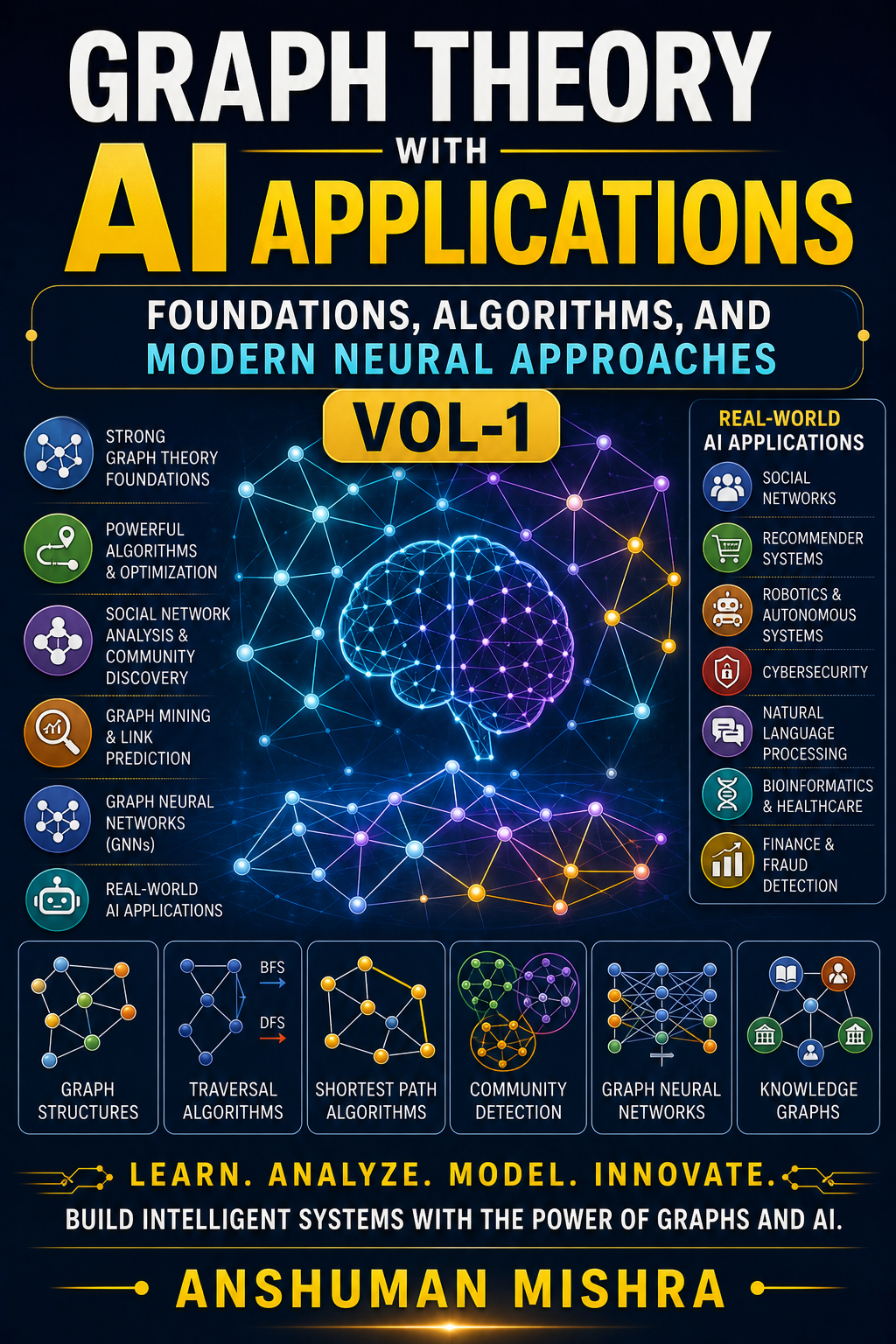
Graph Theory with AI Applications – VOL-1
Foundations, Algorithms, and Modern Neural Approaches
Author: Anshuman Mishra
Publisher: Published by Anshuman Mishra
Publication Year: 2025
Volume: VOL-1
About the Book
Graph Theory with AI Applications: Foundations, Algorithms, and Modern Neural Approaches – VOL-1 presents a comprehensive introduction to Graph Theory and demonstrates how graph-based mathematical models and algorithms are increasingly important in Artificial Intelligence, Machine Learning, Robotics, Social Network Analysis, Navigation, Recommendation Systems, Network Design, and Intelligent Computing.
Graphs provide a powerful way to represent relationships and connections. Computers use graph structures to model everything from road networks and communication systems to social relationships, knowledge structures, recommendation systems, and complex AI environments.
This volume begins with the mathematical foundations of Graph Theory and progressively introduces classical graph algorithms, pathfinding techniques, network flow methods, social network analysis, community detection, link prediction, and graph mining.
The book is designed to provide both a strong theoretical foundation and an understanding of practical AI-oriented applications.
What You Will Learn
The book covers:
- Fundamentals of Graph Theory
- Graph terminology and properties
- Directed and undirected graphs
- Weighted and unweighted graphs
- Labeled graphs
- Static and dynamic graphs
- Trees and forests
- Cliques and independent sets
- Cut vertices
- Bipartite graphs
- Matching
- Graph isomorphism and automorphism
- Graph representations
- Adjacency matrices
- Incidence matrices
- Laplacian matrices
- Spectral properties of graphs
- Eigenvalues and graph connectivity
- BFS
- DFS
- Bidirectional Search
- Topological Sorting
- Connected Component Detection
- Shortest Path Algorithms
- Dijkstra’s Algorithm
- Bellman-Ford Algorithm
- Floyd-Warshall Algorithm
- Johnson’s Algorithm
- AI Pathfinding
- A* Search
- Heuristics and admissibility
- IDA*
- Jump Point Search
- Minimum Spanning Trees
- Kruskal’s Algorithm
- Prim’s Algorithm
- Disjoint Set Union
- Network Flows
- Max Flow-Min Cut
- Ford-Fulkerson Algorithm
- Edmonds-Karp Algorithm
- Social Network Analysis
- Centrality Measures
- PageRank
- Community Detection
- Modularity Optimization
- Girvan-Newman Algorithm
- Spectral Clustering
- Label Propagation
- Link Prediction
- Graph Mining
- Graph Embeddings
- Fraud Detection
- Recommendation Systems
PART I – FOUNDATIONS OF GRAPH THEORY
Chapter 1: Introduction to Graph Theory
The first chapter introduces the fundamental concept of graphs and explains why graph structures are important in computer science and Artificial Intelligence.
Topics include:
- What is a Graph?
- Historical Evolution of Graph Theory
- Graphs in Modern Computing and AI
- Directed and Undirected Graphs
- Weighted and Unweighted Graphs
- Labeled Graphs
- Static and Dynamic Graphs
- Real-World Applications of Graphs
The chapter establishes the foundation for understanding how complex relationships can be represented mathematically.
Chapter 2: Graph Terminologies and Basic Properties
This chapter introduces the fundamental terminology used throughout Graph Theory.
Topics include:
- Degree
- Path
- Cycle
- Connectivity
- Trees
- Forests
- Cliques
- Independent Sets
- Cut Vertices
- Bipartite Graphs
- Matching
- Isomorphism
- Automorphism
- Graph Representations
Different representation methods, including matrices, lists, and adjacency structures, are also introduced.
Chapter 3: Matrix Representations and Computations
Graphs can be represented mathematically using matrices. This chapter explores the important matrix-based representations used in graph algorithms and AI.
Topics include:
- Adjacency Matrix
- Incidence Matrix
- Laplacian Matrix
- Spectral Properties
- Eigenvalues
- Graph Connectivity
- Applications of Graph Matrices in AI
Graph matrices form an important bridge between classical Graph Theory, linear algebra, spectral analysis, and modern AI techniques.
Chapter 4: Graph Traversal Algorithms
Graph traversal is one of the fundamental algorithmic operations in Graph Theory.
This chapter covers:
- Breadth-First Search (BFS)
- Depth-First Search (DFS)
- Bidirectional Search
- Topological Sorting
- Connected Component Detection
- AI Applications of Graph Traversal
Traversal techniques are important in search, planning, navigation, network analysis, and intelligent systems.
PART II – CLASSICAL GRAPH ALGORITHMS AND PATHFINDING
Chapter 5: Shortest Path Algorithms
Shortest path algorithms are among the most widely used graph algorithms in computing.
This chapter introduces:
- Dijkstra’s Algorithm
- Bellman-Ford Algorithm
- Floyd-Warshall Algorithm
- Johnson’s Algorithm
- Robotics Applications
- Navigation Applications
- AI Planning Applications
These techniques provide the algorithmic foundation for route planning, navigation systems, robotics, network optimization, and intelligent path selection.
Chapter 6: Advanced Pathfinding in AI
AI systems often need to search through large spaces to find efficient paths. This chapter focuses on AI-oriented pathfinding techniques.
Topics include:
- Introduction to AI Pathfinding
- A* Search Algorithm
- Heuristics
- Admissibility
- Iterative Deepening A* (IDA*)
- Jump Point Search
- Pathfinding in Games
- Autonomous Systems
The chapter explains how graph search can be combined with heuristic information to improve intelligent pathfinding.
Chapter 7: Minimum Spanning Trees
Minimum Spanning Tree algorithms provide efficient solutions for connecting nodes while minimizing total connection cost.
This chapter covers:
- Kruskal’s Algorithm
- Prim’s Algorithm
- Cycle Detection
- Disjoint Set Union (DSU)
- Network Design Applications
- Clustering Applications
These methods have applications in communication networks, infrastructure design, clustering, and optimization.
Chapter 8: Network Flows and Cuts
Network flow models are important for understanding the movement of resources through networks.
Topics include:
- Max Flow-Min Cut Theorem
- Ford-Fulkerson Algorithm
- Edmonds-Karp Algorithm
- Scheduling Applications
- Matching Applications
- AI Resource Allocation
Network flow techniques provide useful foundations for resource distribution, scheduling, matching, transportation, and network optimization.
PART III – SOCIAL NETWORK ANALYSIS WITH GRAPH THEORY
Chapter 9: Social Networks and Graph Structures
Social networks can naturally be represented as graphs where users, organizations, or entities form nodes and their interactions form edges.
This chapter introduces:
- Graph-Based Social Interaction Modeling
- Homophily
- Influence
- Small-World Phenomenon
- Community Structures
The chapter demonstrates how graph models can help analyze complex social relationships and interaction patterns.
Chapter 10: Centrality Measures in Social Networks
Centrality measures help identify important or influential nodes in a network.
Topics include:
- Degree Centrality
- Betweenness Centrality
- Closeness Centrality
- Eigenvector Centrality
- PageRank
- AI-Driven Influence Prediction
These measures have applications in social network analysis, recommendation systems, influence analysis, information networks, and intelligent decision-making.
Chapter 11: Community Detection Algorithms
Large networks often contain groups of nodes that are more strongly connected to one another. Community detection algorithms help identify these structures.
This chapter explores:
- Modularity Optimization
- Girvan-Newman Algorithm
- Spectral Clustering
- Label Propagation
- Social Recommendation
- AI Applications
Community detection has applications in social media analysis, recommendation systems, customer segmentation, knowledge networks, and fraud analysis.
Chapter 12: Link Prediction & Graph Mining
Link prediction focuses on predicting possible future or missing connections within a graph.
This chapter introduces:
- Similarity-Based Methods
- Probabilistic Models
- Matrix Factorization
- Graph Embeddings
- Link Prediction
- Graph Mining
Applications include:
- Fraud Detection
- Friend Recommendation
- Social Recommendation
- Network Analysis
- Relationship Prediction
The chapter provides an important foundation for understanding how graph structures can be combined with data-driven AI techniques.
Key Highlights
✓ Complete Graph Theory foundations
✓ Directed and undirected graphs
✓ Weighted and dynamic graphs
✓ Graph matrices and spectral properties
✓ BFS and DFS
✓ Shortest path algorithms
✓ Dijkstra, Bellman-Ford and Floyd-Warshall
✓ AI pathfinding with A*
✓ IDA* and Jump Point Search
✓ Minimum Spanning Trees
✓ Kruskal and Prim algorithms
✓ Network Flow and Min-Cut
✓ Social Network Analysis
✓ Centrality measures
✓ PageRank
✓ Community Detection
✓ Spectral Clustering
✓ Link Prediction
✓ Graph Mining
✓ Graph Embeddings
✓ AI applications of Graph Theory
Real-World Applications
Graph Theory has applications across a wide range of modern technologies.
This volume explores applications in:
- Artificial Intelligence
- Machine Learning
- Robotics
- Autonomous Systems
- Navigation
- Route Planning
- Social Networks
- Recommendation Systems
- Fraud Detection
- Network Design
- Communication Networks
- Resource Allocation
- Scheduling
- Game AI
- Knowledge Networks
- Graph Mining
Why Graph Theory Matters in AI
Many Artificial Intelligence problems can be represented as relationships between entities.
For example:
Users → Social Networks
Locations → Road Networks
Web Pages → Web Graphs
Products → Recommendation Networks
Entities → Knowledge Graphs
Robots → Navigation Graphs
Transactions → Fraud Detection Networks
Understanding Graph Theory therefore provides an important mathematical and algorithmic foundation for modern AI systems.
Who Should Read This Book?
This volume is suitable for:
- BCA students
- MCA students
- B.Sc. Computer Science students
- Engineering students
- Computer Science students
- Artificial Intelligence students
- Machine Learning learners
- Data Science students
- Mathematics students
- Researchers
- University teachers
- AI/ML professionals
- Algorithm enthusiasts
It can be used as a textbook, reference book, teaching resource, self-learning guide, or foundation for research in Graph Theory and AI.
Conclusion
Graph Theory with AI Applications – VOL-1 provides a structured journey from the fundamental concepts of Graph Theory to classical algorithms, AI pathfinding, network flows, social network analysis, community detection, link prediction, and graph mining.
By connecting mathematical graph structures with real-world AI applications, the book helps readers understand how graphs can be used to model relationships, search complex spaces, analyze networks, optimize routes, detect communities, and support intelligent decision-making.
VOL-1 establishes the foundation for advanced graph algorithms, graph-based Machine Learning, Graph Neural Networks, graph embeddings, and modern neural approaches explored in subsequent volumes.





Reviews
There are no reviews yet.